Combat helicopters and jets take out intruding vehicle believed to have crossed Syrian border, IDF says, after series of airstrikes attributed to Israel in Syria
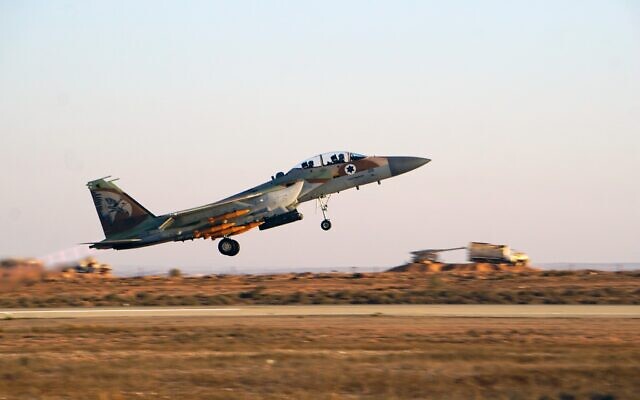
 

File: An IAF F-15I fighter jet of the 69th squadron takes off from Hatzerim Airbase in southern Israel, during a pilots graduation ceremony, June 22, 2022. (Emanuel Fabian/Times of Israel)

Air force combat helicopters and planes downed an unidentified aircraft that appeared to have crossed into Israeli airspace from Syria on Sunday, the military said.

The incident came amid escalating tensions between Israel and Iran related to Iran’s presence on Israel’s northern border, and after a series of airstrikes attributed to Israel in Syria.

The unidentified aircraft was tracked by the military and “taken down over an open area,” without posing a threat to residents of the area, the IDF said in a statement.


Air raid sirens did not sound at any point during the incident.

Hebrew media said the military believes the aircraft was of Iranian origin.

Around an hour after the incursion, Syrian media reported explosions at an airport near the capital Damascus, but did not blame Israel. Syrian state media generally is quick to attribute airstrikes in the country to Israel and has repeatedly done so in recent weeks.

Tensions in northern Israel have escalated after a series of airstrikes in Syria, a terror attack that is believed to have been carried out by an intruder from Lebanon, and threats between Israeli officials and Iran.
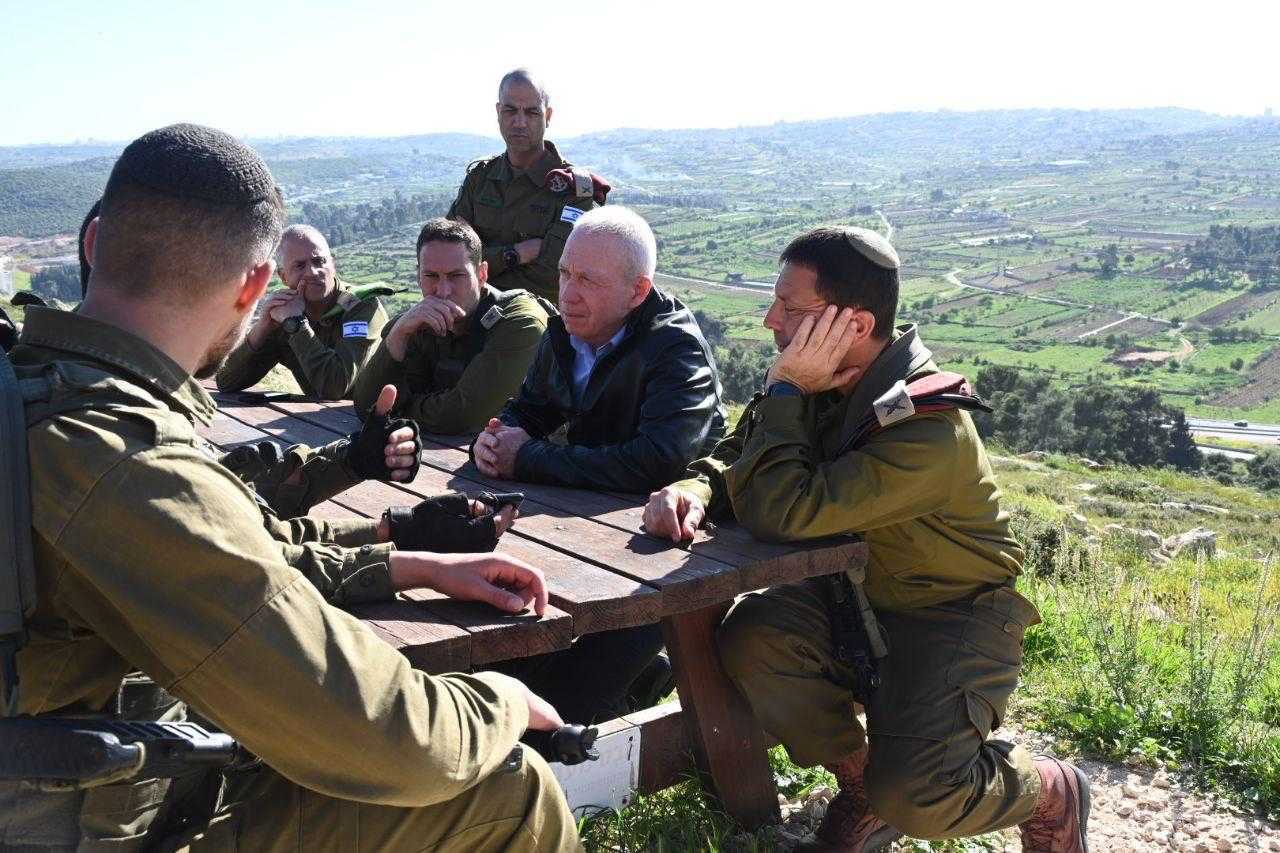
Defense Minister Yoav Gallant (second from right), during a briefing in the West Bank on April 2, 2023. (Ariel Hermoni/ Defense Ministry)

Defense Minister Yoav Gallant on Sunday warned Iran and the Iranian-backed Lebanese terror group Hezbollah that Israel would not tolerate any efforts to harm the country or its citizens.

“We have tensions on all fronts,” Gallant said in a pre-Passover toast with soldiers in the Etzion Brigade in the West Bank, adding that Iran was attempting to make inroads into the territory.

“The Iranians are extending their outreach to Judea and Samaria and Gaza, and are attempting to entrench themselves in Syria and Lebanon,” Gallant said. “We will not allow the Iranians and Hezbollah to harm us. We have not allowed it in the past, we won’t allow it now, or anytime in the future.”

“If necessary, we will push them out of Syria to where they belong – and that is Iran,” he said.

Also Sunday, an Israeli intelligence and imagery firm, ImageSat International, published images that it said showed damage caused to the Syrian military airport at al-Dabaa near Homs in an alleged airstrike after midnight on Saturday, the second in two days.

ImageSat said the airstrike likely targeted Iranian-backed Hezbollah drone activity, destroying an aircraft shed, a UAV communication station and a communication vehicle. Syria said five soldiers were injured.
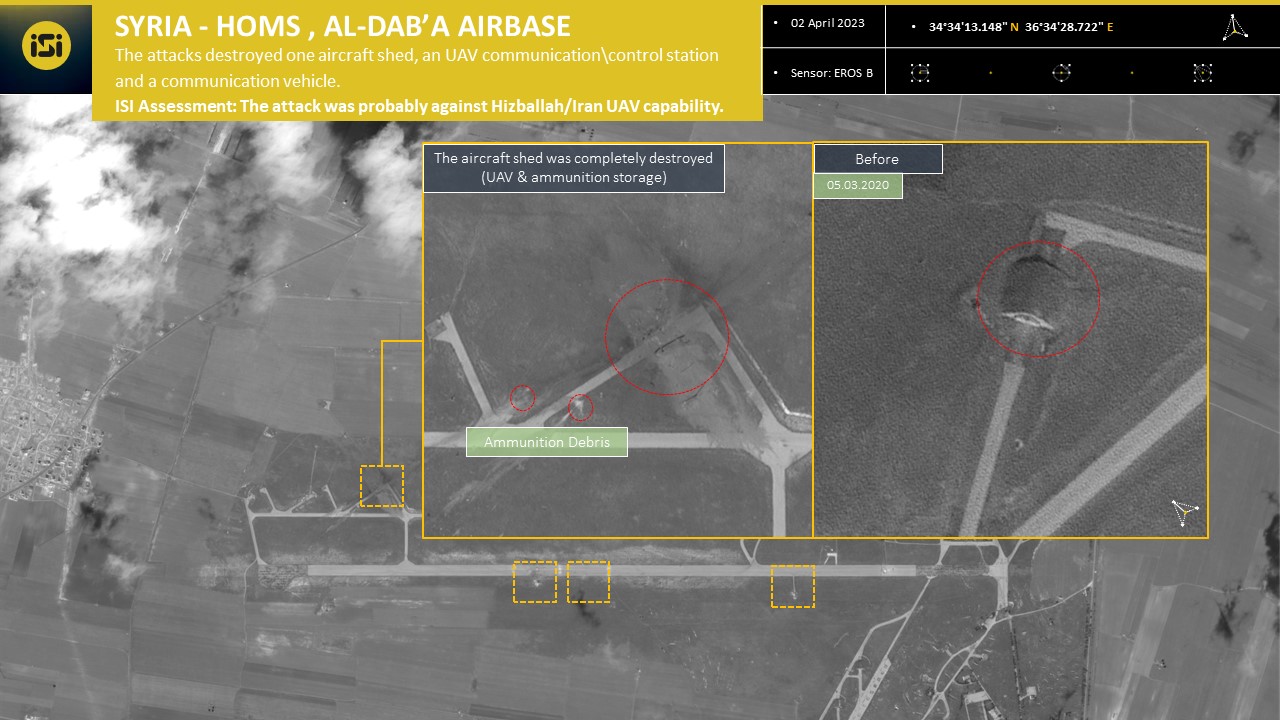
This photo released by ImageSat International on April 2, 2023, shows damage to the al-Dabaa airport in Syria after an airstrike attributed to Israel a day earlier. (ImageSat International)

Western intelligence sources told Reuters the strikes hit a series of air bases in central Syria where Iranian personnel are based.

Iran said Sunday that a second member of its Islamic Revolutionary Guard Corps (IRGC) had died of injuries sustained in an alleged Israeli airstrike in Syria on Friday. Another IRGC adviser, Milad Heydari, was also killed in the strike.

The IRGC threatened to avenge the incident, saying: “The Zionist regime will undoubtedly receive a response to this crime.”

Some Israeli media outlets reported unattributed assessments that the string of airstrikes in Syria — three in four consecutive nights — could be linked to last month’s suspected Hezbollah bombing near Megiddo in northern Israel, which Jerusalem believes was carried out by a terrorist who crossed the Lebanon border fence using a ladder. One man was seriously wounded in the attack.

While many details of the investigation into the Megiddo bombing are barred from publication, Haaretz cited speculation that the series of airstrikes on Iranian targets in Syria could indicate that the IRGC was involved in the latest security incidents.

As a general rule, Israel’s military does not comment on specific strikes in Syria, but it has acknowledged conducting hundreds of sorties over the last decade against Iran-backed groups that have been attempting to gain a foothold in the country.

The IDF says it also attacks arms shipments believed to be bound for those groups, chief among them Hezbollah. Additionally, airstrikes attributed to Israel have repeatedly targeted Syrian air defense systems.

The latest alleged airstrikes came after two attacks in recent weeks against the Aleppo International Airport, also attributed to Israel. Those attacks temporarily closed the airport’s runway. Also this month, Israel carried out a rare daytime strike against targets in northwestern Syria, injuring three soldiers and causing damage, Syria’s SANA news agency said.
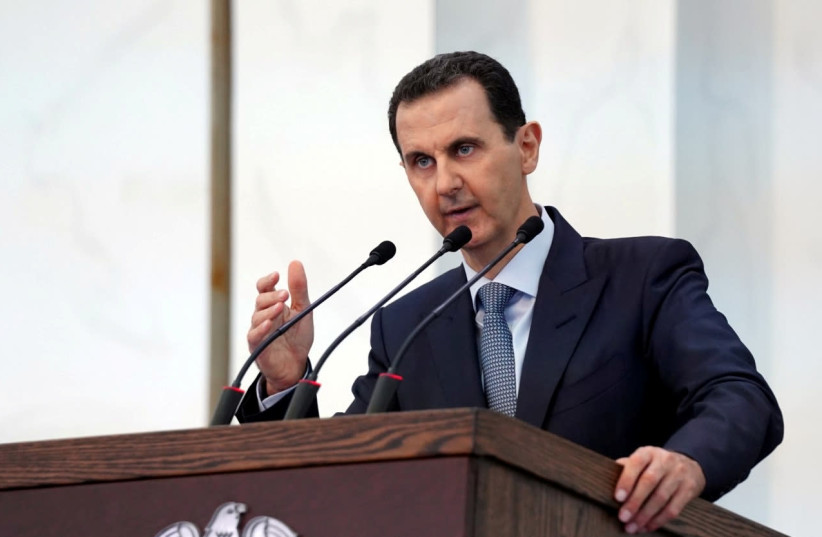
Syria is renewing ties with one country at a time, with Saudi Arabia being the crown jewel achievement of this project.

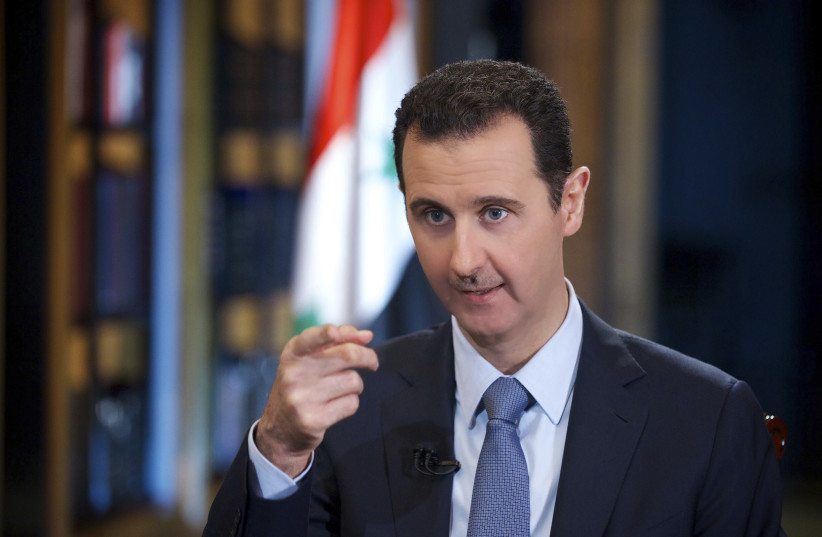
Syria's President Bashar al-Assad speaks during an interview with Turkey's Halk TV in Damascus, in this handout photograph distributed by Syria's national news agency SANA on October 4, 2013. (photo credit: REUTERS/SANA/HANDOUT VIA REUTERS)
Syria’s President Bashar al-Assad speaks during an interview with Turkey’s Halk TV in Damascus, in this handout photograph distributed by Syria’s national news agency SANA on October 4, 2013.
(photo credit: REUTERS/SANA/HANDOUT VIA REUTERS)

Syria’s rapprochement with the Middle East is rapidly gaining steam in the wake of Saudi Arabia’s normalization with Iran and the Assad regime’s outreach to the UAE and other Gulf states.

If Saudi Arabia were to welcome Syrian leader Bashar Assad, it would be a large and symbolic move that would be seen in context of a series of steps taken by Riyadh that are reshaping the region. As well, it comes as Saudi Arabia and the UAE announced surprise oil cuts and as Egypt appears poised to announce the defeat of extremists in Sinai.

The Syrian regime’s emerging ties with the Gulf don’t seem to be slowing down. Assad visited Oman on February 20, followed by a visit to Russia on March 15. On March 10, Iran and Saudi Arabia announced the normalization of ties.

Syria is also renewing ties with Egypt; on Saturday, Syrian Foreign Minister Faisal Mekdad met with his Egyptian counterpart Sameh Shoukry. Egypt had been doing outreach to Damascus for years, but this renewal of ties is more of official, the first visit at this high a level yet.

Syrian and Saudi diplomatic pushes in the Middle East

Syria is renewing ties with one country at a time, with Saudi Arabia being the crown jewel achievement of this project.

Syria's President Bashar Assad addresses the new members of parliament in Damascus, Syria in this handout released by SANA on August 12, 2020 (credit: SANA/HANDOUT VIA REUTERS)Syria’s President Bashar Assad addresses the new members of parliament in Damascus, Syria in this handout released by SANA on August 12, 2020 (credit: SANA/HANDOUT VIA REUTERS)

But not every country in the region is jumping at the opportunity to establish – or reestablish – ties with Syria. Qatar has said it wouldn’t renew ties, and Turkey is also hesitant. The UAE, Bahrain, Egypt and Saudi Arabia often work in concert in the region as a sort of quartet. Kuwait, Oman and Jordan tend to work closely, but on a slightly separately yet parallel line with the quartet, while Qatar and Turkey are close partners. Iraq, close to Iran, also works with Syria, but in a different, more behind-the-scenes way – it helped broker the Saudi-Iran deal, for instance.

Saudi Arabia’s embrace of the Syrian regime, if and when it happens, will be seen as yet another move by Riyadh signaling its independent. Some have wondered how this may affect the Abraham Accords, because Israel has relations with the UAE, Bahrain, Jordan and Egypt, but has not yet achieved relations with Saudi Arabia.

Some believe that the shift towards Iran and China by Saudi Arabia could mean that the issue of potential ties with Israel is on the back burner. The full story is likely more complex.

The New York Times reported on Saturday about Riyadh’s drive for nuclear power, while other reports pointed to a potential visit to Turkey by Russia’s leader as part of Turkey’s drive for nuclear power. This is all part of a regional process of countries acting more independently and less interdependently.

What has busied Gulf media over the past few days is the possibility of Syria returning to the Arab League. If this happens, it would be nearly 12 years after the start of the Syrian Civil War in 2011 and a major step for the Syrian regime.

It would also impact many issues in the region, including US presence in eastern Syria and Iran’s entrenchment in the country. Would Syria’s sovereignty be upheld and will Turkey withdraw from northern Syria? Iran continues to use Syria’s territory to threaten US forces in eastern Syria and Israel.

UAE-based Al-Ain media asserted as well that Syria’ return to the Arab League will be a major step. The report added that Syria now has good relations with Iraq, Jordan, the UAE, Oman and Algeria, “and today Egypt completes this Arab encirclement.” Saudi Arabia, the UAE, Jordan and Egypt are all close US partners – the US has sanctioned Syria in the past as well as recently.

Anwar Gargash, a key figure in the UAE and an expert in the region and foreign policy, tweeted on Sunday that “the visit of the Syrian Foreign Minister to brotherly Egypt is another positive step towards the return of brotherly Syria to its Arab surroundings and overcoming the repercussions of the decade of chaos. The consolidation of the Arab dimension is strengthened with every step and the UAE is in the depth of this benevolent consensus.” This important statement reflects the emerging consensus.

Riyadh-based Arab News reported that Saudi Arabia’s Foreign Minister Prince Faisal bin Farhan received a phone call from his Iranian counterpart Hossein Amirabdollahian on Sunday. According to the report, “during the phone call, the ministers discussed issues of common interest and ‘the next steps in light of the recent tripartite agreement.’”

This flurry of activity in the region is unprecedented and deserves its own spotlight; it is not just a story of the US losing influence across the Middle East or, oil production cuts or of rebalancing against the China, Russia and Iran alliance. There are much larger moves taking place that are reshaping the region diplomatically.

More than a decade of diplomacy and norms are completely shifting, not just regarding the Syrian regime and the Arab League, but about a much larger movement of countries, often in concert, in which diplomacy plays the most important of roles and the region is looking to reshape its consensus.

This means that some of the “status quo” issues, such as “Iran vs. Saudi Arabia,” are evaporating. Meanwhile, other issues that once loomed large, such as the role of Qatar, Turkey and their backing of the Muslim Brotherhood, are shifting. In addition, the role and threat of extremist groups, such as ISIS, has been greatly reduced.

This means that as a decade of conflict shifts, the priorities of the region will as well. In some ways, this major shift, if it continues, could represent a change from conflicts that date back to the 1980s and 1990s. The deep roots of extremism, the rise of Iran’s “revolutionary resistance” and the role that Arab nationalism and Saddam’s invasion of Kuwait once played were crucial.

Time will tell whether what appear to be a series of important moves today are actually premature or if they have a long-lasting impact. It will also be important to see how these shifts impact Israel and its ties with many of these countries, or how it may impact Iran’s attempts to threaten Israel throughout the region.

Because the new moves in the Gulf are ostensibly about “stability,” Iran’s role as a destabilizing influence will be in the spotlight. Syria, which was a major center of instability because of the power vacuum in the country, may be seeking a return to the Arab League, but can it ever return to the role it once played in the region?


Iran says Meqdad Meqdani succumbs to wounds from Friday strike; 3 alleged Israeli strikes in 4 nights may indicate Jerusalem believes Tehran behind last month’s cross-border attack

Screen capture from a video showing an alleged Israeli strike on Damascus, Syria March 31, 2023. (screen capture: Twitter)

Iran said Sunday that a second member of its Islamic Revolutionary Guard Corps (IRGC) had died of injuries sustained in an alleged Israeli airstrike in Syria early Friday.

“Meqdad Meqdani was wounded during the Zionist attack on Friday dawn and was martyred,” the semi-official Mehr news agency said, adding that he had been a military adviser to the IRGC, according to the Reuters news agency. A second IRGC adviser, Milad Heydari, was also killed in the strike.

The IRGC has threatened to avenge the incident, saying: “The Zionist regime will undoubtedly receive a response to this crime.”


Meanwhile, some Israeli media outlets were reporting unattributed assessments that the string of airstrikes in Syria — three in four consecutive nights — could be linked to last month’s suspected Hezbollah terror bombing near Megiddo in northern Israel, which Jerusalem believes was carried out by a terrorist who crossed the Lebanon border fence using a ladder. One man was seriously wounded in the attack.

While many details of the investigation into Megiddo bombing are barred from publication, the Haaretz news site cited a speculation that the series of airstrikes on Iranian targets in Syria could indicate that the IRGC was involved in the latest security incidents.

The Israeli Air Force (IAF) carried out airstrikes near the city of Homs late Saturday, injuring five soldiers, according to Syria’s state-run media outlet. The alleged operation came after airstrikes attributed to Israel were carried out in the Syrian capital Damascus shortly after midnight in the early hours of Friday, and also on the night before that.

Western intelligence sources told Reuters that Saturday’s strikes hit a series of air bases in central Syria where Iranian personnel are based.

The two sources said the strikes targeted the Tiyas air base, also known as T-4, located near the ancient city of Palmyra in the Homs Governorate, and the al-Dabaa airport near the city of al-Qusayr also in the Homs Governorate, near the Lebanese border. It is an area known for the presence of members of Lebanese Hezbollah, a major terror organization backed by Iran, and other pro-Iranian groups and militias.

T-4 is believed to be one of two major airports — the other being Damascus International Airport — where Iranian cargo airlines carrying large weapons set for Lebanon often land. The weaponry is then believed to be stored in warehouses in the area before being trucked to Lebanon.

Saturday’s airstrikes came a day after Syrian media said Israeli airstrikes hit in the capital Damascus for the second time this week. The Syrian Observatory for Human Rights said those strikes targeted an arms depots for government forces and Iran-backed groups just south of Damascus.

On the previous night, SANA said that the IAF targeted sites in Damascus, wounding two soldiers and causing material damage.

The conditions of the two soldiers were not immediately clear. In recent years, numerous Syrian soldiers serving in air defense units have been killed in Israeli airstrikes.

As a general rule, Israel’s military does not comment on specific strikes in Syria, but it has acknowledged conducting hundreds of sorties against Iran-backed groups attempting to gain a foothold in the country over the last decade.

The IDF says it also attacks arms shipments believed to be bound for those groups, chief among them Hezbollah. Additionally, airstrikes attributed to Israel have repeatedly targeted Syrian air defense systems.

Thursday and Friday’s alleged airstrikes came after two attacks in recent weeks against the Aleppo International Airport, also attributed to Israel. Those attacks temporarily closed the airport’s runway.

One of the strikes last week also targeted an underground munitions depot at the adjacent Nairab military airport, according to two unnamed “regional intelligence sources” who spoke to the Reuters news agency. The sources said the site was used to store missile-guided systems that had been delivered by Iranian cargo flights.

Also this month, Israel carried out a rare daytime strike against targets in northwestern Syria, injuring three soldiers and causing damage, SANA said.

Emanuel Fabian and AP contributed to this report.