Three strategic factors are driving the State of Israel and Sunni Arab Gulf countries to closer cooperation with one another – and Iran is the common denominator behind them all.
The first is the conflict raging over regional hegemony in the Middle East between the two Muslim blocs – the Iranian-Shi’ite axis and the Sunni moderate camp.
The Shi’ite-Iran axis is growing in dominance and it has hegemonic ambitions. Facing it is a Sunni world often described as moderate, pro-Western, and modernist. Saudi Arabia, Egypt, Jordan, and the Gulf states are all central players in the Sunni camp.
The second driver is the Abraham Accord framework of normalization agreements between Gulf states and Israel. Since 2020, Jordan and Egypt have been joined by the UAE, Bahrain, Morocco, and Sudan in establishing ties with Israel. Saudi Arabia, while not yet having broken the ice by normalizing ties with Israel is nevertheless quietly involved in enabling the Abraham Accords. Shared interests are driving this process.
The Saudis have not become “lovers of Zion.” Rather, they and the other Gulf states understand that there is an urgent need to deal with a common security threat. The 2019 Iranian UAV (unmanned aerial vehicle or drone) attack on the Aramco oil facility taught the Saudis that they could no longer sit on the fence; they had to take action and defend their national interests, immediately.
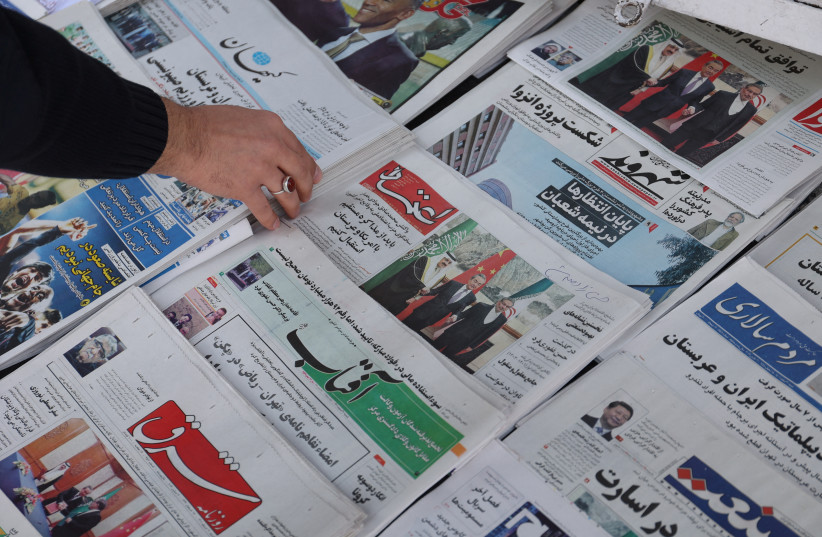
Newspapers with a cover picture of the Iranian Rear Admiral Ali Shamkhani, the secretary of the Supreme National Security Council and Saudi Minister of State and National Security Adviser Musaed bin Mohammed Al-Aiban, is seen in Tehran, Iran March 11, 2023. (credit: MAJID ASGARIPOUR/WANA/REUTERS)
This leads to the third and interlinked factor – the direct threats posed to Sunni states and Israel by Iran’s proxies and allies. Hezbollah, Hamas, the Houthis in Yemen, and Shi’ite militias in Iraq collectively form a clear and present threat to Gulf states and Israel. The UAE has sustained deadly UAV attacks, Saudi cities have come under Houthi missile attacks, and Israel has been repeatedly assaulted by Hamas and Hezbollah rocket barrages.
Iran is the mother ship when it comes to all three of these factors, creating the common regional interest – the glue – for new levels of cooperation. In 2023, Israel does not stand alone in the Middle East.
MEANWHILE, THE United States remains extremely relevant in the Middle East, where its superpower capabilities remain present in the form of CENTCOM (United States Central Command), the US military’s Middle Eastern framework and coordinator. The US, despite its focus on China and Russia, continues to have economic and trade interests in the Middle East and seeks to stabilize the area against radical Iranian-led influences.
Saudi Arabia and Israel, two key US allies – albeit engaged in different forms of alliances with Washington – are the subjects of an American attempt to group them with additional Sunni states.
The American goal is to create areas of cooperation, in which capabilities, assets, and interests are shared against the Iranian threat. CENTCOM forms a natural contractor to translate this into practice. With Israel’s move into CENTCOM’s area of responsibility in September 2021 (from EUCOM, the European command, where it was located under an older, Cold War logic), the opportunity now exists for creating this zone of joint capabilities.
The potential exists for creating a synergy of Israeli, Sunni Arab, and American capabilities, in which the sum is greater than the parts. The sharing of big data, threat intelligence and resources can contribute to a powerful whole, even as each state in the area threatened by Iran continues to defend its own particular national interests.
If, for example, Israel connects its early warning systems with sensors in the Gulf region that provide alerts of incoming Iranian missile attacks before they enter Israel’s radar sphere, this would provide a significant advantage compared to relying solely on its own sensors.
On top of this, a platform can be built to connect all the relevant states’ sensors, data, and protocols, so that all see the same picture, in real-time, and with precision.
In addition, each member state can contribute its intelligence sources to this common picture. This cooperation has the potential to also create opportunities for joint action, common flight zones that reduce the range needed to be covered to reach targets, and fosters operational creativity.
THE END result is ultimately a kind of playground where regional cooperation through CENTCOM, as the central operator, connects all of the regional players. Jordan, Saudi Arabia, the UAE, Israel, and others can build a flexible system, into which further players and resources with common interests can plug and play, making this tool even more precise and significant.
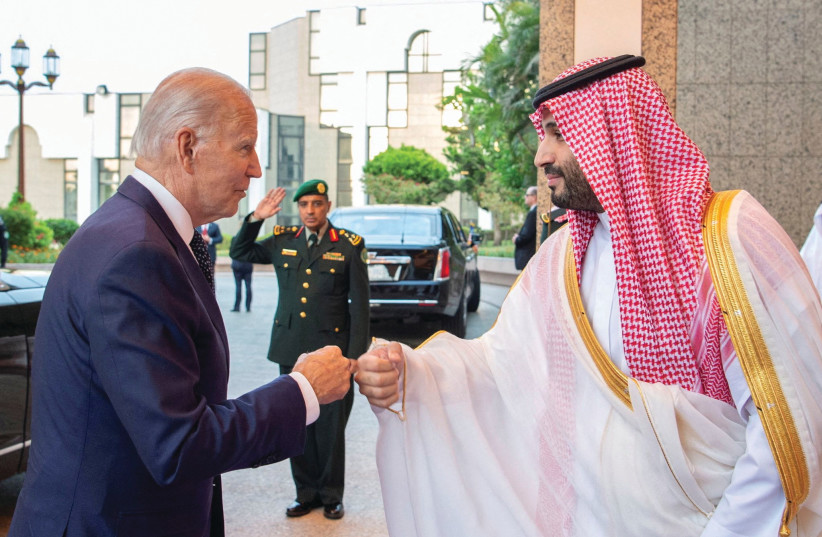
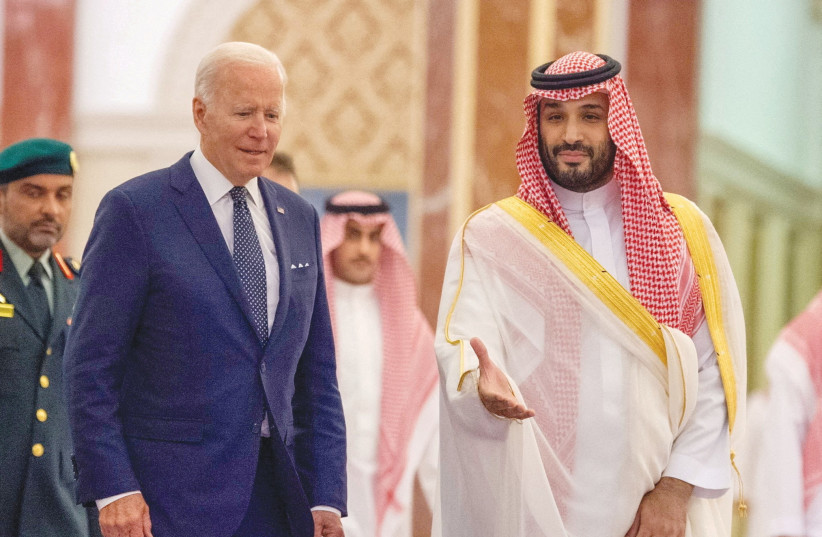
SAUDI CROWN Prince Mohammed bin Salman receives US President Joe Biden at Al Salman Palace in Jeddah, in July. Although Biden visited Saudi Arabia this summer, the relationship between the two nations has continued to deteriorate, says the writer. (credit: Saudi Royal Court/Reuters)
The possibility for bilateral as well as multilateral cooperation is a part of this flexibility. Strategic deterrence would flow from this setup against the Iranian-led axis, and the security cooperation would have a positive knock-on effect on regional economies.
US-Saudi Arabia tensions delay normalization
Saudi Arabia is a pivotal figure in this story. Together with Egypt, it currently plays a significant role in leading the Sunni Arab world.
There are diplomatic tensions between the US and Saudi Arabia, which is one of the factors delaying Israeli – Saudi normalization.
The Biden administration deemed the Saudi regime problematic regarding human rights and imposed sanctions on it. Now that the pieces of a new regional platform are coming together, however, future Saudi-Israeli normalization is within grasp. It is these three key players – the US, Saudi Arabia, and Israel – that are best positioned to lead to a reshuffling of the Middle East, consolidating the region against the Iranian threat.
The Palestinian issue, meanwhile, is growing less important to the Middle East.
While Arab Sunni states still pay lip service to the Palestinian cause, it is clear to them that even within the Palestinian arena, the conflict between Hamas and Fatah is very far from resolution, and that there is no single Palestinian voice.
Iran is not only a challenge to Israel. Middle Eastern states are aware of this, but the West, generally, less so. Building a regional coalition under an American umbrella provides significant and strategic validity to the goal of rolling Iran back. It is therefore worthwhile to build, expand, and improve this front through training, and to bring this regional readiness to actual military capabilities. Israel is not alone, but it still must be prepared to deal by itself with the Iranian challenge.
The writer, a brigadier general (res.), is a publishing expert with The MirYam Institute. He served as the commander of the Air Defense Forces from 2015-2018, during which time the David’s Sling and Arrow 3 systems became operational.



 In light of the significance of the Codex Sassoon’s arrival in Israel, the ANU Museum will present the ancient manuscript to the public free of charge with early registration between March 23-29, 2023. (credit: COURTESY SOTHEBY’S)