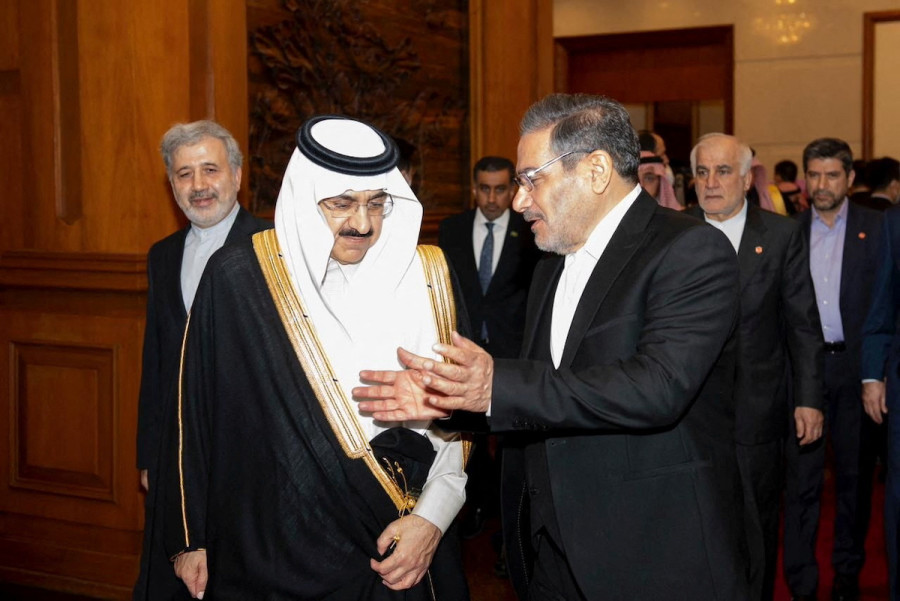
Saudi Minister of State and National Security Adviser Musaed bin Mohammed Al-Aiban, meets the Iranian Rear Admiral Ali Shamkhani, the secretary of the Supreme National Security Council, in Beijing, China, Mar. 10, 2023. (Photo: Saudi Press Agency/Handout via)
In a dramatic statement on Friday, the Kingdom of Saudi Arabia and the Islamic Republic of Iran announced an agreement to re-establish their diplomatic ties, ending seven years of hostilities. The agreement, achieved through mediation from China, will see Riyadh and Tehran re-open embassies in each other’s countries within two months.
“The agreement includes their affirmation of the respect for the sovereignty of states and the non-interference in internal affairs,” it said.
The two regional powerhouses also agreed to cooperate on countering terrorism, drug smuggling, money-laundering, as well as to revive a deal from 1998 on trade, economy and investment.
The implications for the region are tremendous.
Besides Saudi Arabia and Iran, the list of winners from the deal potentially include Lebanon, Yemen, Iraq and Bahrain and other Middle Eastern countries in which the Sunni-Shiite rivalry threatens the overall stability.
Above all, the biggest winner is China. Which leaves Israel and the United States on the losing side.
In a checkmate move, China rushed to facilitate the agreement, handing a crushing defeat to American diplomatic efforts that were meant to draw the Saudis away from Chinese, Iranian and Russian influence. China is obviously not just playing a ‘good Samaritan’ role. It initiated the move first and foremost to hurt the United States, not because it actually cared about bringing two rival Muslim nations closer together.
Reuters quoted a top Chinese diplomat saying that the deal is a “victory for dialogue and peace.” He added that Beijing would continue to play a constructive role in addressing tough global issues.
Unlike the Trump administration, which brokered the historic Abraham Accords, the Biden administration, so far, lacks such a record achievement. Even more so, with Russia’s invasion of Ukraine taking place under U.S. President Joe Biden’s watch, with no diplomatic solution in sight.
The Russia-Ukraine war and the global energy crisis have forced Biden’s hand to change his original approach to Saudi Arabia. Biden moved from referring to Saudi as “pariah” as a presidential candidate, to ‘fist-bumping’ with Saudi Crown Prince Mohammed bin Salman. Only China was already high-fiving in the Gulf.
The Saudi-Iranian rapprochement was announced a few days after The Wall Street Journal revealed the Kingdom was expecting to receive security guarantees from the U.S. in exchange for signing a normalization agreement with Israel. Unnamed officials involved in the discussions said Riyadh was also waiting for Washington’s help in developing a civilian nuclear program.
It is still unclear what assurances the Saudis and Iranians have received from China, but one thing is certain: The agreement between the two comes at the expense of a potential peace agreement with Israel. At least for the moment.
Pursuing an even more historic and transformative peace deal – potentially the “mother of all peace deals” –with Saudi Arabia was one of Israeli Prime Minister Benjamin Netanyahu’s foreign policy priorities upon entering office in December.
Meanwhile, in the Jewish state, the blame game is on.
A senior Israeli official traveling with Netanyahu in Rome accused the previous government of this dangerous outcome.
“There was a feeling of U.S. and Israeli weakness, and this is why the Saudis started looking for new avenues. It was clear that this was going to happen,” the official told reporters, according to Axios.
The official said the Saudis were progressing diplomatically in Iran’s direction, adding that the overtures began during Bennett-Lapid government tenure. He said the talks accelerated in 2021, when the Saudis felt the Biden administration was rushing towards a revival of the nuclear deal.
However, Netanyahu’s political opponents point the finger back at him. Opposition leader Yair Lapid called the agreement between Saudi Arabia and Iran on Twitter, “a complete and dangerous failure of the Israeli government’s foreign policy.”
“This is a collapse of the regional defense wall that we started to build against Iran. This is what happens when you deal with the judiciary madness all day, instead of doing the job on Iran and strengthening relations with the United States,” Lapid added, referring to Netanyahu’s government focusing on advancing an overhaul reform to the judicial system.
Former Israeli Prime Minister Naftali Bennett said, “This is a resounding failure of the Netanyahu government that stems from a combination of political neglect with general weakness and internal conflict in the country.”
Nevertheless, the unnamed official from Netanyahu’s circle insisted that a Saudi-Iranian agreement will not necessarily hamper the prospects of a Saudi peace agreement with Israel. He stressed that “developments happening under the surface” matter more than “diplomatic agreements.”
“The U.S. and Israeli positions matter more than the agreement between Saudi Arabia and Iran. The Western position towards Iran starts to change but it still hasn’t changed enough,” the official said.
In that realm, top Israeli Middle East expert Guy Bechor noted that the United Arab Emirates had also renewed its diplomatic ties with Iran. This has not affected the UAE’s warm relationship with Israel, thanks to the Abraham Accords.
Bechor added that, even though the Saudi-Iranian agreement includes a clause that prevents each country from interfering in the other’s internal affairs, there is no guarantee that it will not happen.
Much of the rivalry between the two countries has to do with a political, economic power-struggle over their dominance in the Muslim world, but religion is an inseparable aspect. The Shiite-Sunni rift is deep, and it goes back centuries. It is almost as old as Islam itself.
The split between Sunnis and Shiites occurred soon after the death of the Prophet Muhammad, in the year 632 A.D.. It originated as a dispute in the Muslim community over who was the rightful successor to the prophet Muhammad. The Sunnis wanted the community to determine who would succeed Muhammad. The Shiites saw Ali, Muhammad’s cousin and son-in-law, as his successor. He eventually became the fourth caliph and was later assassinated.
As the historical birthplace of Islam, Saudi Arabia sees itself as the leader of the Muslim world. This perception came to a head with Iran following the 1797 Islamic Revolution in Iran which brought a theocracy to power. The Iranian regime aspires to export its revolution outward to the rest of the Muslim world.
There is an ethnic layer which adds to the tensions between Saudi and Iran. Modern-day Iran has never forgotten the historical Muslim occupation of Persia by the Arabs in 633 A.D. The long process of Islamization of Iran included the brutal oppression and enslavement of Persians. Even though ancient Persians adopted their conquerors’ religion, they reasserted themselves over hundreds of years by maintaining their own language and culture.
The new agreement between Saudi Arabia and Iran does not dig into the wounds of past wars. Nor does it aim to bridge the gaps between the two largest branches of Islam. The Chinese-negotiated deal plays into the bigger picture of shifting global alliances. Time will tell if the Saudis have chosen one side, and if that choice seals the deal on a deteriorating decades-old partnership with the United States.