Official claims talks between Riyadh and Tehran began in 2021 during tenure of short-lived unity coalition when US was working to re-enter nuclear deal

Prime Minister Benjamin Netanyahu attends a joint press conference with Italian Premier Giorgia Meloni at Chigi Palace government offices in Rome, Friday, March 10, 2023. (AP Photo/Andrew Medichini)

Prime Minister Benjamin Netanyahu attends a joint press conference with Italian Premier Giorgia Meloni at Chigi Palace government offices in Rome, Friday, March 10, 2023. (AP Photo/Andrew Medichini)

ROME — A senior official traveling with Prime Minister Benjamin Netanyahu’s entourage on Friday sought to blame the deal reached by Saudi Arabia and Iran to re-establish diplomatic relations on the previous Israeli government and the Biden administration’s combined weakness.

“There was a feeling of American and Israeli weakness, so Saudi Arabia turned to other channels,” said the senior Israeli official briefing reporters who were traveling with Netanyahu in Italy.

The official claimed that the talks between Riyadh and Tehran began in 2021 during the tenure of Naftali Bennett and Yair Lapid’s short-lived unity government when the Biden administration was more committed to re-entering the Iran nuclear deal. As a result, Saudi Arabia turned to China, which served as a counterweight to the US and helped broker the agreement announced Friday.

Earlier in the day, Bennett and Lapid blamed Netanyahu for the Saudi Arabia-Iran rapprochement, arguing that it was the result of diplomatic neglect, general weakness and internal conflict in the country since the current government was established on December 29.

The remarks represented a clear shot by the Prime Minister’s Office at US President Joe Biden who entered office pledging to re-enter the Iran nuclear deal but has gradually moved away from that effort over the past year amid Tehran’s military cooperation with Russia and the ongoing protests in the Islamic Republic against the regime there.

Dismissing claims that the current government was responsible, the senior Israeli official said members of the previous government should ask themselves why the initial contacts began during their tenure  (The Iranian and Saudi announcements on Friday did not specify when their contacts began).

In this photo released by Nournews, Secretary of Iran’s Supreme National Security Council, Ali Shamkhani, right, China’s most senior diplomat Wang Yi, center, and Saudi Arabia’s National Security Adviser Musaad bin Mohammed al-Aiban looks on during an agreement signing ceremony between Iran and Saudi Arabia to reestablish diplomatic relations and reopen embassies after seven years of tensions between the Mideast rivals, in Beijing, China, Friday, March 10, 2023. (Nournews via AP)

Lapid — now opposition chairman — scoffed at Netanyahu’s accusations, tweeting that his government put every other issue aside when it became clear to them that the Biden administration was on the verge of re-entering the Iran nuclear deal. “We worked on it 24/7,” Lapid said, suggesting that Israel played a role in blocking the deal.

He contrasted that with the current government’s tenure, during which Iran has succeeded in enriching uranium to 84% purity and signed a normalization agreement with Saudi Arabia.

“And this right-wing government? [Is focused] “Not on Iran, not on the terror attacks, not on the economy, not the cost of living. All they care about is destroying democracy and tearing the people apart. Oh, and holiday weekends in Rome too,” Lapid said referring to the criticism that Netanyahu was spending the weekend in Rome at the taxpayer’s expense.

Meanwhile Friday, Iran National Security Council secretary Ali Shamkhani told Iran’s Nour News that the agreement his government inked with Saudi Arabia “will definitely be a serious obstacle to the presence and interference of extra-regional countries and the Zionist regime in the region.”

The deal also appeared to mark a blow to Israeli efforts to normalize relations with Saudi Arabia.

However, the senior Israeli official briefing reporters insisted that the Friday agreement would not harm Netanyahu’s endeavor.

“What happens on the diplomatic level is not what happens under the surface,” the official said, hinting at ongoing efforts between Israel and Saudi Arabia taking place behind the scenes.
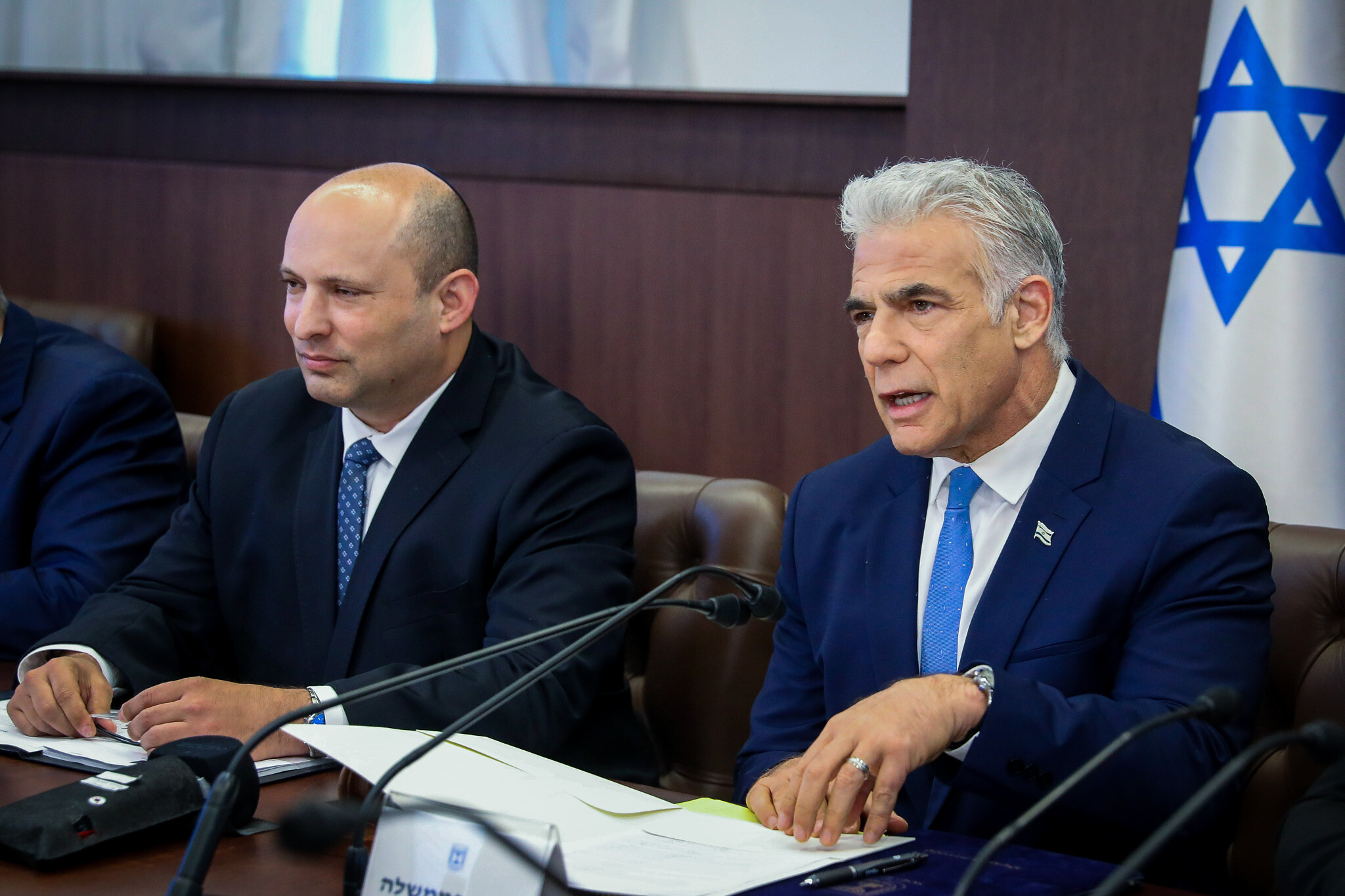
Prime Minister Yair Lapid (right) and alternate prime minister Naftali Bennett at a cabinet meeting at the Prime Minister’s Office in Jerusalem on July 31, 2022. (Marc Israel Sellem/Pool)

A senior Middle East diplomat told The Times of Israel Thursday that the Biden administration has held talks with Saudi Arabia in order to broker such a normalization agreement with Israel. However, the diplomat acknowledged that such a deal remains “very far off,” amid the Gulf kingdom’s far-reaching demands of the US.

The senior Israeli official speaking Friday argued that the tougher the Israeli and Western positions on Iran — including their demonstration of a credible nuclear threat — the more likely that Saudi Arabia will be willing to warm ties with Israel.

The official argued that the stances of Israel and the US “are more decisive” than the normalization agreement reached Friday.

The official added that the West’s position on Iran has begun to improve in Israel’s favor but that “it hasn’t changed enough.”

The US says that nuclear talks with Iran are not currently on the table but that it still prefers a diplomatic solution.


Netanyahu gave an interview to Iran International who intend on dubbing it into Persian and broadcasting it in Iran.

 Israeli Prime Minister Benjamin Netanyahu leads a government conference at the Prime Minister's Office in Jerusalem on January 3, 2023. (photo credit: YONATAN SINDEL/FLASH90)
Israeli Prime Minister Benjamin Netanyahu leads a government conference at the Prime Minister’s Office in Jerusalem on January 3, 2023.
(photo credit: YONATAN SINDEL/FLASH90)

A “horrible nuclear war” will break out if the world does not stop Tehran from obtaining atomic weapons, Prime Minister Benjamin Netanyahu said in his first ever address to the Iranian people on Thursday night.

“If Iran gets a nuclear weapon, this will be a problem all of us will face. It will change the world,” he said in an English-language interview with Washington-based Iran International that was also dubbed into Persian and broadcast in Iran.

A nuclear Iran will cause “the criss-crossing of the Middle East with nuclear trip wires,” as other regimes who understand the danger of a nuclear Iran will rush to arm themselves,” Netanyahu said, using the platform to urge global action in response to Iran’s enrichment of uranium to 84%, which is close to 90% weapons grade.

Netanyahu said he had a message for “those who say, ‘Well, if we take action against Iran, we will face war’ – You will face a war if you don’t, a potentially horrible nuclear war if you don’t.”

“Iran’s nuclear program has hit a danger zone,” he said, adding that Israeli actions had delayed them by a decade, but now the program is pushing forward.The international community must deliver a strong common message to Iran, Netanyahu said

 An undated handout picture shows a missile being launched during a military exercise in an undisclosed location in Iran, obtained by Reuters on February 28, 2023. (credit: IRANIAN ARMY/WANA (WEST ASIA NEWS AGENCY)/HANDOUT VIA REUTERS)An undated handout picture shows a missile being launched during a military exercise in an undisclosed location in Iran, obtained by Reuters on February 28, 2023. (credit: IRANIAN ARMY/WANA (WEST ASIA NEWS AGENCY)/HANDOUT VIA REUTERS)

“We should tell them that if they cross over a nuclear threshold, that is something that we cannot tolerate,” he said. “We have to tell them there is a line you cannot cross, and there is a price to be paid if you do.”

The security of the world and the hopes of the Iranian people are at stake, Netanyahu said.

Netanyahu has long argued that the combination of crippling sanctions and the presence of a credible military threat is the only way to stop Iran from producing nuclear weapons.

“History will change if Iran will get nuclear weapons,” he said, adding that the Iranian people and Israel have a common enemy in the Islamic Republic.

To the Iranian people, “We stand with you; I stand with you,” Netanyahu said. “But now most of the world stands with you. You should know that. Do not lose heart. Be strong.”

In a terse message to the Islamic regime, he said, “We’ll be here long after you’re gone.”

Netanyahu spoke about the growing Iranian threat when he addressed the Jewish community in Rome on Thursday and said he intended to bring the matter up with the Italian prime minister.

He also discussed it with US Defense Secretary Lloyd Austin, who met with him at Ben-Gurion Airport prior to his departure to Rome on Thursday.

The US has long said it supports Israel’s right to defend itself. In Israel, however, Austin underscored that US President Joe Biden’s “preference is to explore all diplomatic avenues to ensure that we constrain Iran’s progress in this field, and so we would look to continue to work to make sure that we constrain their dangerous advances.”


Middle East official stresses deal remains ‘far off,’ amid Congressional opposition to boosting defense ties with Riyadh and intensifying Israeli-Palestinian violence

In this photo released by Saudi Press Agency (SPA), Saudi Crown Prince Mohammed bin Salman, right, greets US President Joe Biden, with a fist bump after his arrival in Jeddah, Saudi Arabia, July 15, 2022. (Saudi Press Agency via AP)

In this photo released by Saudi Press Agency (SPA), Saudi Crown Prince Mohammed bin Salman, right, greets US President Joe Biden, with a fist bump after his arrival in Jeddah, Saudi Arabia, July 15, 2022. (Saudi Press Agency via AP)

Saudi Arabia has asked the US to green-light its development of a civilian nuclear program in exchange for the kingdom normalizing relations with Israel, a senior Middle East diplomat said Thursday.

The civilian nuclear program is among several demands Riyadh has presented in talks with the Biden administration over the past year, the diplomat said, confirming a report in The Wall Street Journal while clarifying that such a deal remains “very far off.”

The senior diplomat said though Washington is interested in brokering a normalization agreement, Riyadh is not rushing to sign on, recognizing Congressional opposition to Saudi demands for closer US defense cooperation. The diplomat also noted intensified violence in the Israeli-Palestinian conflict since Prime Minister Benjamin Netanyahu’s hard-right government took office in late December, which has made such a deal with Jerusalem less palatable in Saudi Arabia and the broader Muslim world.

Given the Biden administration’s fears that a Saudi nuclear program could further accelerate a regional nuclear arms race, Riyadh has suggested developing it in full cooperation with the US and agreeing to American monitoring and inspections, the diplomat said, while acknowledging that Washington has not yet been sold on the idea.

Further complicating the effort, Saudi Arabia is also conditioning a normalization deal with Israel on a significant expansion of defense ties with the US, including a system of guarantees to prevent future administrations from pulling out of weapons deals that have already been signed, the diplomat said.

Notably, the Middle East diplomat revealed that Saudi officials have not raised a specific demand related to the Palestinian issue in their talks with the US, as the United Arab Emirates did when it conditioned its decision to normalize ties in 2020 on Netanyahu shelving his plan to annex large parts of the West Bank.

Palestinians hurl rocks at an Israeli army bulldozer, during clashes in the West Bank city of Jenin, January 26, 2023. (Zain Jaafar/AFP)

The diplomat speculated that a Palestinian-related demand would likely be raised toward the end of the negotiations though.

Saudi officials have repeatedly stated publicly that they will not normalize relations with Israel until the establishment of a Palestinian state, which the current Netanyahu government vehemently opposes.

The Gulf kingdom has also issued a series of condemnations of the Israeli government in recent months, including for National Security Minister Itamar Ben Gvir’s visit to the flashpoint Temple Mount, a series of deadly IDF raids in the West Bank, the legalization of West Bank outposts and Finance Minister Bezalel Smotrich’s call to “wipe out” a Palestinian town.

While Riyadh periodically weighed in on the Israeli-Palestinian conflict in the past, the frequency and intensity of the condemnations since Netanyahu’s latest government was formed have been unprecedented in recent memory, further indicating a normalization deal remains far off.

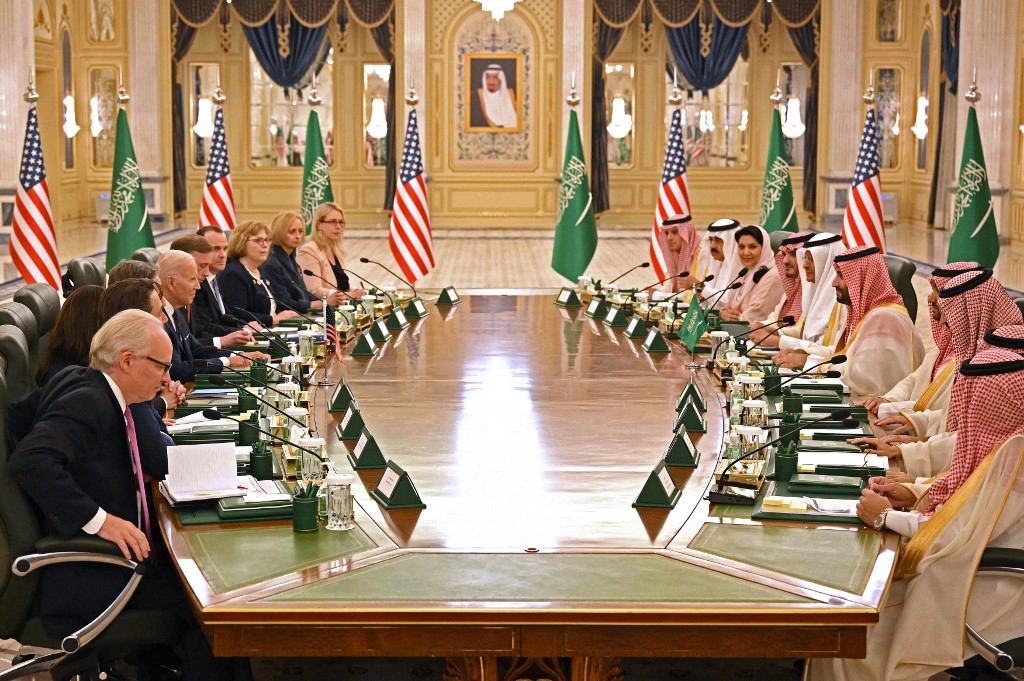
US President Joe Biden (C-L) takes part in a working session with Saudi Arabia’s Crown Prince Mohammed bin Salman (C-R) at the Al Salam Royal Palace in the Saudi coastal city of Jeddah, on July 15, 2022. (Mandel Ngan/AFP)

Analysts have also speculated that a deal will not take place during the lifetime of Saudi King Salman. The ailing 87-year-old is seen as a longtime stalwart of the Palestinian cause. His son, Saudi Crown Prince Muhammad bin Salman, has indicated more willingness to reach such a deal though, largely due to his desire to boost cooperation against Iran.

Saudi Arabia did agree last year to open its skies to Israeli airliners in a move characterized by the Biden administration as a first step toward normalization with Israel, though Riyadh quickly rejected the notion that the move was a precursor to any additional steps.

An official familiar with the matter told The Times of Israel that a normalization deal would be more likely under a Republican administration, as Riyadh believes it will be able to get more than it would under a Democratic president.

But opposition on Capitol Hill to warming ties with Riyadh has extended to both parties, due to Saudi Arabia’s human rights record and energy policies, with many fuming last year over oil production cuts.