
PM says remarks ‘unworthy’ of Rafael Grossi, vows Israel will protect itself against ‘oppressors’ like Purim villain Haman

Prime Minister Benjamin Netanyahu in the Knesset on March 1, 2023. (Yonatan Sindel/Flash90)

Prime Minister Benjamin Netanyahu in the Knesset on March 1, 2023. (Yonatan Sindel/Flash90)

Prime Minister Benjamin Netanyahu on Sunday slammed International Atomic Energy Association chief Rafael Grossi for comments he made against a possible Israeli strike on Iranian nuclear facilities, calling them “unworthy.”

Grossi, who had just returned from a visit to Tehran, said on Saturday that “any military attack on a nuclear facility is outlawed, is out of the normative structures that we all abide by,” when asked by a reporter about threats from the United States and Israel to attack Iran if negotiations to curb its nuclear program are unsuccessful.

“Rafael Grossi is a worthy person who made an unworthy remark,” Netanyahu said in response at the weekly cabinet meeting. “Outlawed by what law? Is Iran, which publicly calls for our extermination, allowed to protect its weapons of destruction that will slaughter us?”

“Are we forbidden to defend ourselves?” he added. “Of course, we are allowed, and of course, we are doing this… nothing will prevent us from protecting our country and preventing oppressors from destroying the Jewish state.”

Netanyahu noted the Jewish festival of Purim, set to take place this week, when “2,500 years ago, a certain persecutor arose in Persia that wanted to exterminate the Jews.

International Atomic Energy Organization Director General Rafael Mariano Grossi, right, arrives for a meeting with the head of the Atomic Energy Organization of Iran Mohammad Eslami as he is welcomed by the spokesman for Iran’s atomic agency Behrouz Kamalvandi in Tehran, March 4, 2023. (AP Photo/Vahid Salemi)

Grossi arrived in Iran on Friday amid a deadlock in negotiations on reviving the landmark 2015 accord curbing the Islamic Republic’s nuclear activity, known formally as the Joint Comprehensive Plan of Action, or JCPOA.

After the meeting, Iran agreed to reconnect surveillance cameras at several nuclear sites and increase the pace of inspections, Grossi said Saturday.

Uranium particles enriched up to 83.7 percent — just under the 90% needed to produce an atomic bomb — had been detected at Iran’s underground Fordo plant, about 100 kilometers (60 miles) south of the capital, according to a confidential IAEA report.

The JCPOA limited Tehran’s uranium stockpile to 300 kilograms and enrichment to 3.67% — enough to fuel a nuclear power plant. The US’s unilateral withdrawal from the accord in 2018 set in motion a series of attacks and escalations by Tehran over its program.

Tehran denies wanting to acquire atomic weapons and said it had not made any attempt to enrich uranium beyond 60% purity.

Iran’s government claimed that “unintended fluctuations… may have occurred” during the enrichment process.

The discovery came after Iran substantially modified an interconnection between two centrifuge clusters enriching uranium, without declaring it to the IAEA.

Netanyahu has threatened military actions against Tehran, and Israel and Iran have been engaged in a high-stakes shadow war across the wider Middle East since the nuclear deal’s collapse.

Israel is suspected of launching a series of attacks on Iranian nuclear and military sites, including an April 2021 assault on the underground Natanz facility that damaged its centrifuges. In 2020, Iran blamed Israel for a sophisticated attack that killed its top military nuclear scientist.
Iran seeks to receive S-400 missile systems from Russia

Russia has yet to confirm if they will supply Iran with the S-400 missile system.

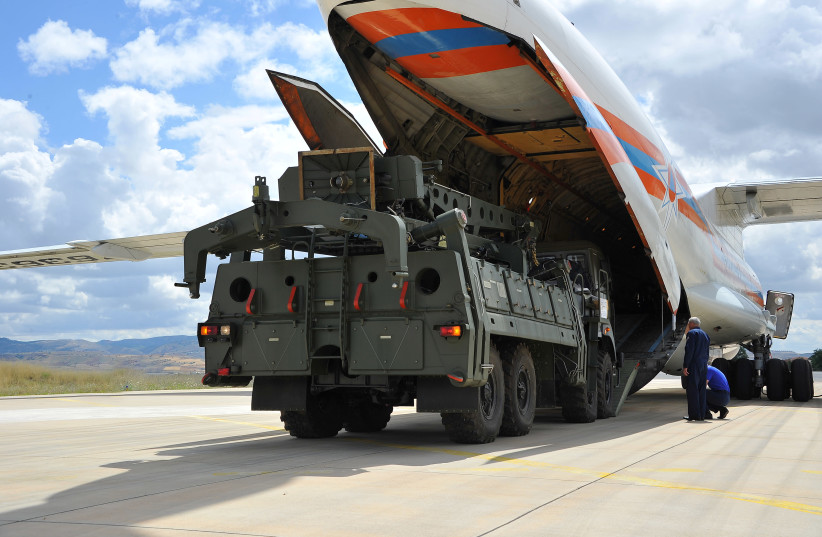
First parts of a Russian S-400 missile defense system are unloaded from a Russian plane at Murted Airport, known as Akinci Air Base, near Ankara, Turkey, July 12, 2019. (photo credit: REUTERS)
First parts of a Russian S-400 missile defense system are unloaded from a Russian plane at Murted Airport, known as Akinci Air Base, near Ankara, Turkey, July 12, 2019.
(photo credit: REUTERS)

Iran has requested a new air-defense system, S-400s, from Russia, which could prove problematic for Israel.

Russia has yet to publicly confirm if it will supply the S-400s in question.  If supplied, Iran will need only two years for the system to become operational.

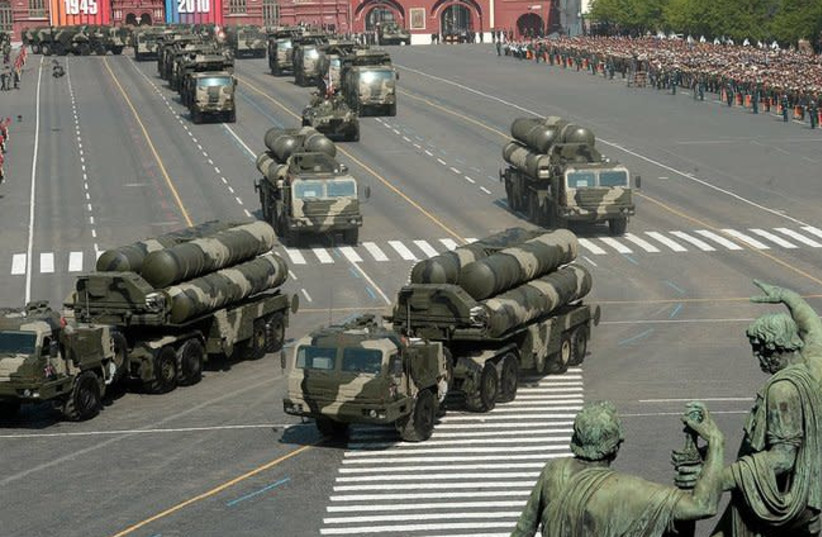
The S-400 is a mobile, surface-to-air missile system created by Russia. It engages with aircrafts, unmanned aerial vehicles, and cruise missiles. It also has a terminal ballistic missile defense capability, according to the Center for Strategic and International studies.

Russia has been recieving ammunition from Iran for its invasion of Ukraine, which has helped solidify a military relationship. Now, it is expected that Russia will gift Iran military materials.

Ukraine has said that Russia received 2400 drones from Iran.

S-400 surface-to-air missile systems displayed during the May Day parade 2010. (credit: Wikimedia Commons)S-400 surface-to-air missile systems displayed during the May Day parade 2010. (credit: Wikimedia Commons)

Israel, Russia and Iran

Israel has had a neutrality policy in dealing with Russia thus far. This has meant that Israel has sent only humanitarian aid to Ukraine but not military support or resources.

However, Israel has claimed responsibility for strikes against Iranian military factories. This has led to veiled threats, to Israel, from Russia.

“I think we are moving to the point that the chance of success for doing something effective militarily is getting slimmer,” Prof. Avner Cohen, a premier Israeli-American scholar on nuclear proliferation warned in an interview with The Jerusalem Post.

“The longer you wait, the harder that becomes,” Israeli Prime Minister Benjamin Netanyahu said of a strike on Iran at a security conference in Tel Aviv. “We’ve waited very long. I can tell you that I will do everything in my power to prevent Iran from acquiring nuclear weapons.”

National Security Council spokesman John Kirby said that Tehran had sent munitions to Russia last year. “We believe Russia might provide Iran unprecedented defense cooperation, including missiles, electronics, and air defense. We believe that Russia might provide Iran with fighter jets,” Kirby said in a call that was widely reported.

Israel also voted for a resolution that called for Russia to withdraw from Ukraine. Russia’s Ambassador to the UN Vasily Alekseyevich Nebenzya responded by stating, to the whole panel, “It becomes absolutely clear that the Ukrainian crisis was just a catalyst that helped this savage Russophobia to come to the surface and contaminate all American and European elites.”

Adding to the conflicted relationship between Russia and Israel, Moscow banned the Jewish Agency in Russia and declared that it would be considered a “foreign agent.”

Seth J. Frantzman and Yaakov Katz contributed to this article. 


US Army General Mark Milley’s trip comes amid Iranian nuclear advances and spiraling violence in the West Bank.

US Chairman of the Joint Chiefs of Staff General Mark A. Milley looks on as he attends a news conference with US Secretary of Defense Lloyd Austin (not pictured), on the day of the NATO defence ministers' meeting at the Alliance's headquarters in Brussels, Belgium, February 14, 2023. (photo credit:  REUTERS/JOHANNA GERON)
US Chairman of the Joint Chiefs of Staff General Mark A. Milley looks on as he attends a news conference with US Secretary of Defense Lloyd Austin (not pictured), on the day of the NATO defence ministers’ meeting at the Alliance’s headquarters in Brussels, Belgium, February 14, 2023.
(photo credit: REUTERS/JOHANNA GERON)

Israel hosted the top US military officer, Army General Mark Milley, on Friday for discussions that it said included the need for cooperation on denying Iran nuclear weaponry.

Milley made the previously unannounced visit ahead of a trip to Israel by US Defense Secretary Lloyd Austin that will also include neighboring Egypt and Jordan – US-aligned Arab states that have influence on Israeli-Palestinian affairs.

“Ongoing cooperation is required in order to prevent Iran from gaining a nuclear weapon.”

Defense Minister Yoav Gallant

“Ongoing cooperation is required in order to prevent Iran from gaining a nuclear weapon,” Israeli Defense Minister Yoav Gallant’s office quoted him as telling Milley, chairman of the US Joint Chiefs of Staff.

Milley made no public remarks in Israel. His spokesperson said Milley discussed regional security issues and “coordination to defend against threats posed by Iran” in his talks with Chief of the Israeli General Staff Lieutenant General Herzi Halevi.

Milley’s trip comes amid Iranian nuclear advancement, West Bank violence

Amid its long-stalled negotiations with world powers on renewing a 2015 nuclear deal, Western powers say Iran has made advances with technologies that could potentially yield it a bomb. Tehran denies having any such plan.

Chief of Police Kobi Shabtai speaks with IDF Chief of Staff Herzi Halevi at the Police headquarters in Jerusalem on January 27, 2023. (credit: YONATAN SINDEL/FLASH90)Chief of Police Kobi Shabtai speaks with IDF Chief of Staff Herzi Halevi at the Police headquarters in Jerusalem on January 27, 2023. (credit: YONATAN SINDEL/FLASH90)

In January, the United States and Israel held what one US official described as the allies’ most significant joint military exercise to date, involving thousands of forces, a dozen ships and 142 aircraft, including nuclear-capable bombers.

Milley’s trip also comes amid spiraling violence in the West Bank, with stepped-up Israeli military raids following a spate of Palestinian attacks. Fears of escalation ahead of the Muslim holy month of Ramadan and the Jewish Passover festival have prompted the United States, Jordan and Egypt to appeal for calm.

At least 62 Palestinians, including gunmen and civilians, have been killed since the start of 2023, the Palestinian health ministry said. Thirteen Israelis and a Ukrainian tourist died in Palestinian attacks in the same period, according to official Israeli figures.
