William Burns says start of ‘full-fledged defense partnership’ between Tehran and Moscow already has effect in Ukraine, could have ‘an even more dangerous impact on Middle East’

A drone flies over Kyiv during an attack on October 17, 2022, amid the Russian invasion of Ukraine (Sergei Supinsky/AFP)

A drone flies over Kyiv during an attack on October 17, 2022, amid the Russian invasion of Ukraine (Sergei Supinsky/AFP)

The head of the Central Intelligence Agency (CIA) said in an interview broadcast Friday that Russia was looking to help Iran, which would pose a threat to US allies in the region.

“What’s beginning to emerge is at least the beginnings of a full-fledged defense partnership between Russia and Iran, with the Iranians supplying drones to the Russians, which are killing Ukrainian civilians as we speak today,” Bill Burns told PBS.

“The Russians are beginning to look at ways in which, technologically or technically, they can support the Iranians, which poses real threats to Iran’s own neighborhood, to many of our friends and partners in Iran’s neighborhood as well,” he said, without naming any of the countries.

Burns said the relationship between Tehran and Moscow was “already having an impact on the battlefield in Ukraine, again, costing the lives of a lot of innocent Ukrainians.”

“I think it can have an even more dangerous impact on the Middle East as well if it continues. So, it’s something that we take very, very seriously,” Burns said.

Iran has supplied suicide drones to Russia, which has in turn used the UAVs to hit civilian and infrastructure targets during its invasion of Ukraine. The EU has said it had evidence that Iran sold drones to Russia since the start of the invasion in February.

Central Intelligence Agency Director William Burns speaks at the Central Intelligence Agency headquarters in Langley, Virginia, July 8, 2022. (AP Photo/Susan Walsh)

Burns’ comments came after the NBC network reported earlier this month that Russia is providing an “unprecedented level” of military and technical support to Iran, in exchange for the weapons Tehran has supplied for Moscow’s invasion of Ukraine.

In addition to drones, Tehran is also reportedly considering supplying Russia with ballistic missiles.

“This partnership poses a threat not just to Ukraine, but to Iran’s neighbors in the region,” an unnamed senior official from the Biden administration told NBC. “We have shared this information with partners in the Middle East and around the world.”

The report said Russia may be supplying Iran with military equipment including helicopters and air defense systems, as well as training Iranian pilots on the Sukhoi Su-35 fighter jet. US officials said Iran “may begin receiving the aircraft within the next year.”

Officials also said Iran and Russia were looking to cooperate on the manufacture of weapons, including drones. Iran has recently ramped up its use of drones to hit targets in the Middle East, including Israeli-owned ships.

The Russian military largely controls Syria’s airspace, complicating Moscow’s relationship with Jerusalem as Israel is alleged to carry out multiple strikes on targets there as part of its efforts to prevent Iranian entrenchment on its doorstep.

To that end, Israel cooperates with the Russian military, and Israel’s strategic need to maintain freedom of operations in Syria appears to be the reasoning behind Jerusalem’s decision not to supply Kyiv only with humanitarian aid rather than the requested military help.

Illustrative: Footage of Israeli strikes on Iranian and Syrian targets in southern Syria following an attempted explosive attack by Iranian-backed operatives against Israeli troops on the Golan Heights, November 18, 2020 (Israel Defense Forces)

There have long been concerns that Moscow could put an end to, or reduce, cooperation with Israel on Syria.

Burns also briefly discussed the ongoing protests in Iran, now entering their fourth month.

“I don’t think the Iranian regime perceives an immediate threat to its grip. It still has some very practiced habits of repression and brutality that it’s continuing to employ,” he said, noting that CIA analysts had been struck by the longevity of the protests as well as the breadth of involvement across Iranian society.

“In the long term, though, I think the reality is that this is an Iranian regime does not have good answers for what’s on the minds of a very young population, 70 percent of which today is under the age of 30,” Burns said.


“It will change our region in ways that are unimaginable. And I think it will facilitate, ultimately, a Palestinian-Israel peace. I believe in that. I intend to pursue it.”

By Associated Press

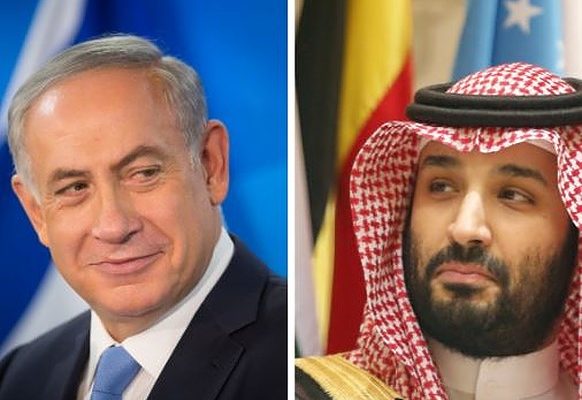
Israel’s designated prime minister, Benjamin Netanyahu, on Thursday vowed to seek full diplomatic relations with Saudi Arabia once he takes office, claiming that doing so would also promote peace with the Palestinians.

Netanyahu also said he would be open to restarting behind-the-scenes peace talks with the Palestinians.

The comments, made in a rare interview with an Arab news outlet, the Saudi-owned Al-Arabiya news channel, appeared to be aimed at easing concerns over the government that Netanyahu is forming with the Religious Zionist party. Netanyahu told the channel that he will set overall policies.

“I will govern and I will lead,” he said. “The other parties are joining me. I’m not joining them.”

Netanyahu said he hoped to expand the Abraham Accords — a set of normalization agreements reached with four Arab countries in 2020 — by reaching a similar deal with Saudi Arabia.

“It will be a quantum leap for an overall peace between Israel and the Arab world,” he said. “It will change our region in ways that are unimaginable. And I think it will facilitate, ultimately, a Palestinian-Israel peace. I believe in that. I intend to pursue it.”

  SMOTRICH MAY GIVE UP DEFENSE PORTFOLIO FOR ISRAEL LANDS AUTHORITY

“Of course, it’s up to the leadership of Saudi Arabia if they want to partake in this effort,” he added. “I certainly hope they would.”

Israel has long had behind-the-scenes contacts with Saudi Arabia — based largely on their shared animosity to Iran. But the Saudis have said full diplomatic relations will only come once an independent Palestinian state is established on territories Israel won in the 1967 Mideast war, when the Jewish state was attacked by the surrounding Arab countries intent on destroying it.

Netanyahu said he would seek peace with the Palestinians, perhaps through discreet negotiations. But he refused to endorse a two-state solution, calling instead for “a fresh view” and creative thinking. He also expressed support for an arrangement proposed by the Trump administration that was rejected by the Palestinians.

“I think we need to talk about it,” he said. “Maybe talk discreetly.”

“I believe in open covenants, secretly arrived at or discreetly arrived at,” he said.

During Netanyahu’s previous 12-year stint as prime minister, which ended last year, peace talks ground to a halt.

The Palestinians seek Judea and Samaria, eastern Jerusalem and the Gaza Strip for a future state, with Jerusalem as its capital.

Netanyahu gave few specifics on his vision of peace, but made clear that it would fall short of Palestinian demands.

  ABBAS FEARS NEW ISRAELI RIGHT-WING GOVT, PALESTINIAN OFFICIAL SAYS

“I would say that the Palestinians should have in a final settlement all the powers to govern themselves, but none of the powers to threaten the survival and existence of the state of Israel,” he said.

Palestinian President Mahmoud Abbas’ office declined to comment on Netanyahu’s remarks.

Netanyahu has reached a series of coalition deals, but still has not finalized an agreement. He has until Dec. 21 to form a government.

World Israel News contributed to this report.


Russia: US air defense systems could be targets in Ukraine

Pentagon: U.S. is “not going to allow comments from Russia to dictate the security assistance that we provide to Ukraine.”

By Associated Press

Russia’s Foreign Ministry warned Thursday that if the U.S. delivers sophisticated air defense systems to Ukraine, those systems and any crews that accompany them would be a “legitimate target” for the Russian military, a blunt threat that was quickly rejected by Washington.

The exchange of statements reflected soaring Russia-U.S. tensions amid the fighting in Ukraine, which is now in its 10th month.

Russian Foreign Ministry spokeswoman Maria Zakharova said the U.S. had “effectively become a party” to the war by providing Ukraine with weapons and training its troops. She added that if reports about U.S. intentions to provide Kyiv with Patriot surface-to-air missile system prove true, it would become “another provocative move by the U.S.” and broaden its involvement in the hostilities, “entailing possible consequences.”

“Any weapons systems supplied to Ukraine, including the Patriot, along with the personnel servicing them, have been and will remain legitimate priority targets for the Russian armed forces,” Zakharova declared.

Asked about the Russian warning, Pentagon spokesman Air Force Gen. Pat Ryder responded that the U.S. was “not going to allow comments from Russia to dictate the security assistance that we provide to Ukraine.”

“I find it ironic and very telling that officials from a country that brutally attacked its neighbor — in an illegal and unprovoked invasion, through a campaign that is deliberately targeting and killing innocent civilians and destroying civilian infrastructure — that they would choose to use words like ‘provocative’ to describe defensive systems that are meant to save lives and protect civilians,” Ryder said.

U.S. officials said Tuesday that Washington was poised to approve sending a Patriot missile battery to Ukraine, finally agreeing to an urgent request from Ukrainian leaders desperate for more robust weapons to shoot down incoming Russian missiles that have crippled much of the country’s vital infrastructure. An official announcement is expected soon.

Operating and maintaining a Patriot battery requires as many as 90 troops, and for months the U.S. has been reluctant to provide the complex system because sending American forces into Ukraine to run the systems is a nonstarter for the administration of President Joe Biden.

  ZELENSKY CLAIMS NETANYAHU CONSIDERING AIR DEFENSE SYSTEMS FOR UKRAINE

Even without the presence of U.S. service members to train Ukrainians on use of the system, concerns remain that deployment of the missiles could provoke Russia or risk that a fired projectile could hit inside Russia and further escalate the conflict.

Russia has repeatedly claimed that its forces struck Western-supplied weapons in Ukraine, but those statements have been impossible to independently verify.

Ukraine has so far been cautious in reacting to the reports.

Hanna Maliar, Ukraine’s deputy defense minister, told reporters Thursday in Kyiv that the delivery of such weaponry remains “sensitive not only for Ukraine, but for our partners,” and that only President Volodymyr Zelensky or Defense Minister Oleksiy Reznikov would make any official announcement on such an agreement.

White House and Pentagon leaders have said consistently that providing Ukraine with additional air defenses is a priority, and Patriot missiles have been under consideration for some time. As the winter closed in and the Russian bombardment of civilian infrastructure escalated, official said, the idea became a higher priority.

Until now, the U.S. and other NATO allies have provided Ukraine with short- and medium-range air defense systems that can down Russian aircraft and drones but not ballistic and cruise missiles.

Ukraine’s electricity provider said Thursday that the country’s energy system had a “significant deficit of electricity,” and that emergency shutdowns had been applied in some areas as temperatures hover around or below freezing.

  WATCH: THIS LIE COULD GET MILLIONS OF AMERICANS KILLED

The state-owned grid operator Ukrenergo warned in a statement on Facebook that damage caused to energy infrastructure by Russian attacks is being compounded by harsh weather, including snow, ice and strong winds.

The southern Ukrainian city of Kherson was left completely without power following Russian shelling on Thursday, according to Kyrylo Tymoshenko, deputy head of the Ukrainian president’s office, who wrote on Telegram. He added that two people were killed in the attacks.

Heavy shelling of the city’s Korabelny district was still underway in the afternoon, and Russian shells hit 100 meters (yards) from the regional administration building, he said.

Amid the infrastructure attacks and power outages across the country, seven civilians were killed and 19 wounded on Wednesday and Thursday, according to a report issued by the Ukrainian president’s office.

The head of Ukraine’s eastern Donetsk province, Pavlo Kyrylenko, reported that Russian strikes the previous day had killed two civilians and wounded seven.

Kremlin-backed authorities in the region, which was illegally annexed by Moscow in September, announced that Russia had taken control of 80% of the city of Marinka, seen as critical to Ukrainian hopes of retaking the Russian-held regional capital, Donetsk.

The Moscow-installed mayor of Donetsk, Aleksei Kulemzin, said Thursday that the city center had been hit by “the most massive strike” since the area came under the control of Russian-backed separatists in 2014.

Writing on Telegram, Kulemzin said 40 Ukrainian rockets struck Donetsk on Thursday morning, noting that multistory residential buildings were hit and that fires broke out at a hospital and university campus.

  QATAR’S DOUBLE GAME: FUNDING ISLAMISTS WHILE PRETENDING TO BE AMERICA’S ALLY

Elsewhere, Ukrainian forces shelled Russia’s western Kursk province, according to regional Gov. Roman Starovoyt. Six shells reportedly struck a farm in the province’s Belovsky district, which borders Ukraine’s Sumy province. There were no casualties, Starovoyt wrote on Telegram.

EU approves new sanctions

In other developments Thursday:

— The European Union said it approved a new package of sanctions aimed at ramping up pressure on Russia for the war. The package was approved after days of deliberations during a meeting of the 27-nation bloc’s ambassadors.

— Russia continued to build up its military presence in Belarus, a senior Ukrainian military official said. According to Brig. Gen. Oleksiy Hromov, Russian units “are undergoing training and combat coordination” in Belarus, with the Kremlin using Belarusian officers and training grounds to improve the combat capability of existing units, as well as to train newly created units.

Speaking at a press briefing, Hromov said the probability of a Russian offensive from Belarus “remains low,” but he highlighted that the transfer of Russian weapons to Belarus is ongoing, including three hypersonic missile-carrying aircraft, a set of tanks and a long-range radar-detection aircraft.

— Russia’s Foreign Ministry said the Vatican has apologized for a statement Pope Francis made in a recent interview in which he singled out two Russian ethnic minorities — the Chechens and the Buryats — as being “the most cruel” participants in the war in Ukraine.

At a briefing, Zakharova quoted from what she said was a message from the Vatican that “apologizes to the Russian side” for the pope’s comments. Zakharova praised the message, saying that it showed the Vatican’s “ability to conduct dialogue and listen to interlocutors.” A Vatican spokesman would say only that there had been diplomatic contacts on the matter.