Russia warns of ‘consequences’ if US sends missiles to Ukraine

Pentagon: U.S. is “not going to allow comments from Russia to dictate the security assistance that we provide to Ukraine.”

By Associated Press

Russia’s Foreign Ministry warned Thursday that if the U.S. delivers sophisticated air defense systems to Ukraine, those systems and any crews that accompany them would be a “legitimate target” for the Russian military, a blunt threat that was quickly rejected by Washington.

The exchange of statements reflected soaring Russia-U.S. tensions amid the fighting in Ukraine, which is now in its 10th month.

Russian Foreign Ministry spokeswoman Maria Zakharova said the U.S. had “effectively become a party” to the war by providing Ukraine with weapons and training its troops. She added that if reports about U.S. intentions to provide Kyiv with Patriot surface-to-air missile system prove true, it would become “another provocative move by the U.S.” and broaden its involvement in the hostilities, “entailing possible consequences.”

“Any weapons systems supplied to Ukraine, including the Patriot, along with the personnel servicing them, have been and will remain legitimate priority targets for the Russian armed forces,” Zakharova declared.

Asked about the Russian warning, Pentagon spokesman Air Force Gen. Pat Ryder responded that the U.S. was “not going to allow comments from Russia to dictate the security assistance that we provide to Ukraine.”

“I find it ironic and very telling that officials from a country that brutally attacked its neighbor — in an illegal and unprovoked invasion, through a campaign that is deliberately targeting and killing innocent civilians and destroying civilian infrastructure — that they would choose to use words like ‘provocative’ to describe defensive systems that are meant to save lives and protect civilians,” Ryder said.

U.S. officials said Tuesday that Washington was poised to approve sending a Patriot missile battery to Ukraine, finally agreeing to an urgent request from Ukrainian leaders desperate for more robust weapons to shoot down incoming Russian missiles that have crippled much of the country’s vital infrastructure. An official announcement is expected soon.

Operating and maintaining a Patriot battery requires as many as 90 troops, and for months the U.S. has been reluctant to provide the complex system because sending American forces into Ukraine to run the systems is a nonstarter for the administration of President Joe Biden.

  ZELENSKY CLAIMS NETANYAHU CONSIDERING AIR DEFENSE SYSTEMS FOR UKRAINE

Even without the presence of U.S. service members to train Ukrainians on use of the system, concerns remain that deployment of the missiles could provoke Russia or risk that a fired projectile could hit inside Russia and further escalate the conflict.

Russia has repeatedly claimed that its forces struck Western-supplied weapons in Ukraine, but those statements have been impossible to independently verify.

Ukraine has so far been cautious in reacting to the reports.

Hanna Maliar, Ukraine’s deputy defense minister, told reporters Thursday in Kyiv that the delivery of such weaponry remains “sensitive not only for Ukraine, but for our partners,” and that only President Volodymyr Zelensky or Defense Minister Oleksiy Reznikov would make any official announcement on such an agreement.

White House and Pentagon leaders have said consistently that providing Ukraine with additional air defenses is a priority, and Patriot missiles have been under consideration for some time. As the winter closed in and the Russian bombardment of civilian infrastructure escalated, official said, the idea became a higher priority.

Until now, the U.S. and other NATO allies have provided Ukraine with short- and medium-range air defense systems that can down Russian aircraft and drones but not ballistic and cruise missiles.

Ukraine’s electricity provider said Thursday that the country’s energy system had a “significant deficit of electricity,” and that emergency shutdowns had been applied in some areas as temperatures hover around or below freezing.

  WATCH: THIS LIE COULD GET MILLIONS OF AMERICANS KILLED

The state-owned grid operator Ukrenergo warned in a statement on Facebook that damage caused to energy infrastructure by Russian attacks is being compounded by harsh weather, including snow, ice and strong winds.

The southern Ukrainian city of Kherson was left completely without power following Russian shelling on Thursday, according to Kyrylo Tymoshenko, deputy head of the Ukrainian president’s office, who wrote on Telegram. He added that two people were killed in the attacks.

Heavy shelling of the city’s Korabelny district was still underway in the afternoon, and Russian shells hit 100 meters (yards) from the regional administration building, he said.

Amid the infrastructure attacks and power outages across the country, seven civilians were killed and 19 wounded on Wednesday and Thursday, according to a report issued by the Ukrainian president’s office.

The head of Ukraine’s eastern Donetsk province, Pavlo Kyrylenko, reported that Russian strikes the previous day had killed two civilians and wounded seven.

Kremlin-backed authorities in the region, which was illegally annexed by Moscow in September, announced that Russia had taken control of 80% of the city of Marinka, seen as critical to Ukrainian hopes of retaking the Russian-held regional capital, Donetsk.

The Moscow-installed mayor of Donetsk, Aleksei Kulemzin, said Thursday that the city center had been hit by “the most massive strike” since the area came under the control of Russian-backed separatists in 2014.

Writing on Telegram, Kulemzin said 40 Ukrainian rockets struck Donetsk on Thursday morning, noting that multistory residential buildings were hit and that fires broke out at a hospital and university campus.

  QATAR’S DOUBLE GAME: FUNDING ISLAMISTS WHILE PRETENDING TO BE AMERICA’S ALLY

Elsewhere, Ukrainian forces shelled Russia’s western Kursk province, according to regional Gov. Roman Starovoyt. Six shells reportedly struck a farm in the province’s Belovsky district, which borders Ukraine’s Sumy province. There were no casualties, Starovoyt wrote on Telegram.

EU approves new sanctions

In other developments Thursday:

— The European Union said it approved a new package of sanctions aimed at ramping up pressure on Russia for the war. The package was approved after days of deliberations during a meeting of the 27-nation bloc’s ambassadors.

— Russia continued to build up its military presence in Belarus, a senior Ukrainian military official said. According to Brig. Gen. Oleksiy Hromov, Russian units “are undergoing training and combat coordination” in Belarus, with the Kremlin using Belarusian officers and training grounds to improve the combat capability of existing units, as well as to train newly created units.

Speaking at a press briefing, Hromov said the probability of a Russian offensive from Belarus “remains low,” but he highlighted that the transfer of Russian weapons to Belarus is ongoing, including three hypersonic missile-carrying aircraft, a set of tanks and a long-range radar-detection aircraft.

— Russia’s Foreign Ministry said the Vatican has apologized for a statement Pope Francis made in a recent interview in which he singled out two Russian ethnic minorities — the Chechens and the Buryats — as being “the most cruel” participants in the war in Ukraine.

At a briefing, Zakharova quoted from what she said was a message from the Vatican that “apologizes to the Russian side” for the pope’s comments. Zakharova praised the message, saying that it showed the Vatican’s “ability to conduct dialogue and listen to interlocutors.” A Vatican spokesman would say only that there had been diplomatic contacts on the matter.

Kohavi used the IDF hit on an Iranian convoy as an illustration of the IDF’s ability to adapt to new situations and shape reality on the fronts.

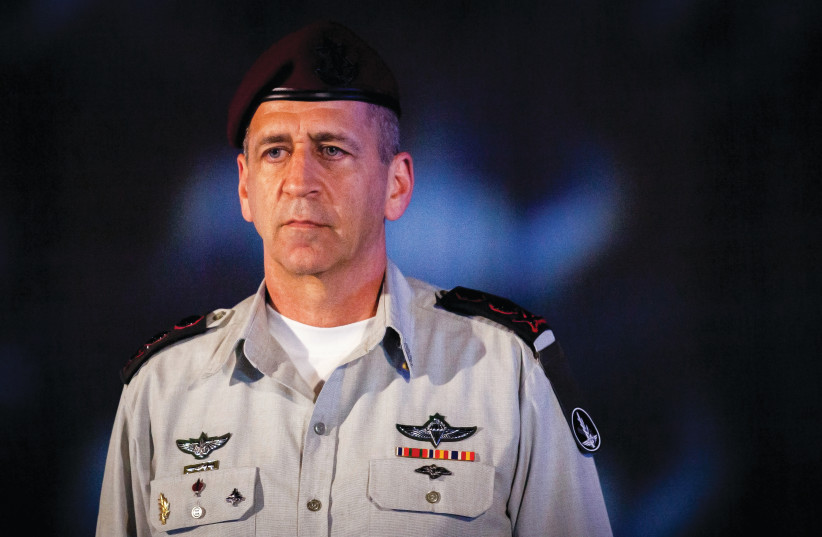
IDF Chief of Staff Lt. Gen. Aviv Kochavi at a graduation ceremony of naval officers at the Haifa naval base in March (photo credit: FLASH90)
IDF Chief of Staff Lt. Gen. Aviv Kochavi at a graduation ceremony of naval officers at the Haifa naval base in March
(photo credit: FLASH90)

Tucked into the middle of Chief of Staff Lt.-Gen. Aviv Kohavi‘s 50-minute speech Wednesday on the IDF’s challenges and capabilities was an admission that the IDF hit an Iranian convoy on the Syrian-Iraqi border in November.

“We could’ve been unaware of the Syrian convoy moving from Iraq to Syria a few weeks ago,” Kohavi said. “We could’ve been unaware of what it was carrying, and out of 25 trucks in the convoy, number eight was carrying military equipment. That is where we need to send pilots to attack, hit, and return.”

These words, understandably, attracted all the media attention and made headlines.

What was interesting, however, was that they were said almost in passing, as an aside. It is not as if Kohavi stood up and, early on in his address, said: “In November, the IDF hit an Iranian convoy trying to smuggle arms to Hezbollah.” Instead, he used this as an illustration of the IDFs ability to adapt to new situations, shape reality on the fronts where it operates, and integrate tremendous intelligence capacity with operational capabilities.

This was, in fact, the second illustration he used. The first was how during Israel’s operation in Gaza in May 2021, Operation Guardian of the Walls, the IDF knew precisely when and where to hit 18 Hamas fighters moving north in an underground tunnel for an attack in Israel.

 IDF Chief of Staff Aviv Kochavi speaks during a ceremony on the second night of the Jewish holiday of Hanukkah, at the Nativ program on the Kiryat Moriah campus in Jerusalem, November 29, 2021 (credit: OLIVIER FITOUSSI/FLASH90)IDF Chief of Staff Aviv Kochavi speaks during a ceremony on the second night of the Jewish holiday of Hanukkah, at the Nativ program on the Kiryat Moriah campus in Jerusalem, November 29, 2021 (credit: OLIVIER FITOUSSI/FLASH90)

The IDF was able to neutralize them by knowing exactly how long the tunnel was and how deep it was, having the ordinance that would explode precisely at the depth of the tunnel and having skilled pilots able to ensure that the bombs fell exactly where they needed to fall, and not somewhere else. What is required is impeccable intelligence, the right equipment, and skill.

The same precision operation was needed to ensure that the exact truck carrying the munitions from Iran to Hezbollah — truck number 8 out of a convoy of 25  — was the one hit. It was necessary to know what was in the truck, when and where the convoy would move, and then have the wherewithal and the capabilities to precisely attack it.

None of that is a given, Kohavi stressed.

But beyond its use for illustrative purposes, the story — and revelation of how much detail Israel had — sent a clear message to the Iranians. Even if Israel never claimed responsibility, Iran knew who acted against them. They, too, have intelligence. They may not have known, however, the degree of resolution in the Israeli intelligence picture. This is something that Kohavi shed some light upon on Wednesday.

What were the messages?

Why Wednesday? First the mundane reason: he happened to have a public speech that day planned at the Reichman University In Herzliya. Second, to send a signal to Iran, Hezbollah and Lebanon that Israel knows exactly what they are doing, and will act if necessary.

Why send that message now? Because of reports that Iran is using Beirut’s airport to smuggle in weaponry via Iran’s civilian Meraj airline, which recently began direct flights from Tehran to Beirut.  If Israel can pick out the eighth truck in a long convoy and destroy it because of the arms inside, it can take action against planes smuggling arms, even if they land at Beirut International Airport.

There was another message in Kohavi’s address as well, which was to the Israeli public. Don’t lose heart; the security situation in Judea and Samaria is difficult, but keep things in proportion, the situation on all of Israel’s fronts, including in the West Bank, could and has been much worse.

Kohavi, whose stint as chief of staff is to end on January 17, said that if the situation in Gaza remains quiet, then by April, this will be the quietest two years in the south in the last decade and a half. He recalled that just two years ago Israel was dealing with near-daily mass demonstrations on the Gaza fence, inflammable balloons setting fields in the south alight, and rockets fired at Sderot almost every Friday.

That situation, he said, has ended. It ended because of the success of Operation Guardian of the Walls, which significantly degraded Hamas’ military assets, including their underground tunnels. An enormous gap was created between Israel’s achievement in downgrading Hamas’s capabilities, and any lack of achievements Hamas could show from that war.

Hamas’ strategy has changed

As a result, Hamas’ strategy has changed, something evident in the fact that the organization did not respond to the Flag march in Jerusalem earlier this year, did not respond when Israel arrested Islamic Jihad senior officials and responded forcefully to that group’s rocket fire from Gaza following those arrests, and did not respond when the IDF killed Hamas members during nightly operations in the West Bank.

The use of force over the last seven years in Syria has also thwarted Iran’s dream of having thousands of precision-guided missiles in Syria and Lebanon, tens of thousands of militiamen, and a new Hezbollah in southern Lebanon, Kohavi said.

“As a result of this, and other actions against Iran, the deterrence of Iran has increased significantly, he said, “most of it done covertly, but not all of it, and this is through the uses of force only.”

His point: military might can shape reality on the ground. And though there are other ways to shape reality, other tools — diplomatic and economic — have limited impact in dealing with Hamas and Iran. The force used needs to match the theater of operation. And one of the army’s strengths, he said, is an ability to change and adopt tactics — using cutting-edge technology — to the different fronts.

In the middle of his address, Kohavi quoted from a book written by one of his predecessors as chief of staff, Motta Gur, who recorded a number to horrendous terror attacks that began in May 1974 with the attack Ma’alot and culminated two years later with the Entebbe raid. He then quoted from a recent book by another predecessor, Yitzchak Mordechai, who wrote that from Mach 1969 to August 1970, 507 IDF soldiers were killed during the War of Attrition, and over 3,000 were wounded.

His point: keep today’s security situation in perspective. Things have been a lot worse, and they could be a lot worse, and they are not a lot worse because of the IDF’s ability to adapt to the changing realities on the ground and, with skilled manpower and state-of-the-art technology, remain ahead of the curve.


Second Temple-era silver coin found near Temple Mount

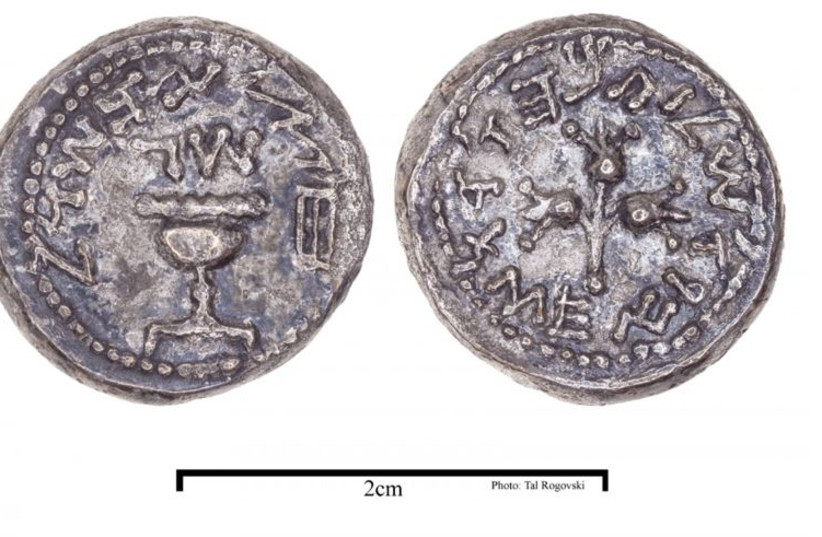
“This is the third coin of this type found in excavations in Jerusalem, and one of the few ever found in archeological excavations,” said the researchers.

Half-shekel coin from the third year of the Great Revolt. (photo credit: Tal Rogovski)
Half-shekel coin from the third year of the Great Revolt.
(photo credit: Tal Rogovski)

A rare, half-shekel coin from the Great Revolt from 66 CE to 70 CE during the Second Temple period has been discovered in Jerusalem’s Ophel excavations south of the Temple Mount.

Only a few days ago, a wooden box containing 15 silver coins that serve as proof of the Hanukkah story of the Maccabees – which was found recently during an excavation in the Negev Desert – was announced.

The Ophel – or citadel – is the still-extant Herodian, cased-in Temple Mount bordered to the south by a saddle, followed by the ridge known as the southeastern hill that stretches down to the King’s Garden and the lower Siloam Pool. Two kings of Judah, Yotam and Manasseh, are described in the Book of 2 Chronicles to have massively strengthened the Ophel fortifications and was either very close to or identical with the “stronghold of Zion” conquered and reused by King David.

In the destruction layer, dozens of Jewish coins were found from the period of the Great Revolt, most of them made of bronze. They also included a particularly rare and unusual find – a silver coin in a half-shekel denomination originating from 69/70 CE.

Dig and discovery

 A wooden box containing 15 silver coins from the Maccabean period was discovered in the Judean Desert earlier this year, and will be put on display in the Hasmonean Museum in Modi'in, December 13, 2022. (credit: SHAI HALEVI / ISRAEL ANTIQUITIES AUTHORITY)A wooden box containing 15 silver coins from the Maccabean period was discovered in the Judean Desert earlier this year, and will be put on display in the Hasmonean Museum in Modi’in, December 13, 2022. (credit: SHAI HALEVI / ISRAEL ANTIQUITIES AUTHORITY)

The dig was carried out by a team from the Hebrew University (HU), led by Prof. Uzi Leibner of the Institute of Archaeology, in partnership with Armstrong College in Edmond, Oklahoma, and with the support of the East Jerusalem Development Company, the Israel Antiquities Authority and the Israel Nature and Parks Authority. 

The rare silver coin was cleaned at the conservation lab of the Institute of Archaeology and identified by Dr. Yoav Farhi, the team’s numismatic expert and curator of the Kadman Numismatic Pavilion at the Eretz Israel Museum in Tel Aviv. Silver coins from the Great Revolt were the first and the last in ancient times to bear the title “shekel,” the archaeologist said. “The next time this name was used was in 1980, on Israeli shekel coins produced by the Bank of Israel.”

“This is the third coin of this type found in excavations in Jerusalem, and one of the few ever found in archeological excavations,” said the researchers.

During the Great Revolt against Rome, the Jews in Jerusalem minted bronze and silver coins. Most of the silver coins featured a goblet on one side, with ancient Hebrew script above it noting the year of the Revolt. Depending on its denomination, the coins also included an inscription around the border noting either, “Israel Shekel,” “Half-Shekel” or “Quarter-Shekel.” The other side of these coins showcased a branch with three pomegranates, surrounded by an inscription in ancient Hebrew script, “Holy Jerusalem.”

The production of silver coins

Throughout the Roman era, the authority to produce silver coins was reserved solely for the emperor. During the Revolt, the minting of coins, especially those made of silver, was a political statement and an expression of national liberation from Roman rule by the Jewish rebels. In fact, throughout the Roman period leading up to the Revolt, no silver coins were minted by Jews, not even during the rule of King Herod the Great.

According to the researchers, half-shekel coins with an average weight of seven grams were also used to pay the “half-shekel” tax to the Temple, contributed annually by every Jewish adult male to help cover the costs of worship.

“Until the revolt, it was customary to pay the half-shekel tax using good-quality silver coins minted in Tyre in Lebanon, known as Tyrean shekels or Tyrean half-shekels,” said Farhi. These coins held the image of Herakles-Melqart, the principal deity of Tyre, and on the reverse, they featured an eagle surrounded by a Greek inscription, “Tyre the holy and City of refuge.” The silver coins produced by the rebels were intended to also serve as a replacement for the Tyrean coins, by using more appropriate inscriptions and replacing images forbidden by the Second Commandment with symbols.