File: Rockets being fired by Islamic Jihad toward Israel from the Gaza Strip, on August 5, 2022. (Attia Muhammed/Flash90)
A rocket was fired from the Gaza Strip at southern Israel on Saturday night, the military said.
The Israel Defense Forces said the projectile landed in an open field, causing no injuries or damage.
Incoming rocket sirens did not sound in Israel as the rocket was projected by defense systems to land in uninhabited areas, but an alert was activated near the Gaza border towns of Nahal Oz and Kfar Aza on the Home Front Command mobile application.
Residents of the area reported hearing a large explosion.
The IDF said there were no special instructions for residents following the rocket fire.
The rocket fire came as Israeli officials were reportedly concerned about potential retaliation, including in the form of rocket fire from Gaza, over the deaths of two Palestinian Islamic Jihad members.
Both PIJ and the Hamas terror group that rules the Gaza Strip threatened to hit back over the deaths of the pair, who were killed Thursday during a military raid in the West Bank.
Over the past year, the PIJ has launched rockets at Israel in response to members being killed or arrested in the West Bank.
Still, there was no immediate claim by any of the Gaza-based terror groups for the rocket fire Saturday.
In the past, Israel has responded with airstrikes against Hamas sites regardless of the group launching the attack. More rarely, it has directed its response at Islamic Jihad, if the terror group claimed responsibility.
The last time rockets were fired from the coastal enclave toward Israel was on November 3, apparently in response to the death of a PIJ member during a West Bank raid.
Analysis: Despite deep strategic ties, Israel’s new far-right government could threaten Jordan’s custodianship over holy sites in Jerusalem and jeopardise the fragile peace agreement between both countries.
With Israel’s most right-wing parliament now in session and headed by Likud party leader Benjamin Netanyahu, analysts fear Jordan’s relations with Tel Aviv are at risk of deterioration.
“Jordan represents the most likely and the most dangerous point of escalation or deterioration in Israel’s foreign policy,” said Gil Murciano, the CEO of Mitvim, an Israel-based foreign policy think tank.
There is “continued mistrust” between Netanyahu and Jordan’s King Abdullah II, Murciano told The New Arab, referencing the all-time-low Jordan-Israeli relations reached during Netanyahu’s former 12 years as prime minister.
Among the many points of tension under Netanyahu’s previous term was a tit-for-tat row last year when Netanyahu cancelled the Jordanian Crown Prince’s visit to Al-Aqsa Mosque and in retaliation, Amman denied Netanyahu’s helicopter access to Jordanian airspace.
“The far-right government has an agenda which harms Jordan’s top national interests. There will be no effort to restore any kind of negotiations for the peace process or the two-state solution”
The year prior, the 1994 Wadi Araba treaty — which established Jordan and Israel’s diplomatic relations — was nearly ruptured when Netanyahu proposed a plan to annex the occupied West Bank’s Jordan Valley.
And these disputes occurred when Netanyahu had a much more centrist government. Today, with religious and political extremism entering Israel’s mainstream, radical and once fringe politicians now sit in the Knesset majority.
Analysis
Fatih Şemsettin Işık
“The far-right government has an agenda which harms Jordan’s top national interests. There will be no effort to restore any kind of negotiations for the peace process or the two-state solution,” Oraib Rantawi, the director of the Amman-based Al Quds Center for Political Studies, told The New Arab.
Israel’s Religious Zionist Party, headed by Bezalel Smotrich and Itamar Ben Gvir, won 14 seats in the recent election and is now the third-largest political force in Israel. The party attracts immense support from settlers with its overt agenda to expel Palestinians from the occupied West Bank.
“Ben Gvir’s government uses annexation as not only a slogan, but as a policy plan — a policy plan that makes collision with Jordan immediate,” said Murciano.
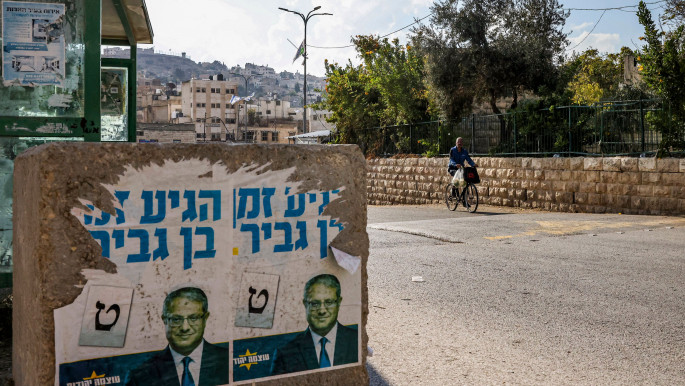
A man cycles near a concrete block bearing posters depicting Itamar Ben Gvir, leader of the Otzma Yehudit (Jewish Power) far-right party, in the city of Hebron in the occupied West Bank on 1 November 2022. [Getty]
Tensions to escalate
Under the Netanyahu government, with a majority of ultranationalist, fervently zionist politicians, tensions in Israel and the occupied West Bank are expected to escalate.
And with the majority of Jordan’s population vehemently opposed to the Israeli occupation, an escalation may likely spill over into the Kingdom, according to Rantawi.
Soon after Ben Gvir’s election victory he led a rampage in Hebron, in the occupied West Bank, where thousands of Jewish settlers attacked Palestinians and destroyed their shops and vehicles — one of the largest attacks on record in the occupied city.
Dima Tahboub, a spokesperson for the Islamic Action Front (IAF) in Jordan, told The New Arab that in Jordan there is a “national steadfastness” with the Palestinian cause. “You can always feel that anything that happens in Palestine is always echoed here in Jordan,” she said.
“Ben Gvir’s government uses annexation as not only a slogan, but as a policy plan — a policy plan that makes collision with Jordan immediate”
A March public opinion poll found that most Jordanians viewed Israel as the greatest threat to Jordan’s national security and to the Arab world, and the vast majority opposed normalisation with Israel.
“The polls prove that people in Jordan have not really approved of the so-called peace process or the Wadi Arab agreement,” Tahboub said.
Meanwhile, Israel has seen a radicalisation of its right-wing politicians, who now increasingly see Jordan as a hostile country, according to Barak Ravid, an Israeli veteran journalist and political analyst. In the Israeli parliament “the majority of its members don’t think Jordan should exist as a country”, Ravid told The New Arab.
Under the new right-wing government, a high point of conflict will be at al-Haram al-Sharif, said Murciano; the sacred compound where Jordan exercises its custodian role over holy sites.
Ben Gvir’s far-right coalition has called for full prayer rights for Jews at the mosque site, the third holiest site in Islam and where Jews believe the biblical Jewish temples once stood.
This would disrupt the sensitive status quo agreement that Jordan has worked to maintain for decades, threatening a key piece of the Hashemite regime’s domestic and international legitimacy.
There will be “almost no room for the Hashemite custodianship of Al Aqsa” in Israel’s new government, said Rantawi.
Despite the widespread public anger towards the Israeli occupation in Jordan, on a strategic level, Jordan’s ties with Israel run deep. The two neighbours cooperate on water and gas deals and their security apparatuses have long worked together to counter Iranian proxies and secure their shared border.
“Jordan does not want to see its relationship with Israel deteriorate,” said Rantawi.
The King called Netanyahu to congratulate him on his new post as prime minister, a move Rantawi said could have been part of efforts to maintain “business as normal”.
Under the new far-right Israeli government, a high point of conflict will be at al-Haram al-Sharif. [Getty]
The United States, Israel’s staunchest ally, recently offered Jordan the longest and largest aid package, at $10.15 billion over the next seven years. “Jordan is not in a position to risk it [Israeli relations],” Rantawi stated, referencing the financial support and strategic benefits attached to Jordan’s ties with Israel.
The two countries are moving forward with a water-for-energy deal, which would see Jordan providing solar energy to Israel in return for water, despite widespread protests in Jordan against the deal. Jordan and Israel also recently signed a cooperation agreement to protect their shared Jordan River.
“There is a great interest in coordination [between Israel and Jordan],” said Murciano. “But the political setting I believe will define it… I am afraid and concerned about the resilience of the relations that we saw last year.”
With a bleak future ahead for Jordan-Israel relations, some analysts pin hope on the United Arab Emirates (UAE) to prevent an Israeli-Jordanian conflict or Israeli policies that may spark an outbreak of public discontent in the Kingdom.
Netanyahu values the relationship with the UAE, the first signatory of the Abraham Accords, as his “biggest achievement in his political career”, Ravid noted, adding that King Abdullah and UAE President Mohammad bin Zayed (MbZ) also enjoy close relations.
“Jordan is likely to use this strong relationship with the UAE to try to press or dissuade Israel from taking a step that might undermine the security of Jordan,” Ravid said.
Today in Jordan, there is “a great deal of anger among the public”, Rantawi said, adding that an escalation in Israel and the occupied Palestinian territories may “revive a protest either in solidarity with the Palestinians or to achieve something else, with other goals”.
“There will be almost no room for the Hashemite custodianship of Al Aqsa in Israel’s new government”
Murciano pointed out that among the Israeli public there is a general understanding of the “fragility of Jordan” and fear of the “total collapse of the Kingdom and the rise of radical parties”.
The majority of Israelis attach great importance to strengthening relations with Jordan, according to a 2022 Mitvim poll. The poll also found that the majority of Israelis support a joint coordination mechanism to prevent escalation in Jerusalem, in cooperation with Palestinians and Jordan – a step away from the radical views of the politicians now in the Knesset.
“Jordan is very eager to see a source of truce, calm,” said Rantawi, noting that if Palestine and Israel were to slide into serious clashes there may be the impetus for larger, anti-regime protests to break out in Jordan.
“We really need to put our home [Jordan] in order to be well prepared to face the upcoming Israel-Palestine developments,” Rantawi said.
Hanna Davis is a freelance journalist reporting on politics, foreign policy, and humanitarian affairs.
Israel’s Ambassador to the UN Gilad Erdan is seen holding up a sign reading “Stop ignoring Jewish Nakba,” at the United Nations, on November 30, 2022.
(photo credit: ISRAEL AT THE UN)
The UN General Assembly voted Wednesday afternoon in favor of holding a commemorative event in honor of the 75th “Nakba Day,” the Palestinian name for Israel’s establishment, which translates to “catastrophe.”
The vote was 90-30, with 47 abstentions. The United States, Canada, Australia and the United Kingdom were among those who opposed the move. Most of the European Union also rejected the, save for Cyprus which supported the measure.
Ambassador to the UN Gilad Erdan called in his address ahead of the vote for the UN to “stop ignoring the Jewish Nakba,” referring to the 750,000 Jews expelled from Arab and Muslim countries in the aftermath of Israel’s establishment.
“What would you say if the international community celebrated the establishment of your country as a disaster? What a disgrace,” Erdan said.
“What would you say if the international community celebrated the establishment of your country as a disaster? What a disgrace.”
Gilad Erdan
Erdan showed the General Assembly a front page of The New York Times from May 16, 1948, with a top headline stating: “Jews in grave danger in all Moslem lands.”
Results of the UN vote to officially recognize Nakba Day. The vote was 90-30, with 47 abstentions. (credit: ISRAEL MISSION TO THE UN)
Partition, Palestinians, Israel and right of return
The ambassador described the history of that period, in which the UN voted on November 29, 1947 in favor of partition of the British Mandate into Jewish and Arab states, which the Jews accepted and the Arabs did not, opting instead to declare war on the fledgling State of Israel the following year.
The Jewish communities in the Middle East and North Africa “did not revolt against the international community’s decision,” Erdan said. “They did not try to annihilate another people. Their only crime was being Jewish. This is the true Nakba. This is the disaster carried out against the Jewish people and this is the disaster that this body has ignored for decades.”
Erdan said other diplomats tell him privately that they know the Palestinians’ demand for a “right of return,” that the descendants of a war that took place 75 years ago should be able to move to Israel, effectively dismantling it as a Jewish state.
“Why are you afraid to say it publicly? Why does this house have to be a house of lies?” he asked.
Palestinian Ambassador to the UN Riyad Mansour claimed the new State of Israel’s “plan was, and in many aspects still is, to displace and replace our people on their ancestral land. Maximum Palestinian geography with minimum Palestinian demography.”
Mansour said the UN “will finally acknowledge the historical injustice that befell the Palestinian people” by marking Nakba Day.
“Our people deserve recognition of their plight, justice for the victims, reparation for their loss and fulfillment of their rights,” he stated.
The Israeli Embassy launched the first-ever exhibit on the Jews’ expulsion from Arab states and Iran at the UN on Tuesday. The exhibit, called “The Story of the Jewish Nakba,” will be in the main corridor of the UN in New York for a week.