Emmanuel Macron Comes Clean: “We Need A Single Global Order”

BY TYLER DURDEN
TUESDAY, NOV 22, 2022 – 06:30 AM

Authored by Paul Joseph Watson via Summit News,

During a speech at the Apec summit in Bangkok, where world leaders gathered, French President Emmanuel Macron called for a “single global order.”

Macron made the comments while discussing the power interests of Russia and China and the threat of war.

“We are in a jungle and we have two big elephants trying to become more and more nervous,” he said.

“If they become very nervous and start a war, it will be a big problem for the rest of the jungle. You need the cooperation of a lot of other animals, tigers, monkeys and so on,” added Macron.

“Are you on the U.S. or the Chinese side? Because now, progressively, a lot of people would like to see that there are two orders in this world. This is a huge mistake, even for both the U.S. and China.”

“We need a single global order,” he concluded.

Macron’s words are sure to confuse the ‘fact checker’ industry, which continues to insist that claims about the ‘New World Order’ or one world government are a baseless conspiracy theory.

Indeed, much hilarity ensued last week when it was revealed that Google-owned YouTube had effectively fact-checked a video published by ‘The World Government Summit 2022’.

In the video, the host of a panel discussion asks H.E. Dr. Anwar bin Mohammed Gargash, Diplomatic Advisor to the UAE President, “Are you ready for a new world order?”

Underneath the video is a fact check box about the ‘New World Order’ which links to a Wikipedia article that states, “The New World Order (NWO) is a conspiracy theory which hypothesizes a secretly emerging totalitarian world government.”

The tone of the article debunks the notion that there is a move towards a ‘New World Order’, despite the panelists at the World Government Summit openly discussing that very agenda.

*  *  *

Brand new merch now available! Get it at https://www.pjwshop.com/

In the age of mass Silicon Valley censorship It is crucial that we stay in touch. I need you to sign up for my free newsletter here. Support my sponsor – Turbo Force – a supercharged boost of clean energy without the comedown. Get early access, exclusive content and behind the scenes stuff by following me on Locals.


Aviv Kohavi says ‘we are at a critical point in time’ following meetings on Iranian threat with American military chief, national security adviser, CIA director

Two Israeli and one American F-16 fighter jets fly alongside one another during a joint exercise in southern Israel in January 2022. (Israel Defense Forces)

Two Israeli and one American F-16 fighter jets fly alongside one another during a joint exercise in southern Israel in January 2022. (Israel Defense Forces)

Israel Defense Forces chief Aviv Kohavi told American defense officials in Washington that the two militaries must accelerate joint plans for offensive actions against Iran, the Israeli military said Tuesday.

Kohavi landed in the US on Sunday morning for five days of meetings with senior officials focused on the Iranian threat, the IDF said.

On Monday, Kohavi met with Chairman of the US Joint Chiefs of Staff Mark Milley, US National Security Adviser Jake Sullivan, and CIA Director William Burns. He also met with the Israel Ambassador to the US Michael Herzog.

“During the discussions, it was agreed that we are at a critical point in time that requires the acceleration of operational plans and cooperation against Iran and its terrorist proxies in the region,” Kohavi said in remarks provided by the IDF Tuesday.

“On the one hand, Iran is under many economic, military, and internal pressures, and on the other hand, it continues to promote its nuclear program. The IDF strongly promotes all operational plans against the Iranian threat,” Kohavi said.

The Kan public broadcaster reported the Israeli and US militaries would hold an imminent drill simulating strikes against Iran and its proxies, citing the IDF, but a military source said they were unaware of such a drill, and there was no mention of such plans in the statement.

The Israeli statement marked a departure from an earlier US readout of Kohavi’s meeting with Sullivan, which focused on reaching a negotiated solution to thwart Iran’s nuclear intentions, echoing Biden administration talking points.

“The two discussed the importance of taking steps to de-escalate the security situation in the West Bank, and Mr. Sullivan reiterated that a negotiated two-state solution remains the best avenue to achieve a lasting peace,” the White House readout said.

File: IDF Chief of Staff Aviv Kohavi (L) and US National Security Adviser Jake Sullivan meet in Washington on June 23, 2021. (Israel Defense Forces)

Jerusalem opposes US President Joe Biden’s attempts to revive the nuclear agreement between Tehran and world powers that traded sanctions reliefs for curbs on the Islamic Republic’s nuclear program.

But that disagreement has been less relevant lately, as nuclear talks have fizzled and the US has preferred to focus on addressing the ongoing civilian protests in Iran against the regime.

Iran said Tuesday it had begun producing uranium enriched to 60 percent at its Fordo plant, a level it never reached before, and a short, technical step away from the 90% enrichment necessary to produce a nuclear weapon.

The International Atomic Energy Agency confirmed the move and said Tuesday that its chief, Rafael Grossi, had reported the development to its member states.

The US expressed “deep concern” Tuesday over the announcement, which was also condemned by Germany, France and the UK.

“We’re going to make sure we have all options available to the president,” said White House national security spokesman John Kirby.

Israel has been pushing for the US to prepare military contingency plans in order to prevent Iran from obtaining a nuclear weapon. Biden has said he is prepared to use military force if necessary, but still prefers exhausting the diplomatic route first.

In light of growing uncertainty regarding a return by Iran to the 2015 nuclear deal with world powers amid long-stalled negotiations, the past two years have seen the IDF ramp up its efforts to prepare a credible military threat against Tehran’s nuclear sites.
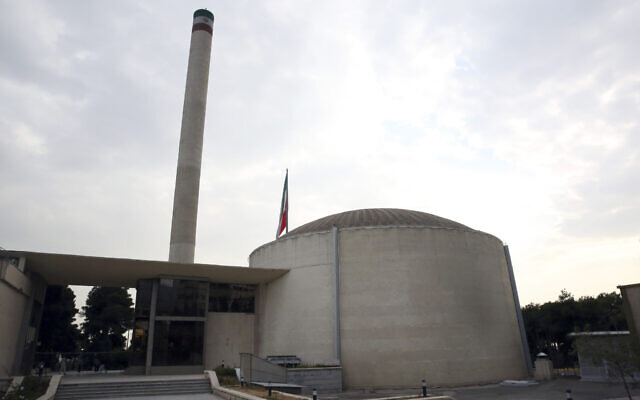
This September 1, 2014 file photo, shows a nuclear research reactor at the headquarters of the Atomic Energy Organization of Iran. (AP Photo/Vahid Salemi, File)

European Union-sponsored talks have failed to bring the US back into the 2015 nuclear deal with Iran known as the Joint Comprehensive Plan of Action.

The deal, signed between Iran and the US, UK, France, Germany, China and Russia, has unraveled since the Trump administration pulled out in 2018. The US reimposed stiff sanctions and Iran responded by dropping many of its own commitments to the pact while also ramping up its uranium enrichment to levels far beyond the agreement’s limits.

While Iran long has maintained its program is peaceful, non-profileration experts warn Tehran has enough 60%-enriched uranium to reprocess into fuel for at least one nuclear bomb.

Israeli officials have also warned of Iran’s proxies across the region, from Hezbollah in Lebanon to the Houthis in Yemen.

The official Washington visit marked Kohavi’s final scheduled one as chief of staff, as his tenure is set to end on January 17.

Milley, who met with Kohavi on Monday, awarded his Israeli counterpart the Legion of Merit commander degree.


NOVEMBER 22, 2022 5:07 PM

Iranian state media on Tuesday announced that the Atomic Energy Organization of Iran has begun enriching uranium at the underground Fordow enrichment facility to 60% purity for the first time. Iran’s SNN media outlet also said that 60% enrichment would continue at Iran’s Natanz nuclear site and that it was upgrading its centrifuges at both sites to increase production capacity. The International Atomic Energy Agency (IAEA) on Tuesday confirmed that Iran had begun enriching to 60% at Fordow.

The UK, France, and Germany (the E3) issued a statement condemning the move.

“By increasing its production capabilities at Fordow and Natanz, well beyond Joint Comprehensive Plan of Action (JCPOA) limits, and by accelerating its production of enriched uranium, Iran has taken further significant steps in hollowing out the JCPOA,” they said, referring to the limits placed on Iranian enrichment by the 2015 Iran nuclear deal. Under the provisions of the JCPOA, Iran was limited to 3.67% enrichment, with enrichment to be carried out exclusively at Natanz.

“This step, which carries significant proliferation-related risks, has no credible civilian justification,” the E3 said.


Uranium enriched to 3-5% is the level typically used for civilian nuclear reactors. 60% pure uranium is considered to be “highly enriched”, but remains short of the approximately 90% purity required for weapons grade uranium used in nuclear weapons.

US Secretary of State Antony Blinken said Tuesday that while he could not confirm Iran’s enrichment activities, the US was monitoring the situation closely. “Even as we’ve been engaged in diplomacy to try to see if we can get a mutual return to compliance with the JCPOA, we continue to exert pressure on Iran for steps that it’s taken to strengthen its nuclear program in contravention of the JCPOA itself, as well as the steps that it’s taking in other areas that pose significant challenges, concerns to people around the world,” he said.

US officials have previously said that diplomatic efforts to return to the deal have been stalled since August.

Iran’s decision to enrich to 60% at Fordow follows an IAEA board of governors resolution introduced by the US and E3 calling on Iran to meet its legal obligations under the Non-Proliferation Treaty Safeguards Agreement. IAEA Direct General Rafael Grossi at a press conference on 16 November said of Iran’s nuclear program that there is a “mass of activity about which we don’t know anything.”

John Kirby, the US National Security Council Coordinator for Strategic Communications, told reporters Tuesday that “all options” remain available to the President to respond to Iran’s nuclear enrichment and its ballistic missile program.