
Tehran also claims to build new centrifuges, says moves are retaliation for international resolution criticizing its lack of cooperation with UN nuclear agency
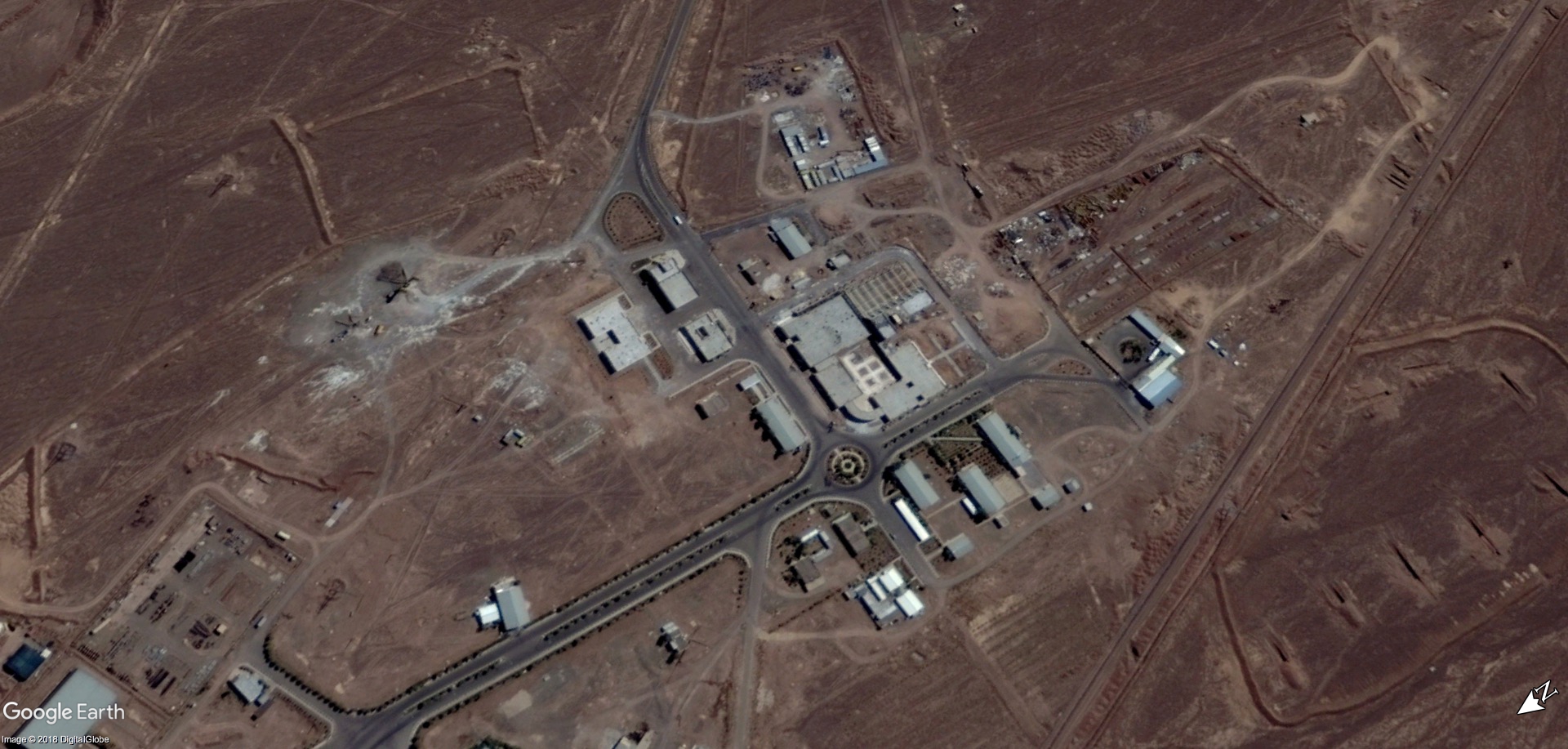
A satellite image from September 15, 2017, of the Fordo nuclear facility in Iran. (Google Earth)

A satellite image from September 15, 2017, of the Fordo nuclear facility in Iran. (Google Earth)

Iran said Tuesday it had begun enriching uranium to 60 percent purity at its underground Fordo site, a technical step from weapons-grade levels of 90%, saying the move was in response to international criticism.

The enrichment was being carried out using the advanced IR-6 centrifuges at the facility, and was a response to the International Atomic Energy Agency’s resolution last week criticizing Tehran’s lack of cooperation with the nuclear watchdog, according to Iranian state media cited by Reuters.

“In a letter to the International Atomic Energy Agency (IAEA), Iran has informed the agency that it has started enriching uranium to 60% purity at Fordo site,” said the semi-official ISNA news agency.

Iran’s Student News Network announced that Tehran would additionally build new sets of centrifuges at the Natanz and Fordo nuclear sites.

Under the terms of the 2015 agreement with world powers, Iran is only permitted to enrich uranium to 3.67% purity. That deal gave Iran sanctions relief in return for curbs on its nuclear program to prevent the production of a weapon.
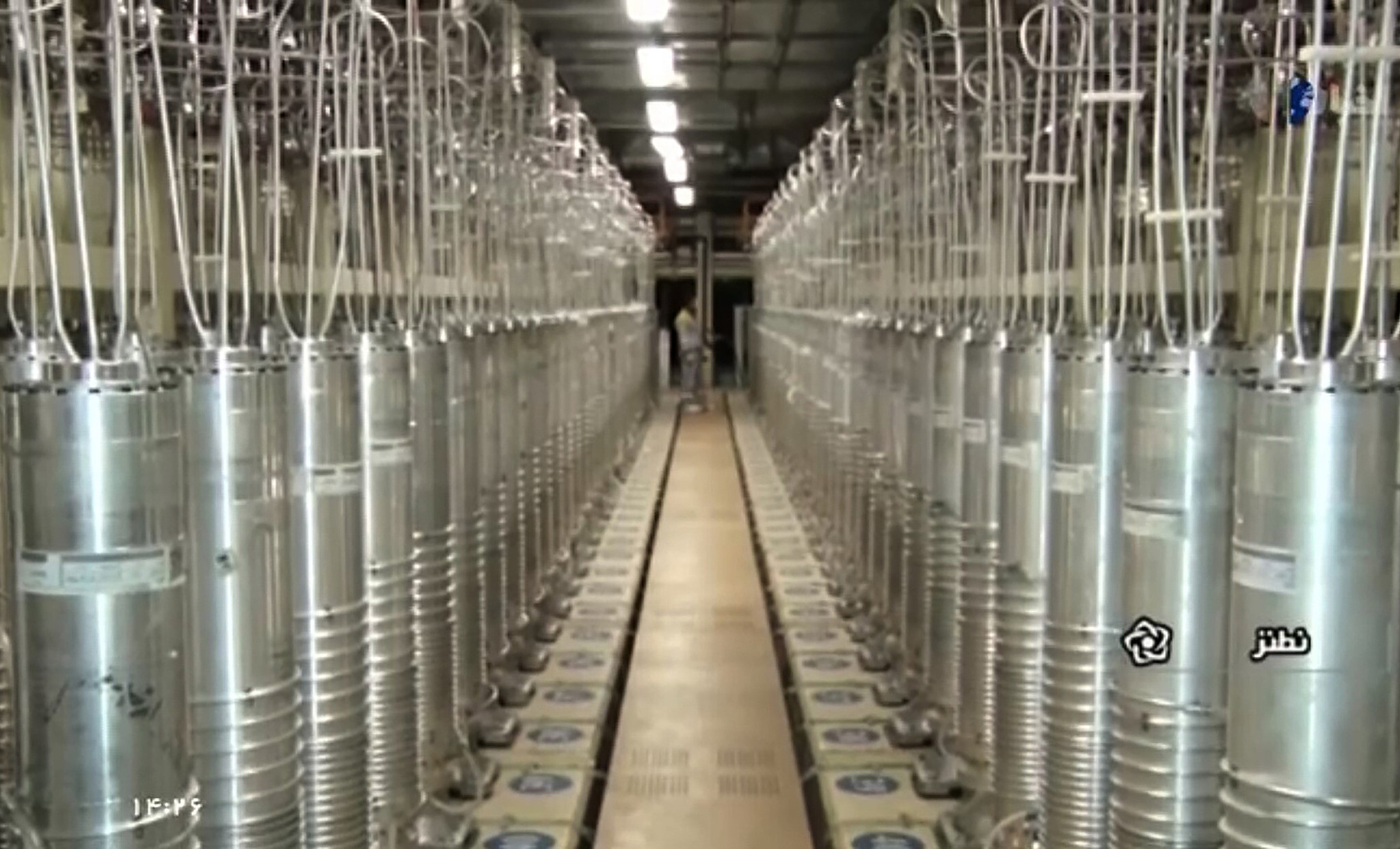
Various centrifuge machines line a hall at the Natanz Uranium Enrichment Facility, on April 17, 2021. (Screenshot/Islamic Republic Iran Broadcasting-IRIB, via AP)

In September, Defense Minister Benny Gantz said the enrichment capacity had tripled at Fordo over the past year, months after Iran said it had begun enriching uranium to 20% purity at the plant.

The IAEA reported in July that Iran had 43 kilograms of uranium enriched to 60% purity at other sites, enough fissile material for one nuclear weapon if Iran chose to pursue it.

However, Iran still would need to design a bomb and a delivery system for it, likely a months-long project.

Iran said that the latest upgrade in enrichment was a retaliatory measure against the IAEA over the resolution submitted by the United States, Britain, France and Germany to the UN nuclear watchdog’s board last week, censuring Iran over its lack of cooperation with the agency.

A truck containing cylinder of uranium hexafluoride gas leaves Ahmadi Roshan uranium enrichment facility in Natanz to Fordo nuclear facility for the purpose of injecting the gas into Fordo centrifuges, November 6, 2019. (Atomic Energy Organization of Iran via AP)

On Sunday, Iran’s foreign ministry spokesman Nasser Kanani said a response “was realized today in the presence of IAEA inspectors in the Natanz and Fordo enrichment complexes,” without specifying what the measures entailed.

He also hinted at the likelihood that the IAEA delegation’s next visit to Iran would be canceled.

Kanani added that “the Islamic Republic of Iran is always prepared to respond in the appropriate manner to the actions of Western parties when they return to their commitments.”

The resolution came amid an impasse over undeclared uranium particles in Iran, and as talks seeking to revive the nuclear deal have stalled, alongside international condemnation of Tehran’s response to domestic protests.

The deal collapsed after Washington’s unilateral withdrawal in 2018 under then-president Donald Trump.

Israel has long opposed the nuclear accord, saying it delayed rather ended Iran’s nuclear progress and arguing that sanctions relief empowered Tehran’s proxy militias across the region, with expected incoming prime minister Benjamin Netanyahu coming out strongly against the deal.
IAEA and protests blow up in Iran’s face – analysis

The Islamic Republic could be faced with global snapback sanctions which would apply even to Russia and China.

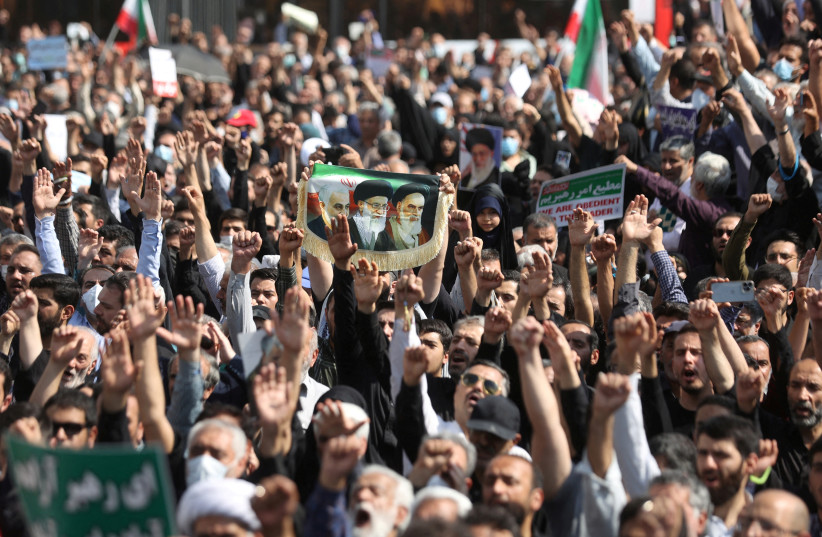
 Pro-government peoples rally against the recent protest gatherings in Iran, after the Friday prayer ceremony in Tehran, Iran September 23, 2022.  (photo credit: Majid Asgaripour/ WANA via Reuters)
Pro-government peoples rally against the recent protest gatherings in Iran, after the Friday prayer ceremony in Tehran, Iran September 23, 2022.
(photo credit: Majid Asgaripour/ WANA via Reuters)

Iran is trying to maintain an uncompromising stance in every area, but is up against the wall more than it has been in prior years both regarding the IAEA nuclear standoff and in confronting domestic protests.

Normally, when the Islamic Republic tries to govern its foreign and internal problems using an iron hand, those it is up against retreat or back down.

What is unique now is that Tehran has pulled out the stops against both the IAEA and domestic protesters, and both of these challengers appear ready to escalate and could potentially shake the foundations of the regime.

Against the IAEA and its US and EU supporters, Iran Supreme Leader Ayatollah Ali Khamenei has limited aspects of cooperation now dating back to February 2021 and has cut off 27 key surveillance cameras for the last half-year.

Khamenei has also repeatedly refused to clarify to the IAEA the true stories behind illicit uranium and undeclared nuclear sites that the Mossad exposed dating back to 2018.


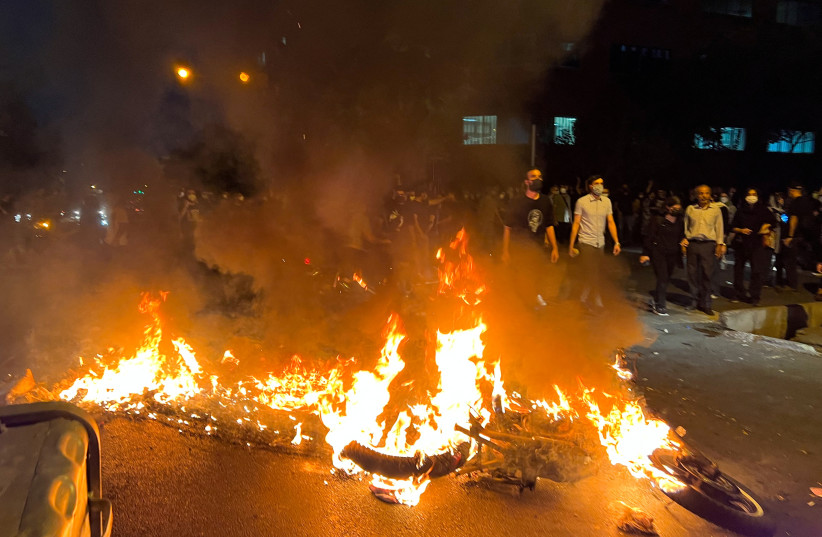
 A police motorcycle burns during a protest over the death of Mahsa Amini, a woman who died after being arrested by the Islamic republic's ''morality police'', in Tehran, Iran September 19, 2022. (credit: WANA (WEST ASIA NEWS AGENCY) VIA REUTERS)A police motorcycle burns during a protest over the death of Mahsa Amini, a woman who died after being arrested by the Islamic republic’s ”morality police”, in Tehran, Iran September 19, 2022. (credit: WANA (WEST ASIA NEWS AGENCY) VIA REUTERS)

Just as IAEA Director-General Rafael Grossi was appealing to Khamenei through the media last week to accelerate dialogue with his agency to overcome roadblocks on these issues, Iran decided to cancel holding any meeting with Grossi in the near future.

Has their patience run out?

But the IAEA and the West’s patience may have run out.

They issued a second condemnation of Tehran regarding its nuclear violations and obstruction, and this time there were hints that the IAEA may finally send the issue to the UN Security Council when its next meeting comes up in March 2023.

If it goes the distance in the UNSC, the Islamic Republic could be faced with global snapback sanctions that would apply even to Russia and China.

The way that the 2015 JCPOA deal was set up, neither Moscow nor Beijing could veto snapping-back sanctions if the IAEA Board sends the issue to the UNSC.

Although much of the world has been observing sanctions against Tehran, one reason Khamenei has been able to resist the US’s “maximum pressure” campaign has been because Russia, China and others have disregarded Washington’s dictates.

When Khamenei caved into a serious negotiations process in 2012 and signed the JCPOA in 2015, it was only when sanctions were being observed by all countries.

In that sense, if the issue finally goes to the UNSC in mid-2023, Iran could suddenly face the most intense sanctions pressure in over a decade.

All of this is happening at the same time as a nine week-long protest against the regime is starting to break various records.

No one knows the real numbers, but media reports are saying that close to 400 Iranians have been killed and around 15,000 have been arrested by the regime.

During the November 2019-July 2020 protests, it is estimated that 1,500 people were killed. June-December 2009 were probably the protests that most endangered the regime because former national leaders sided with the protesters and there was a clear group that could have replaced the regime.

So in some ways the current protests have still not hit the same heights as those earlier rounds of protests.

The number of killed has not yet broken records. There is still no coherent leadership or organization uniting all of the disparate protesters in a country that is so large that it could fit several of Europe’s largest countries inside.

The regime has control of the Internet and has the Basij militia force and backup from the IRGC, who are willing to beat their own people so that it can keep the military out of most issues (Iran learned from the USSR that professional military soldiers are not always willing to fire on their own people).

Khamenei hand-picked current hardliner Ebrahim Raisi as president in June 2021 to replace the somewhat more moderate Hassan Rouhani.

Raisi is famous for helping lead a domestic crackdown in the 1980s that led to mass casualties and executions.

But the Khamenei-Raisi team assumed that their harsh crackdowns on the protesters would fizzle the widespread anti-government movement within around a month.

What is unique this time is that the protests have been national the whole time, including in Shi’ite strongholds, where killing and oppressing women has broken a restraint that kept many Shi’ites out of earlier rounds of protests.

It is also possible that Khamenei’s blatant canceling of any potential legitimate electoral challenger to Raisi eliminated a horizon of potential hope of many average Iranians that their situation could improve cyclically when there would be elections.

Whatever the reason, even if the protesters are not yet close to toppling the regime, they are bringing the ayatollahs into a new reality of having to continuously live with widespread protests, not just in Kurdish and minority areas, but on their hometown Shi’ite turf.

It is unclear if Khamenei will unleash new levels of violence against his own people, including Shi’ites, or whether even that level of brutish violence would be enough to extinguish the current level of animosity to the regime.

In this volatile situation, the face of Iranian public and basic social relations may change in fundamental waves even as the regime has multiple powerful tools to survive.

The last unknown is whether the confluence of these two crises, one external and one internal, will lead to some other new state of play.

Until now, the regime has simply presented a tougher and harder line on both fronts.

But whether the synergy of the two will at some point explode and make the regime entertain new levels of aggression or retreat in a way that it has not done in a decade or more is the million-dollar question.


Iran’s neighboring country, Azerbaijan, to open embassy in Israel

The embassy announcement comes amid rising tensions between Azerbaijan and its southern neighbor, Iran.

By World Israel News Staff

Azerbaijan will open an embassy in Israel, becoming the first Shi’ite Muslim country to do so following a parliamentary vote on Friday.

“I welcome the decision by the National Assembly of Azerbaijan to open an embassy in Israel. Azerbaijan is an important partner of Israel and home to one of the largest Jewish communities in the Muslim world,” Prime Minister Yair Lapid said in a statement.

“The decision to open an embassy reflects the depth of the relationship between our countries. This move is the result of the Israeli government’s efforts to build strong diplomatic bridges with the Muslim world,” he said.

“I want to thank President Ilham Aliyev and congratulate the Azeri people who will now be represented for the first time in the State of Israel,” he added.

Azerbaijan and Israel have 30 years of diplomatic relations, and share particularly strong security ties, but only in August 2021 did the Turkic state inaugurate a Trade and Tourism office in Tel Aviv with diplomatic status.

Even though Azerbaijan is one of Israel’s largest clients in the defense industry, the relationship between the two countries has remained mostly covert until now.

  IRAN’S NEIGHBOR IS ISRAEL’S KEY ALLY IN ITS BATTLE AGAINST IRAN

Israel is also represented in Azerbaijan in fields outside of security, from road construction to telecom to medicine.

The embassy announcement comes amid rising tensions between Azerbaijan and its southern neighbor, Iran, with Baku arresting five Azeris for spying for Tehran.

Israeli Defense Minister Benny Gantz last month paid an official visit to Azerbaijan, where he met with his Azeri counterpart, Zakir Hasanov, and Aliyev.

Incoming Prime Minister Benjamin Netanyahu met with Aliyev on a visit to Baku in 2016.
