“The return of the Jews to their ancient land is a sure sign that the Lord’s return is imminent.”


“The return of the Jews to their ancient land is a sure sign that the Lord’s return is imminent.”
Deep changes in American society are a security risk for Israel.

(JNS) Can Israel break its dependency on the United States?
The question has always been widely dismissed as unthinkable. But recent events are prompting it to be raised with increasing urgency.
The administration of US President Joe Biden has been far from friendly towards Israel. Despite continuing to fund its defense needs and support it against the relentless malice of the UN, the Bidenites’ reckless appeasement of the Iranian regime has increased the Islamic republic’s capacity to attack Israel. At the same time, the US has repeatedly pressured Jerusalem to make dangerous concessions to the Palestinian Arabs.
The administration’s latest move, however, is an act of naked hostility.
Last May, Shireen Abu Akleh, a Palestinian-American journalist, was killed in Jenin. She was standing among Palestinian Islamic Jihad terrorists who were involved in a fierce gun battle with IDF soldiers, who were conducting anti-terror raids following a series of murderous attacks on Israeli citizens.
Right from the start, the Biden administration tried to lay the blame for Abu Akleh’s death on Israel despite a lack of evidence that this was the case. Outrageously, it even demanded that the IDF change its rules of engagement, which would have hobbled its ability to protect its own people.
An investigation conducted by the IDF produced an inconclusive result, since the bullet alleged to have killed Abu Akleh was found to be badly damaged when it was finally handed over by the Palestinian Authority.
Nonetheless, Israel said it was most likely that Abu Akleh was killed by an IDF bullet that went astray. If it thought this openness would lay the matter to rest, it was very much mistaken. This week, the FBI announced it was launching a fresh investigation into the killing.
There is no decent reason for such a move. The Americans themselves inspected the bullet and said it was too damaged to permit any conclusion. The motivation for this new probe is either malice or political pressure, or both.
There has been intense pressure on the administration from Abu Akleh’s family to conduct an investigation, as well as from Democratic members of Congress such as Sen. Robert Menendez (D-NJ) and Sen. Cory Booker (D-NJ).
Sen. Ted Cruz (R-Tex.) pushed back with a blistering statement accusing the administration of “weaponizing” the Department of Justice against Israel. He said:
“Joe Biden and his administration view Israel and Prime Minister-elect Benjamin Netanyahu as political enemies, and so they are responding to them the way they respond to all their political enemies: by unleashing the FBI.”
Of course, this is hardly the first time there have been tensions between Israel and the US. Israel went through eight terrible years with former President Barack Obama, whose agenda of empowering Israel’s enemies and undermining its security is serving as the template for the Biden administration. Various other presidents were also hostile to Israel and the Jewish people.
Now, however, America is beginning to act against Israel in a more fundamental way. There has been a volcanic eruption over the possibility that, in Israel, the leaders of the Religious Zionist Party—the rabble-rouser Itamar Ben-Gvir and the religiously ultra-conservative Bezalel Smotrich—might become ministers in the government being assembled by Netanyahu.
Sen. Menendez, who has a reputation as a friend of Israel, recently warned Netanyahu that if he heads a coalition including Ben-Gvir and Smotrich, the US-Israel relationship will be badly affected.
More painfully, the American Jewish community is increasingly pulling away from Israel and even turning against it. The rise of Ben-Gvir and Smotrich is providing such American Jews with a way to launder their visceral rejection of Jewish nationhood.
In The New York Times, journalist Thomas Friedman claimed that such an Israeli government would turn American Jews and other friends of Israel against the Jewish state.
Friedman is not only generally venomous towards Israel but has often proved to be out of touch with reality. Nevertheless, his views reflect those held by a considerable swath of American Jews.
However, the implication that Israel is beholden to American Jews for approval is as arrogant and offensive as the FBI inquiry.
Portraying Israel’s coalition—which hasn’t even been established yet—as some kind of neo-fascist specter serves as cover for a process that’s going on anyway. These American Jews are rushing to declare Israel a lost cause because they have already decided to lose it.
The American Jewish community’s turn towards apathy or hostility to Israel has nothing to do with whether Netanyahu is prime minister or Ben-Gvir and Smotrich are in his government. It’s because the community’s support for Israel is demonstrably shallow and eroding in tandem with the number of American Jews who are turning away from Judaism itself.
That’s why, at a conference on Israel-US relations this week in Tel Aviv, American law professor Alan Dershowitz said:
“The future Israel-American relationship is in grave danger.”
If nothing is done to change current trends, he asserted:
“Israel must prepare to go it alone without the support of the US, and it must adopt a doomsday strategy in relation to US-Israeli relations.”
Dershowitz, along with several other speakers who warned that American attitudes to Israel now pose a security risk, was talking principally about attitudes on the left. Of course, the real support base for Israel in America remains its large population of Evangelical Christians. But support there is beginning to fray too, especially among the young.
Israel has long wanted to break away from dependency on the US. But could it be done?
Conventional wisdom says not. When America’s 10-year military assistance package ends in 2028, Israel will have received $170 billion in US military aid, most of it since the 1973 Yom Kippur War.
Israel depends on the US for its defense. American assistance accounts for fully 40% of the overall IDF budget. This gives the US leverage over Israel. But that leverage has been weakening.
Israel began working towards military autonomy as long ago as the 1990s. The chilly attitude of the George H.W. Bush administration and the perceived American failure to stop Iraqi missiles from striking Israel convinced Israeli leaders that they couldn’t count on American backing forever.
Israel’s situation now is very different. It has made peace and strengthened alliances with a number of neighboring states that were formerly its foes.
Once reliant on American arms transfers, Israel now produces many of its most essential weapons domestically. In 1981, American aid was equivalent to almost 10% of Israel’s economy. As a result of Israel’s long economic boom, in 2020 it was closer to 1%.
Given the deep changes in American society and within its Jewish community—particularly the steady encroachment of anti-Western, anti-Jewish and anti-Israel feeling among the young—Israel cannot afford not to plan more actively for a drastic lessening of US support.
Unquestionably, as things currently stand, any immediate lessening of US military aid would be extremely difficult. Moreover, the importance of American support doesn’t reside primarily in funding Israel’s defense. It lies in the overall relationship between the two countries, including joint strategic planning, missile defense, joint exercises, an implicit security guarantee and the US veto at the UN Security Council, which has repeatedly prevented sanctions on Israel.
Dependency, however, is not all one way. America needs Israel—and it will need it more and more. It’s not just that Israel is America’s beachhead and intelligence arm in the Middle East against the enemies of the West. In many respects, Israel—with its strong economy, high birthrate and unshakeable commitment to defend the nation—has become far stronger than America, where all those features are fast eroding.
The real question may not be whether Israel can survive without support from the United States, but whether the United States itself can survive at all.
Melanie Phillips, a British journalist, broadcaster and author, writes a weekly column for JNS. Currently a columnist for The Times of London, her personal and political memoir Guardian Angel has been published by Bombardier, which also published her first novel, The Legacy. Go to melaniephillips.substack.com to access her work.
Iran and its proxies have also frequently targeted US forces in Syria, but the import of drones to Russia has put increased attention on Tehran.
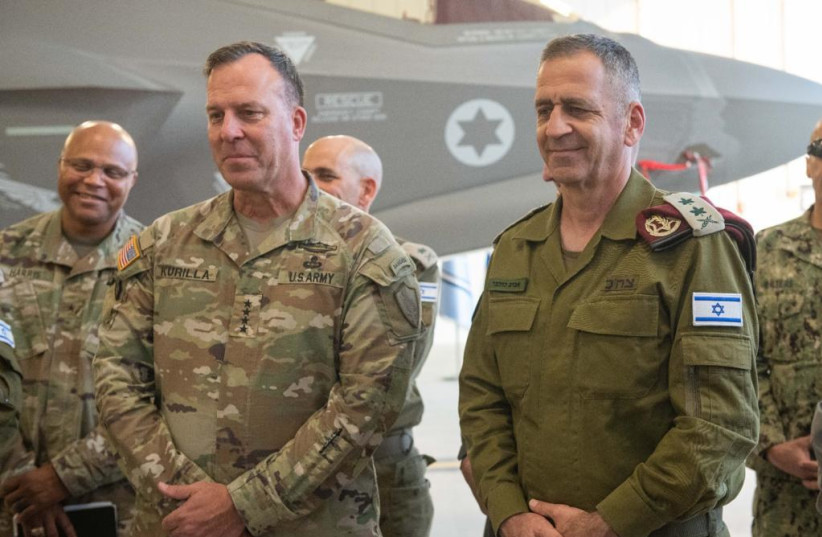
Two recent incidents, an Iranian drone attack on a ship in the Gulf of Oman, and a rocket attack on US forces in Syria, have received quick responses from US Central Command (CENTCOM).
The responses come in the form of verification of what happened and also determination regarding the threats. On the surface, this could appear routine, but evidence shows that in the past it often took longer for the US to respond to these types of incidents.
CENTCOM is only one part of the US government’s focus on the Middle East, which includes diplomats and other offices; but it is an important part of the overall American footprint. It is also an important part of the information nexus, meaning it puts out statements about its activities and this apparently includes acknowledging attacks in the region.
On November 16, CENTCOM put out a page-long statement about the “Shahed-series UAV” strike on a commercial vessel, the Pacific Zircon.
The quick determination that this was a Shahed series drone matters. These drones have been used by Russia against Ukraine and they are made by Iran. This means there is increased awareness this year about the types of drones involved and Iran’s nefarious activities involving the use of drones against ships and against the US and partner forces in the region.

 Tanker Pacific Zircon is seen at sea near Isle of Wright, Britain in this undated handout picture. (credit: David Potter/Handout via REUTERS)
Iranian drones, for instance, have targeted US bases and facilities in the region in the past and they have targeted Saudi Arabia, the UAE, Israel, and Iraq.
What matters, in this case, is that CENTCOM commander General Michael Kurilla was recently in Israel. US Central Command said that “during the visit, Kurilla…visited the Rosh HaNikra crossing point on the Blue Line between Israel and Lebanon and the Alpha Line between Israel and Syria on the Golan Heights.” He was provided with an overview of the threat posed by Hezbollah in the area, and the IDF’s focuses on security.
Meanwhile, Iran has been increasing its activity in the region. Iran carried out missile and drone attacks on Kurdish opposition groups in Iraq this week and it has targeted the ship and the US facility in Syria. These are not new operations for Iran. In the past Iran struck at Kurds in Iraq, in September and also back in 2018.
Iran and its proxies have also frequently targeted US forces in Syria. Earlier this year the US carried out air strikes in response. However, the Iranian export of drones to Russia appears to mean that there is an increased spotlight on Tehran’s threats. This is important for the region as US partners all want Washington to be more focused here.
Scofield Biblical Institute and Theological Seminary Copyright 2010 – 2020

Assisting the return of Jews from the worldwide diaspora is among the many Christian ministries facing great challenges.
And with the flood of would-be emigrants from Russia and Eastern Europe threatening to turn into a modern-day Exodus, the struggle to cope is all too apparent – some 40,000 Jewish people have fled Russia and the Ukraine and arrived in Israel undocumented.
This is a time of upheaval and the need for perseverance has never been greater, according to Dr Fred Wright, who has been in the thick of the action over Aliyah (Jewish immigration to Israel) for more than three decades.
Carrying the scars of his mercy missions all over his body – his latest injury was incurred when a car door slammed into his face following a crash on the field – he is now temporarily restricted to directing operations from his home in Essex.
In recent years Fred has been especially involved in facilitating Aliyah for Jews in Russia, Ukraine and South America. His particular expertise is rescuing individuals in war situations and antisemitic eruptions while perseverance is also needed in sourcing documents proving qualification for residence in Israel which he pursues in partnership with Ezra International and Ezra UK led by his friend Pat Frame.
Such paperwork is essential for the process, but is made much more difficult for those whose families have suffered persecution for generations, with the result that they have had little incentive for keeping tabs on their Jewish heritage.
Now the need is becoming more urgent than ever with war in Europe once more wreaking havoc but, with funding also a major issue, Fred is determined to persevere, and has been encouraging others to do the same.
Addressing supporters in Sheffield, he drew comparisons with the sufferings of the early church as indicated by James, the brother of Jesus, who wrote:
Just as they suffered at the hands of both politicians and priests – as indeed Jesus did – so today pressure is applied from the lawmakers on the outside and from the church hierarchy within.
Nero was an obvious example of political opposition for early believers while, on the religious front, Judaism was split into many factions all claiming to be the true Israel.
Today we are faced with political correctness on the one hand and unbiblical teaching from within the religious institutions, with antisemitic ‘replacement theology’ claiming the church to be the new Israel.
This in turn affects our understanding of Israel’s position in today’s world and suggests that Aliyah is unbiblical despite 700 Scriptural references to latter-day Jewish restoration.
Fred recalled:
Charles Gardner is author of Israel the Chosen, available from Amazon; Peace in Jerusalem, available from olivepresspublisher.com; To the Jew First, A Nation Reborn, and King of the Jews, all available from Christian Publications International.