Moscow and Tehran finalized the deal during a meeting in early November, accelerating the exchange of key components and designs that would allow production to begin within months.

 Russian President Vladimir Putin shakes hands with Iranian President Ebrahim Raisi during a meeting on the sidelines of the Shanghai Cooperation Organization (SCO) summit in Samarkand (photo credit: REUTERS)
Russian President Vladimir Putin shakes hands with Iranian President Ebrahim Raisi during a meeting on the sidelines of the Shanghai Cooperation Organization (SCO) summit in Samarkand
(photo credit: REUTERS)

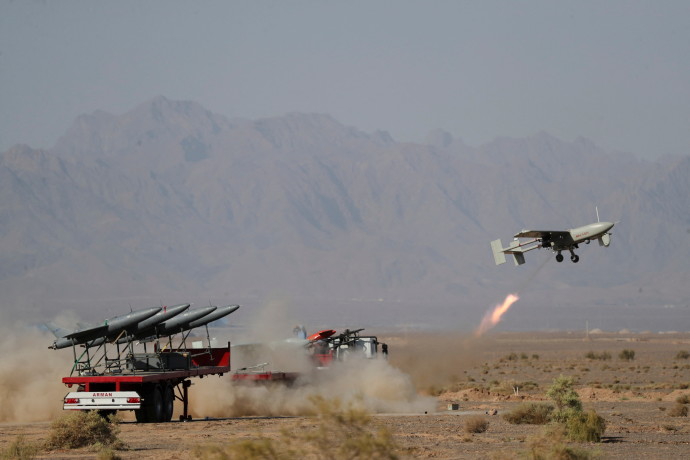
Russia has quietly reached an agreement with Iran to begin manufacturing hundreds of weaponized drones on Russian soil, according to new intelligence seen by the US and other Western security agencies, the Washington Post has reported.

Officials from Moscow and Tehran finalized the deal during a meeting in Iran in early November, accelerating the exchange of key components and designs that would allow production to begin within months.

If the new agreement is fully realized, it would signify a further deepening of a Russian-Iranian alliance that has slowly been forming in light of Moscow’s faltering military campaign in Ukraine. As the two countries grow closer, Iran has already provided crucial support for Russia during its war.

By moving drone production lines directly into Russia, Moscow could quickly replenish its dwindling munition stockpile with relatively inexpensive but highly destructive weapons systems that have recently begun playing a much larger role in the nine-month-old Ukrainian war.

While the newly provided weapons could give a significant boost to Russia’s failing war efforts, as well as provide a much-needed economic boost to isolated Iran, Iran’s clerical rulers face mounting international pressure over their military alliance with Moscow.
In a separate delegation, Russian Security Council Secretary Nikolai Patrushev met Iran’s President Ebrahim Raisi on November 9. The two discussed, among other topics, the economic sanctions and other “Western interferences” interfering with both countries, according to state-run Russian and Iranian news media.

Russian Security Council secretary Nikolai Patrushev’s visit was a sign of Iran’s growing importance as a supportive partner and weapons supplier at a time when Moscow is isolated by Western sanctions and faces intense Ukrainian military pressure.

Tehran growing closer to Russia under shadow of Western isolation

Tehran has sought to portray itself as neutral in the Ukraine conflict so far, but more and more Iranian-made drones are found to be used to attack Ukrainian cities, triggering threats of new economic sanctions from the West.

Emboldened by high oil prices since the Ukraine war, Iran is betting that with Russia’s support it could pressure Washington to offer concessions for the revival of its 2015 nuclear deal with world powers.

Forming a real alliance with a superpower that shares anti-Western views and is not afraid of pushing such views on the battlefield is a strategic move designed to show Iran is not isolated.

Iran’s leaders may be attempting to avert these new sanctions, however, by moving the physical assembly of the drones to Russian soil, the officials said, according to the Washington Post.

The Iranian drone industry is already spreading to other countries. Iran opened a drone factory in Tajikistan in May, which produces the Ababil-2 drone capable of reconnaissance and combat, according to the Eurasia Times.

Iran promises to supply Russia with missiles, drones

Iran has already promised to provide Russia with surface-to-surface missiles, in addition to more drones, last month, according to Iranian officials, a move that has infuriated the United States and other Western powers which are backing Ukraine in the war.

The Islamic Republic says its drones are the region’s most powerful. In addition to surveillance, they can be used for attacks, either by dropping munitions or as so-called “kamikaze drones” that fly into a target and blow themselves up. Its advanced long-range suicide drone is designed to hit Israel’s Tel Aviv.

Ukraine’s President Volodymyr Zelensky warned last month that Tehran is actively supporting Moscow with drones in its invasion in exchange for getting assistance to develop its nuclear program.

Speaking at the Haaretz Democracy Conference, Zelensky said that the Islamic Republic would have not been able to send equipment to Russia if Israel had not taken a neutral stance in the Ukraine war.

“In eight months of full-scale war, Russia has used almost 4,500 missiles against us. And their stock of missiles is dwindling. Therefore, Russia went looking for affordable weapons in other countries to continue its terror. It found them in Iran,” Zelensky said.

“In eight months of full-scale war, Russia has used almost 4,500 missiles against us. And their stock of missiles is dwindling. Therefore, Russia went looking for affordable weapons in other countries to continue its terror. It found them in Iran,”

Volodymyr Zelensky

Zelensky’s remarks come as the Ukrainian Defense Ministry’s Intelligence Directorate claimed that Russia’s infantry are being provided with Iranian-made body armor and helmets, and new groups of Iranian instructors are also arriving in Russia to train them on the use of a new and more lethal type of drones, Arash UAVs, according to Iran International.

Reuters contributed to this report.

State media says Israeli aircraft flying over the Mediterranean fired missiles at military positions in coastal and central Syria; no comment from IDF

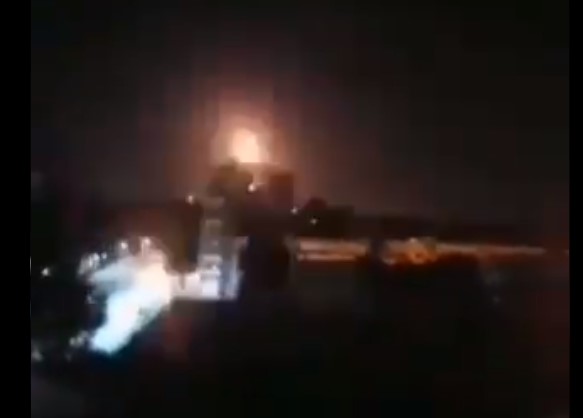
Illustrative: An explosion seen near the city of Homs in Syria attributed to Israeli airstrikes on March 5, 2020 (video screen capture)

Illustrative: An explosion seen near the city of Homs in Syria attributed to Israeli airstrikes on March 5, 2020 (video screen capture)

BEIRUT  — Airstrikes hit central and coastal regions of Syria early Saturday, killing four soldiers and wounding one, the Syrian military said, blaming Israel for the strikes.

State media quoted an unidentified Syrian military official as saying that Israeli warplanes flying over the Mediterranean fired missiles toward military positions in coastal and central Syria.

The Syrian Observatory for Human Rights, an opposition war monitor, reported that loud explosions were heard in the coastal province of Latakia as well as Hama and Homs regions in central Syria. It gave no further details.

On Nov. 13, a strike also blamed on Israel in central Syria targeting the Shayrat air base killed two soldiers and wounded three.

There was no comment from the Israel Defense Forces, in line with its policy of not generally commenting on air raids in the country.

As a rule, Israel’s military does not comment on specific strikes in Syria, but has admitted to conducting hundreds of sorties against Iran-backed groups attempting to gain a foothold in the country.

The IDF says it also attacks arms shipments believed to be bound for those groups, chief among them Lebanon’s Hezbollah. Additionally, airstrikes attributed to Israel have repeatedly targeted Syrian air defense systems.

Israeli strikes have continued in Syrian airspace, which is largely controlled by Russia, even as Jerusalem’s ties with Moscow have deteriorated in recent months. Israel has found itself at odds with Russia as it has increasingly supported Ukraine while seeking to maintain freedom of movement in Syria’s skies.


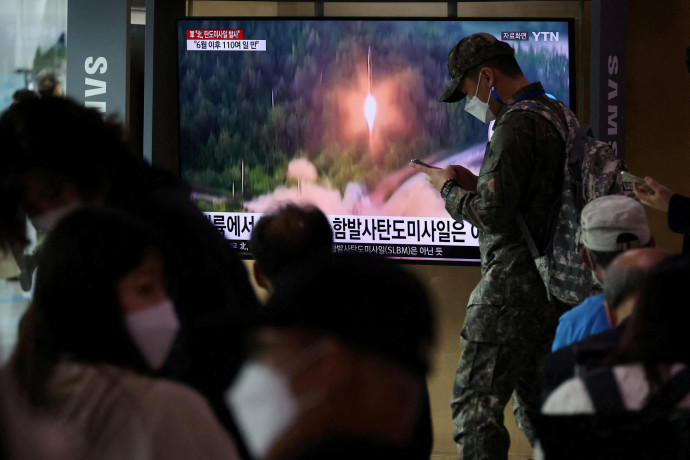
The isolated country tested an intercontinental ballistic missile (ICBM) on Friday shortly after warning of “fiercer military responses.”

North Korea's leader Kim Jong Un oversees a missile launch at an undisclosed location in North Korea, in this undated photo released on October 10, 2022 by North Korea's Korean Central News Agency (KCNA). (photo credit: KCNA VIA REUTERS/FILE PHOTO)
North Korea’s leader Kim Jong Un oversees a missile launch at an undisclosed location in North Korea, in this undated photo released on October 10, 2022 by North Korea’s Korean Central News Agency (KCNA).
(photo credit: KCNA VIA REUTERS/FILE PHOTO)

North Korean leader Kim Jong Un pledged to counter US nuclear threats with nuclear weapons as he inspected a test of the country’s new intercontinental ballistic missile, state media KCNA said on Saturday.

The isolated country fired an intercontinental ballistic missile (ICBM) toward the East Sea on Friday, the South Korean military said, in protest over the United States’ move to reinforce its “extended deterrence” protection of South Korea and Japan.

Attending the site with his daughter and wife, Kim said threats from the United States and its allies pursing a hostile policy prompted his country to “substantially accelerate the bolstering of its overwhelming nuclear deterrence.”

“Kim Jong Un solemnly declared that if the enemies continue to pose threats … our party and government will resolutely react to nukes with nuclear weapons and to total confrontation with all-out confrontation,” the official KCNA news agency said.

The launch is presumed to have involved the Hwasong-17 ICBM, according to Yonhap, the same ICBM was test-fired on Novermber 3, but the launch was seen as a failure.

“Kim Jong Un solemnly declared that if the enemies continue to pose threats … our party and government will resolutely react to nukes with nuclear weapons and to total confrontation with all-out confrontation.”

KCNA statement

The Hwasong-17 ICBM was called a “monster” of a missile for its sheer size. It is able to carry multiple warheads and has a range of around 15,000 km, according to North Korea, long enough to reach the entire US mainland.

“North Korea’s ICBM launch this time is a significant provocation and serious act of threat that undermines peace and stability not only on the Korean Peninsula but also in the international community and a clear violation of UN Security Council resolutions,” the JCS said in a text message sent to reporters, according to Yonhap.

North Korea has conducted a record number of missile tests this year, and also fired hundreds of artillery shells into the sea more recently as South Korea and the United States staged exercises, some of which involved Japan.

South Korea strengthens extended deterrence measures

South Korean President Yoon Suk-yeol instructed the National Security Council on Friday to implement strengthened extended deterrence measures following North Korea’s launch, according to Korean media.

“President Yoon ordered a strengthening of the South Korea-US combined defense posture, active implementation of measures to strengthen the executability of the extended deterrence against North Korea agreed between South Korea and the US, and a strengthening of security cooperation between South Korea, the US and Japan,” the presidential office said.

Yoon also ordered action for strong condemnation and sanctions against the North, including a UN Security Council response, together with the United States and the international community, according to the South Korean presidential office.

United Nations Security Council will discuss North Korea

The White House strongly condemned the ICBM launch and US President Joe Biden has been briefed on the North’s latest provocation.

“This launch is a brazen violation of multiple UN Security Council resolutions and needlessly raises tensions and risks destabilizing the security situation in the region,” the White House said in a statement. “The United States will take all necessary measures to ensure the security of the American homeland and Republic of Korea and Japanese allies.”

The United Nations Security Council will discuss North Korea in a meeting on Monday, according to its schedule, after Pyongyang’s ICBM test fire.

A senior US administration official said earlier that North Korea’s latest missile test was of a “longer range missile … that can hit many, many countries,” and said the United Nations security council should meet to discuss it.