
by Algemeiner Staff

A view of the Israeli community of Ma’ale Adumim in the West Bank. Photo: Reuters/Ammar Awad

The US State Department has condemned a new UN report that decries Israel’s continuing presence in the West Bank as “unlawful under international law” and accuses Jerusalem of “maintaining a restrictive and discriminatory planning and building regime for Palestinians.”

Speaking to reporters on Thursday, State Department spokesperson Ned Price said that the 28-page report from the ongoing “Independent International Commission of Inquiry on the Occupied Palestinian Territory, including East Jerusalem, and Israel” reflected the institutional bias faced by Israel at the UN.

“Israel is consistently unfairly targeted in the U.N. system, including in the course of this commission of inquiry,” Price said. “No country, the record of no country, should be immune from scrutiny, but no country should also be targeted unfairly. And that’s the principle that we seek to uphold.”

The commission — created in the wake of the May 2021 war between Israel and the Hamas terrorist group in Gaza — will present its report to the UN General Assembly on Oct. 27.

In a statement accompanying the report, Navi Pillay, the chair of the commission, argued that it was hypocritical for the international community to oppose Russia’s annexation of occupied Ukrainian territories while ignoring Israel’s actions.

“Unless universally applied, including to the situation in the Occupied Palestinian Territory, this core principle of the United Nations Charter will become meaningless,” she said.

On Friday morning, Israeli Prime Minister Yair Lapid slammed the report as “antisemitic.”

“Not all criticism of Israel is antisemitism, but this report was written by antisemites (as Israel has already revealed) and is a distinctly antisemitic report,” Lapid said, in an apparent reference to the outburst last August by Miloon Kothari, a member of the commission, in which he claimed that “social media” was “controlled largely” by the “Jewish lobby” and that “a lot of money is being thrown in to trying to discredit us.”

The commission’s latest report charges Israel with having created an “ongoing coercive environment” that has “fragmented Palestinian society and ensured that Palestinians are unable of fulfill their right to self-determination among other rights.” Hamas missile attacks against Israel were meanwhile entirely unmentioned in the report.
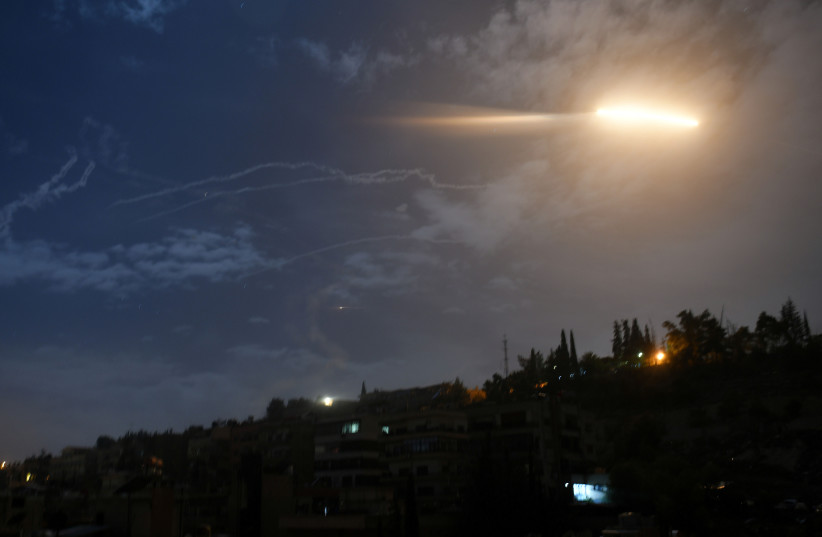

Syrian air defenses respond to alleged Israeli airstrike

The incident comes one month after the last alleged Israeli airstrikes in Syria.

 Missile fire is seen over Damascus, Syria January 21, 2019.  (photo credit: SANA/HANDOUT VIA REUTERS)
Missile fire is seen over Damascus, Syria January 21, 2019.
(photo credit: SANA/HANDOUT VIA REUTERS)

Syrian air defenses intercepted an alleged Israeli missile attack over the capital Damascus and the southern region late on Friday and explosions were heard in the capital’s vicinity, state media reported.

No information was immediately available on damages or casualties.

The target of the attack was the Damascus International Airport, according to international reports.

This attack comes after over a month without any alleged Israeli attacks in Syria. The last alleged Israeli strike in Syria happened on September 17th, and it also allegedly targeted the Damascus International Airport.

Why is Israel allegedly attacking Syria?

Israel has been accused by the Syrian government of conducting airstrikes for over a decade. The strikes come as part of the Israeli campaign of “ar-between-wars” (known in Hebrew as MABAM), and its purpose is to disrupt the smuggling of advanced weapons from Iran through Syria and into the hands of Hezbollah in Lebanon.

Ofek 1 images of Damascus International Airport (credit: MINISTRY OF DEFENSE SPOKESPERSON'S OFFICE)Ofek 1 images of Damascus International Airport (credit: MINISTRY OF DEFENSE SPOKESPERSON’S OFFICE)

Israel has been trying to prevent the establishment of an Iranian outpost on its border ever since the Syrian-Iranian alliance was formed.

Anna Ahronheim contributed to this report.


Syria says Israeli airstrikes target Damascus, south

State media claims missiles shot down in what would be first alleged attack since bombing of Damascus airport that killed five over a month ago

Illustrative: This photo released by the Syrian official news agency SANA shows anti-aircraft fire in the sky after US-led airstrikes targeting different parts of the Syrian capital Damascus in retaliation for the country's alleged use of chemical weapons, April 14, 2018. (SANA via AP)

Illustrative: This photo released by the Syrian official news agency SANA shows anti-aircraft fire in the sky after US-led airstrikes targeting different parts of the Syrian capital Damascus in retaliation for the country’s alleged use of chemical weapons, April 14, 2018. (SANA via AP)

Syria said Israeli missiles targeted areas near Damascus late Friday, the first alleged Israeli airstrike on the country in over a month.

State media claimed that missiles were shot down over the capital and closer to the border with Israel.

“Our air defenses intercepted Israeli missile strikes in the airspace of Damascus and the southern region,” Syria’s official news agency SANA said.

The alleged attack would be the first since September 17, when an apparent Israeli strike around the capital Damascus killed five soldiers last month.

In June, Israeli airstrikes put Damascus airport out of service for nearly two weeks.

A pair of sorties targeting the Aleppo airport in early September also forced that facility to shut down.

The alleged strike comes a day after Israel’s military launched a week-long drill across the country’s north.

Since civil war erupted in Syria in 2011, Israel has carried out hundreds of strikes against its northern neighbor, targeting government troops as well as allied Iran-backed forces and Hezbollah fighters. Syria regularly claims to have intercepted most Israeli missiles, which analysts generally dismiss as empty boasts.

While Israel rarely comments on individual strikes, it has acknowledged carrying out hundreds.

It says its air campaign is necessary to stop arch-foe Iran gaining a foothold on its doorstep.

The rare lull in strikes coincided with high-stakes negotiations to settle a longstanding maritime dispute between Israel and Lebanon that ended in an agreement earlier this month. A brief hiccup in the talks had briefly raised tensions along the northern frontier with Lebanon-based Hezbollah.

Earlier this week, a senior Israeli defense official and two senior Western diplomats told the New York Times that Russia had removed its S-300 anti-aircraft system from Syria to bolster its war effort against Syria, a move that could give Israel more freedom over Syria’s skies even as ties with Moscow have cratered.
