IRGC Chief Warns Saudis Against ‘Relying on Israel’

In an apparent reference to the strengthening ties between Israel and Gulf Arab governments, Tehran’s semi-official Tasnim News Agency said on Thursday that Iranian officials had told Saudi Arabia’s leaders they should stop relying on Israel.

“This is our warning. Your house is that of a spider [fragile]. You have relied on Israel, which is on the verge of collapse, and this is your fate,” said Maj. Gen. Hossein Salami, commander of Iran’s Revolutionary Guards, reported Tasnim.

“Stop meddling in our country’s internal affairs,” he said while speaking at the Qom Islamic Seminary.

Salami also threatened the United States and the United Kingdom, demanding they lift their sanctions imposed on Iran.

“Whatever move you make against the Iranian nation, you will receive blows several times harder,” he said.


Hamas warns against Israel-Egypt-PA deal on natural gas near Gaza

The development of the fields has been held up for over two decades due to disputes with Israel and economic difficulties, including disputes surrounding an agreement granting Israel surplus gas.

 Palestinians sail with boats towards the maritime border with Israel as smoke rises from a burning tire during a protest calling for lifting the Israeli blockade on Gaza, in the Mediterranean Sea off the coast of the northern Gaza Strip September 10, 2018 (photo credit: MOHAMMED SALEM/REUTERS)
Palestinians sail with boats towards the maritime border with Israel as smoke rises from a burning tire during a protest calling for lifting the Israeli blockade on Gaza, in the Mediterranean Sea off the coast of the northern Gaza Strip September 10, 2018
(photo credit: MOHAMMED SALEM/REUTERS)

Hamas warned the Palestinian Authority against handling the issue of natural gas fields located off the coast of the Gaza Strip on Thursday, just days after PA Prime Minister Mohammed Shtayyeh announced that a team would be formed to conclude an agreement with Egypt concerning the gas.

The development of the fields has been held up for over two decades due to disputes with Israel and economic difficulties, including disputes surrounding an agreement granting Israel surplus gas from the field. The Gaza Strip is under an Israeli maritime blockade which restricts Gazans from going more than at most 12 nautical miles from the coast.

“All previous experiences have proven the inability of the Palestinian Authority to manage the wealth of our Palestinian people,” said Hamas to Al-Watan news. “The Authority is not qualified to receive the gas file, as it is involved in cases of corruption, waste of money and misconduct.”

Shtayyeh stated on Monday that Mohammad Mustafa, the chairman of the Palestine Investment Fund (PIF), and his team, which includes a number of ministers, were conducting negotiations with Egypt in order to develop the gas fields off the coast of Gaza.

In recent days, foreign media reported that Israel, Egypt and the Palestinian Authority were holding discussions to begin pumping gas from the gas fields located off the coast of Gaza. Some of the reports have claimed that Israel would receive part of the profits generated from the gas fields.

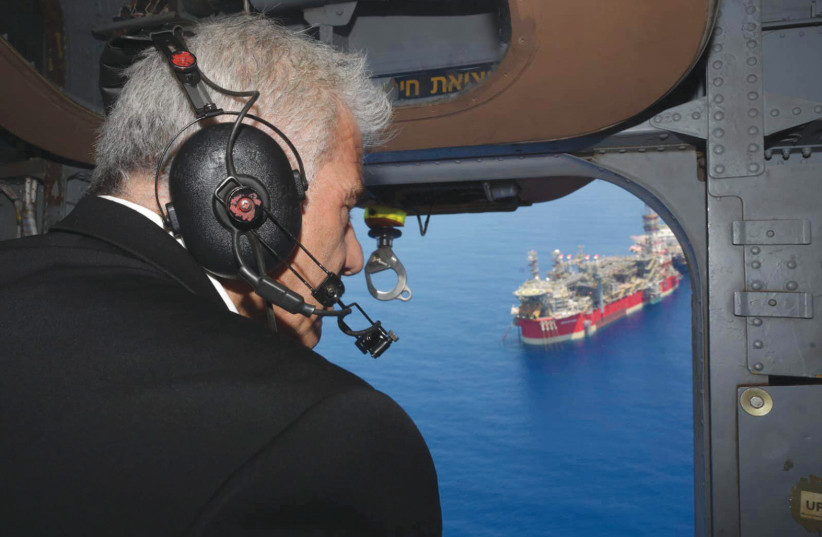
 Prime Minister Yair Lapid flies over the Karish gas rig. (credit: AMOS BEN-GERSHOM/GPO)Prime Minister Yair Lapid flies over the Karish gas rig. (credit: AMOS BEN-GERSHOM/GPO)

Transfer of ownership

In 2000, the British Gas (BG) group discovered the Marine 1 and Marine 2 gas fields about 35 kilometers off the coast of Gaza after being granted an exploration license by the Palestinian National Authority. After Shell acquired BG in 2016, CC Oil & Gas and the Palestinian Investment Fund (PIF) acquired Shell’s working interest in the fields, with each party owning 50%.

According to CC Oil & Gas, the fields are estimated to contain over 1 trillion cubic feet of gas, similar to the size of the Karish gas field.

In February 2021, the Palestinian Authority signed a memorandum of understanding with the Egyptian Natural Gas Holding Company (EGAS) to cooperate on efforts to develop the gas fields off the coast of Gaza.

An Egyptian source told AFP on Friday that Egypt has been “in contact with all parties, including Israel, to develop and profit from Gaza’s gas reserves, which would also support the Palestinian economy.” The talks include the Palestinian Engineering firm Consolidated Contractors Company, the PIF, EGAS and Israel, according to AFP.

Reuters also reported that EGAS was holding negotiations with Palestinian authorities to develop the offshore field and was seeking a green light from Israel for the project.

A senior PA official told AFP that after an agreement is signed, EGAS will begin developing the Marine gas fields with the goal of starting production within two years.

An official in the Egyptian intelligence service told Al-Monitor on that an Egyptian economic and security delegation has succeeded in reaching “a compromise that would benefit all relevant parties, the most important of which are Israel and the PA.” One of the conditions Israel insisted on is the start of practical measures to extract gas from the fields at the beginning of 2024 for security reasons, according to Al-Monitor.

A member of the PLO Executive Committee told Al-Monitor that the gas development would be supervised by Egypt and Israel and that part of the gas will be exported to Egypt while the rest will be exported to Europe, with the revenues returning to the treasury of the PA. Part of the revenue will be used to support Gaza’s economy.

Globes reported on Thursday that Energy Minister Karin Elharar had confirmed that Israel had been contacted about reaching an agreement concerning the gas fields off the coast of Gaza, but added that the matter should wait until after the upcoming Knesset elections.

Despite the reports, a Palestinian source has denied that Israel was involved in negotiations about the gas fields, the Turkish Anadolu Agency reported on Thursday. “The talks don’t include Israel. We will not pay Israel to extract our gas. This is unacceptable,” said the source.

Earlier this week, Hamas official Suhail al-Hindi told the Palestinian Quds news that the movement would not allow Israel or anyone else to benefit from resources that belong to the Palestinian people. “We cannot allow anyone to control these wealth, whether the occupation or others, and to enjoy them at the expense of our people,” said Hindi.

The reports on attempts to reach an agreement concerning the Gaza Marine gas fields come just weeks after Lebanon and Israel announced that they had reached understandings concerning the demarcation of their shared maritime border, opening up the door for Lebanon to begin gas exploration in the Kana gas field.

Hamas demands end to maritime blockade

In May, Hamas’s leader in the Gaza Strip, Yahya Sinwar, claimed that Hamas was working with other parties to operate a maritime line to the Strip in order to bypass the Israeli blockade on the coastal enclave.

Sinwar added that consultations and preparations on this issue are “in full swing” in order to “break the siege completely,” but did not elaborate on how such a line would get past the Israeli blockade.

Since then, Hamas and other Palestinian factions have held events on the Gazan coast calling for an end to the maritime blockade.


Penny Wong says Scott Morrison’s made decision due to crucial by-election, and that return to original policy is in line with view of international community

In this image taken from video, Australian Foreign Minister Penny Wong speaks during a press conference, October 18, 2022, in Canberra, Australia. (Australia Pool via AP)

In this image taken from video, Australian Foreign Minister Penny Wong speaks during a press conference, October 18, 2022, in Canberra, Australia. (Australia Pool via AP)

Australian Foreign Minister Penny Wong admitted regret on Thursday over the timing of her withdrawal of the previous government’s recognition of West Jerusalem as Israel’s capital but defended the move as in line with Canberra’s historical position on the matter.

In an article published in the Australian Jewish News, Wong acknowledged that the change shouldn’t have been made on the Jewish festival of Simchat Torah, and expressed regret over any distress that may have been caused to “communities that have a deep-rooted and keenly felt stake in the cessation of conflict, particularly the Australian Jewish community.”

However, Wong defended the move, charging that former prime minister Scott Morrison’s recognition in 2018 was made not out of “conviction,” but out of “cynicism,” amid a key by-election in the federal electorate of Wentworth, which includes a significant Jewish population.

Morrison had signaled he would consider recognizing Jerusalem as Israel’s capital and moving Australia’s embassy from Tel Aviv before the vote, likely to boost the chances of his Liberal Party candidate, Dave Sharma, a former ambassador to Israel.

After he lost to independent Kerryn Phelps, the then-prime minister went ahead with recognizing West Jerusalem as the capital but held back on the embassy move.

Then an opposition senator, Wong vowed at the time that a future Labor Party government would reverse the move.

In her article, Wong emphasized that, with the exception of the Morrison government, Australia long shared the view of the “overwhelming majority of the international community,” which sees the final status of Jerusalem as a matter to be settled at the negotiating table.

Australia’s Prime Minister Scott Morrison concedes defeat in the national elections in Sydney on May 21, 2022. (Saeed Khan/AFP)

“Indeed, that was Australia’s position for nearly all of Israel’s history. It was not changed by the Gorton government following the Six-Day War in 1967. And through all of the events since, it was not changed by Malcolm Fraser, Bob Hawke, John Howard, Julia Gillard or Malcolm Turnbull,” she explained, listing successive Australian prime ministers from both major parties.

“Reasonable people can disagree, as many readers will disagree with me. But I will always be straight with you, and I won’t use this issue to score points.”

Canberra’s decision came amid confusion after the British newspaper The Guardian reported on Monday that the Australian Department of Foreign Affairs had removed text about the recognition of West Jerusalem from its website.

The deleted text described “West Jerusalem as the capital of Israel” and noted that Australia “looks forward to moving its embassy to West Jerusalem when practical, in support of, and after the final status determination of, a two-state solution.”

According to The Guardian, the site was updated after it approached Australia’s Department of Foreign Affairs regarding the government’s view on the status of Jerusalem.

Prime Minister Yair Lapid called the announcement “a hasty response to incorrect news in the media.”

“We can only hope that the Australian government manages other matters more seriously and professionally,” Lapid said. “Jerusalem is the eternal capital of united Israel and nothing will ever change that.”

Prime Minister and Yesh Atid party leader Yair Lapid speaks during a faction meeting in Tel Aviv on October 18, 2022. (Avshalom Sassoni/Flash90)

Morrison’s decision in 2018 received a lukewarm reception in Israel at the time, with many politicians charging that the move did not go far enough, having not recognized the entirety of the city as the Jewish state’s capital, and keeping Australia’s embassy in Tel Aviv. The previous year, the United States under then-president Donald Trump recognized Jerusalem as Israel’s capital and later moved the American embassy there.

Both Israel and the Palestinians claim Jerusalem as their capital. Israel captured East Jerusalem from Jordan in the 1967 Six Day War and later annexed it in a move never recognized by the international community.

For decades the international community maintained that the city’s status should be negotiated between Israel and the Palestinians. Critics argue that declaring Jerusalem the capital of either inflames tensions and prejudges the outcome of final status peace talks.