
David Friedman: Hezbollah obtained another 40% for Lebanon

The former ambassador insists Hezbollah was the one who forced Israel’s hand in the deal and will be the one to profit from it.

David Friedman

David FriedmanReuters

In an interview with Israel Hayom, former American ambassador to Israel, David Friedman, harshly criticized the maritime border agreement with Lebanon. Friedman, who accompanied the previous round of talks, said that Hezbollah’s insistence on receiving complete control of the entire territory in question resulted in Israel caving in to their demands.

“Hezbollah is the party that managed to get others to move from the position we were in a few years ago. Therefore, it seems to me that Hezbollah will be the one to profit from the spoils,” insisted Friedman, adding that, “Hezbollah was not directly part of the talks, but its position is what brought Lebanon the additional 40 percent [of the disputed territory]. This addition, compared to past negotiations, is a direct result of Hezbollah’s actions.”

“By the way, I’m not the only one saying this,” he continued. “The official mediator during Trump’s tenure, David Schenker, a professional diplomat in the State Department is saying the same thing.”

According to a recent poll, a majority of Israelis support the agreement, and say that it was appropriate to sign it even during an election period.

Asked whether it was right to sign the agreement during an election period, 47% of respondents said they support signing the agreement during this period, while 36% answered in the negative, 17% answered that they do not know.

Poll respondents were also asked what were Prime Minister Yair Lapid’s main motives in deciding to reach the agreement. 47% think that Lapid’s motives were political, compared to 41% who think that the motives were out of concern for the security and economy of the State of Israel. 12% answered that they do not know.

Israel’s security cabinet voted on Wednesday afternoon to back the maritime boundary deal with Lebanon, sending the tentative agreement to the full cabinet for ratification.

Interior Minister Ayelet Shaked voted against the agreement, while Alternate Prime Minister Naftali Bennett backed the agreement, even as he downplayed its significance.

Despite pressure from the opposition to bring the deal to a vote in the full Knesset, the government will only allow the Knesset to review the agreement, but without holding a vote on the matter.

Lapid on Wednesday hailed the agreement as a “great achievement for the State of Israel, for Israel’s security and for Israel’s economy”.

Netanyahu, meanwhile, accused the government of surrendering to the Hezbollah terrorist organization.

https://www.israelnationalnews.com/flashes/589018


The security system continues to be on heightened alert throughout Jerusalem, as well as Judea and Samaria following the latest spade of attacks and riots in the capital.

Four Border Police reserve units have been mobilized to reinforce existing forces.


https://www.israelnationalnews.com/flashes/589018


“Resolving the Taiwan issue is the Chinese people’s own business, and it up to the Chinese people to decide,” he said.

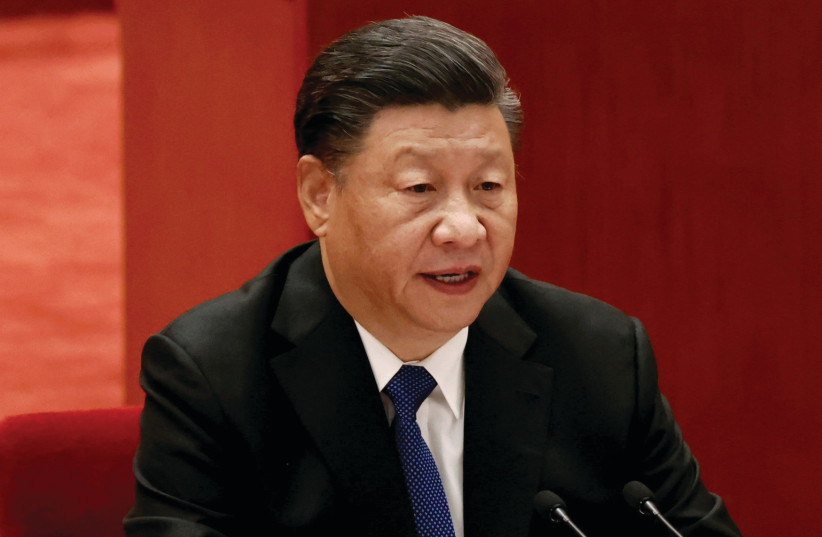
Chinese president Xi Jinping speaks at a meeting marking the 110th anniversary of the Xinhai Revolution, at the Great Hall of the People in Beijing, earlier this month. (photo credit: CARLOS GARCIA RAWLINS/REUTERS)
Chinese president Xi Jinping speaks at a meeting marking the 110th anniversary of the Xinhai Revolution, at the Great Hall of the People in Beijing, earlier this month.
(photo credit: CARLOS GARCIA RAWLINS/REUTERS)

It is up to the Chinese people to resolve the Taiwan issue and China will never renounce the right to use force but will strive for a peaceful resolution, President Xi Jinping said on Sunday at the opening of a major party meeting.

China views democratically ruled Taiwan as its own territory, despite the strong objections of the government in Taipei, which rejects the sovereignty claims and says only the island’s people have the right to decide their future.

Tensions rose dramatically in August after China staged war games near Taiwan following the visit to Taipei of US House Speaker Nancy Pelosi. Those military activities have continued though at a reduced pace.

In a speech opening the ruling Communist Party’s 20th party congress in Beijing, Xi said China always “respected, cared for and benefited” Taiwan’s people and was committed to promoting economic and cultural exchanges across the Taiwan Strait.

“Resolving the Taiwan issue is the Chinese people’s own business, and it is up to the Chinese people to decide,” he said.

 Chinese President Xi Jinping talks to Solomon Islands Prime Minister Manasseh Sogavare (not pictured) during their meeting at the Diaoyutai State Guesthouse in Beijing, China, October 9, 2019 (credit: PARKER SONG/POOL VIA REUTERS)Chinese President Xi Jinping talks to Solomon Islands Prime Minister Manasseh Sogavare (not pictured) during their meeting at the Diaoyutai State Guesthouse in Beijing, China, October 9, 2019 (credit: PARKER SONG/POOL VIA REUTERS)

“We insist on striving for the prospect of peaceful reunification with the greatest sincerity and best efforts, but we will never promise to give up the use of force and reserve the option to take all necessary measures.”

“Resolving the Taiwan issue is the Chinese people’s own business, and it’s up to the Chinese people to decide.”

Chinese President Xi Jinping

That option is aimed at “interference” by external forces and a “very small number” of Taiwan independence supporters rather than the vast majority of the Taiwanese people, Xi said.

“The historical wheels of national reunification and national rejuvenation are rolling forward, and the complete reunification of the motherland must be achieved, and it must be achieved!” to added, to a long round of applause.

Taiwan President Tsai Ing-wen

In her national day speech on Monday, Taiwan President Tsai Ing-wen said war between Taiwan and China was “absolutely not an option” and reiterated her willingness to talk to Beijing.

China refuses to speak to Tsai, considering her a separatist.

Beijing has offered Taiwan a “one country, two systems” model of autonomy, the same formula it uses for Hong Kong. But all mainstream Taiwanese political parties have rejected that proposal and it has almost no public support, according to opinion polls.

Taiwan will not back down on its sovereignty or compromise on freedom and democracy, and its people clearly oppose Beijing’s idea of “one country, two systems” management for Taiwan, the self-ruled island’s presidential office said on Sunday.

The statement came shortly after Chinese President Xi Jinping said in a speech at the opening of a the Communist Party Congress in Beijing that it is up to the Chinese people to resolve the Taiwan issue and China will never renounce the use of force over Taiwan.

Maintaining peace and stability in the Taiwan Strait and the region is the common responsibility of both sides and meeting on the battlefield is not an option, Taiwan’s presidential office said in the statement.
