Security establishment reportedly believes that those same kamikaze drones will be launched by Hezbollah, other Iran proxies
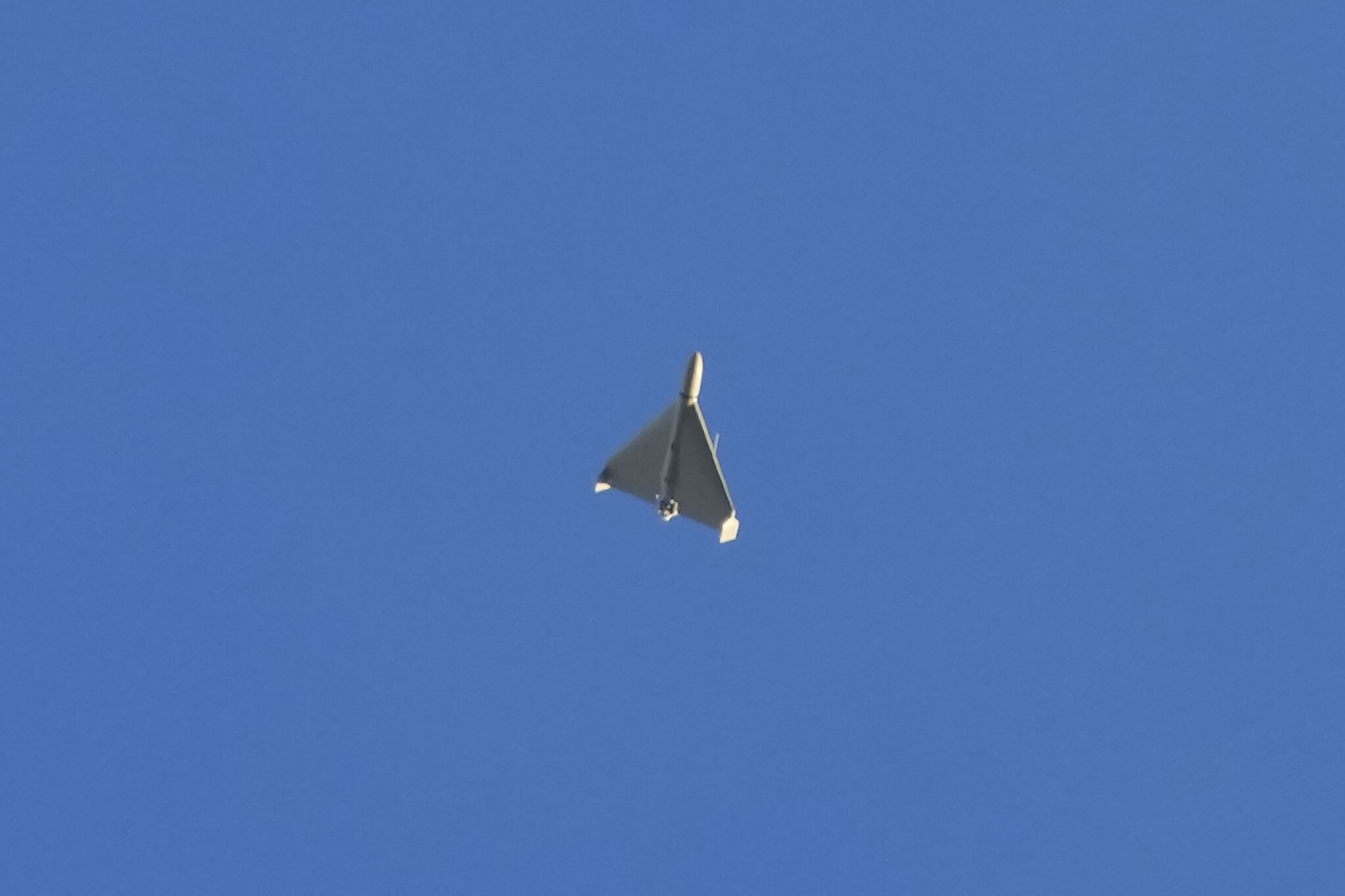
A drone is seen in the sky seconds before it hit buildings in Kyiv, Ukraine, Oct. 17, 2022. (AP Photo/Efrem Lukatsky)

A drone is seen in the sky seconds before it hit buildings in Kyiv, Ukraine, Oct. 17, 2022. (AP Photo/Efrem Lukatsky)

Jerusalem has reportedly been closely monitoring Russia’s deadly launch of Iranian-made suicide drones at the Ukrainian capital of Kyiv, fearing that similar weapons will be directed at Israel in future wars on its northern border.

The security establishment believes similar drones will be deployed against Israel by Lebanon’s Hezbollah and other Iranian proxies, the Kan public broadcaster reported Monday evening without citing any sources.

The network said the fear regarding Iran’s drone-making capabilities is what led Israel to bulk up its air defenses in the north with systems like Iron Dome, David’s Sling, and Arrow missiles.

The concern has also led to enhanced cooperation on the matter between Israel, the US and Abraham Accords signatories UAE and Bahrain, the public broadcaster said.

Israel and the US were the only two countries until recently who gained operational experience in dealing with Iranian drones given their employment in attacks targeting Israeli and American forces in the Middle East.

Last week, The New York Times reported that Israel is providing Ukraine with “basic intelligence” on Iranian suicide drones being deployed by the Russian army, citing a senior Ukrainian official.

Firefighters work after a drone attack in Kyiv, Ukraine, Oct. 17, 2022. (AP Photo/Efrem Lukatsky)

The report also said that a private Israeli security firm has been giving the Ukrainians satellite imagery of Russian military positions.

In September, Russia began using the Iranian-made Shahed-136 drone, after it reportedly received deliveries of hundreds of units from Tehran, despite Washington warning the Iranians against exporting the weapon.

An Iranian Shahed-136 drone is launched during a military exercise in Iran, December 2021. (Screenshot: Twitter)

President Volodymyr Zelensky has repeatedly asked Israel to provide air defense systems, listing the Jewish state as one of five countries possessing the technology to help the Ukrainians against aerial attack during a September CNN interview.

But Jerusalem has resisted providing Kyiv with significant defensive or offensive weaponry, as it tries to protect its sensitive relationship with Moscow.

Monday’s drone attack on Kyiv killed four people and led Ukrainian Foreign Minister Dmytro Kuleba to call for EU sanctions on Iran.

Last week, Zelensky said Iranian drones were also used in Russian attacks on energy infrastructure in several Ukrainian cities.

On Sunday, The Washington Post reported that Tehran is preparing its first delivery of short-range ballistic missiles to Moscow during the war.

Local residents run away after a drone attack in Kyiv on October 17, 2022, amid the Russian war on Ukraine. (Sergei SUPINSKY / AFP)

According to US Deputy Director of National Intelligence Morgan Muir, Russia has lost more than 6,000 pieces of equipment since the beginning of the war. Amid the pressure applied by Western sanctions, Moscow has turned to pariah states such as North Korea and Iran for military supplies


Comments to Hebrew media come after Russian ex-president warned move would ‘destroy all’ ties between Jerusalem and Moscow

Diaspora Affairs Minister Nachman Shai attends the Jewish People's Lobby, at the Knesset, in Jerusalem, on November 15, 2021. (Yonatan Sindel/Flash90)

Diaspora Affairs Minister Nachman Shai attends the Jewish People’s Lobby, at the Knesset, in Jerusalem, on November 15, 2021. (Yonatan Sindel/Flash90)

The Foreign Ministry moved to distance Israel from a minister’s call to supply Ukraine with military aid to counter the Russian invasion, after the former president of Russia warned the move would “destroy all” ties between Jerusalem and Moscow.

In a tweet Sunday, Diaspora Minister Nachman Shai noted a report that Iran is due to ship ballistic missiles to Russia, responding that Israel should reverse its refusal to provide weaponry to Ukrainian forces.

“There is no longer any doubt where Israel should stand in this bloody conflict. The time has come for Ukraine to receive military aid as well, just as the US and NATO countries provide,” he said.

Unnamed government sources on Monday stressed to several Hebrew media outlets that Shai’s comments do not reflect government policy, with Israel having made no official statement of any plans to send military aid to Ukraine.

The remarks came after a report by Russian state media directly linked Shai’s tweet to Dmitry Medvedev’s warning Monday against sending arms to Ukraine.

“It seems Israel will supply weapons to the Kyiv regime. A very reckless move. It will destroy all diplomatic relations between our countries,” Medvedev wrote on Telegram.

Medvedev, who was also once prime minister, currently serves as the deputy chairman of the Security Council of Russia, and is considered to be a key ally of Russian President Vladimir Putin.

Russian President Vladimir Putin (right) listens to then-Prime Minister Dmitry Medvedev during the State Council meeting on the agricultural policy at the Kremlin in Moscow, Russia, on December 26, 2019. (Yekaterina Shtukina/Sputnik, Government Pool Photo via AP)

His comments came shortly after explosive-laden suicide drones, apparently including Iranian-made Shaheds, struck Ukraine’s capital, killing at least four people and prompting Kyiv to call for the EU to slap sanctions on Tehran.

Since Russia invaded on February 24, Ukraine’s President Volodymyr Zelensky and other Ukrainian officials have consistently pressed Israel to supply weapons. Jerusalem has sent repeated shipments of humanitarian aid to Ukraine, but has repeatedly rebuffed Kyiv’s requests for defense weapons, specifically missile defense systems that could be used to fend off Russian airstrikes, despite expressing sympathy for the country’s plight.

Last month, Zelensky said that Israel had given his country “nothing” to help it defend itself, indicating that its leaders had been disingenuous in rejecting his requests for air defense systems.

Israel’s refusal is seen as an attempt by Jerusalem to maintain working ties with Moscow, due to Russia’s control of Syrian air space, where Israel’s air force has carried out hundreds of sorties against alleged Iranian arms shipments and in order to keep groups backed by Tehran from establishing a foothold.

Russia has largely turned a blind eye to the Israeli air strikes, though ties between Jerusalem and Moscow have suffered as Israeli has condemned its invasion of its neighbor.

A senior Ukrainian official has said Israel is providing Ukraine with “basic intelligence” on Iranian suicide drones being deployed by the Russian army.

A drone flies over Kyiv during an attack on October 17, 2022, amid the Russian invasion of Ukraine (Sergei SUPINSKY / AFP)

The New York Times report last week, which cited an anonymous Ukrainian source, also said that a private Israeli security firm was giving the Ukrainians satellite imagery of Russian military positions.

Additionally, Israel has sent over 100 tons of humanitarian aid and set up a field hospital in western Ukraine for six weeks at the start of the war.

It also shipped 2,000 helmets and 500 flak jackets that the Defense Ministry said would be given to Ukrainian rescue forces and civilian organizations.


The abduction-style capture of the Gazan man, whose ties to Hamas were subject to a Mossad investigation, ended in the arrest of the Mossad agents.

A general view of Malaysia's National Palace in Kuala Lumpur, Malaysia, February 25, 2020 (photo credit: REUTERS/LIM HUEY TENG)
A general view of Malaysia’s National Palace in Kuala Lumpur, Malaysia, February 25, 2020
(photo credit: REUTERS/LIM HUEY TENG)

A Palestinian man from Gaza was detained by alleged Mossad agents in Malaysia and released by Malaysia’s security services, the Malaysian New Straits Times reported on Monday.

The abduction-style capture of the Gazan men, whose ties to Hamas were allegedly subject to a Mossad investigation, occurred in Kuala Lumpur on September 28th, according to the New Straits Times.

Four Malaysian mercenaries allegedly operating on behalf of the Mossad drove up to two Palestinian nationals, who were reportedly computer programming experts. They dragged one into the vehicle – warning the other to stay away – and drove him to a secretive location, where he was tied up and forced to answer questions via a video call with Israeli agents, the Malaysian paper reports.

Malaysian security forces freed the two Palestinian men and arrested the alleged Mossad operatives 24 hours later, as the second suspect lodged a report at a Kuala Lumpur police station about 40 minutes after the abduction.

Hamas in Malaysia

Hamas has set up a network of satellite offices across the world – a network that reaches as far as the southeast Asian nation of Malaysia. During the Israeli-Hamas conflict in May 2021, the IDF announced that it was their policy to target Hamas activists anywhere. Malaysia was noted specifically, as Hamas has built a social media propaganda apparatus in Malaysia.

Malaysia, which does not have formal ties with Israel, has been seen as sympathetic to the Palestinians. In 2020, a Gaza imam was sentenced to one year in jail for smuggling funds from Malaysian charities to Hamas, while in 2018 a Hamas-affiliated Palestinian engineer from the Gaza Strip was shot dead in Kuala Lumpur in what many suspected was a Mossad assassination.