Nasrallah Issues Fresh Threats as Karish Gas Field Nears Extraction

Hezbollah terrorist chief Hassan Nasrallah again threatened Israel over the impending extraction of natural gas from its Karish gas field off the coast of northern Israel, according to the Lebanese Naharnet news outlet.

Speaking in a televised address marking Arba’een, and annual Shiite religious observance, Nasrallah warned that any extraction of the resource by Israel from Karish would be a “red line” that would elicit a response.

US Intelligence, IDF Warn Hezbollah Preparing for War

“Lebanon is before a golden chance that might not be repeated,” Nasrallah said. “The Zionist officials have said that extraction from Karish would happen in September, but they later announced postponing extraction from Karish and this is good and we don’t care about the reason, be it technical or not.

“The red line to us is that there should not be extraction from Karish,” Nasrallah said.

Nasrallah has been trying to beef up his relevance by threatening Israel over the disputed area that includes Karish and the Qana natural gas field.

The Iranian proxy has a significant presence in Lebanon’s parliament, but has lost some of its popularity with those threats, which many Lebanese fear could jeopardize a deal being negotiated by US energy envoy Amos Hochstein that could reboot the country’s crashing economy.

Hochstein was in the region earlier this month to continue the negotiations between Israel and Lebanon over their mutual maritime boundary. The talks include demarcation of who has access to which Mediterranean offshore gas field.

Lebanese Official: Maritime Border Talks with Israel ‘Nearly Complete’

Hochstein told reporters after meeting with Lebanon’s President Michel Aoun, deputy parliament speaker Elias Bou Saab and General Security chief Abbas Ibraham that the talks to resolve the conflict have made “very good progress” but that more work was required to reach a final deal.

Israel’s Energy Ministry said Friday there will soon be a test run at Karish, with gas being pumped from Israel to the rig at the gas field to check the line before beginning extraction.

On Thursday (Sept. 15) Israel’s National Security Adviser Eyal Hulata said at a conference held at Herzliya’s Reichman University that the Karish gas rig, run by UK-based Energean, will be brought online as soon as all the tests have been completed.

Extraction is expected to start next month.

Speaking at the same event as Hulata, Defense Minister Benny Gantz warned that if Nasrallah wants to disrupt the current US-brokered talks over the maritime border, “he’s welcome to do so, but the price will be Lebanon.”

Gantz said Israel is ready to reach a deal “that will assist both countries economically and energy-wise. I believe there will be two gas rigs in the sea – one on the Israeli side and one on the Lebanese side.”

But he added, “We will protect our gas rig regardless.”

On Saturday, Nasrallah said Hezbollah, Lebanon’s Iranian proxy, “sent a very strong message” to Israel about the test run – and that Israel clarified there would be no extraction from the gas field during its test run.

“We’ve been calm over the past weeks because we were giving a real chance to negotiations,” Nasrallah said. “Our objective is to enable Lebanon to extract oil and gas and we are not seeking a problem.”

Nevertheless, he added, “We are following up on the negotiations and all our eyes are on Karish and our missiles are locked on Karish.

“As long as extraction has not started, there is a chance for solutions. . . We will not allow that oil and gas be extracted from the disputed Karish field before Lebanon obtains its rightful demands,” he said.

“Things are calm now. . . but if a confrontation is imposed [on us], it will be totally inevitable.”

Shanghai Cooperation Organization brought together countries that are close partners of Russia and China. Turkey’s growing role showcases its anti-Western stance.

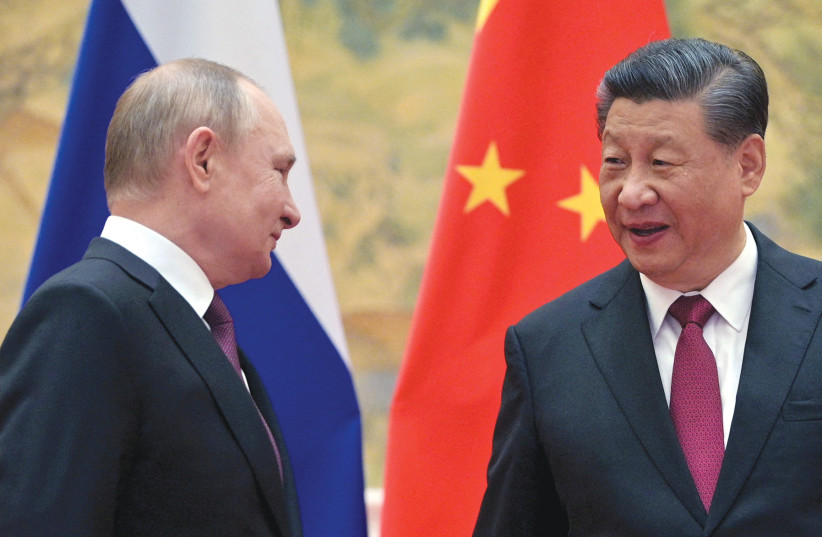
 CHINESE PRESIDENT Xi Jinping hosts Russian President Vladimir Putin in Beijing in February.  (photo credit: Sputnik/Aleksey Druzhinin/Kremlin via Reuters)
CHINESE PRESIDENT Xi Jinping hosts Russian President Vladimir Putin in Beijing in February.
(photo credit: Sputnik/Aleksey Druzhinin/Kremlin via Reuters)

The Shanghai Cooperation Organization (SCO) showcased the rise of China, Russia, Turkey and Iran as an emerging bloc of countries. While the SCO is ostensibly a group of states that includes most of the countries of Central Asia; the role of Turkey and Iran this year was of greater importance than in the Past. Turkish social media was full of posts showing Turkey’s President meeting with Russia’s leader; as well as speaking with other authoritarian leaders at the SCO summit in Uzbekistan.

Meanwhile, CGTN media reported that “Chinese President Xi Jinping on Friday urged Shanghai Cooperation Organization (SCO) member states to keep the SCO on the right course, deepen cooperation in various fields, and continue to foster a favorable environment for the development and rejuvenation of member states.”

What does the Chinese leader have to say?

The Chinese leader stressed the need for states to work toward security and stability. He spoke after clashes had taken place between Azerbaijan and Armenia as well as Kyrgyzstan and Tajikistan; and as Russia continues its war in Ukraine. It appears that this chaos could undermine China’s push for economic success. The Chinese leader said that it’s important for SCO member states to pursue inclusiveness and shared benefits in promoting development cooperation. “Member states should actively promote trade and investment liberalization and facilitation, ensure the stable and smooth functioning of industrial and supply chains, and encourage the orderly flow of resources and factors of production, so as to realize greater economic integration and development in the region,” said Xi, according to CGTN.

China cares about its Belt and Road Initiative and other national development strategies, and new conflicts would undermine China’s agenda. However, it’s clear that other members of the SCO and dialogue partners of the forum, such as Turkey, are pushing for more influence and they will use conflict to get what they want. China, meanwhile, pays lip service to support “harmonious coexistence and mutual learning between different countries, nations and cultures.”

 RUSSIAN PRESIDENT Vladimir Putin meets with Chinese President Xi Jinping in Beijing earlier this month.  (credit: Sputnik/Kremlin/Reuters)RUSSIAN PRESIDENT Vladimir Putin meets with Chinese President Xi Jinping in Beijing earlier this month. (credit: Sputnik/Kremlin/Reuters)

Overall the goal of China is for the SCO to play a larger role in the emerging multipolar world, meaning the SCO will balance the role of the US and the West. The SCO in general is moving to include more countries and influence Arab and Asian countries. Russia’s President was closely watched at the meetings. He has appeared weakened by Russia’s setbacks in Ukraine. Photos showed Vladimir Putin waiting for meetings and appeared to place a secondary role, even less influential than Erdogan. This shows that countries may wonder whether Russia can pull its weight and follow through on its obligations. However, it is not clear if the photos conveyed the whole story; Russia is still an important part of the SCO and China and Russia cooperate on many issues.


US president says such a step by Putin, who’s losing ground in Ukraine, ‘would change the face of war unlike anything since World War II’; ‘They’d become even more of a pariah’


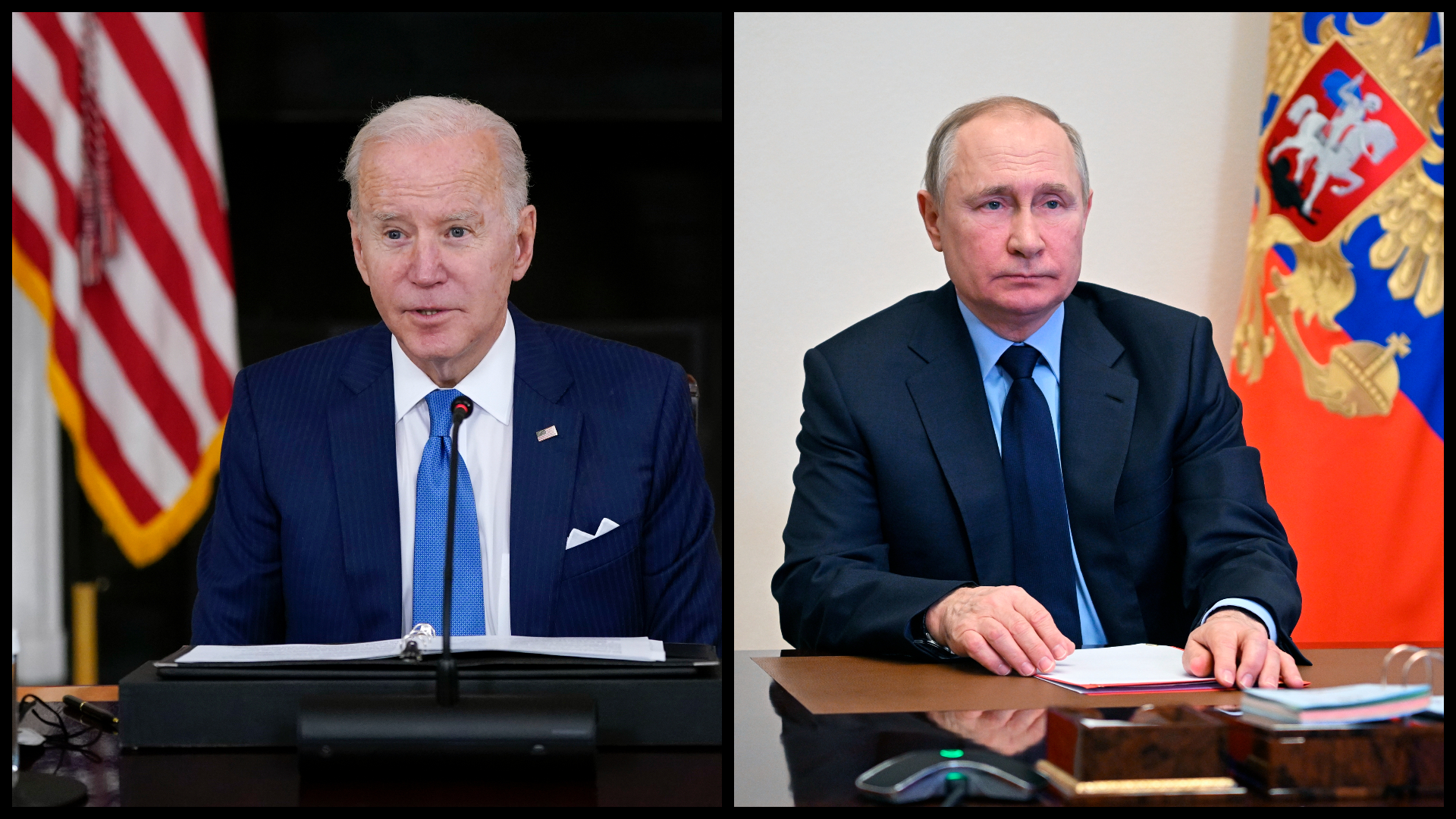
President Joe Biden speaks in the State Dining Room of the White House, February 9, 2022, in Washington; Russian President Vladimir Putin chairs a Security Council meeting via videoconference at the Novo-Ogaryovo residence outside Moscow, Russia, February 11, 2022. ( (AP Photo/Patrick Semansky; Alexei Nikolsky, Sputnik, Kremlin Pool Photo via AP)

WASHINGTON — US President Joe Biden is warning his Russian counterpart Vladimir Putin against using chemical or tactical nuclear weapons in the wake of serious losses in his war in Ukraine.

“Don’t. Don’t. Don’t,” Biden said in an excerpt from an interview with CBS’ “60 Minutes” that aired Friday evening.

Biden was responding to an interviewer’s question about the possibility of Putin, whose army is incurring heavy losses in the Ukraine counteroffensive this month, resorting to chemical or tactical nuclear weapons.

“You would change the face of war unlike anything since World War II,” Biden said.

“They will become more of a pariah in the world, more than they have ever been,” the US leader added.

Ukraine has recaptured swaths of territory in the east from occupying Russian forces in recent weeks, boosted by heavy weapons supplied by Western allies.

And Moscow is facing fresh outrage from the West after the discovery of a mass grave outside the formerly Russian-occupied city of Izyum, where, Kyiv officials say, almost all of the exhumed bodies showed signs of torture.

But Putin remained steadfast, saying his war against Russia’s Western-leaning neighbor was proceeding according to plan.

“The plan is not subject to adjustment,” Putin said Friday. “Our offensive operations in Donbas itself do not stop. They are going at a slow pace… The Russian army is occupying newer and newer territories.”