US president says such a step by Putin, who’s losing ground in Ukraine, ‘would change the face of war unlike anything since World War II’; ‘They’d become even more of a pariah’


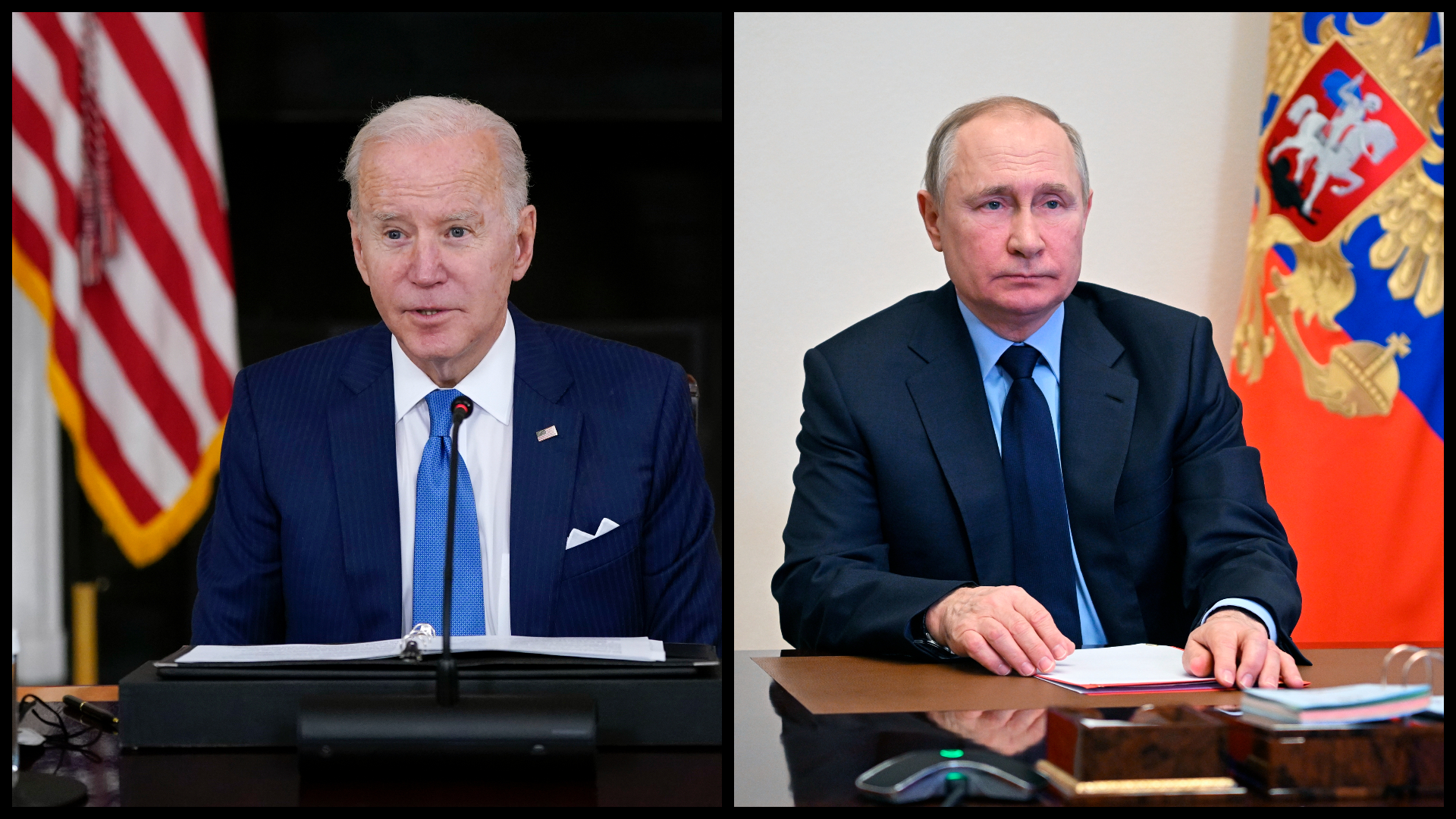
President Joe Biden speaks in the State Dining Room of the White House, February 9, 2022, in Washington; Russian President Vladimir Putin chairs a Security Council meeting via videoconference at the Novo-Ogaryovo residence outside Moscow, Russia, February 11, 2022. ( (AP Photo/Patrick Semansky; Alexei Nikolsky, Sputnik, Kremlin Pool Photo via AP)

WASHINGTON — US President Joe Biden is warning his Russian counterpart Vladimir Putin against using chemical or tactical nuclear weapons in the wake of serious losses in his war in Ukraine.

“Don’t. Don’t. Don’t,” Biden said in an excerpt from an interview with CBS’ “60 Minutes” that aired Friday evening.

Biden was responding to an interviewer’s question about the possibility of Putin, whose army is incurring heavy losses in the Ukraine counteroffensive this month, resorting to chemical or tactical nuclear weapons.

“You would change the face of war unlike anything since World War II,” Biden said.

“They will become more of a pariah in the world, more than they have ever been,” the US leader added.

Ukraine has recaptured swaths of territory in the east from occupying Russian forces in recent weeks, boosted by heavy weapons supplied by Western allies.

And Moscow is facing fresh outrage from the West after the discovery of a mass grave outside the formerly Russian-occupied city of Izyum, where, Kyiv officials say, almost all of the exhumed bodies showed signs of torture.

But Putin remained steadfast, saying his war against Russia’s Western-leaning neighbor was proceeding according to plan.

“The plan is not subject to adjustment,” Putin said Friday. “Our offensive operations in Donbas itself do not stop. They are going at a slow pace… The Russian army is occupying newer and newer territories.”


Iran’s Supreme Leader Falls Ill, Cancels Public Appearances

SEPTEMBER 17, 2022 6:00 AM

Iran’s Supreme Leader Ayatollah Ali Khamenei delivers a televised speech in Tehran, Iran. Official Khamenei Website/Handout via REUTERS

i24 News – Iran’s Supreme Leader Ali Khamenei canceled all public appearances and is on bed rest, under the supervision of a team of doctors, four people familiar with his health situation told US media.

According to The New York Times (NYT), the 83-year-old spiritual leader canceled all meetings and public showings last week after falling “gravely ill.”

Khamenei had surgery sometime last week for bowel obstruction after suffering extreme stomach pains and high fever, one of the people told NYT. The four people, two of whom are based in Iran, including one who has close ties with the country’s Revolutionary Guards (IRGC), requested anonymity.

One of the sources said the Iranian Ayatollah underwent surgery at a clinic set up in his home and office complex and is currently being monitored around the clock by doctors, adding that his condition was critical last week but has since improved.

As the Islamic Republic’s supreme leader, Khamenei has wide-ranging authority in Iran and is the final arbiter on issues such as the nuclear deal being negotiated between Tehran and world powers.

A former president of Iran, a protégé of Ayatollah Ruhollah Khomeini, and the founder of the revolution that led to the creation of the Islamic Republic of Iran in 1979, Khamenei assumed the position of the country’s top religious, political, and military authority in 1989.


Lebanese terror chief calls extraction from Karish a ‘red line’ amid US-brokered maritime border talks; also rails at UNIFIL amendment stating peacekeepers operate ‘independently’

Hassan Nasrallah, leader of the Lebanese terror group Hezbollah, gives a televised speech for the Shiite commemoration of Arbaeen, September 17, 2022. (Twitter screenshot, used in accordance with Clause 27a of the Copyright Law)

Hassan Nasrallah, leader of the Lebanese terror group Hezbollah, gives a televised speech for the Shiite commemoration of Arbaeen, September 17, 2022. (Twitter screenshot, used in accordance with Clause 27a of the Copyright Law)

Hezbollah terror chief Hassan Nasrallah on Friday issued a fresh threat over the offshore Karish gas field partly claimed by Lebanon, warning Israel against beginning extraction amid maritime border talks between Jerusalem and Beirut.

In a televised speech for the Shiite commemoration of Arbaeen, Nasrallah noted upcoming tests at Karish, with the platform slated to be connected to Israel’s national gas grid in the coming days. According to Nasrallah, Hezbollah “sent a very strong message” concerning the tests but Israel clarified they would not involve extracting gas from Karish.

“The red line to us is that there should not be extraction from Karish,” he said, according to the Naharnet news site.

He said Hezbollah was “giving a real chance” to the US-brokered negotiations, which are aimed at demarcating a maritime border between the countries to allow for offshore drilling in disputed areas.

Lebanon claims part of Karish, which Israel says lies in its waters and is not part of the disputed area subject to ongoing negotiations. The two countries remain technically at war.

“We are following up on the negotiations and all our eyes are on Karish and our missiles are locked on Karish,” Nasrallah said. “As long as extraction has not started, there is a chance for solutions.”

“We will not allow that oil and gas be extracted from the disputed Karish field before Lebanon obtains its rightful demands,” he added.
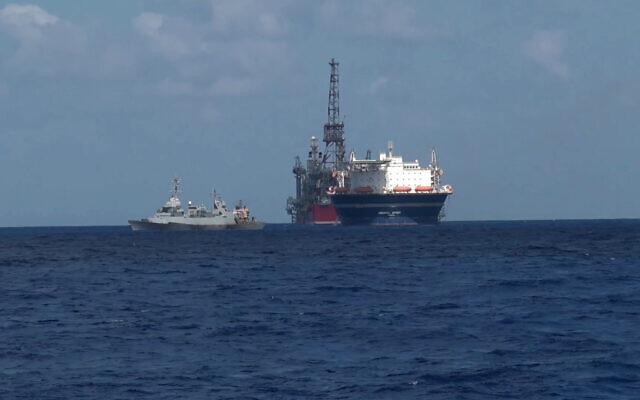
An Israeli Sa’ar Class 5 Corvette guards the Energean floating production, storage and offloading vessel at the Karish gas field, in footage published by the military on July 2, 2022. (Israel Defense Forces)

Energean, a London-listed company that has the license to develop Karish, said September 8 that it was “on track to deliver (the) first gas from the Karish development project within weeks.”

Hezbollah has threatened further attacks if the gas extraction goes ahead, after launching four unarmed drones toward Karish in July.

Top security Israeli officials have responded to Hezbollah’s threats, with Defense Minister Benny Gantz warning Thursday that Lebanon will suffer dire consequences if the Iran-backed terror organization torpedoes the maritime talks.

In his remarks, Nasrallah also railed at a recent amendment in the mandate of the UN peacekeeping force deployed along the border with Israel.

The UN Security Council on August 31 extended the mandate of the UNIFIL peacekeeping force for a period of a year but with a slight modification in the wording.

Nasrallah took issue with a part of the resolution that states the peacekeeping force “is allowed to conduct its operations independently.”

The UNIFIL force, which was first deployed more than four decades ago, has routinely coordinated its patrols and movements in its area of operations in the south with the Lebanese army.

“This is a trap that the Israelis have set for Lebanon over many years,” Nasrallah said, calling the resolution “a violation of Lebanese sovereignty.”

Nasrallah lambasted the Lebanese government for allowing the resolution through and warned that it could give rise “to great dangers in the area south of the Litani” river.

A UNIFIL patrol drives past a billboard showing the faces of slain Iraqi Popular Mobilization Forces commander Abu Mahdi al-Muhandis, Iranian Quds Force commander Qassem Soleimani and Hezbollah military commander Imad Mughniyeh, in the southern Lebanese village of Adaisseh on the border with Israel, August 26, 2020. (Mahmoud Zayyat/AFP)

On September 13, UNIFIL reacted to Hezbollah concerns by assuring it was still working closely with the Lebanese army, a statement Nasrallah welcomed in his Saturday speech.

UNIFIL was set up in 1978 to monitor the withdrawal of Israeli forces after they invaded Lebanon in reprisal for a Palestinian terror attack.

It was beefed up in 2006 after Israel and Hezbollah fought a 34-day war, and the 10,500-strong force is tasked with monitoring a ceasefire between the two sides.

In August, UNIFIL complained that it has recently observed at least four illicit shooting ranges in its area of operations and has informed the UN Security Council.

Lebanon’s Armed Forces confirmed to UNIFIL that it did not operate the shooting ranges.