
Russia categorically denied a Ukrainian claim that it was planning to fire missiles at visiting Jews in Uman.

By Debbie Reiss, World Israel News

Russian Deputy Foreign Minister Mikhail Bogdanov told Israel’s Ambassador to Moscow Alexander Ben Zvi that his country cannot guarantee the safety of Jewish pilgrims visiting Uman in Ukraine for the upcoming high holiday of Rosh Hashanah, Israeli TV news reported.

Bogdanov told the Israeli envoy that it was incumbent on Israel to prevent its citizens from traveling to Uman, which is the burial site of the Hasidic Rabbi Nachman of Breslov, Channel 12 reported.

Earlier this month, Prime Minister Yair Lapid called on Israeli to avoid Uman, warning of a “life-threatening danger,” and the Ukrainian embassy in Israel last week released a similar warning.

Uman has been the target of Russian missiles before.

Also on Thursday, Russia categorically denied a Ukrainian claim that it was planning to fire missiles at visiting Jews in Uman.

Mykhailo Podolyak, an adviser to Ukrainian President Volodymyr Zelensky, told Israeli TV last week that Russia may fire missiles there to trigger “global shock.”

Russian foreign ministry spokesperson, Maria Zakharova, said Podolyak’s warning was “an absurd thought and of course fake” but went on to say that the “remarks need to be taken seriously because they are coming from the regime in Kyiv.”

  UKRAINE WARNS JEWISH PILGRIMS: RUSSIA COULD SEND MISSILES TO HIT YOU, DON’T COME

“There is no doubt that [the Ukrainians] are brutal enough to exploit the opportunity to create another anti-Russian provocation,” she told the Kan public broadcaster.

Tens of thousands of Israelis traditionally travel to Uman for the High Holidays to pray at the tomb of Rabbi Nachman.

According to Gilad Malach, director of the Ultra-Orthodox in Israel program at the Israel Democracy Institute thinktank, up to 10,000 pilgrims would attempt to go this year, despite the travel warnings.

“The majority, when there are restrictions, understand the reasons not to go, whether that is COVID-19 or the war,” Malach told AFP. “But for the hardcore Hasidim, it’s one of the basic commitments that they have,” he added, adding that they believe “you should do anything to get there.”

“The more it is forbidden or hard, the more you are appreciated as a follower if you succeed in overcoming the obstacles and visiting the grave,” he said.

The withdrawal comes on the heels of a reported demand by Russia for Iranian proxies to leave positions across Syria to avoid Israeli strikes.

By Debbie Reiss, World Israel News

Iranian militia and Iranian and Hezbollah operatives have begun to to withdraw from Syria following as a result of Israeli airstrikes in recent weeks, a senior IDF officer told reporters on Thursday.

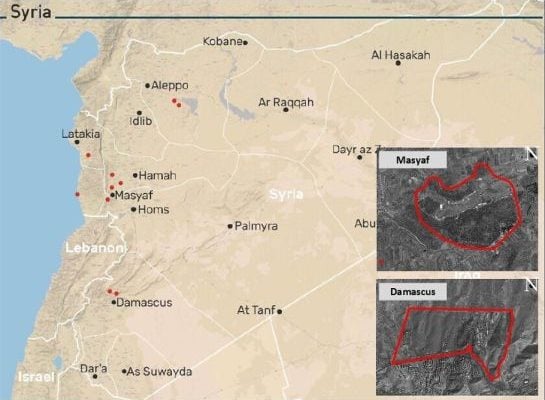
The targets included two international airports in Aleppo and Damascus earlier this month, in an attempt to stop the smuggle of weapons to Iranian proxies, especially Hezbollah, which has more than 15 bases in Syria.

Defense Minister Benny Gantz said on Monday that Iran had transformed the Scientific Studies and Research Center (CERS) into factories for producing advanced missiles for Hezbollah.

“Iran transformed CERS into production facilities for mid- and long-range precise missiles and weapons,” Gantz said, noting that the project was the vision of Qassem Soleimani, the head of Iran’s elite Quds Force who was assassinated by the U.S. under the Trump administration.

“The sites that I reveal to you on the map, and in particular the underground site in Masyaf where precision missiles are manufactured, constitute a significant potential threat to the region and to Israel,” Gantz said.

  IRAN PREPARES TO TAKE OUT ISRAEL – RIGHT AFTER IRAN DEAL IS SIGNED

The Iranian withdrawal identified by the IDF comes on the heels of a report in the Saudi-owned a-Sharq al-Awsat newspaper that said Russia had demanded that the Iranians withdrew from several key positions in Syria, to avoid Israeli strikes near Russian military sites.

Israel has for close to ten years fought to counter Tehran’s hegemonic aspirations in a covert, war between the wars campaing known in Hebrew as mabam.

Mabam effectively “destroyed” Soleimani’s vision, the Jerusalem Post reported citing a senior IDF official, which was to establish missile bases, anti-aircraft and intelligence bases as well as build a force similar to Hezbollah in Syria.


Secretary-General Guterres says IAEA nuclear watchdog’s independence is ‘essential’ after Iran demands an end to probes, again stalling negotiations

United Nations Secretary-General Antonio Guterres speaks during a joint press conference in Islamabad, Pakistan on September 9, 2022. (Ghulam Rasool/AFP)

United Nations Secretary-General Antonio Guterres speaks during a joint press conference in Islamabad, Pakistan on September 9, 2022. (Ghulam Rasool/AFP)

UNITED NATIONS — United Nations Secretary-General Antonio Guterres on Tuesday urged Iran to hold a “serious dialogue” about investigations by UN nuclear inspectors, which have in recent weeks become a roadblock in negotiations toward a renewed nuclear deal.

The International Atomic Energy Agency, or IAEA, acts as the UN’s nuclear watchdog. Iran last week demanded the agency close its investigation into several undeclared nuclear sites, a nonstarter for Western powers at the talks.

“I think the IAEA is a very important pillar and I believe that its independence that exists and must be preserved is essential,” Guterres said at a press briefing ahead of the UN General Assembly next week.

“The IAEA cannot be the instrument of parties against other parties,” he said.

“My appeal to the government of Iran, or any other government in the same situation, is to establish a serious dialogue with the IAEA, creating the conditions for effective cooperation that is needed,” he said, adding that he did not believe nuclear inspections were “the most difficult question on the table.”

Iranian President Ebrahim Raisi speaks during a press conference in Tehran on August 29, 2022. (AFP)

In 2018, then-US president Donald Trump pulled the US from the agreement and began reimposing sanctions, spurring Iran to roll back on its commitments.

The Biden administration has sought a return to the deal, and negotiations taking place in Vienna since April 2021 have aimed to revive the agreement by lifting sanctions on Iran again in exchange for Tehran again curbing its nuclear activities.

European mediators last month appeared to make progress in the negotiations as Iran largely agreed to a proposed final text. Their hopes were dashed when Iran made fresh demands that the IAEA close three ongoing probes into its undeclared nuclear activity.

“This latest demand raises serious doubts as to Iran’s intentions and commitment to a successful outcome on the JCPOA,” France, Germany and Britain said.

“Unfortunately, Iran has chosen not to seize this critical diplomatic opportunity,” they said, adding that “instead, Iran continues to escalate its nuclear program way beyond any plausible civilian justification.”

Iran called that statement “unconstructive” and “regrettable.”

A senior Israeli official predicted on Sunday that there will be no return to the nuclear deal before the November midterm elections in the United States.

Iran’s President Ebrahim Raisi will attend the UN General Assembly in New York next week. Guterres said Wednesday that he expects to meet with Raisi during that time, and said “it’s obvious” that the two will discuss Iran’s human rights record and the nuclear negotiations.

Guterres’s Wednesday briefing mainly addressed the war in Ukraine, climate change, and the related food and energy crises. The secretary-general recently returned from Pakistan, which has been devastated by flooding, and spoke to Russian President Vladimir Putin earlier on Wednesday.