US Envoy Pressures Israel on ‘Two-State Solution’ at UNSC

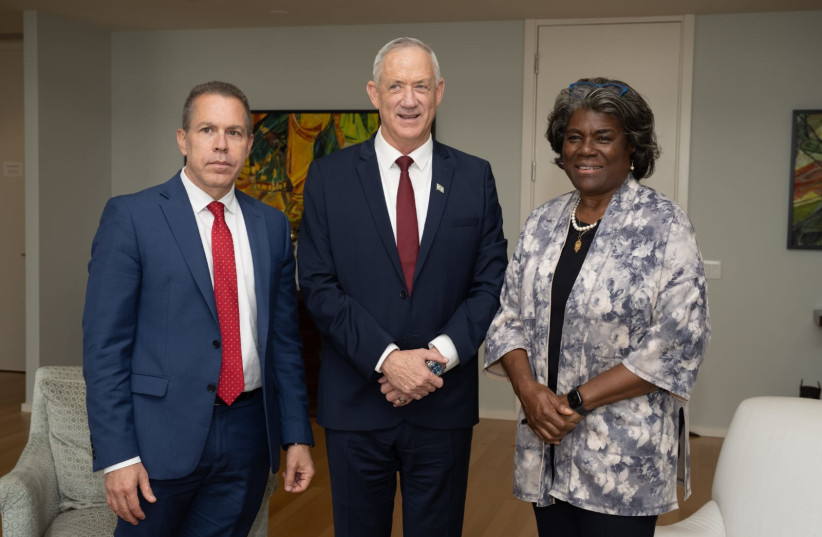
US Ambassador to the United Nations Linda Thomas-Greenfield met with Israel’s Defense Minister Benny Gantz on Monday to discuss the Biden Administration’s “commitment to prevent Iran from obtaining a nuclear weapon” – but used the opportunity to also continue her boss’s mission of pressuring Israel into accepting the so-called “two state solution.”

Nate Evans, a spokesperson for the US Mission to the United Nations, said in a statement that Thomas-Greenfield “expressed the United States’ ironclad commitment to Israel’s security” and discussed with Gantz “our shared commitment to prevent Iran from obtaining a nuclear weapon.”

The two leaders expressed their concerns about the activities of Iran’s Lebanese proxy, Hezbollah, and their strong support for the mandate of the United Nations Interim Force in Lebanon (UNIFIL).

But Thomas-Greenfield also “underscored the critical need for accountability for the killing of Palestinian-American journalist Shireen Abu Akleh,” the spokesperson said.

The US envoy also “reiterated the Biden Administration’s commitment to supporting efforts towards a two-state solution and its belief that Israelis and Palestinians deserve equal measures of freedom, security, prosperity, and dignity,” Evans added.

President Joe Biden told Palestinian Authority leader Mahmoud Abbas during their meeting in Bethlehem this past July that the US would not give up on the goal of finding a “just settlement” to the decades-long conflict.

But Biden acknowledged at the time that the “ground is not ripe” to restart talks between Israel and the PA, although he said the US commitment to the moribund “two state solution” had not changed.

“Even if the ground is not right at this moment to restart negotiations, the United States and my administration will not give up on trying to bring the Palestinians, Israelis and both sides closer together,” Biden said.

Gantz, Abbas, Celebrate Together Abraham’s Sacrifice of Ishmael

Gantz met several times with Abbas over the past year, including this past July, when he joined the Palestinian Authority leader for the celebration of the Islamic holiday Eid al-Adha, which marks Abraham’s intended sacrifice of his son – in the case of Islam, Ishmael.

Following that meeting, Gantz approved a series of “confidence building” measures that included approval of an additional 1,500 entry permits for Gazans to work in Israel, a new crossing from the Palestinian Authority into Israel and approval of six outlines for PA construction in Area C of Judea and Samaria.

Gantz Approves ‘Confidence Building Measures’ with the PA for Biden’s Visit

“These approvals give the P.A. the green light to transfer Arab residents of Areas A and B of Judea and Samaria to Area C, the part under full Israeli control, effectively allowing them to take over strategic swaths of land,” Gush Etzion Regional Council head Shlomo Ne’eman warned at the time. “This transfer de facto puts Area C under the control of the PA.”

There has been cautious optimism that Jerusalem and Beirut are close to signing an agreement on the maritime border dispute after back-and-forth diplomacy by the United States.

  Defense Minister Gantz holds briefing with representatives of the UN Security Council and Abraham Accord countries, September 13, 2022 (photo credit: NIR ARIELI)
Defense Minister Gantz holds briefing with representatives of the UN Security Council and Abraham Accord countries, September 13, 2022
(photo credit: NIR ARIELI)

Israel is keen to make a deal with Lebanon regarding its maritime borders, Defense Minister Gantz said in a briefing to representatives of the UN Security Council and Abraham Accord countries.

“The state of Israel is interested in progressing maritime border negotiations with Lebanon,” Gantz said. “In the end, there will be two gas rigs, one Israeli and one Lebanese. The question is whether we can reach this scenario without an unnecessary escalation as a result of Hezbollah threats.”

There has been cautious optimism that Jerusalem and Beirut are close to signing an agreement on the maritime border dispute after back-and-forth diplomacy by the United States. According to reports, the deal would see the Karish gas field remain in Israel while the Kana field will be owned by Lebanon.

“We must advance the negotiations and strengthen the stability and prosperity in the region and prevent an escalation that will first of all harm the citizens of Lebanon and the Lebanese state, and bring us back to the start.”

Defense Minister Benny Gantz

“Establishing a rig on the Lebanese side is in the interest of Lebanon, whose residents do not have a regular electricity supply and are experiencing a devastating economic crisis,” he said, explaining that Israel will also capitalize on its resources.

Despite continued threats by Hezbollah’s Secretary-General Hassan Nasrallah, the  Greek-French-owned company that drills in Karish, said that gas extraction is expected to start within weeks.

  Defense Minister Gantzwith representatives of the UN Security Council and Abraham Accord countries, September 13, 2022 (credit: NIR ARIELI)Defense Minister Gantzwith representatives of the UN Security Council and Abraham Accord countries, September 13, 2022 (credit: NIR ARIELI)

Gantz warned that Israel would not tolerate any threats to Israel’s security by Nasrallah and called on the Security Council to condemn any violation of Israeli sovereignty by the terror group.

“We must advance the negotiations and strengthen the stability and prosperity in the region and prevent an escalation that will first of all harm the citizens of Lebanon and the Lebanese state, and bring us back to the start,” he said.


State Department refutes several assertions by senior Israeli official who briefed reporters during PM’s visit to Berlin, rejects claim that Israel managed to sideline Rob Malley

US President Joe Biden, left, and Prime Minister Yair Lapid address the media following their meeting in Jerusalem, July 14, 2022. (AP Photo/Evan Vucci)

US President Joe Biden, left, and Prime Minister Yair Lapid address the media following their meeting in Jerusalem, July 14, 2022. (AP Photo/Evan Vucci)

The US State Department rejected on Monday remarks made by a senior Israeli official who claimed that the Biden administration has effectively given up on the Iranian nuclear talks, insisting that Washington’s efforts to reach an agreement with Tehran were ongoing.

“We have been and are continuing to seek a mutual return to full implementation of the JCPOA [Joint Comprehensive Plan of Action] because President Biden is convinced that this is the best way to deliver on his commitment not to allow Iran to possess a nuclear weapon,” said a statement made attributable to an anonymous State Department spokesperson.

The US statement came hours after a senior Israeli official, briefing reporters during Prime Minister Yair Lapid’s visit to Germany, relayed that “The Americans and most Europeans say there’s not going to be a [Joint Comprehensive Plan of Action].”

The senior Israeli official said that those who reached this conclusion have offered different “excuses”: Some claim that the deal fell apart because of Iran’s response to the final proposal drafted by the EU; others say it’s because EU Foreign Affairs head Josep Borrell and his chief of staff Enrique Mora got ahead of themselves in the talks; and others argue that the Biden administration “hardened” its positions vis-à-vis Iran as a result of Israeli lobbying against the JCPOA.

Regardless of how the sides ended up where they are, the senior Israeli official said that the time has come to launch “strategic dialogue” with the US and European powers aimed at achieving a “longer and stronger” Iran nuclear agreement.

This was a goal set out by Biden upon entering office, but one his aides argue won’t be possible until after the US revives the original JCPOA, which former president Donald Trump abandoned in 2018 in favor of crushing sanctions against Iran.

The senior Israeli official then indicated that Jerusalem’s “strategic dialogue” with the Biden administration about next steps has already begun, pointing to Lapid’s call with the US president last month along with the recent visits to Washington by Defense Minister Benny Gantz, National Security Council chairman Eyal Hulata, and Mossad chief David Barnea.

The official claimed that Israel has managed to sideline Robert Malley, who helped craft the original agreement signed in 2015 and who has become a frequent target of Israeli criticism.

In this file photo from May 25, 2022, Robert Malley, the Biden’s administration special envoy for Iran, waits to testify about the Iran nuclear deal during a hearing of the Senate Foreign Relations on Capitol Hill in Washington. (Brendan Smialowski/AFP)

“This is out of the hands of Malley’s camp by now. The decisive talks we’re having with the US are no longer in Malley’s hands,” said the senior Israeli official.

While the State Department does not frequently respond to comments made by foreign officials criticizing its policies, it chose to do so in this instance, taking the opportunity to refute several claims made by the anonymous Israeli briefer.

“We have a very close dialogue with Israel and other allies and partners about Iran, including the JCPOA. Special Envoy Malley is an integral part of those talks,” the US State Department spokesperson continued in the statement.

“It is not correct that our position has ‘toughened.’ The President has always been very clear about what we need in order to reach an understanding and return to full implementation.”

“There is only one reason that we have not yet reached an understanding: Tehran has not yet accepted the reasonable basis presented by the EU as coordinator of JCPOA talks,” the spokesperson added.

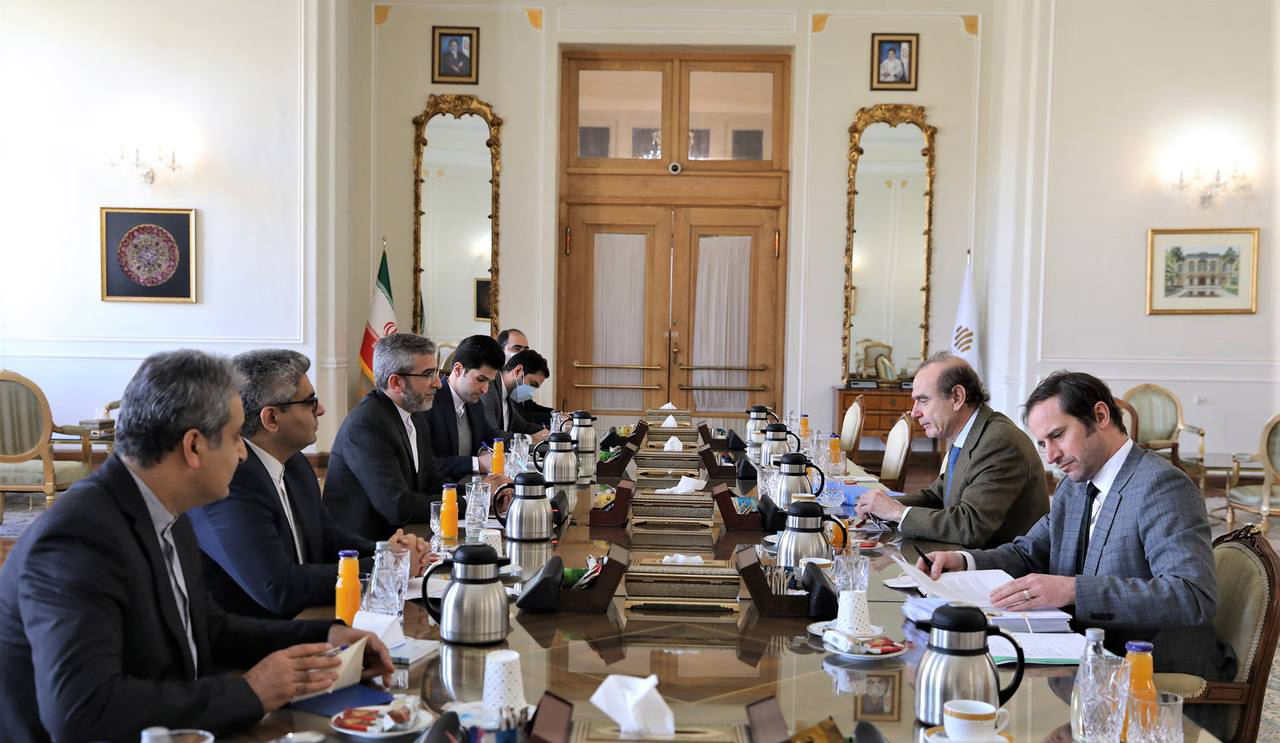
Enrique Mora, a leading European Union diplomat, second right, attends a meeting with Iran’s top nuclear negotiator Ali Bagheri Kani, third left, in Tehran, Iran, March 27, 2022. (Iranian Foreign Ministry via AP)

While there had been initial optimism about prospects for reviving the nuclear deal, it has dissipated in recent weeks with the world powers claiming that Iran has made unreasonable demands at the last minute.

A major sticking point had been Tehran’s insistence that the UN’s International Atomic Energy Agency drop a probe into unaccounted-for traces of enriched uranium at three sites in Iran, which the agency and the West have rebuffed out of hand.

Israel has long opposed a revival of the 2015 accord, which has been moribund since the Trump withdrawal and the rapid enrichment of uranium by Iran that followed.

Biden has recognized that the original deal fails to address Iran’s ballistic missile program along with its malign activities abroad. However, he maintains that the JCPOA at least keeps Tehran’s nuclear program “in a box” and that other issues are only compounded when the program remains unrestrained.

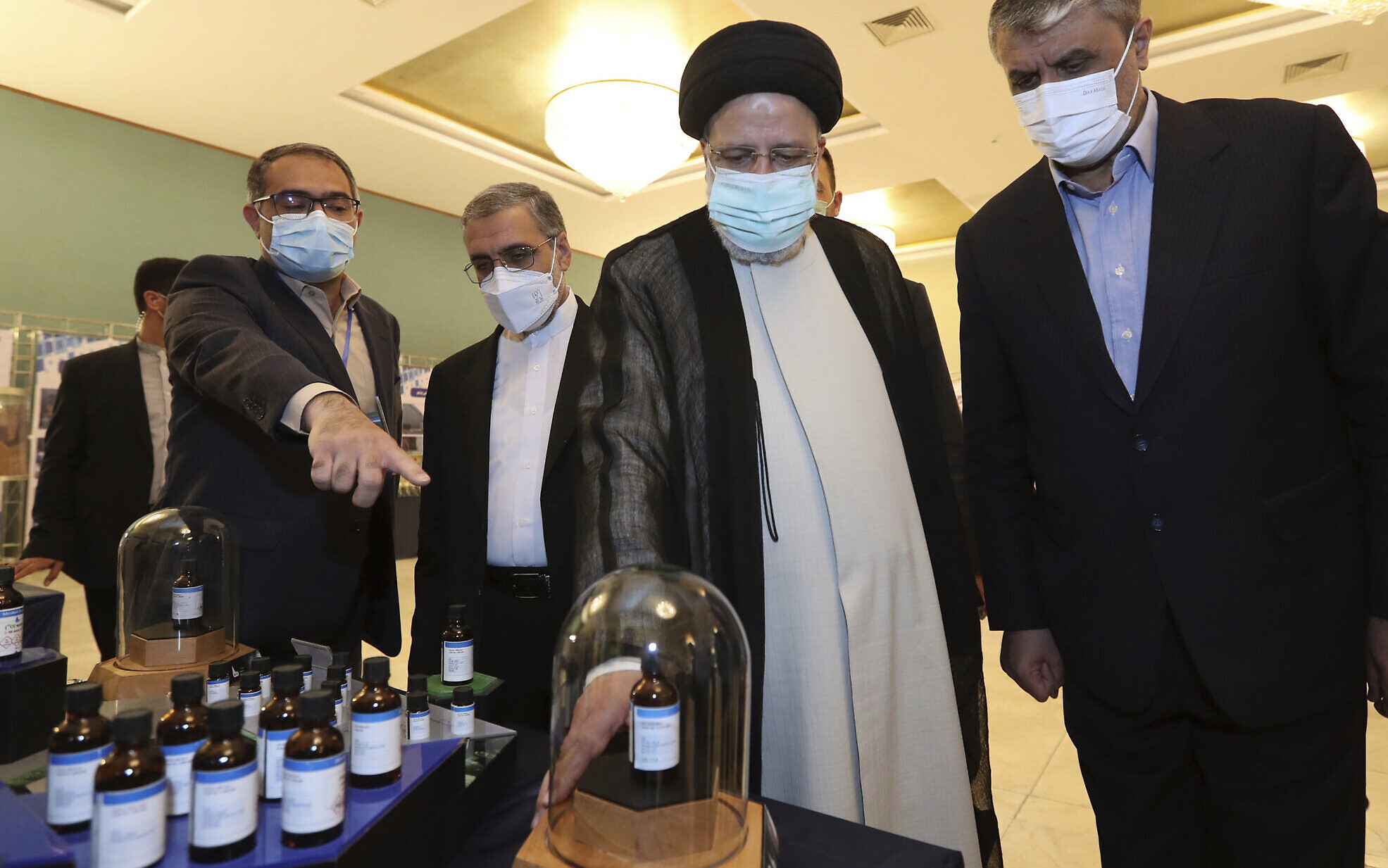
In this photo released by the official website of the office of the Iranian Presidency, President Ebrahim Raisi, second right, receives an explanation while visiting an exhibition of Iran’s nuclear achievements in Tehran, Iran, on Saturday, April 9, 2022. (Iranian Presidency Office via AP)

Lapid has said that Israel is not opposed to any deal, but that the specific one being negotiated would still allow Iran to advance toward a nuclear bomb in the future. Israel also insists Iran would use revenue from sanctions relief to bolster allied groups capable of attacking Israelis, notably Lebanese Shiite terror group Hezbollah, and Hamas and Islamic Jihad, two key Palestinian terror organizations.

The senior Israeli official briefing reporters Monday after Lapid’s meeting with German Chancellor Olaf Scholz said Jerusalem had played up European jitters over the fact that Russia, which is a party to the JCPOA, will use Tehran as a way to bypass Western sanctions imposed since the invasion of Ukraine.

“We, of course, encouraged this,” the official said.

Lazar Berman contributed to this report