The deal includes SDF withdrawal east of the Euphrates, integration of fighters into Syria’s defense ministries, and transfer of control over oil fields and key provinces to Damascus
An aerial view shows Syrian residents in vehicles, queuing to flee the Sheikh Maqsoud and Achrafieh districts after clashes broke out Tuesday between Syrian government forces and Kurdish fighters in a disputed area of the northern Syrian city of Aleppo, Wednesday, January 7, 2026.AP Photo/Omar Albam
Syrian state media reported on Sunday that the Syrian government and the US-backed Syrian Democratic Forces (SDF) have reached an immediate ceasefire after days of clashes in Kurdish-held areas of the northeast.
The agreement, announced electronically by Damascus, marks a major shift in Syria’s ongoing efforts to reassert control over its Kurdish-majority regions.
Recommended
According to the Syrian presidency, the deal, signed by President Ahmed al-Sharaa and SDF commander Mazloum Abdi, calls for a full halt to combat operations on all fronts, the withdrawal of SDF-affiliated forces to the east of the Euphrates, and the integration of SDF fighters into Syria’s defense and interior ministries on an individual basis.
US-backed Syrian Democratic Forces (SDF) fighters stand guard at Al Naeem Square, in Raqqa, SyriaAP Photo/Baderkhan Ahmad, File
The agreement also stipulates that the Syrian government will assume military and administrative control over Deir al-Zor and Raqqa, take over all oil and gas fields, and assume responsibility for prisons and camps holding ISIS members and their families. The SDF has committed to evacuating all non-Syrian PKK-affiliated personnel from the country.
Syria, US Envoy confirm agreement with Kurdish Forces
“All lingering files with the SDF will be resolved,” Sharaa said, adding that he is scheduled to meet Abdi on Monday to continue discussions. The ceasefire is intended to open safe corridors for civilians to return to their areas and allow state institutions to resume their duties.
US Special Envoy Tom Barrack praised the agreement, describing it as a “pivotal inflection point” that brings former adversaries together and advances Syria toward national unity. Barrack noted that the deal facilitates the continued fight against ISIS while integrating Kurdish forces into the broader Syrian state.
The ceasefire comes after days of heavy fighting in northeastern Syria, highlighting both the fragility and potential of Damascus’ reconciliation efforts with Kurdish forces
Three F-35i “Adir” fighter jets, manufactured by Lockheed Martin, landed today (Sunday) at the Nevatim Air Base.
The aircraft will be assigned to the 116th Squadron and the 140th Squadron. The Israeli Air Force insignia has been emblazoned on the aircraft.
Since the outbreak of the war, the “Adir” fleet has been operating continuously across a wide range of defensive and offensive missions in all arenas of combat.
The IDF noted that the arrival of the new aircraft marks a further enhancement of the “Adir” fleet and contributes to the Israeli Air Force’s operational capabilities.
Israel recognizes the importance of its defense partnership with the United States, stemming from a commitment to strengthening stability in the Middle East.
Board of Peace executive committee responsible for overseeing postwar management of Gaza also includes Witkoff, Kushner, representatives from UAE, Egypt and pair of prominent businessmen
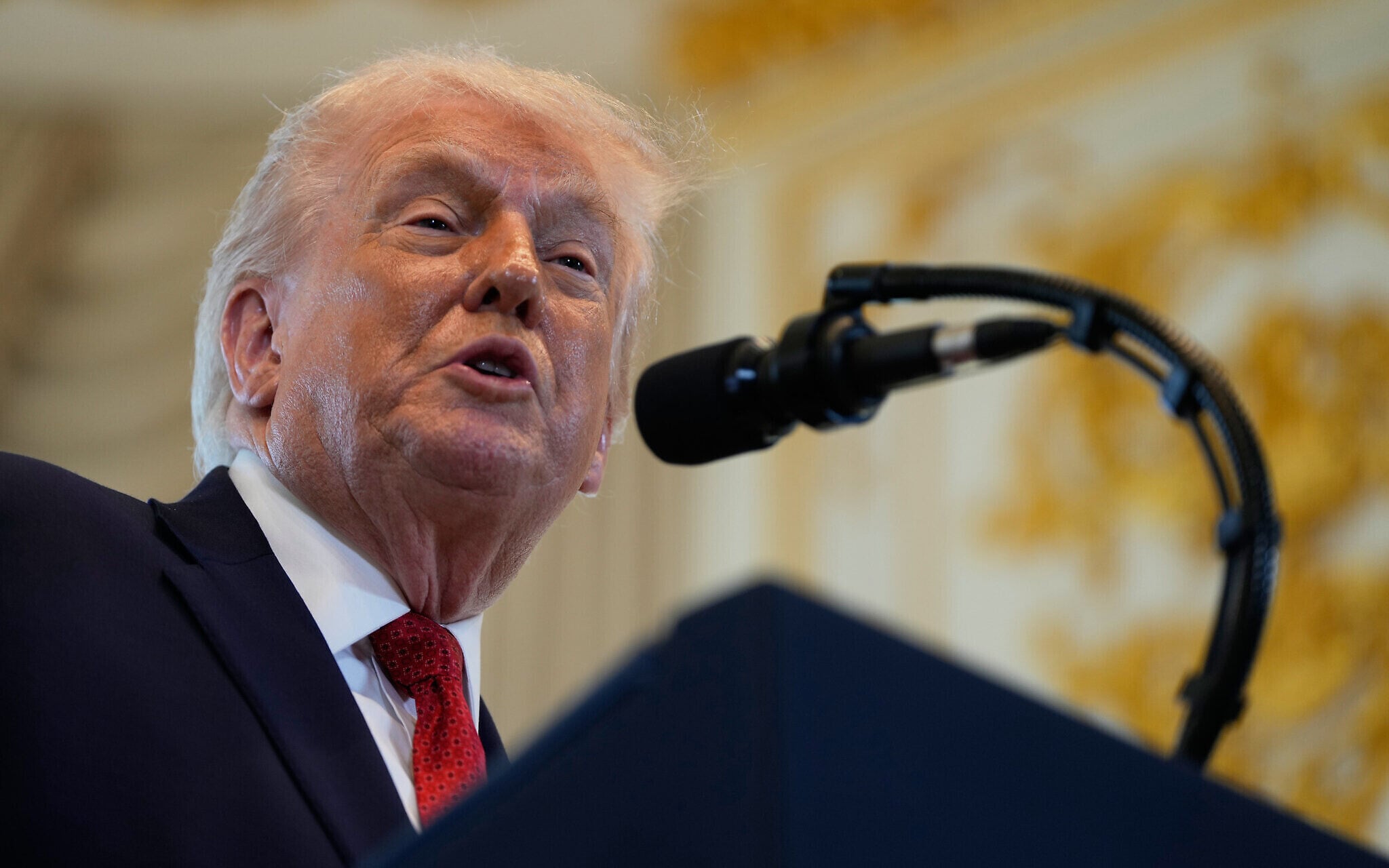
US President Donald Trump speaks at a dedication ceremony for a portion of Southern Boulevard, which the Town of Palm Beach Council recently voted to rename,”President Donald J. Trump Boulevard,” January 16, 2026, at his Mar-a-Lago Club in Palm Beach, Florida (AP Photo/Julia Demaree Nikhinson)
The White House on Friday unveiled the members of a key international panel that will oversee the postwar management of Gaza.
Notable members of the Board of Peace’s Executive Committee include Turkish Foreign Minister Hakan Fidan, senior Qatari diplomat Ali Thawadi, Egyptian intelligence chief Hassan Rashad, UAE Minister of International Cooperation Reem Al-Hashimy and former UK prime minister Tony Blair.
The inclusion of prominent officials from Qatar and Turkey — two countries who have been highly critical of Israel’s prosecution of the war in Gaza — is likely to upset Jerusalem, but demonstrates their perceived utility to Trump, who has touted their abilities to coax Hamas into agreeing to a ceasefire in October.
The Executive Committee will oversee the National Committee for the Administration of Gaza (NCAG), the similarly new panel of Palestinian technocrats that will be responsible for providing basic services to Gazans.
It will operate under the Board of Peace, a panel of world leaders headed by Trump, which the US is aiming to unveil in the coming days. However, the Board of Peace will play a more symbolic role, with the executive committee serving as its operational arm.
Also serving on the Executive Committee will be US special envoy Steve Witkoff, top Trump aide Jared Kushner, Apollo Global Management CEO Marc Rowan, Israeli-Cypriot businessman Yakir Gabay, former UN humanitarian coordinator Sigrid Kaag, and former UN envoy to the Mideast Nickolay Mladenov.
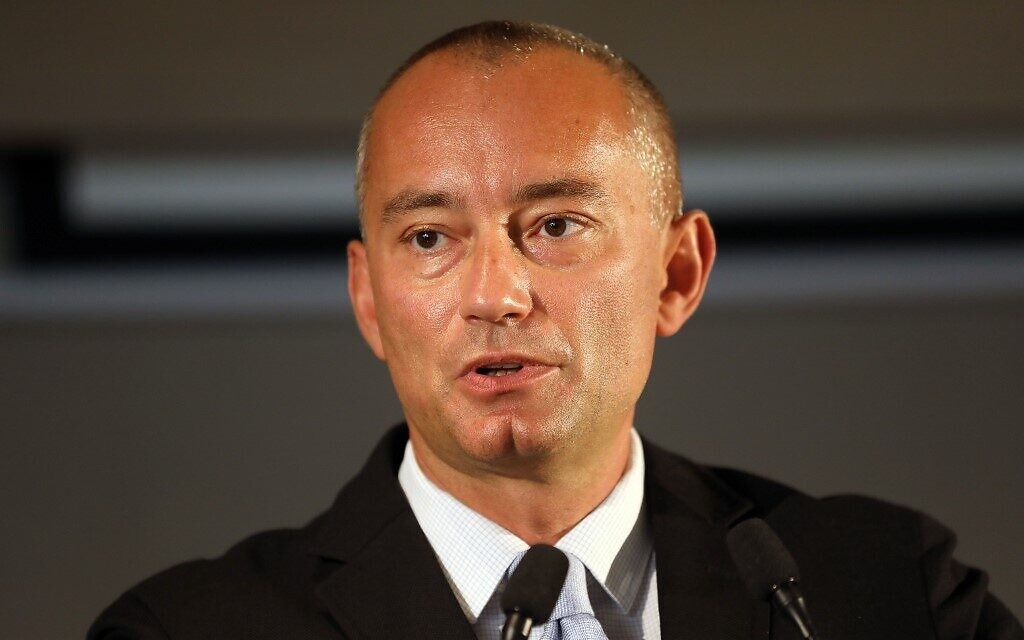
The United Nations Middle East special envoy, Nickolay Mladenov, speaks during a press conference in Jerusalem on June 25, 2020. (Menahem KAHANA / AFP)
Mladenov will also serve as the Board of Peace’s High Representative for Gaza. “In this capacity, he will act as the on-the-ground link between the Board of Peace and the NCAG,” the White House said in its statement announcing the new Gaza oversight bodies.
Mladenov “will support the Board’s oversight of all aspects of Gaza’s governance, reconstruction, and development, while ensuring coordination across civilian and security pillars,” the White House said.
The NCAG of Palestinian technocrats held its first meeting with Mladenov in Cairo on Thursday, during which Kushner and Witkoff joined virtually.
NCAG will be headed by former Palestinian Authority deputy planning minister Ali Shaath, who the White House in its Friday announcement called “a widely respected technocratic leader who will oversee the restoration of core public services, the rebuilding of civil institutions, and the stabilization of daily life in Gaza, while laying the foundation for long-term, self-sustaining governance.”
“Dr. Sha’ath brings deep experience in public administration, economic development, and international engagement, and is widely respected for his pragmatic, technocratic leadership and understanding of Gaza’s institutional realities,” the White House said.
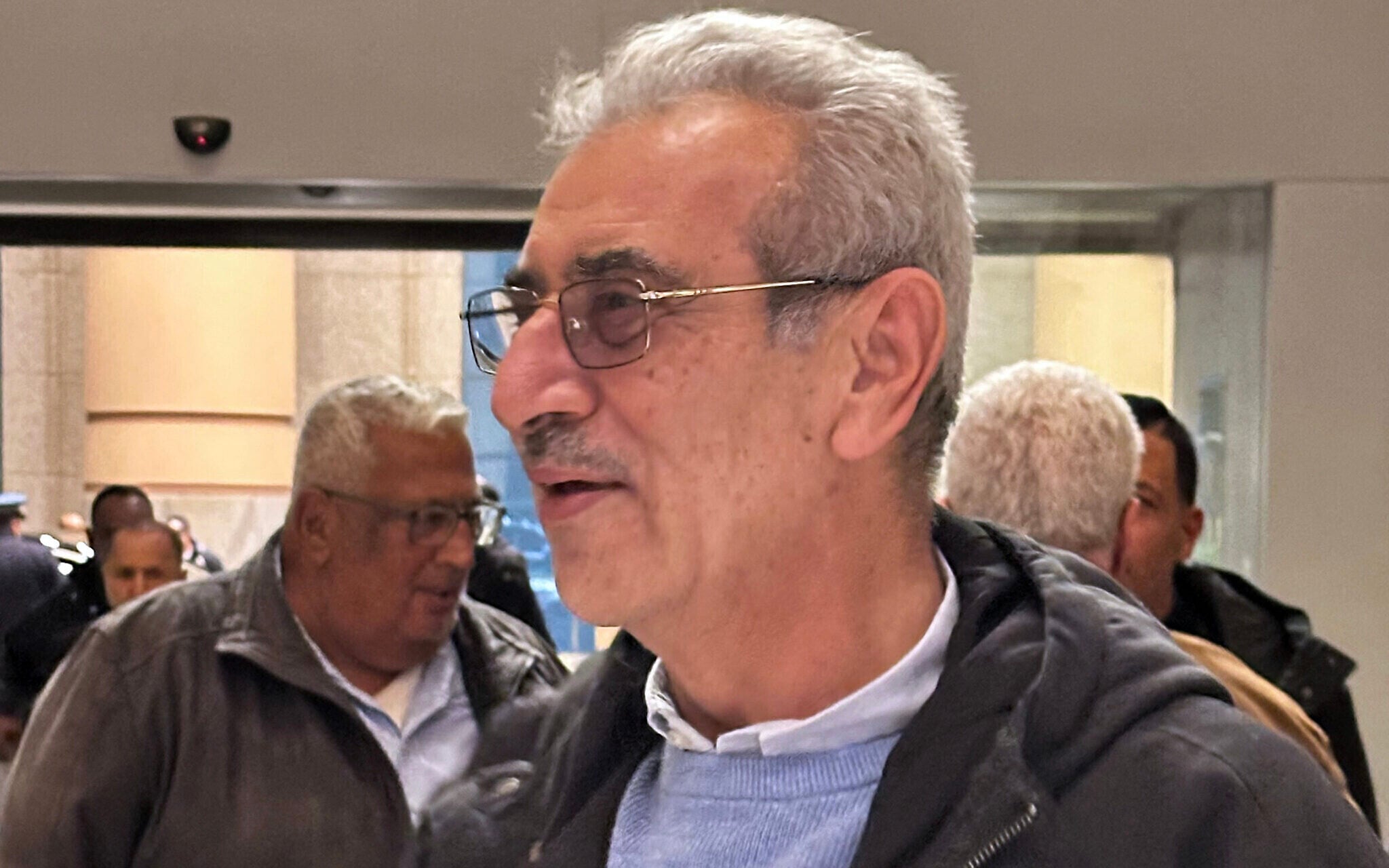
Ali Shaath, head of the Palestinian technocratic committee for managing the Gaza Strip, arrives at a hotel in Cairo on January 16, 2026. (Mohammed Abed/AFP)
As for the yet-to-be-established International Stabilization Force, which will be tasked with providing security for the Strip and gradually phasing out the IDF, the White House announced that Central Command Special Operations Commander Maj. Gen. Jasper Jeffers has been appointed commander of the ISF “where he will lead security operations, support comprehensive demilitarization, and enable the safe delivery of humanitarian aid and reconstruction materials.”
Jeffers previously was a co-chairman of the Cessation of Hostilities Implementation Mechanism, which has been monitoring the Israel-Hezbollah ceasefire in Lebanon reached in November 2024.
US Maj. Gen. Jasper Jeffers, appointed to oversee the implementation of the Washington-brokered ceasefire in Lebanon, is pictured during a meeting with the Lebanese parliament speaker, in Beirut, on December 5, 2024. (AFP)
The US had struggled to convince countries to contribute troops to the ISF board amid heavy speculation that Hamas will disarm and that the IDF will withdraw further from Gaza. One of the two countries Washington had publicly touted, Azerbaijan, announced earlier this month that it would not be participating.
US officials briefing reporters earlier this week insisted that they now have enough countries offering troops and that an announcement can be expected in about two weeks.
Moreover, one of the briefers appeared to confirm The Times of Israel’s reporting on the shrinking of the ISF mandate to more limited tasks such as securing borders and humanitarian aid, rather than kinetic activity to disarm Hamas.
“A lot of the work inside Gaza will be done by the local Palestinian police forces, which we think is the most important element of this plan, so we’ve been putting a lot of time into that,” the US official said.
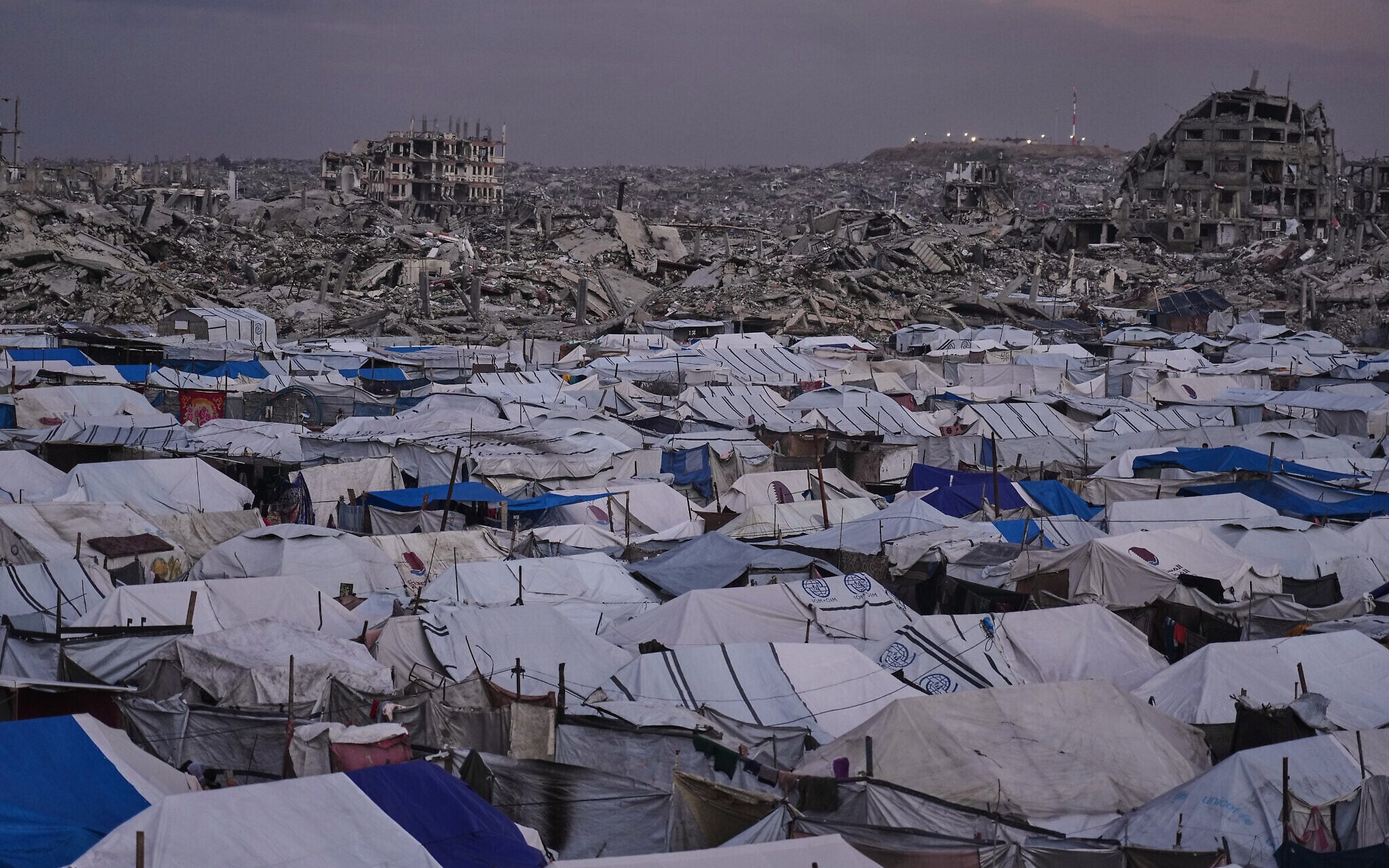
A tent camp for displaced Palestinians stretches across the Zeitoun neighborhood of Gaza City, January 14, 2026. (AP Photo/Jehad Alshrafi)
Still left to unveil is the Board of Peace that is slated to meet next week on the sidelines of the World Economic Forum in Davos, Switzerland, and comprise of world leaders. The Times of Israel reported last month that the US had informed interlocutors that it secured commitments from Egypt, Qatar, the United Arab Emirates, the United Kingdom, Italy and Germany to have their leaders join Trump on the Board of Peace.
“The Board of Peace will play an essential role in fulfilling all 20 points of the President’s plan, providing strategic oversight, mobilizing international resources, and ensuring accountability as Gaza transitions from conflict to peace and development,” the White House said.
“The United States remains fully committed to supporting this transitional framework, working in close partnership with Israel, key Arab nations, and the international community to achieve the objectives of [Trump’s 20-point plan for ending the Gaza war],” the White House continued. “The president calls on all parties to cooperate fully with the NCAG, the Board of Peace, and the International Stabilization Force to ensure the swift and successful implementation” of the 20-point plan.”
In addition to the Executive Committee for Gaza, the White House also unveiled an additional panel that it called the founding Executive Committee, though it is made up largely of members from the other Executive Committee and even shares the same name.
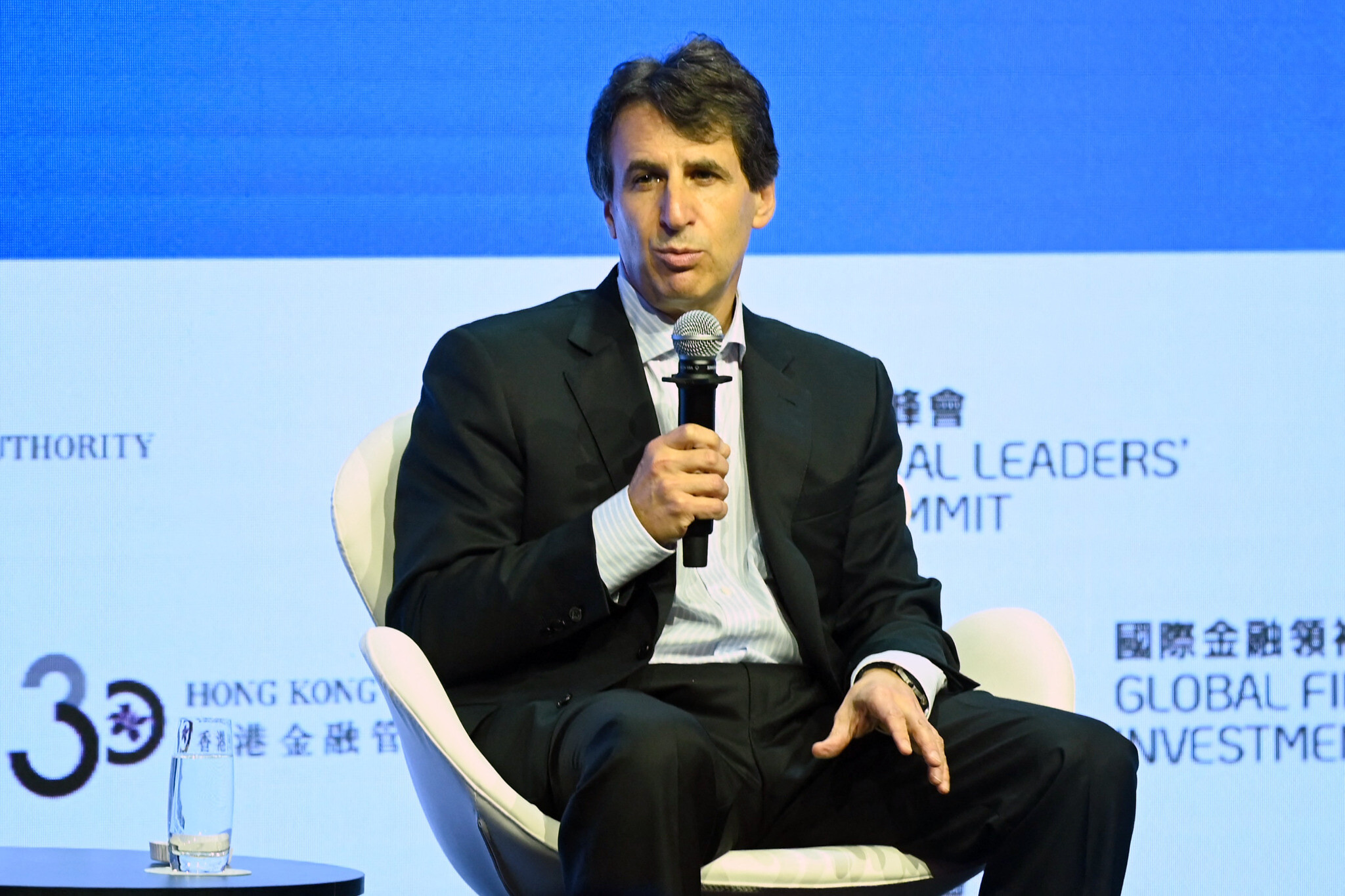
Marc Rowan, chief executive officer of Apollo Global Management speaks at the Global Financial Leaders’ Investment Summit in Hong Kong on November 7, 2023. (Peter PARKS / AFP)
Joining Witkoff, Kushner, Blair and Rowan on this additional executive committee are US Secretary of State Marco Rubio, World Bank president Ajay Banga and Trump’s former deputy national security adviser Robert Gabriel.
The White House said that each member of this additional executive committee “will oversee a defined portfolio critical to Gaza’s stabilization and long-term success, including, but not limited to, governance capacity-building, regional relations, reconstruction, investment attraction, large-scale funding, and capital mobilization.”
The White House didn’t respond to requests for clarification regarding the significance of this additional committee and why it shares nearly the same name — and many of the same members — as the more essential Executive Committee for Gaza that will effectively be headed by Mladenov.
A source familiar with the matter told The Times of Israel that this additional executive committee will not play a critical role in decision-making, but the White House statement said that additional members of both committees would be announced in the coming weeks.