Greece plans to extend its territorial waters further, including potentially in the Aegean Sea, Foreign Minister George Gerapetritis said on Friday, despite Turkey’s long-standing threat of war should Athens take such a step.
The NATO allies, but historic rivals, have eased tensions in recent years but remain at odds over where their continental shelves begin and end in the Aegean – an area believed to hold significant energy potential and with implications for overflights and airspace.
Greece has already extended its territorial waters in the Ionian Sea to 12 nautical miles from six, following agreements with Italy, and it has signed a maritime delimitation deal with Egypt in the eastern Mediterranean.
But it has avoided similar moves in the Aegean, where Ankara objected sharply.
In 1995, the Turkish parliament declared a “casus belli,” or cause for war, if Greece unilaterally extended its waters beyond six nautical miles in the Aegean, a position Athens says violates international maritime law.
Answering questions in parliament on Friday, Gerapetritis said further expansion was expected.
“Today, our sovereignty in the Aegean Sea extends to six nautical miles,” Gerapetritis said. “As there was an agreement with Egypt, as there was an agreement with Italy, there will also be a (further) extension of the territorial waters.”
He didn’t specify which maritime areas could be extended.
Turkey’s Foreign Ministry was not immediately available for comment.
In July, Greece took another step by unveiling the boundaries of two planned marine parks in the Ionian and Aegean seas. The Aegean park, covering 9,500 square kilometers (3,668 square miles), would initially expand around the southern Cyclades islands, further south of Turkey, according to the maps submitted by Athens. The announcement has drawn objections from Ankara.
Greece says the only issue it is prepared to discuss with Turkey is the demarcation of their maritime zones, including the continental shelf and an exclusive economic zone.
Alerts cite ‘regional tensions’ as Washington weighs strike on regime; UK shuts Tehran embassy; Lufthansa group says it will limit flights to Israel so crew won’t have overnight stay
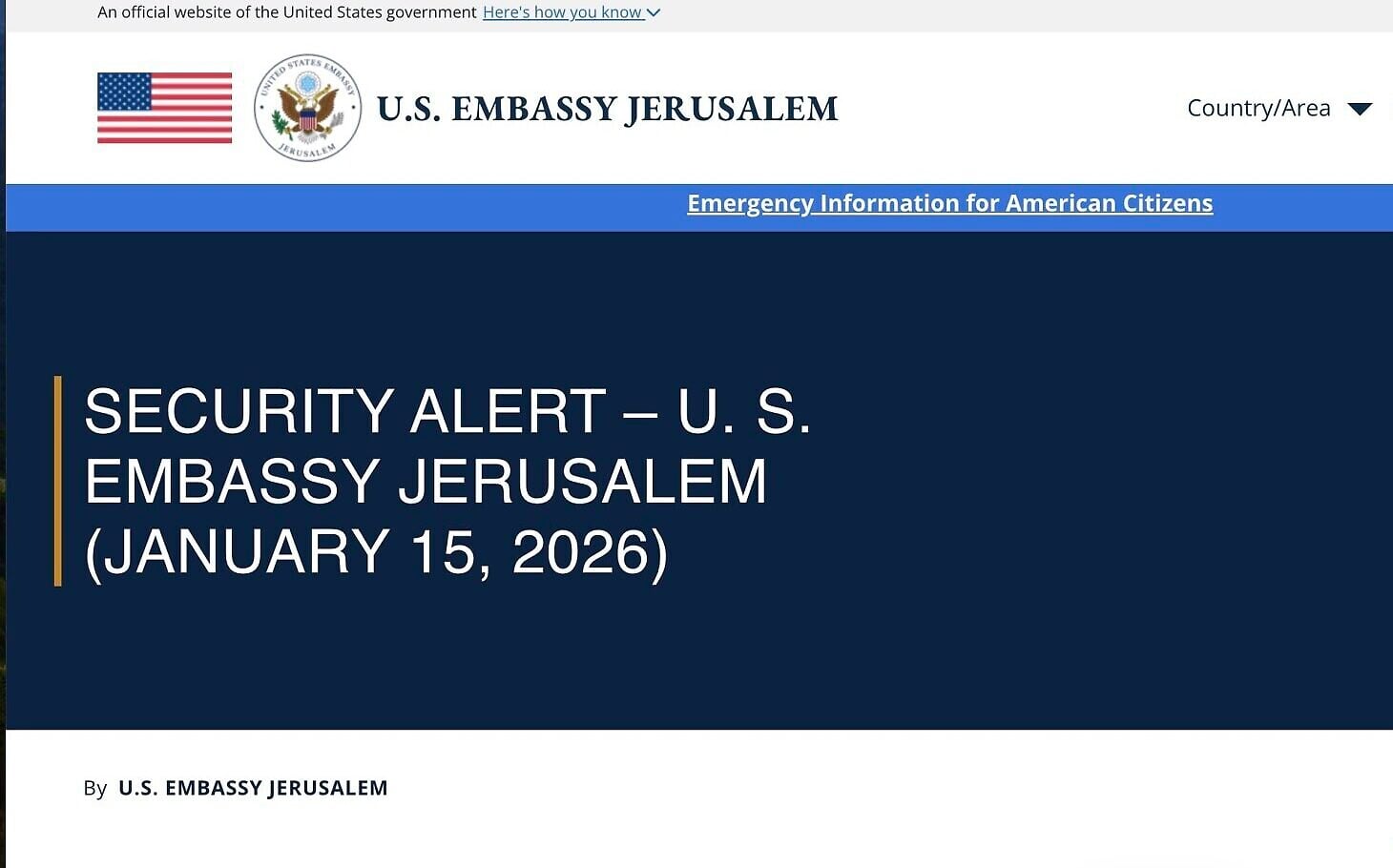
Screen capture of a US Embassy in Jerusalem security alert on travel to Israel, issued January 15, 2026. (US Embassy Jerusalem)
The US and the UK issued warnings on Thursday against travel to Israel, as tensions spiraled over the Iranian regime’s lethal crackdown on protests in the country and amid indications an American strike on the Islamic Republic could be imminent.
US President Donald Trump repeatedly warned, as demonstrations grew, that the regime’s use of deadly force against protesters would lead to American intervention. With thousands now reported dead, US military action has for several days been seen as imminent.
Iran has threatened that if the US attacks, it will target Israel as well as US bases in the region.
The US Embassy in Jerusalem published a new security alert advising American citizens that “given ongoing regional tensions,” they should “review any travel plans in case of disruptions, and make appropriate decisions for themselves and their families.”
The UK Foreign Office also issued a new travel advisory for Israel, warning British citizens to avoid visiting the country for “all but essential travel.”
“There is a heightened risk of regional tension. Escalation could lead to travel disruption and other unanticipated impacts,” the advisory said.
And several countries have put out warnings for their citizens to leave Iran, including the UK, India, Italy, Spain, and Poland. Last week, Australia told its citizens to leave the country “as soon as possible” due to the “volatile” security situation.
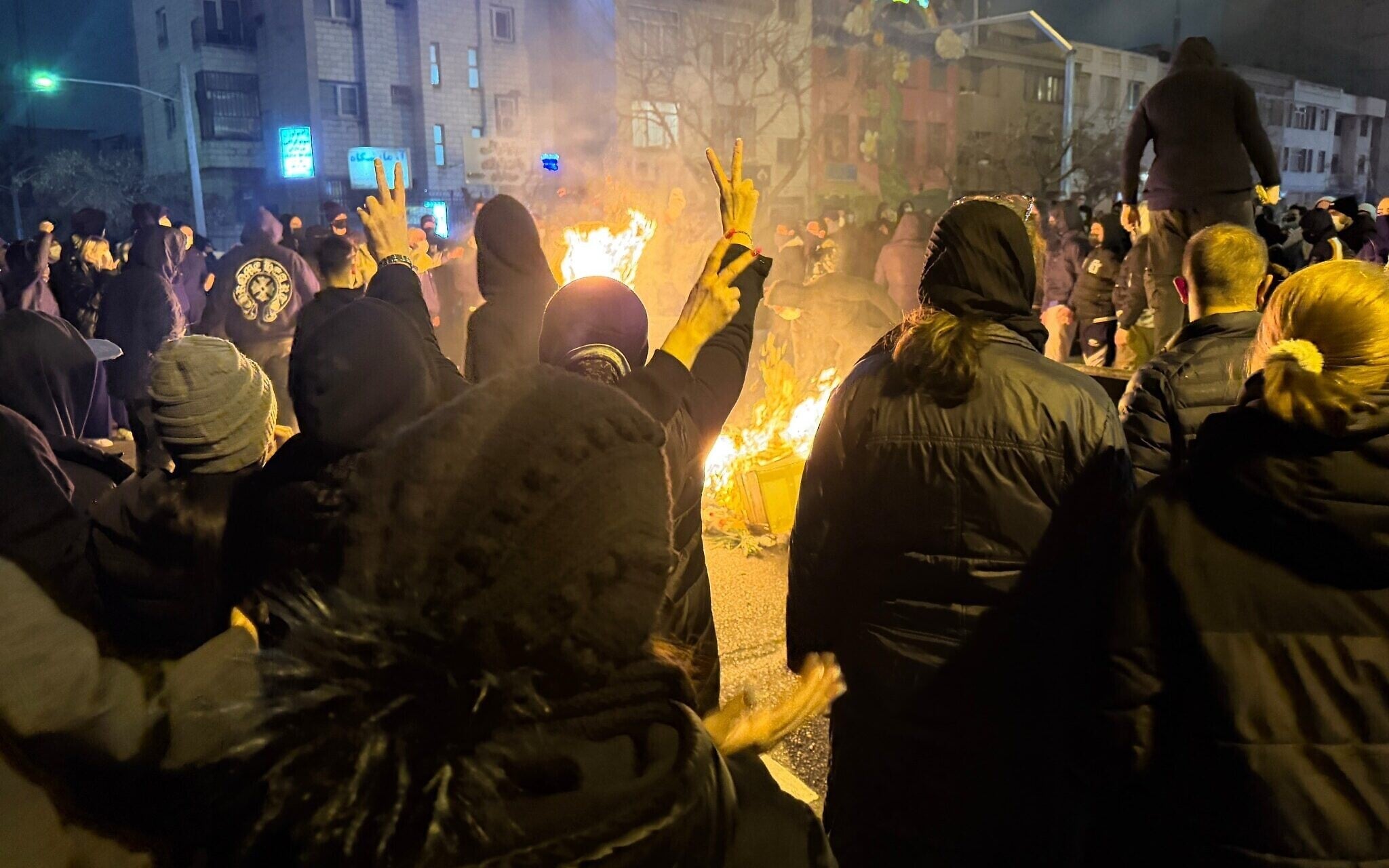
In this photo obtained by The Associated Press, Iranians attend an anti-government protest in Tehran, Iran, January 9, 2026. (UGC via AP)
Meanwhile, Britain shut its embassy in Tehran and withdrew its diplomats.
The UK Foreign Office said Wednesday that “we have temporarily closed the British Embassy in Tehran, this will now operate remotely.”
It said British staff had been withdrawn “due to the security situation.”
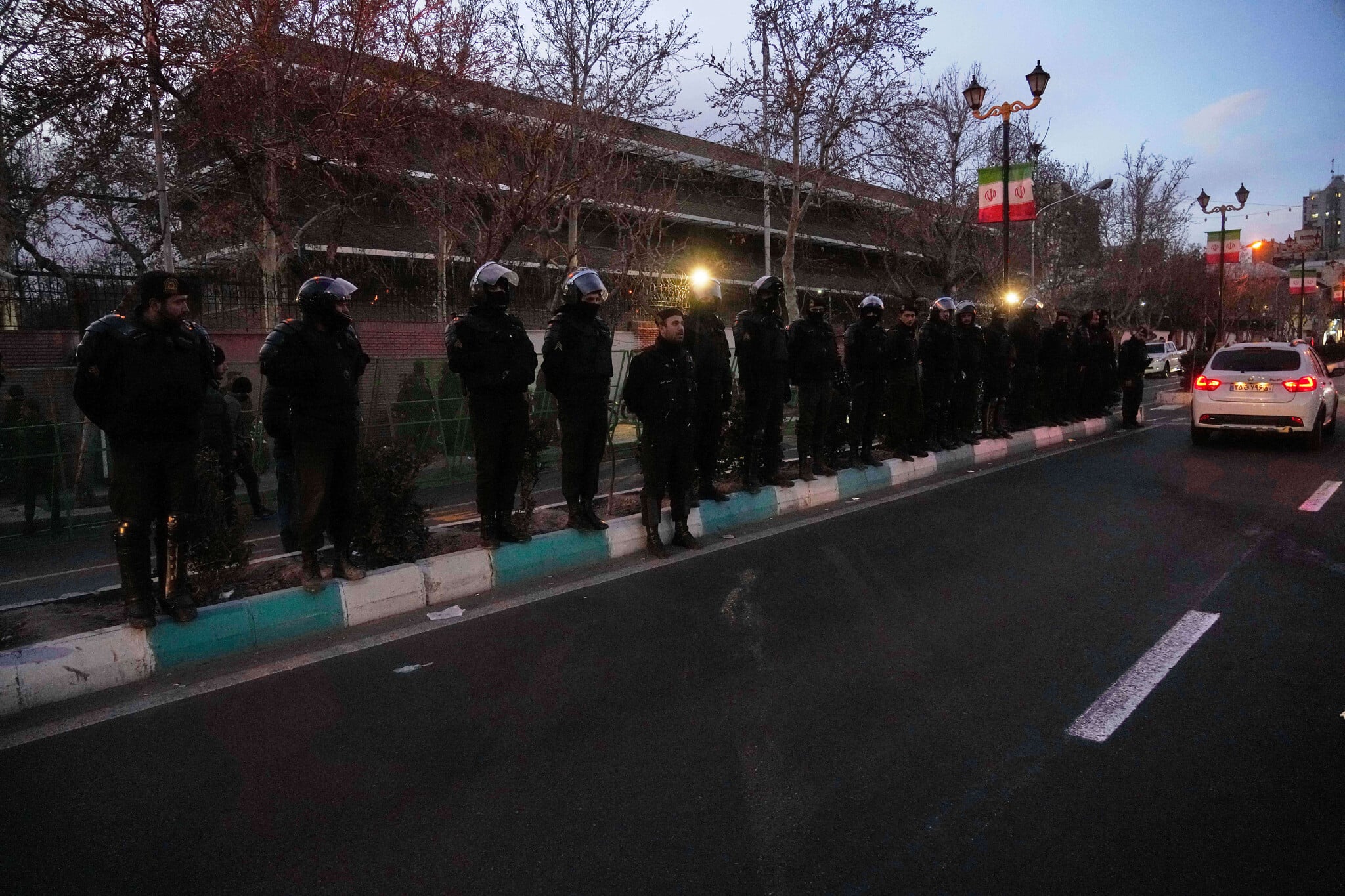
Policemen protect the British Embassy during a protest by hardline supporters of the Iranian government, in Tehran, Iran, January 14, 2026. (Vahid Salemi/AP)
Dozens of Pakistani students studying in Iran returned home through a remote southwestern border crossing, a Pakistani immigration official said Wednesday.
Mudassir Tipu, Pakistan’s ambassador to Iran, said Tuesday that Iranian universities had rescheduled exams and permitted international students to leave the country.
Further afield, the US Embassy in Kuwait said it had ordered a “temporary halt” on personnel traveling to multiple military bases in the small Gulf Arab country.
In Qatar, some personnel had been told to leave the Middle East’s largest US base. The precautions at Al Udeid were “in response to the current regional tensions,” Qatar’s International Media Office said.
In Saudi Arabia, the US embassy told staff and American citizens “to exercise increased caution and limit non-essential travel to any military installations in the region.”
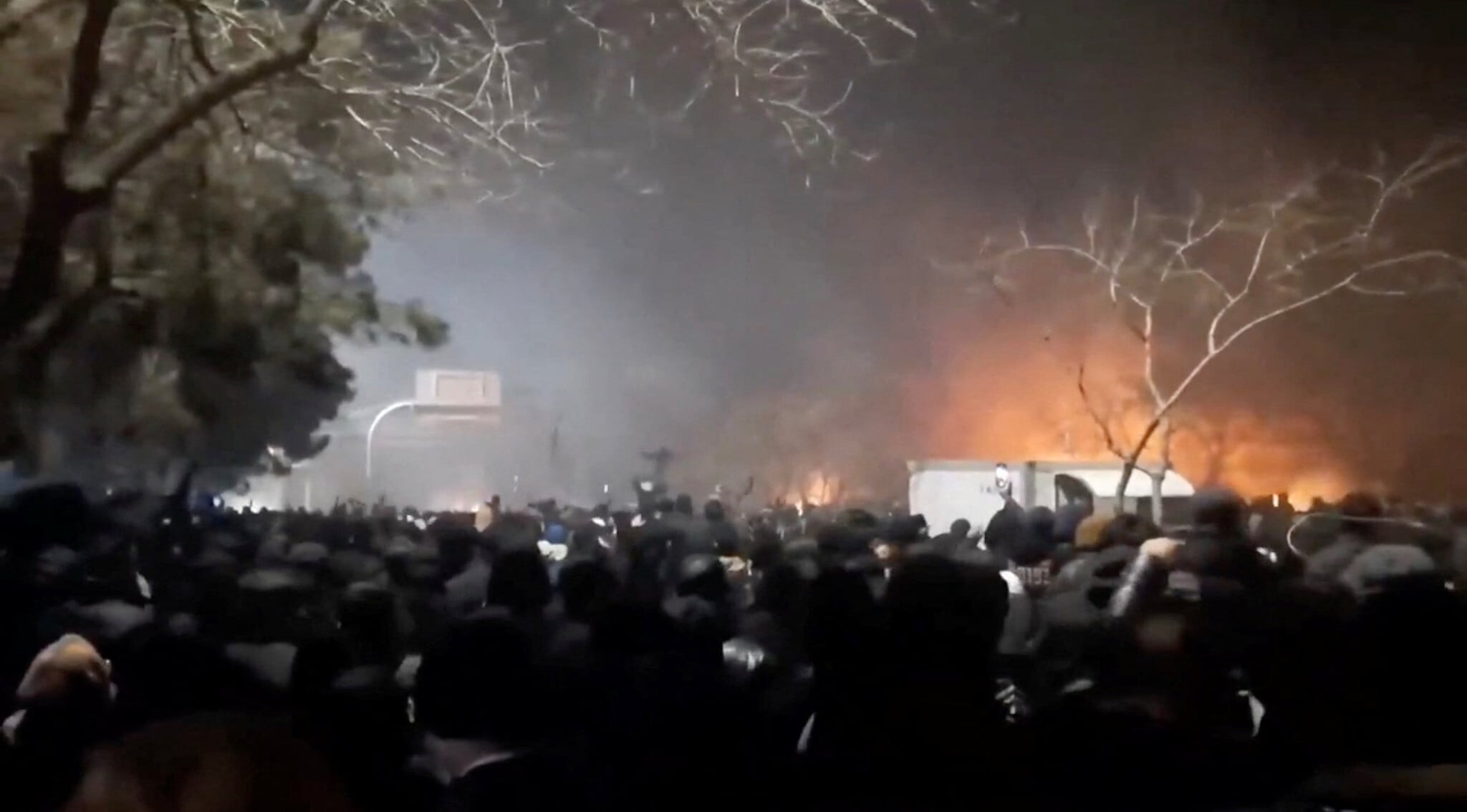
Smoke rises as protesters gather amid evolving anti-government unrest at Vakilabad highway in Mashhad, Razavi Khorasan province, Iran, January 10, 2026, in this screen grab obtained from a social media video. (SOCIAL MEDIA/via REUTERS)
Also, the French embassy in Bahrain asked citizens to be especially vigilant due to the “security situation in Iran and its potential local repercussions,” in a statement on social media.
The US Navy’s Fifth Fleet, which oversees the region, is based in Bahrain, which also hosts a British naval facility.
Iran closed its airspace to commercial flights for several hours on Wednesday, before reopening it for travel.
The Lufthansa Group said Wednesday it will operate only daytime flights to and from Tel Aviv’s Ben Gurion Airport in the coming days, citing the “current situation in the Middle East.”
The group — whose carriers include SWISS, Austrian Airlines, Brussels Airlines, and Eurowings — said it “has decided to operate flights to and from Tel Aviv and Amman from Thursday, January 15 as day flights until and including Monday, January 19, 2026.”
“This means that crews will fly back directly without an overnight stay on site,” a Lufthansa representative said in a statement. “Some flights may also be canceled.”
“Additionally, Iranian and Iraqi airspace will be bypassed by all Lufthansa Group Airlines until further notice,” the airline said.
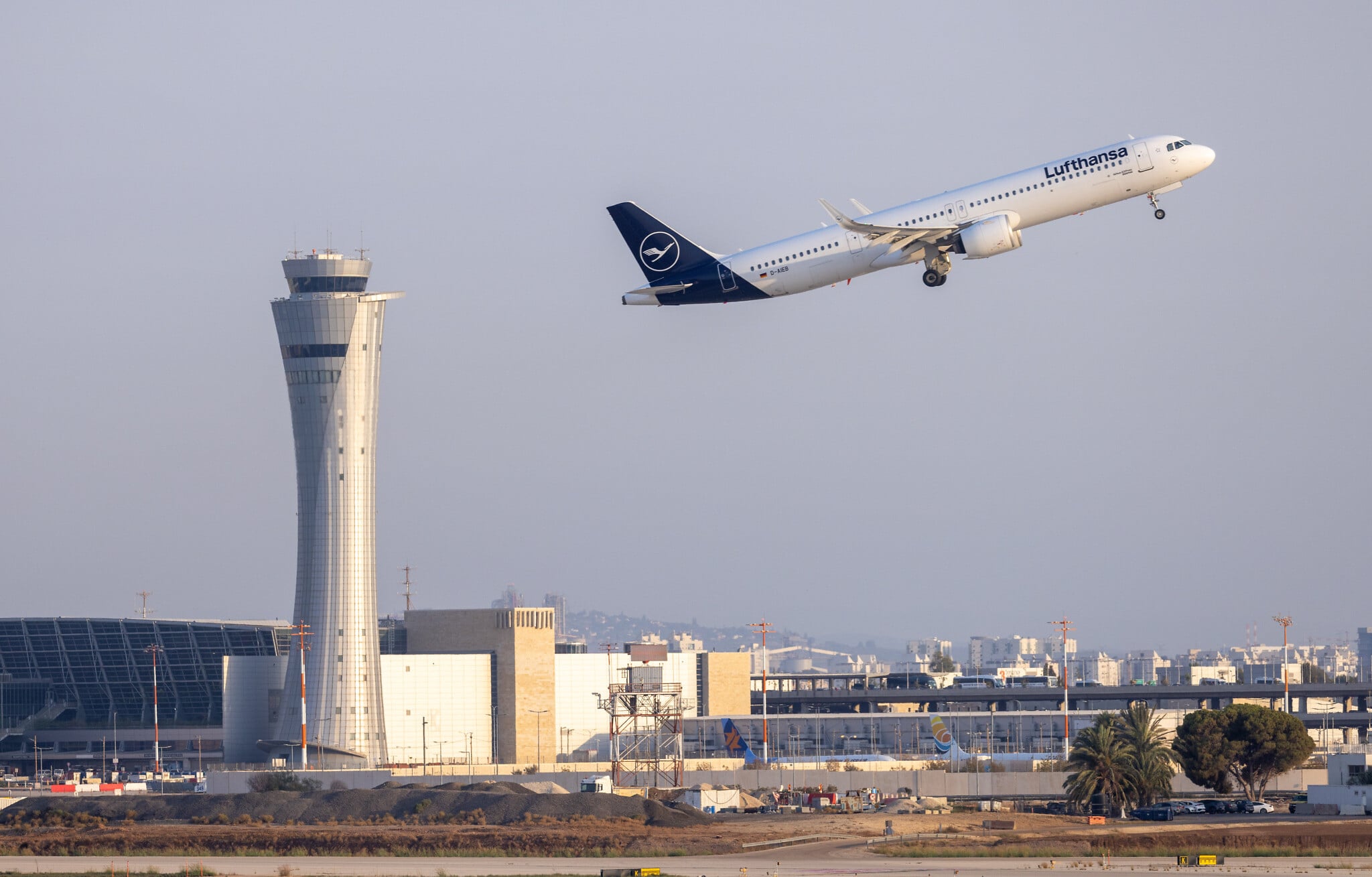
A Lufthansa plane takes off at Ben Gurion International Airport, outside of Tel Aviv, August 14, 2025. (Yossi Aloni/Flash90)
The Lufthansa Group said it was “monitoring the situation closely and will continue to assess the situation in the coming days. Affected passengers will be automatically rebooked and proactively contacted.”
Trump has been openly threatening to intervene in Iran for days, though without giving specifics. The Iranian protests began as economic rallies on December 28, but rapidly ballooned into mass anti-regime demonstrations.
On Wednesday, the US-based Human Rights Activists News Agency said that at least 2,571 people had been killed and more than 18,100 had been arrested in the more than two weeks of protests. Israel’s Mossad spy agency is said to believe the death toll is more than twice as high. An Iranian-linked opposition site has claimed it has evidence of over 12,000 dead.
The statement put Rajji in the crosshairs of Hezbollah supporters, with several prominent figures releasing statements condemning the Foreign Minister and his statement during the interview.
LEBANESE FOREIGN MINISTER Youssef Rajji attends a press conference during his Syrian couterpart Asaad Al-Shibani’s first official visit since the fall of Bashar al-Assad, at the foreign ministry in Beirut, Lebanon, October 10, 2025.(photo credit: REUTERS/MOHAMED AZAKIR)ByTZVI JASPERUpdated: Youssef Rajji, the Minister of Foreign Affairs of Lebanon, said that “so long as Hezbollah is not completely disarmed, Israel has the right to continue its attacks,” in an interview with Sky News, N12 reported on Wednesday.
The statement put Rajji in the crosshairs of Hezbollah supporters, with several prominent figures releasing statements condemning the Foreign Minister and his statement during the interview.
Lebanese pro-Hezbollah newspaper Al Akhbar published a piece describing Rajji as the “speaker of the enemy in the government,” and called for the Lebanese Prime Minister and President to take action against him.
Hezbollah supporters attend a ceremony held by Hezbollah to commemorate the first anniversary of their late leader Hassan Nasrallah’s killing by Israel, on the outskirts of Beirut, Lebanon, September 27, 2025 (credit: REUTERS/MOHAMED AZAKIR)
“He did not hesitate to turn the Foreign Ministry into a mobile mouthpiece for distraction, using diplomatic hybrid language which addresses the other side using rhetoric and not political speech,” Al Akhbar said. “There is no point in warning him, or directing his attention away, because the whole Foreign Ministry is no longer Lebanese in its rhetoric or role.”
Hezbollah member of Parliament stands gainst Rajji
Ali Ammar, a Hezbollah member of the Lebanese Parliament, also denounced Rajji, calling him “a resonant political, national, and moral failure.”
Ammar also urged the Prime Minister and President to take a stand against Rajji’s words.