‘There is a lot of unpublicized tension in Iran-China relations,’ expert tells The Media Line.

A map of China's One Belt, One Road initiative (photo credit: BOBBY YIP/ REUTERS)
A map of China’s One Belt, One Road initiative
(photo credit: BOBBY YIP/ REUTERS)

Last year, Iraq became a top recipient of Chinese investment and a key link in Beijing’s Belt and Road initiative. Almost 20 years after the war in Iraq began, billions of Chinese yuan are being invested in assorted projects, from green energy capabilities and heavy oil plants to building roads and schools. What role does Iraq play in China’s “Belt and Road” strategy and how does this development affect the big power competition in the Middle East?

‘Ideal Middle Eastern venue for Chinese investment’

In Tehran last March, the Chinese and Iranian foreign ministers signed a 25-year cooperation agreement (a “Comprehensive Strategic Partnership”). Under the accord, Beijing promised to invest $400 billion in Iran’s economy in exchange for a steady and heavily discounted supply of oil.

This agreement and its implications for global security and economy were widely discussed back then. But as 2021 neared its end it became clear that Iran’s neighbor and ex-nemesis Iraq was the real star of the Chinese Belt and Road strategy in the Middle East.

According to a report from Fudan University’s Center for Green Finance and Development in Shanghai, last year Iraq received $10.5 billion in investment under the Belt and Road infrastructure initiative. Iraq has become the third-biggest Belt and Road partner in energy engagement, after Russia and Pakistan. Overall Chinese investment in Arab and Middle Eastern countries rose by about 360% in 2021, while construction engagement increased by 116%, compared to 2020, the study said.

A screen shows a CCTV state media broadcast of Chinese President Xi Jinping's visit to Wuhan at a shopping centre in Beijing as the country is hit by the outbreak of the novel coronavirus, China, March 10, 2020 (credit: REUTERS/THOMAS PETER)A screen shows a CCTV state media broadcast of Chinese President Xi Jinping’s visit to Wuhan at a shopping centre in Beijing as the country is hit by the outbreak of the novel coronavirus, China, March 10, 2020 (credit: REUTERS/THOMAS PETER)

Nowadays China is involved in the building of Al-Khairat heavy oil power plant near Karbala. It took the promise to finance construction of 1,000 schools (and some 7,000 schools in the future) in return for oil products to secure the Al-Khairat deal. China’s state company also won the contract to develop the Mansuriya gas field and there is no shortage of other industrial and civil projects.

“I’m a bit surprised by the fact that Iraq is now the third-largest BRI [Belt and Road Initiative] country since China has a great deal of attention and money invested in Kazakhstan, it is very focused on Central Asia, it conducts business in Egypt and builds cities there,” Carice Witte, the founder and executive director at SIGNAL – Sino-Israel Global Network & Academic Leadership, told The Media Line.

“In my opinion, Iraq being the third-largest BRI country says a number of things: first of all, that Iraq is a less controversial investment than Iran, that it has a great deal of untapped potential and easier access than Iran. And also, that the Iraqi government and people are easier to negotiate with and to do business with than Iranians,” she continued.

“The Chinese have always found it extremely difficult to do business with Iran and there is a lot of unpublicized tension in Iran-China relations. Due to China’s dependence on Saudi and Gulf energy, they feel it’s important to cultivate another significant source of oil. Iraq is a very young market that needs to grow, needs everything and has a way to pay for it (unlike Syria which has limited oil reserves and Lebanon which has none). When you think about it, Iraq is the ideal venue for China in the Middle East,” Witte said.

After 20 years of US presence, it’s China that delivers the goods

The Iraq-China relationship dates to when Beijing was selling Baghdad weapons in the 1960s and 1970s while Iraq supported its claim to a seat on the UN Security Council. Relations developed further during the 2000s, after Saddam Hussein’s regime was toppled. China, along with Russia, was fiercely opposed to the Iraq War, yet it became one of its main beneficiaries.

In 2008, the China National Petroleum Corporation signed a huge production deal with the Iraqi government and became the first foreign firm to do so since the war. In 2013, China bought almost half of Iraqi oil production. During these years Iraq acquired Chinese drones to fight ISIS, supported the Hong Kong national security law at the UN and defended China’s treatment of Muslims in Xinjiang.

Witte explained that since Iraq’s hopes to see America more involved and supportive of its development didn’t materialize, it is looking for deeds, not words.

“There was a time of excitement about the potential of American support for Iraq, and during that time the plans for cooperation with China were stalled. China is patient and it is able to wait until a new opportunity presents itself,” the expert said.

“And after watching the US behavior in the Middle East over the last few years, the reality sank in that the US cannot necessarily be counted on. America wants to give, but not to do. It gives money, but it doesn’t go and improve the situation of the locals. That’s why we have Chinese everywhere – because the Americans don’t do the work anymore,” Witte said.

Eric Davis, professor of political science at Rutgers University and former director of its Center for Middle Eastern Studies, recently tweeted, “When the United States asks why China has become a stronger global power, you should realize that China plays a strong role in investing in developing countries like Iraq. China is investing in the natural gas and solar energy industries in Iraq and is building an airport. Where are the American investments?”

‘The Silk Road Axis’

Not all Iraqis are happy with these developments, just as not all Iranians welcomed the 25-year cooperation agreement signed with China.

Former MP Ghaleb Muhammad Ali wrote in his social media accounts that while China imports crude oil at the price of $70 per barrel, Iraq imports the same volume of Chinese gasoline for $200, indicating that Beijing is getting the better of this cooperation.

Dr. Ronen Zeidel, an Iraq specialist at the Tel Aviv-based Moshe Dayan Center for Middle Eastern and African Studies, said, “On one hand, the Iraqis are highly engaged with the Chinese. They let them access the Iraqi oil market and the Chinese promised to build schools and other infrastructure. Schools are very important since there are plenty of schools in horrible condition and it’s something that is highly discussed in Iraq.

“However, many are also afraid of the barter principle – exchanging their oil for infrastructure, like in Africa. Opponents of Iran fear that pro-Iranian militias’ violence also has something to do with Chinese involvement. They even call it “the Silk Road Axis,” Zeidel said.

Since the 25-year cooperation agreement was signed last year, Iran has seen a few anti-Chinese protests. Demonstrations were staged near parliament where the protesters chanted slogans such as “Iran is Not for Sale” and “Death to Those Who Sell the Homeland.”

Nothing of the kind has taken place in Iraq, where, according to Zeidel, the physical presence of China is not as widespread as in Africa or some parts of Europe. “Iraqis are both drawn to China, since they want their country to develop, and afraid of it,” he said.

The experts are certain that cooperation between China and Iraq will keep growing in 2022, even if the volume of investment does not expand.

Will Chinese involvement contribute to stabilization of the situation in and around Iraq? Some believe this will be the case, due to Chinese concern over disruption of oil supplies. For now, it’s clear China is slowly but surely building its position in the Middle East and that this new reality will affect the global power competition worldwide.
Israel, Gulf States in discussions for air defense systems

The famed Iron Dome system is not the only system that could be on the table.

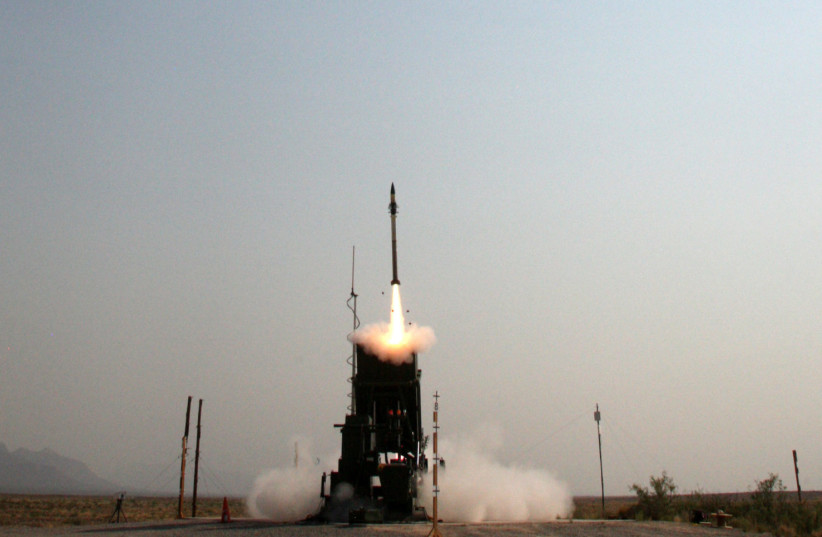
 The Iron Dome missile defense system in action. (photo credit: Israel Defense Ministry Spokesperson’s Office)
The Iron Dome missile defense system in action.
(photo credit: Israel Defense Ministry Spokesperson’s Office)

As rocket and drone attacks against the United Arab Emirates have increased, talks are underway between Israel and several Persian Gulf states to understand what air defense systems are most relevant for the threats that they face.

Though Israel’s famed Iron Dome system has made headlines around the world for its interceptions during the numerous rounds of conflict with the Hamas-run Gaza Strip and has been touted as the system most likely to be sold to countries interested in such platforms, Jerusalem has a variety of air defense systems.

Discussions with the Gulf countries centered around shared threats such as rocket and drone attacks. The discussions allowed Israeli officials to understand that the Jewish State has other systems that may be a better solution to such threats.

Israel, the United Arab Emirates, Bahrain, and a number of other Arab countries signed normalization agreements in 2020 as part of the Abraham Accords, bringing years of covert contacts into the open.

The UAE has faced a number of missile attacks launched by Iran’s Houthi rebels in Yemen in recent weeks, including during the trip of Israel’s President Isaac Herzog to Abu Dhabi and in January that killed three foreign workers.

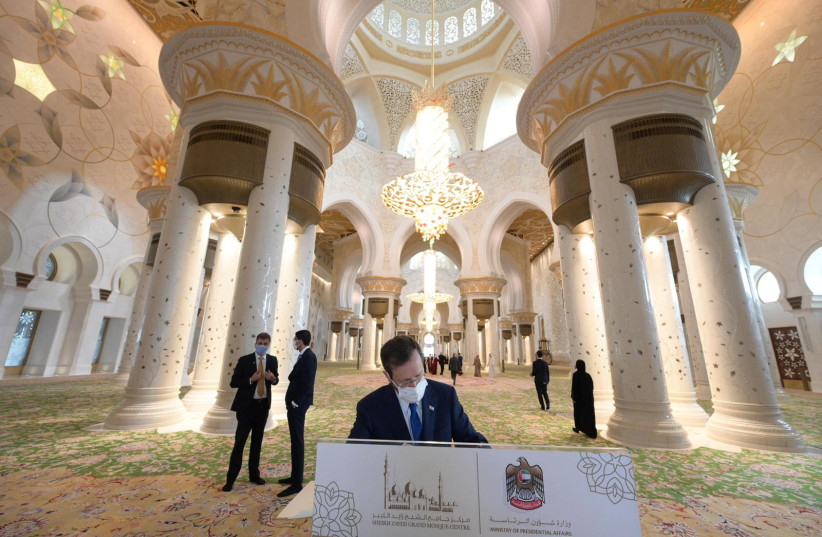
 Israel President Isaac Herzog and his wife Michal visit the Sheikh Zayed mosque in Abu Dhabi. (credit: AMOS BEN-GERSHOM/GPO)Israel President Isaac Herzog and his wife Michal visit the Sheikh Zayed mosque in Abu Dhabi. (credit: AMOS BEN-GERSHOM/GPO)

Other attacks were intercepted by American Patriot systems.

While the UAE has highly formidable medium-to-high altitude air defense systems, following the attacks, both France and the United States announced that they would assist the country in defending against missiles and rockets.

Israel has also offered the UAE support against such threats and Defense Minister Benny Gantz recently returned from a historic trip to Manama where he signed the first Memorandum of Understand with the Kingdom.

The agreement will set a solid security cooperation framework that formalizes defense relations between the two countries, allowing for increased cooperation in various fields such as intelligence sharing,military-to-military training, the cooperation between defense industries and more.

The public meetings, a year after the Abraham Accords were signed, come as tensions with the Islamic Republic are at an all-time high, and missile attacks by their proxies in Yemen and Iraq against the United Arab Emirates have increased.

During his visit, Gantz said that the defense agreement “will contribute to the security of both countries and the stability of the region.”

The systems that may have been discussed include Rafael Advanced Defense System’s SPYDER mobile defense system and Israel Aerospace Industries’s Barak 8 Medium-Range Surface-to-Air Missile system.

The SPYDER, which was on display at IDEX 2021 late last year, has already been purchased by several other countries. The mobile system incorporates Rafael’s advanced Python-5 and I-Derby missiles to provide short, medium, and long-range protection against a range of threats including attack aircraft, cruise missiles, unmanned aerial vehicles, stand-off weapons and more.

The system, which uses electro-optical observation payload and wireless data link communication, can engage multiple threats simultaneously up to 80 kilometers away in all weather conditions.

SPYDER has been sold to several international customers, including the Czech Republic.

The Barak-8 MR-SAM system is able to shoot down enemy aircraft at a range of 50-70 kilometers, the system is designed to defend naval vessels against a myriad of short-to-long range airborne threats like incoming missiles, planes, and drones at both low or high altitudes.

It is jointly developed by India’s Defence Research and Development Organisation (DRDO) in close collaboration with Israel’s Israel Aircraft Industry (IAI)’s Elta, RAFAEL, and additional companies in both countries are used by Israel’s navy as well as by India’s naval, air and ground forces.

The system integrates several advanced state-of-the-art systems including a digital radar, a command and control system, tracking radar launchers, interceptors with advanced homing radio frequency (RF) seekers, data link, and system-wide connectivity. It is also able to engage multiple targets simultaneously in severe saturation scenarios and can be operated in all types of weather.

There are also reports of Morroco being interested in the system.

In addition, there are also several Israeli anti-drone systems that may be on the table, including Rafael’s Drone Dome which is described by the company as an “end-to-end system designed to provide effective airspace defense against hostile drones used by terrorists to perform aerial attacks, collect intelligence, and other intimidating activities.”

The all-weather system has a 360-degree circular coverage and is designed to rapidly detect by an electro-optical/infrared sensor and radar, track and neutralize all types of UAVs that have been classified as threats to a distance of up to 10 km.

It can neutralize the drone by jamming radio frequencies to prevent the drone from being able to move, a high-pressure water gun or it can be equipped with a laser beam to destroy the hostile aerial vehicles depending on the threat.


Israel yet to officially respond to move by US, but sources tell Haaretz that relief on Tehran’s civil atomic program is technical step, not a sign of progress in nuclear talks


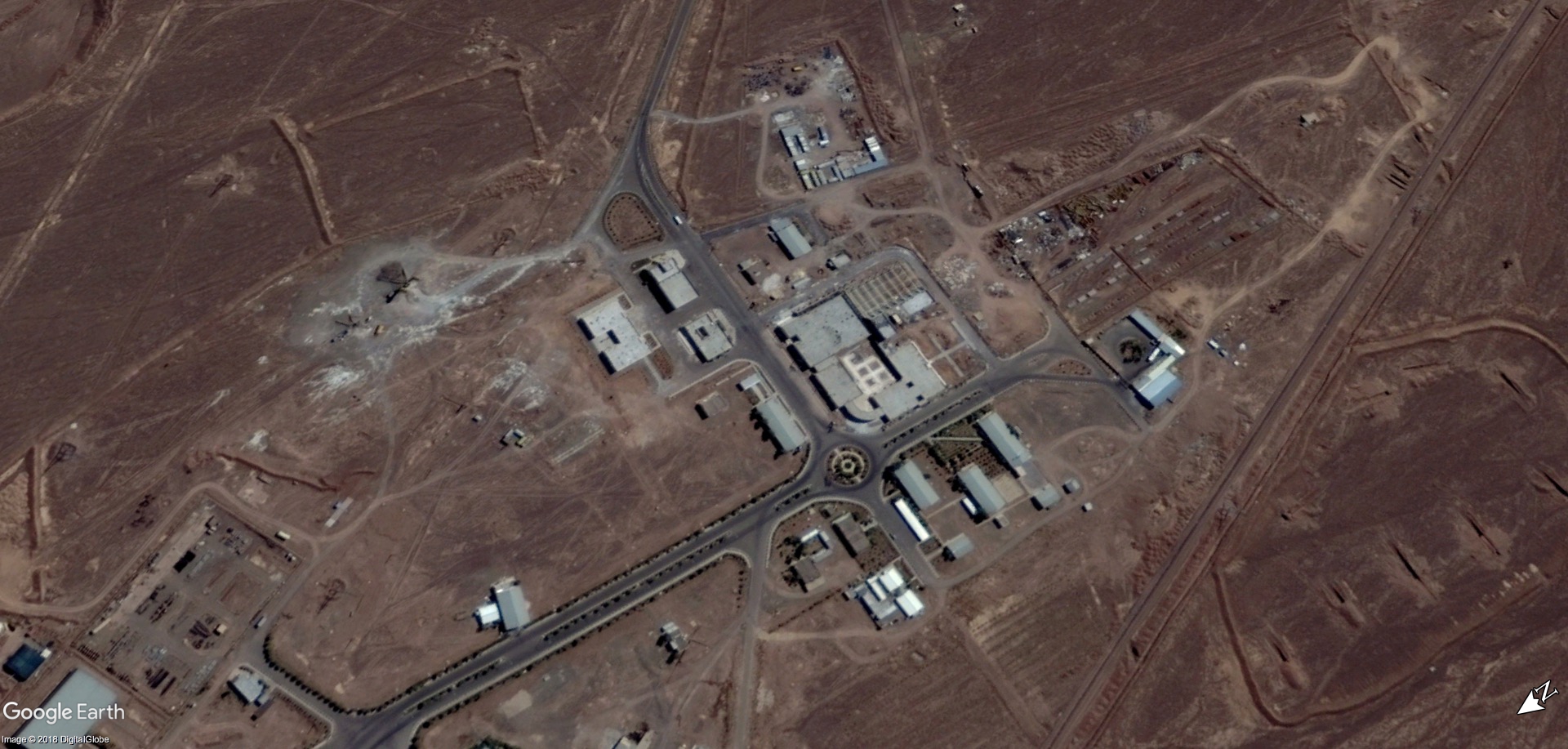
A satellite image from September 15, 2017, of the Fordow nuclear facility in Iran. (Google Earth)

A satellite image from September 15, 2017, of the Fordow nuclear facility in Iran. (Google Earth)

The US decision to ease sanctions on Iran on Friday includes six clauses that now allow foreign countries and companies from Russia, China, and Europe to cooperate with non-military parts of Iran’s nuclear program, according to several reports.

According to a State Department notice cited by Reuters and the Haaretz daily, the clauses included permitting the modification of Iran’s Fordo facility to become a research center for the production of stable radioactive isotopes — used for medical purposes — with Russia.

Reports said Britain and China can now help Iran redesign its Arak heavy-water reactor to a light-water reactor. A light water reactor, like the one Iran has at Bushehr, is used to generate electricity.

As originally designed, the reactor at Arak could have produced substantial amounts of plutonium, material that can be used as the fissile core of a nuclear weapon.

The waiver also allows the Russian supply of nuclear fuel to the Tehran research reactor and Bushehr nuclear power plant, as well as the export of excess heavy water if Iran exceeds the 130 metric tons limit under the 2015 agreement.

Heavy water contains high concentrations of the hydrogen isotope deuterium and is used to produce plutonium, an alternative to uranium for manufacturing atomic weapons.

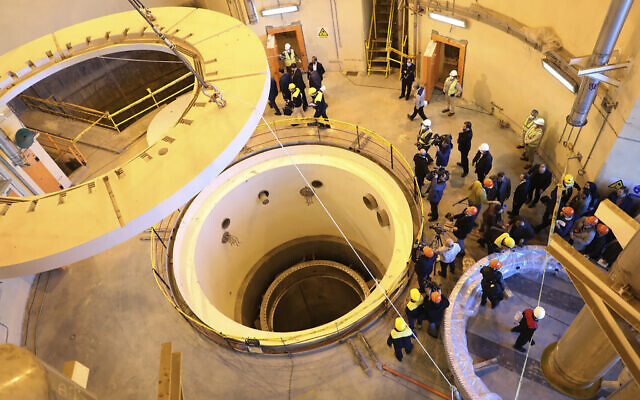
Technicians work at the Iranian Arak heavy water reactor, 150 miles southwest of the capital Tehran, on December 23, 2019. (Atomic Energy Organization of Iran via AP)

Lastly, the reports said the sanctions relief allows Iran to receive yellowcake from Russia, a precursor to enriched uranium. Yellowcake is produced by mining uranium ore from rocks and separating the uranium from the rocks by bathing them in acid. The yellowcake can then be converted, enriched to raise its purity, and then used for weapons or energy production.

The Trump administration had ended the so-called “civ-nuke” waivers in May 2020 as part of its “maximum pressure” campaign against Iran that began when Trump withdrew the US from the deal in 2018, complaining that it was the worst diplomatic agreement ever negotiated and gave Iran a pathway to developing the bomb.

As a presidential candidate, Joe Biden made a US return to the nuclear deal a priority, and his administration has pursued that goal but there has been little obvious progress toward that end since he took office a year ago. Administration officials said the waivers were being restored to help push the Vienna negotiations forward.

“The waiver with respect to these activities is designed to facilitate discussions that would help to close a deal on a mutual return to full implementation of the JCPOA and lay the groundwork for Iran’s return to performance of its JCPOA commitments,” the State Department said in a notice to Congress that announced the move, referring to the 2015 agreement, formally called the Joint Comprehensive Plan of Action.

Israel did not immediately respond officially to the announcement, but sources involved in the matter told Haaretz that the sanctions relief was only a technical step and did not signal progress in the nuclear talks in Vienna.

Iran’s foreign minister on Saturday welcomed the US sanctions relief, but said the move was “insufficient.”

Critics of the nuclear deal who lobbied former US president Donald Trump to withdraw from it protested, arguing that even if the Biden administration wants to return to the 2015 deal it should at least demand some concessions from Iran before granting it sanctions relief.