Unique Sites of Israel: Biblical Tadmor (AKA Tamar)

By Nosson Shulman

Photo Credit: Bukvoed – CC BY 3.0

The originally Solomonic fortress at Tamar was tiny (see inside red circle).

“And Solomon built Gezer and the lower Beth-horon. And Baalath and Tadmor in the desert in the land. (1 Kings: 9: 17-18)”

“And the southern side is from Tamar until the water of Meriboth Kadesh to the stream [that falls] into the Great Sea; this is the southern side. (Ezekiel: 47: 19)”

4 chambered gate built by either King Amatzia, Uziah, or Yehoshafat when King Solomon’s city was expanded (circa 8th century BCE) 
Photo Credit: Hoshvilim- Creative Commons Attribution-Share Alike 4.0 International

Advertisement


Today, we are visiting a fascinating biblical site with well-preserved ruins from various time periods. Biblical Tadmor (aka Tamar) is an incredible site, in a region which seldom sees visitors. Even amongst Israelis, this region is usually just known as an area to pass through to get to Eilat. There is, however, much to do in this area and those who make the effort to visit Biblical Tamar are rarely disappointed. As a bonus, Israel’s oldest tree is located here, and there is also a crocodile farm!

The Jujube tree of Hatzeva is believed to be well over 1000 years (some say it may be close to 2000 years).
Photo Credit: Ariel Palmon and Ronly Konwieser –Creative Commons Attribution 3.0­­
Nile Crocodiles are bred at this location
Photo Credit: Shutterstock

Biblical Tamar is next to Ein Hatzeva (with a population of 50 residents).  Ein Hatzeva is a town located in the Aravah (in Israel’s deep south) which is an extreme desert, having only about an inch of rain per year. The land mass of this desert is huge (making up a whopping 17% of Israel’s total land mass) yet sparsely populated (around 7000 people or 0.00077% of its population). Even so, the region is an agricultural powerhouse (for example 85% of Israel’s peppers are grown here) due to Israel’s high-tech agricultural methods and state-of-the-art greenhouses.

Homes in the town of Ein Hatzeva, a small town of about 50 people.

The first to build here was King Solomon (see 1 Kings 9:17) who built a fortified settlement. How could people survive in an area with almost no rain? Until recently, this town was an oasis with a large freshwater spring (which no longer can be seen because the water is continuously channeled for agricultural use in the surrounding towns). Strategically, Tamar sat on the crossroads of two important routes. One of them (today’s route 227) connected the Kingdom of Edom (who were potential invaders) and Israel’s Negev desert to important coastal cities like Gaza. The other guarded the route (today’s highway 90) from the North and Center until biblical Etzion-Geber and its twin city Elath (today’s Eilat) which was an important port city for trade (see 1 Kings 10:22) and a naval base (see 1 Kings 9:26).

The originally Solomonic fortress was tiny (see inside red circle). After his reign, one of the Judean Kings built a much larger fortress (the pristine walls seen in the background) and used Solomon’s fortress within the structure as a partial foundation.
Photo credit: Bukvoed – CC BY 3.0

Within a few decades Solomon’s fortress was considered inadequate to serve its purpose, and a new, larger (50 x 50 meters) fortress was built. A few years later, an even larger fortress was built (100 X 100) which incorporated the (50 x 50) fortress into the structure, turning it into a fortress within a fortress. It was used as a storage room and silo, packed with lots of food in case of siege (even if most of the city were to be conquered, the inner fortress represented a defensive “second chance”).

The biblical fortress after it was enlarged (notice the older fortress on the righthand top) which was incorporated into the larger structure.
Photo Credit: MFA of Israel

One of the largest and most impressive from this era, the fortress was surrounded by mighty walls, (about 3 meters thick with dirt packed in between them) three protruding towers, and a powerful 4 chambered gate. As it continued to be on the main road from Edom (and Arabia) to Gaza’s port, this city became a way station for travelling traders of valuable goods. Who built this amazing structure? There are four possibilities:

  1. King Jehoshaphat who unsuccessfully attempted to rebuild commercial links with the city (see 1 Kings 22:49-50)
  2. King Amaziah who fought the Edomites (see 2 Kings 14)
  3. King Uzziah (son of Amaziah) who built up Elath (Eilat) and also “Towers in the Desert (see 2 Chronicles:26)”
  4. King Amaziah who built the first (50 x 50 meters) fortress, while his son Uzziah was responsible for expanding it to 100 x 100 meters.
Wall of the post-Solomon city of Tamar. On the top of the hill (in the background), the later Roman walls can be seen. Photo Credit: Hoshvilim- Creative Commons Attribution-Share Alike 4.0 International

In the days of King Uzziah, a major earthquake caused severe damage to the city (see Amos 1:1 and Zechariah 14:5. For more on this major event and recent findings connected to it, click here). Afterwards, it was rebuilt considerably smaller than before. This fortress was destroyed by Assyrian King Sennaherib during the days of the righteous King Hezekiah, although ultimately G-d performed miracles and Judah was saved from the Assyrians (see 2 Kings 19 and 2 Chronicles: 32).

Today the Sennacherib Prism (found in his ancient palace), where he explains his loss to the Jews, is housed in the famous British Museum.

Although the city remained destroyed, an open-air Edomite cultic site emerged here (this was close to Edom and merchants from that nation would stop here on route to Gaza, using it as a rest stop). During excavations, Archeologists discovered smashed Edomite idols and icons, believed to have been destroyed by the pious King Josiah during his campaign to eradicate temples and objects of idol worship throughout Israel (see 2 Kings: 23).

This Edomite cultic site was destroyed by King Josiah during his campaign against idol worship.
Photo Credit: Shutterstock

For the next couple of centuries, the semi-nomadic (and super wealthy) Nabateans (who famously built Petra as their capital city) used this site as a way station. The story of the Nabateans is one of the most fascinating in history. They originated from the deserts of Arabia and Yemen as nomads, trading in valuable spices and perfumes which they brought to the Port in Gaza.  They then exported them to Europe, where they were in high demand among the wealthy. Throughout most of history venturing deep into the desert was dangerous, as water was almost non-existent. Desert life, however, was all the nomadic Nabateans knew and they became adept at finding natural water sources (sometimes underground) and building structures that collected and stored almost every drop of the little rainfall that fell. The fastest way to go from Yemen to Gaza was in a straight line (which passed through the inhabitable Arabian deserts). However, throughout most of history traders had to go the long way from Yemen to Iraq, then Southern Turkey to Syria, and then on to Israel.  This obviously took a long time but to go through the desert would have been a death sentence. The Nabateans, however, could take the desert shortcut which became known as the Spice Route. To go even faster, they placed inns throughout the spice route at certain intervals (usually at a distance equivalent to 12 hours of walking).  They would then pass on the goods to another team who would continue the journey, while the original transporters would return home.  This system proved to be very effective and unprecedentedly lucrative (they yielded a profit of 16 times what they paid for it. This wealth allowed them to build cities like Petra). During the Nabatean period, Tamar was one of these inns.

Map of the Nabatean spice route, which made them fabulously wealthy. The red marker is added to show the approximate location of Tamar on the route.
Photo Credit: Gibson’s book: Qur’anic Geography-   Creative Commons Attribution-Share Alike 4.0 International

Towards the end of the 1st century CE, the Romans (who controlled most of Judea, but not Arabia) wanted to take control of the Nabatean lands, in order to be able to tax this lucrative trade. Rather than fight with the Nabateans (who unlike the Romans could just run back to the desert) the Romans went to the Nabatean King Rabbel II Soter and told him that they could remain independent during his lifetime, but that upon his death, his kingdom would be annexed to the Roman Empire. Upon his death in 106 CE, the Romans annexed the territory and turned it into the Roman province of Arabia. As this was the frontier of the Roman Empire (and to protect the profitable spice trade which passed through here) they built a new and stronger fortress on top of the Nabatean one.

During the second half of the 3rd  century (probably in the days of the Roman Emperor Diocletian) the Romans greatly expanded the fortress with strong walls and 4 protruding towers.

Remains of the Roman wall (likely) built by Roman Emperor Diocletian  
Photo Credit: Hoshvilim- Creative Commons Attribution-Share Alike 4.0 International

Outside of the fortress, a caravanserai (inn) for travelers was built. In addition, an impressive bathhouse was unearthed here. Why was such a large bathhouse needed for a small village in the desert? Because bathhouses were a major component of Roman culture, most towns (no matter how small) had to have a bathhouse (similar to how in present day, most European and North American towns have at least one bar or pub).

Remains of the Caldarium (hot room of the Spa). The brick arches seen in the background were stoves that heated the hot water baths above.
Photo Credit: Shutterstock

In 363 CE, the fortress was destroyed by one of Israel’s most destructive earthquakes (major cities like Petra, Sepphoris, Jericho and much of Jerusalem were destroyed as well). The fortress was never rebuilt, although the Byzantines had a small military outpost here. In the early Islamic period (circa 6th and 7th century) a small agricultural farm was located here and later abandoned. The site would remain uninhabited until the 1930s when a British Mandate police station was built for a Camel squad unit (officers here rode on camels, instead of horses). The British also built a water pump and well which can still be seen by tourists in its pristine shape.

This well was built by the British in the 1930s
Photo Credit: Shutterstock

During the 1948 war of independence the IDF captured the police station, and in 1960 the town of Ein Hatzeva was founded. On your next trip to Israel (and especially Eilat) I highly recommend taking the time to visit some of the great sites of the Aravah desert (of which there are many) including the beautiful ruins of Biblical Tamar!

Please visit the author’s site: https://guidedtoursofisrael.com

Editor’s Note: All commercial images were provided by and leased by the author.
 

By


Is Turkey reconciliation gaining support in Israel? – analysis

If Turkey really is a potential partner with Israel against Iran, how come Turkey adores Iran’s leadership and never opposes Iran?

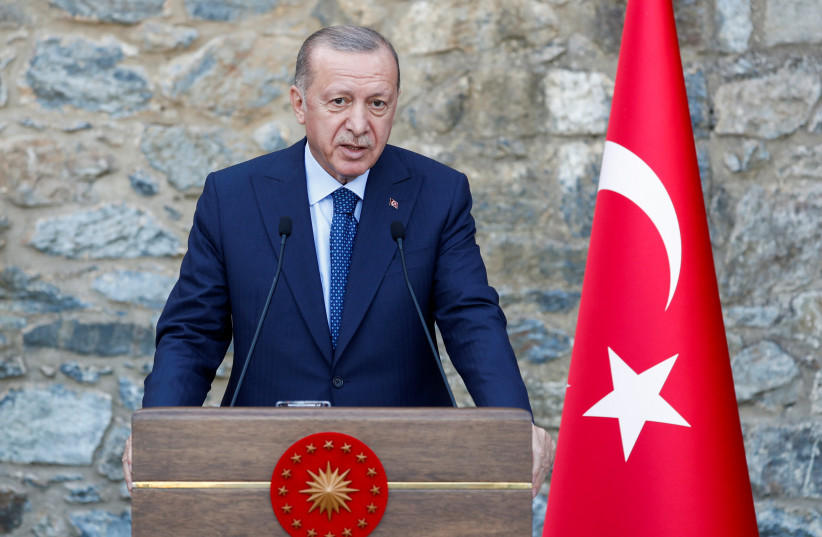
 Turkish President Tayyip Erdogan speaks during a news conference in Istanbul, Turkey October 16, 2021 (photo credit: REUTERS/MURAD SEZER)
Turkish President Tayyip Erdogan speaks during a news conference in Istanbul, Turkey October 16, 2021
(photo credit: REUTERS/MURAD SEZER)

Israel-Turkey relations have been reduced to their worst point in history over the last decade because of the actions of Turkey’s leader and the ruling party.

With its roots in the Muslim Brotherhood and support for Hamas, the AK Party and its leader Recep Tayyip Erdogan is a reactionary far-right religious party that has sought to transform Turkey into an authoritarian one-party state, while backing extremist groups in places like Syria. It has sought to take on an “Islamic” leadership role, not only backing Islamist groups but also championing “Islamic” causes. As part of this, the Palestinians loom large and support for Hamas is part of that cause.

However, despite Turkey’s obsessive anti-Israel policies, such as comparing Israel to Nazi-era Germany and hosting top-level Hamas terrorists who plotted attacks on Israel from Turkey, there has been a constant lobby to restore Turkey-Israel relations. This lobby is primarily made up of some pro-Israel voices, think tanks and a spectrum that stretches from the Left to Right. It is rooted usually in memories of the 1990s when Israeli parties on the Left and Right both held power and had positive relations with Turkey.

Supporters of reconciliation between Israel and Turkey don’t acknowledge that it is Turkey that primarily burned down the relationship due entirely to the ideology of the current regime in Ankara. Instead, the supporters posit that Israel and Turkey enjoy some strategic and economic interests and that they are somehow destined to work together.

This “geopolitical” destiny harkens back to the Cold War era, and supporters of Turkey are almost all people with worldviews rooted in the Cold war or 1990s era. For them Turkey is not a country made up of the ideological roots of the parties that run it, it is not a changing society with different views among its people, it is a “strategic” entity. It transcends politics and the current leader, and because of its position, between Europe and the Middle East, it is destined to clash with Iran and destined to be a conduit for Israeli economic needs.

 Natali and Mordi Oaknin on their way home to Israel after being released from jail in Turkey (credit: FOREIGN MINISTRY)Natali and Mordi Oaknin on their way home to Israel after being released from jail in Turkey (credit: FOREIGN MINISTRY)

This worldview, which posits that whether Turkey is run by ideological allies of the Taliban or Communists is immaterial; that Turkey hosts actual Hamas terrorists who plot to murder Israelis, is not a problem. That Turkey threatened to break off relations with the UAE to try to stop the UAE making peace with Israel, is not a problem. That Turkey sent hundreds of men armed with melee weapons on the Mavi Marmara to try to infiltrate Gaza by sea, is not a problem. That Turkey’s leader has often compared Israel to the Nazis, is not an issue. For the reconciliation narrative, all this is just rhetoric. What matters is strategy.

The latest “reconciliation” talk began, as it usually does, in Ankara. Ankara has floated reconciliation in the past, usually as a way to try to sabotage Israel’s relations with Greece and isolate Israel. Reconciliation is a tool for Ankara to gain things it wants. For instance, it sought to send an envoy to Israel that was openly anti-Zionist. That was “reconciliation.” It also wants to prevent an Israel-Greece pipeline and energy deals. It also wants its economy to improve and also wants better relations with the US. Turkey’s leadership has plunged the country into economic disaster and inflation increases. Ankara thinks that Israel can be an economic lifeline.

In every “reconciliation” story there is nothing that Israel gets from better ties with Ankara.

In the recent bout of “reconciliation” talk from Ankara, Erdogan announced that Israel’s president would visit Turkey. He didn’t coordinate this announcement with Israel and purposely sought to force Israel’s hand in this matter. It turns out that Israel’s president is about to visit the UAE, so Turkey sought to upstage that visit. This is not the announcement of a friend, to go against protocol and try to force Israel’s president into a visit. The goal of Ankara was clear: Force Israel to either confirm or deny the visit. Turkey often abuses Israel to get things it wants. Last year Turkey detained an Israeli tourist couple for no reason. This was said to be part of how Turkey wants “reconciliation.” The idea is that if Israel doesn’t do what Turkey wants, then more Israelis might be detained or disappeared. Reconciliation is always achieved through threats by Ankara.

Those who back reconciliation tend to argue that there are economic benefits for Israel. There is little evidence of this. Israel’s economy has performed well over the last decades. Israel already has trade with Turkey. It is Turkey’s economy that is in free-fall and it’s unclear why Israel would want exposure to this economic shambles. Closer economic ties with the Gulf and stable Asian countries would appear more productive.

Another argument is that Turkey somehow agrees with Israel on Iran issues and Syria. This theory asserts that Turkey is a natural rival of Iran. This is because people think that Turkey is a “Sunni” country and thus destined to fight the “Shia” in Iran. Also because some argue that the Ottomans are historic rivals of the “Persians.” Thus these countries must always fight each other. Surely some misreadings of European history would have one posited that Catholic and Protestant countries will always war, and that France and Britain are bitter rivals. But history tells us that simplistic stories about how countries have to be “geopolitical” rivals is largely a myth based on bad academic studies in the West. The same logic guides the US to work closely with China “against” Russia for decades, only to find out that China and Russia both oppose the US “geopolitically” in the world.

There is no evidence of Turkey and Iran clashing. In the opposite, while Turkey’s regime was destroying relations with Israel over the last decade, it was growing closer to Iran. While Israeli ambassadors were sent packing in Ankara and there were no high-level visits, Turkey’s leadership often hosted its Iranian friends. Meanwhile at think tanks in the US and Israel experts continued to argue that Turkey would work with Israel against Iran. If Ankara wanted to work against Iran in Syria or the region, it would have done this over the last decade. Instead, Turkey devotes its resources to using drones to attack Kurds and Yazidis in Iraq and Syria, and encouraged war between Azerbaijan and Armenia, and threatens Greece. Turkey basically fights everyone, except Iran.

At each juncture the question should be raised, if Turkey really is a potential partner with Israel against Iran, how come Turkey adores Iran’s leadership and never opposes Iran, and compares Israel to the Nazis? The idea is that Israel should “reconcile” with Turkey, which is the country that ruined the relationship, with the hope that in years and year maybe Turkey will want to do something regarding Iran? This is based on the fantasy that Turkey’s leadership doesn’t make its own decisions, but can be somehow influenced by Israel. Yet the leadership in Ankara has made its decisions clear. It has ample opportunity to remove Hamas, confront Iran, or put out positive messages about Israel.

Announcing Israeli presidential visits without coordination isn’t a sign of respect for Israel, it’s just another way to try to muddle Israel-UAE relations. At every step, Turkey has no interest in doing anything that Israel wants. And yet the “reconciliation” narrative continues.

https://www.jpost.com/middle-east/article-694967


Macron tells Iran’s Raisi more effort needed in nuclear talks

Mac

Iran has rejected any deadline imposed by Western powers.

FRENCH PRESIDENT Emmanuel Macron speaks during a video conference with international partners to discuss humanitarian aid for financially-strapped Lebanon, in Paris on December 2. (photo credit: IAN LANGSDON/POOL VIA REUTERS)
FRENCH PRESIDENT Emmanuel Macron speaks during a video conference with international partners to discuss humanitarian aid for financially-strapped Lebanon, in Paris on December 2.
(photo credit: IAN LANGSDON/POOL VIA REUTERS)

French President Emmanuel Macron has told his Iranian counterpart Ebrahim Raisi that a deal lifting sanctions on Iran in return for curbs on its nuclear activities are still possible but talks need to accelerate, Macron’s office said on Sunday.

France, Germany and Britain, known as E3, and the United States are trying to save the 2015 Vienna agreement with Iran but Western diplomats have said negotiations, which have been in their eighth round since December 27, were moving too slowly.

Iran has rejected any deadline imposed by Western powers.

“The President of the Republic reiterated his conviction that a diplomatic solution is possible and imperative, and stressed that any agreement will require clear and sufficient commitments from all the parties,” the Elysee palace said in a statement after a telephone call with Raisi on Saturday.

“Several months after the resumption of negotiations in Vienna, he insisted on the need to accelerate in order to quickly achieve tangible progress in this framework,” it added.

 Will Iranian President Ebrahim Raisi lead the breakout to military-grade uranium? (credit: REUTERS)Will Iranian President Ebrahim Raisi lead the breakout to military-grade uranium? (credit: REUTERS)

“He underlined the need for Iran to demonstrate a constructive approach and return to the full implementation of its obligations,” it said.

Macron also asked for the immediate release of Franco-Iranian academic Fariba Adelkhah, re-imprisoned in January, and French tourist Benjamin Briere, who was sentenced on Tuesday to eight years in prison on spying charges.

ron tells Iran’s Raisi more effort needed in nuclear talks