
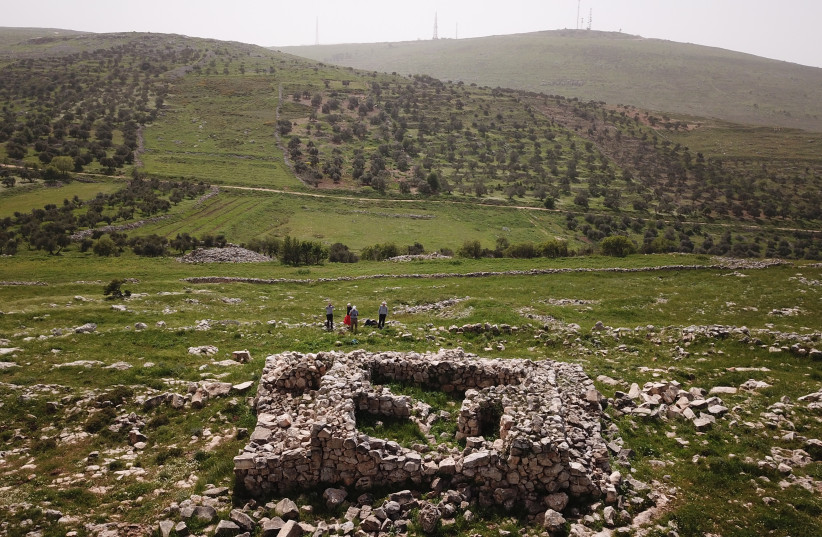
The abundant pottery shards and the jutting walls were important parts of Zertal’s desire to excavate.
Editor’s note: Since this article was submitted, there has been a massive advancement following the discovery of the amulet discussed. Find the full news report here.
The date was October 13, 1983. A Wikipedia search turns up nothing of importance for that date, but it will be etched in my memory forever as the real starting point in the saga of my Mount Ebal research. The goal of the research has been to reveal the historical truth behind the archeological site known popularly as “Joshua’s Altar” at Mount Ebal. It is a journey that continues to this day, and hopefully, will be continued by others once I cannot.
My involvement with Mt. Ebal began about two years earlier when I met Prof. Adam Zertal, who was then still a PhD candidate. (Details of that meeting and our subsequent friendship, which lasted until his passing in 2015, are described in my book, The Lost Temple of Israel.) I was delighted to meet him. I was raised on a heavy dose of traditional Jewish texts, and from the moment I moved to Israel at the age of 20, I became interested in the connection between the Bible and the physical aspects of the Land of Israel. Hearing about Zertal’s research served to intensify that interest.
Already at that initial meeting, Zertal told me about a site he had discovered in 1980 during his survey of the biblical territory of the Tribe of Manasseh, the northern part of Samaria. The site was on a slope of Mount Ebal near its peak, marked by a large pile of stones, surrounded by a series of walls jutting out. It was also marked by thousands of pieces of pottery, almost all belonging to the period known as Iron I, which according to many scholars is the period of the Israelite Settlement under Joshua.
Zertal expressed a strong desire to excavate the site, but excavations are daunting projects, more so for someone in Zertal’s position. He was still a few years away from his doctorate. He was a member of a kibbutz so had only very limited personal funds. Moreover, he would be the object of criticism by kibbutz members for political reasons if he were to undertake the excavation given that it is in the West Bank.
The abundant pottery shards and the jutting walls were important parts of Zertal’s desire to excavate the site. But what was particularly intriguing to him was the huge pile of stones at the center of the site, because he thought it might be covering something important.
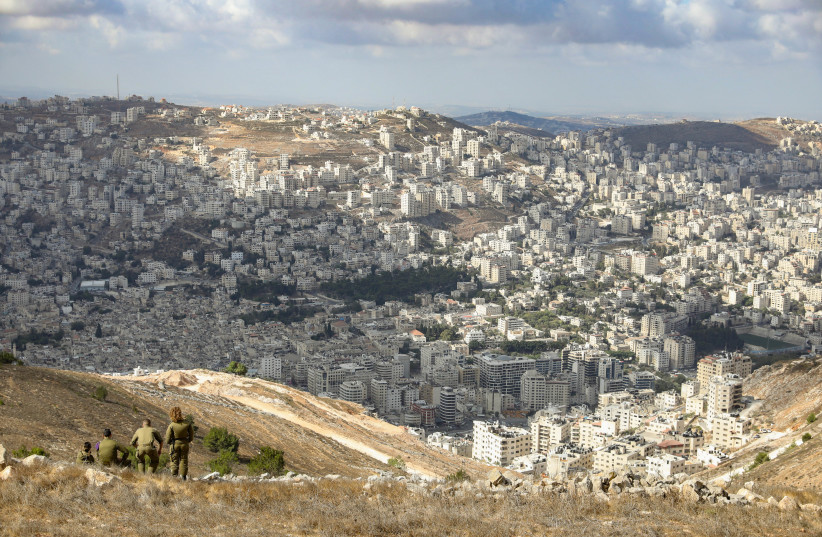
As it happens, I was in a position to help Zertal address many of the challenges that he was facing since I was a local functionary in the Jewish town closest to Ebal, Shavei Shomron. I was able to help him with logistics – such as temporary lodging and meals for the team – to the point that he was able to embark on a major excavation project at Mt. Ebal. And that in turn gave me the opportunity to be in and around the whole excavation and indulge my interest in his research.
The first task was to remove stones from the big mound, to see if the stones were concealing anything. It sounds like a minor task, but it was actually quite involved because care had to be taken not to dismantle any part of any original structure. It wasn’t until the third season of excavation that enough stones were removed to get the beginnings of a sense of what was hidden under the mound – which brings us back to October 13, 1983.
Zertal and I were having coffee while the volunteers were busy washing the pottery they had dug from the ground that day. Zertal was working with a pencil and paper, and then handed me a drawing of what he thought the structure beneath the pile of stones would look like when it was completely revealed.
I was thunderstruck, and bolted from the table without saying a word. I returned moments later with a book, opened to the page I had been seeking, and handed it to Zertal. It was now his turn to be thunderstruck.
The book was one of the tractates of the Mishna, the first post-biblical code of Jewish law, compiled around 200 AD. The page had a drawing of the altar of the Jerusalem temple, drawn to the specifications of the description in the text.
The similarity between the two drawings was striking. All those present are unlikely to ever forget the excitement the diagrams evoked. Age, backgrounds, religion and religious beliefs, education – all differences among those present were swept aside as everyone recognized that we were witnessing archaeological history being made. This was the first physical item ever discovered that was mentioned in the Torah!
Unfortunately, those exhilarating moments were followed by a barrage of disappointments that have continued to this day. Despite the convincing evidence in the preliminary excavation report (1987), Zertal’s identification of the site as “Joshua’s Altar” (Deuteronomy 27 and Joshua 8), has mostly been met with scorn or been ignored.
Why? The site and Zertal’s conclusions contradict many of the entrenched scholarly theories about the historical legitimacy of the earliest biblical texts. Simply put, the construction of an altar at Mt. Ebal had long been considered by most a figment of the biblical authors’ imaginations.
The altar is described in Deuteronomy 27 as part of a ceremony marking the final covenant in the Torah between God and the People of Israel. The Bible indicates that Israel became a nation at that time and place. In fact, Zertal named his book about the excavation, The Birth of a Nation.
The next morning turned out just as eventful for me. I met Prof. Benjamin Mazar, who, after seeing the site, encouraged me to search for answers about Ebal based on scholarship. Given that Mazar was the former president of the Hebrew University of Jerusalem and the excavator of the Western Wall, I couldn’t have hoped for a better mentor. That first meeting initiated a lifelong friendship. We would meet every month or two: I would ask questions, he would provide answers, give me a stack of books to read before our next meeting, and in between, we would exchange jokes in Yiddish.
Mazar was the guiding force in my work on Mt. Ebal and related issues, a search that continues to this day. In addition to the book previously mentioned, I have published four articles that appear in www.thetorah.com, currently the preeminent website in the world for articles about the Torah for scholars and laymen alike.
My two major conclusions are:
- The Ebal site was not only the site of an altar as Zertal concluded, but comprised the central part of a temple, the first-ever Israelite temple. This conclusion suggests that Ebal, and not Jerusalem, is the original object of the well-known phrase in Deuteronomy, “the Place that He will choose” – i.e. the “Home of God.” The historical and biblical implications of this conclusion comprise a huge breakthrough in biblical understanding.
- The comparison between the biblical texts and the finds in the field indicates that the texts must have been written by someone who knew the site, circa 1200 BCE. This upsets the entire scheme of currently accepted biblical dating. Without going into excessive detail, this has far-reaching implications for every aspect of the early history of Israel and its Bible.
Although these conclusions are quite iconoclastic, they have been considered worthy of consideration by some respected institutions and scholars. The venues in which I have been honored to present lectures on the topic include the Hebrew University of Jerusalem (2004), the Hebrew Bible Workshop at Harvard (2016), and the Haifa University Bible Department (2019).
But the lecture that stands out most in my mind is the one I presented at the Bible Lands Museum in Jerusalem in 2019. One of the attendees was Prof. Yair Zakovitch, who was subsequently awarded the Israel Prize for Bible, Israel’s equivalent of the Nobel. Zakovitch had been discussing the issues of Ebal with me for the past 21 years, picking up where Mazar had left off when he passed away. At the end of the lecture, Zakovitch came over to me and said: “The one thing missing from your entire set of ideas is finding ancient Hebrew writing at Mount Ebal.” I understood Zakovitch to mean that in addition to all the research I was presenting, Hebrew writing would undermine opposition to identifying our site as the one mentioned in the Bible.
At the time, that seemed impossible. The excavations had been concluded in 1988, and even if there was a possibility of renewing them, the site had been classified as Area B in the Oslo Accords between Israel and the Palestinian Authority. This meant that the Palestinians had control over civilian affairs there, including archeology. But six weeks later, I optimistically thought that the impossible became a reality!
How did the possibility of uncovering writing come up after all these years? Arabs from the neighboring town of Asira Ashamaliya had begun to develop an interest in the site, and even the Palestinian minister of tourism came to visit, declaring it a “Palestinian Heritage Site” (a laughable claim from every imaginable perspective).
After the excavation, we had left in plain sight many piles of earth that we had dug up. Concerned about the safety of the piles given the new Arab attention to the site, and considering that the piles might contain valuable finds, a group of Zertal’s friends removed them to a safe location where they could be examined.
Tasked with the examination process was Dr. Scott Stripling from the Associates for Biblical Research (ABR) in Texas. Stripling has been directing excavations at Shiloh in recent years, and he developed a rather clever contraption for wet sifting that made the job of sifting out finds from the earth more effective than it had been previously.
One of the items that Stripling turned up was a tiny amulet made of lead, only 2×2 centimeters (approximately one-inch square). Nothing was visible on the surface to the naked eye, but the amulet was sealed like an oyster shell, suggesting that it contained something inside. The leading expert at the Antiquities Authority tried to open it but gave up after it began to crumble at the edges.
Stripling was eager to explore more possibilities for unlocking the amulet’s secrets. He indicated that some lead amulets from later periods were known as “curse amulets,” and this lead amulet was found on the biblical “mountain of the curse” – Mount Ebal. Food for thought… And since this amulet is made of lead, most current methods for seeing inside it would not be effective.
Stripling had to go back to Texas, and entrusted me with the task of researching where this work could get done. Thus began a year-long saga of researching something that might not even exist, and doing so in a world where people were frequently not available for months on end because of corona. But I finally found a lab in Prague, headed by Dr. Daniel Vavrik of the Czech National Academy of Sciences, who had developed a technology for seeing inside unopened objects including those made of lead.
After many exchanges between Prague and Texas and Jerusalem, I ended up in Vavrik’s lab in Prague with the amulet. And he finally sent us his results at the end of December. They consist of a sophisticated 3-D model enabling the best possible viewing of the inside and the outside of the amulet. We could discern many indentations that would be expected in a soft metal buried underground for thousands of years. But it is extremely challenging to distinguish between signs of damage and deliberate man-made markings. One of the indentations looks like a bull’s head, which is an “aleph,” the first letter of the Hebrew alphabet. Another marking looks similar to a lotus flower – an important image in ancient Egypt.
Unfortunately, neither the “bull’s head” nor the “flower” was adequate to make a definitive identification of deliberate markings. But research into the amulet is not over. The process of inspecting the 3-D model is ongoing. Furthermore, we have located another technology that may bear more definitive results.
Going forward, there are a number of additional projects that need to be done, the most vital being the publication of the final excavation report of Mount Ebal. This would be done under the supervision of Dr. Shay Bar of Haifa University, who has been leading the continuation of Zertal’s projects. The volume of materials yet to be examined and recorded is quite extensive.
An extremely exciting sub-project of the final report is a careful examination of the plaster slabs discovered inside the altar. Plaster, during this time period, was used only in cultic sites. It would be fascinating to examine the slabs with technologies that were not yet available to us at the time of the excavations, such as sophisticated infra-red devices, which might reveal the writing. That is particularly interesting because writing on plaster in Mt. Ebal is mentioned in Deuteronomy 27.
There are more exciting projects that also have great potential for adding to our understanding of the early history of Israel. These projects, as well as the two listed above, are very much dependent on raising funds. Anyone who considers these research projects worthy of their assistance are invited to contact me at zvi@thelosttemple.com.
This article is dedicated to my uncle, Shlomo Schmidt, who recently celebrated his 100th birthday. When I took the amulet to Prague, I was in the city where Shlomo was born and raised, and where his father served as the last cantor before WWII of the renowned Altneuschul. I have never met a more refined, educated, and cultured human being than Shlomo Schmidt.


