Experts suggest shekel coin may have been made by priests assisting Great Revolt against Romans, using precious metal from holy site’s plentiful reserves


  • The silver coin engraved with a cup and the caption "Israel Shekel" and the letters: Shin and Bet (the second year of the Great Revolt) (Eliyahu Yanai/City of David)
    The silver coin engraved with a cup and the caption “Israel Shekel” and the letters: Shin and Bet (the second year of the Great Revolt) (Eliyahu Yanai/City of David)
  • The silver coin with an engraving of the headquarters of the High Priest and the inscription 'Holy Jerusalem' (Yaniv Berman/City of David and the Israel Antiquities Authority)
    The silver coin with an engraving of the headquarters of the High Priest and the inscription ‘Holy Jerusalem’ (Yaniv Berman/City of David and the Israel Antiquities Authority)
  • Liel Krutokop, with the rare silver coin she found (Yaniv Berman/City of David and the Israel Antiquities Authority)
    Liel Krutokop, with the rare silver coin she found (Yaniv Berman/City of David and the Israel Antiquities Authority)
  • The rare silver coin (Yaniv Berman/City of David and the Israel Antiquities Authority)
    The rare silver coin (Yaniv Berman/City of David and the Israel Antiquities Authority)
  • The silver coin next to a charred coin that was burned in the destruction of Jerusalem (Yaniv Berman/City of David and the Israel Antiquities Authority)
    The silver coin next to a charred coin that was burned in the destruction of Jerusalem (Yaniv Berman/City of David and the Israel Antiquities Authority)
  • Dr. Robert Kool holds the rare silver coin (Yaniv Berman/City of David and the Israel Antiquities Authority)
    Dr. Robert Kool holds the rare silver coin (Yaniv Berman/City of David and the Israel Antiquities Authority)

A rare 2,000-year-old silver shekel coin, thought to have been minted on the Temple Mount plaza from the plentiful silver reserves held there at the time, has been uncovered in Jerusalem.

If it were indeed minted there, it would make the coin one of the very few items uncovered that were manufactured at the holy site.

The coin, found by an 11-year-old girl, Liel Krutokop, during a sifting project for dirt removed from an archaeological dig at the City of David National Park, was engraved with “second year,” i.e., the second year of the Great Jewish Revolt against the Romans (67-68 CE).

Dr. Robert Kool, head of the Coin Department at the Israel Antiquities Authority, suggested that the coin may have been minted at the plaza of the holy site by one of the priests who worked in coordination with the rebel leaders, providing them with assistance.

“Where else could you find silver in such quantity and such high quality in those days? Only in the Temple. If so, we can say with caution that this coin is, apparently, one of the only items we hold today that originated on the Temple [Mount] itself,” Kool said.

“This is a rare find, since out of many thousands of coins discovered to date in archeological excavations, only about 30 coins are made of silver, from the period of the Great Revolt,” said Kool.

Dr. Robert Kool holds the rare silver coin (Yaniv Berman/City of David and the Israel Antiquities Authority)

“Everyone knows the Arch of Titus in Rome and the descriptions of loot taken from the Temple that appear on it, but not many are familiar with the huge silver reserves that were in the Temple. You can learn about the huge silver reserves that were in the Temple from the ancient inscription uncovered by the researcher Géza Alföldy,” he said.

Kool was referring to a reconstructed inscription at the Colosseum in Rome, which explained that the amphitheater was built using spoils looted from the Temple.

The inscription at the site in Italy reads: “Emperor Vespasian [who, along with his son Titus, suppressed the Jewish Revolt and destroyed the Temple] ordered the construction of this new theater amphitheater [the Colosseum] from his share of the spoils.”

“One can only imagine the extent of the loot and the amount of money the Romans found in the Temple storehouses,” said Dr. Amit Reem, the IAA’s Jerusalem district archaeologist.

The silver coin engraved with a cup and the caption ‘Israel Shekel’ and the letters: Shin and Bet (the second year of the Great Revolt) (Eliyahu Yanai/City of David)

The IAA said in a statement that the coin would have been used for trade in Jerusalem during the period of the Second Temple.

“This street [where the coin was excavated], which connected the Siloam Pool in the south of the City of David to the Temple Mount in the north, was Jerusalem’s main street during the Second Temple period, where thousands of pilgrims marched on their way to the Temple,” Kool said. “There is no doubt that there would have been extensive trading here. This is evidenced by the many weights and bronze coins we have found here. But to find a rebel coin made of pure silver is definitely very special and exciting.”

The coin weighs approximately 14 grams (0.4 ounces) and has an engraving of an image of a cup on one side, with the caption “Israeli shekel” and the Hebrew letters Shin and Bet, shorthand for “second year,” i.e., the second year of the Great Revolt against the Romans (67-68 CE).

The other side of the coin has an inscription that the IAA said was an engraving of the headquarters of the high priest, as well as the words “Holy Jerusalem” in ancient Hebrew script.

The silver coin with an engraving of the headquarters of the High Priest and the inscription ‘Holy Jerusalem’ (Yaniv Berman/City of David and the Israel Antiquities Authority)

Kool said currency is used during rebellions as symbol of independence, and suggested the choice of ancient Hebrew script for the engraving showed a longing for a Jewish kingdom.

“A currency is a sign of sovereignty. If you go into rebellion, you use one of the most obvious symbols of independence, and you mint coins. The inscription on the coin clearly expresses the rebels’ aspirations,” he said.

“The choice to use ancient Hebrew script, which was no longer in use at the time, is not accidental,” Kool said. “The use of this script came to express the longing of the people of the period for the days of David and Solomon and the days of a united Jewish kingdom — days when the people of Israel had full independence in the land.”
Syria reports fourth Israeli attack this month, says two killed

CAIRO, Nov 24 (Reuters) – An Israeli air strike in Syria killed two people and wounded seven others including six soldiers on Wednesday, Syrian state media said, in the fourth Israeli attack reported by Syria this month.


Despite killing of nuclear scientist and explosions at enrichment facilities, Iran building faster and more efficient nuke program that puts it in position to have bomb in weeks


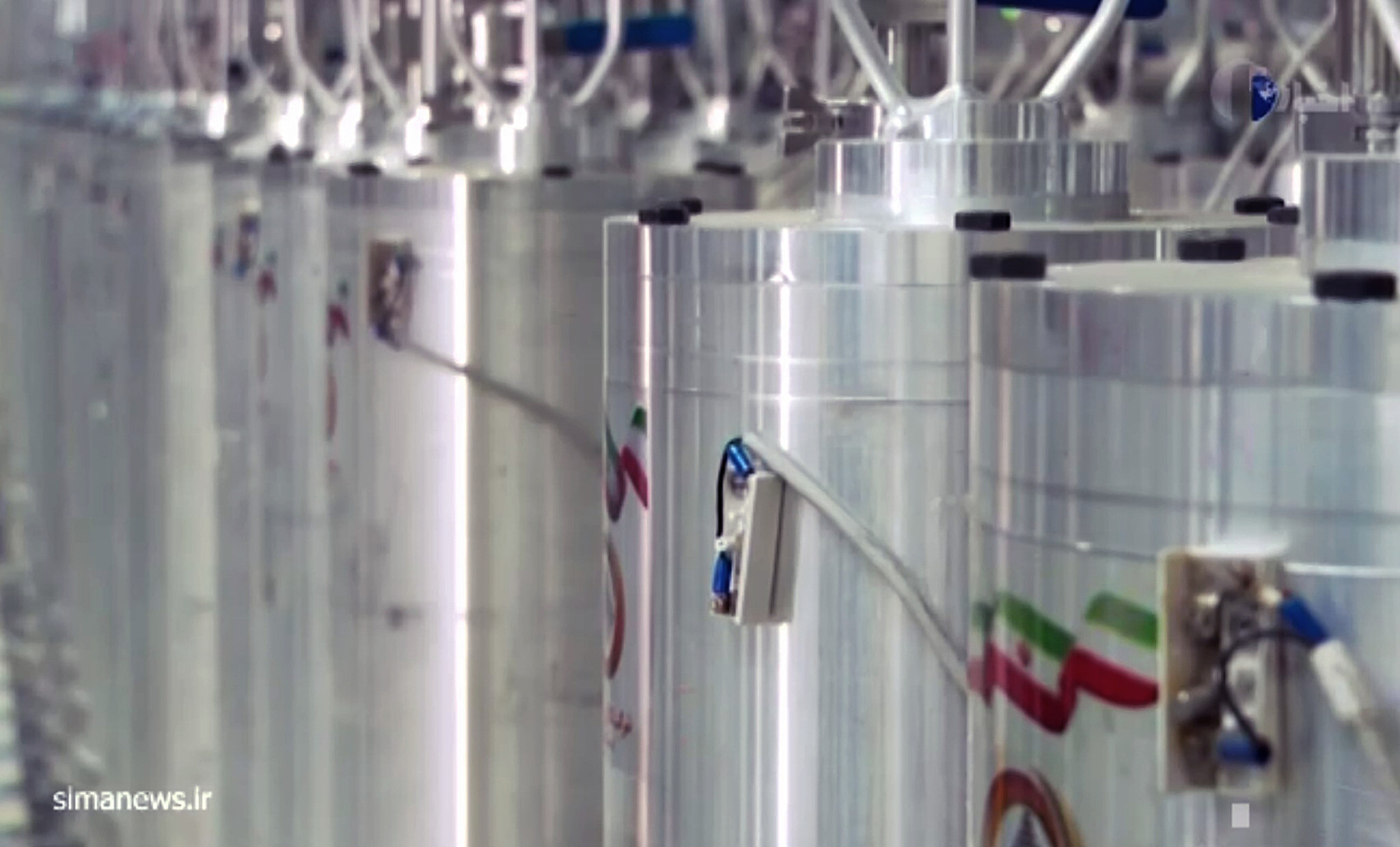
In this image made from April 17, 2021, video released by the Islamic Republic Iran Broadcasting, IRIB, state-run TV, various centrifuge machines line the hall damaged on Sunday, April 11, 2021, at the Natanz Uranium Enrichment Facility, some 200 miles (322 km) south of the capital Tehran. (IRIB via AP, File)

In this image made from April 17, 2021, video released by the Islamic Republic Iran Broadcasting, IRIB, state-run TV, various centrifuge machines line the hall damaged on Sunday, April 11, 2021, at the Natanz Uranium Enrichment Facility, some 200 miles (322 km) south of the capital Tehran. (IRIB via AP, File)

US officials have warned Israel that attacks against the Iranian nuclear program are counterproductive and have caused Tehran to rebuild an even more efficient enrichment system, the New York Times reported Sunday.

Citing officials familiar with the behind-the-scenes discussion between Washington and Jerusalem, as the US continues to try and bring Iran back into the nuclear deal, the report said that Israeli officials have dismissed the warnings.

Noting that in the last 20 months there have been four explosions at Iranian nuclear facilities attributed to Israel, along with the killing of Iran’s top nuclear scientist, the report said that US officials cautioned that while such efforts may be “tactically satisfying,” they are “ultimately counterproductive.”

In the wake of the explosions, which took uranium enrichments plants offline and destroyed dozens of centrifuges, the Americans noted that Iran has managed to resume enrichment within months, often installing newer machines that can enrich uranium far faster.

However, the officials said Israel appeared unmoved by the arguments and this was one of the many areas the US and Israel disagreed with how to approach efforts to contain Tehran’s drive to build nuclear weapons.

Further complicating matters was the fact that Iran has apparently managed to improve its defenses, particularly in the cyber field, the report said, meaning that launching cyber attacks like the Stuxnet attack that crippled centrifuges at the Natanz nuclear enrichment site for more than a year, an attack widely reported to be a joint US-Israeli effort, was no longer as effective.

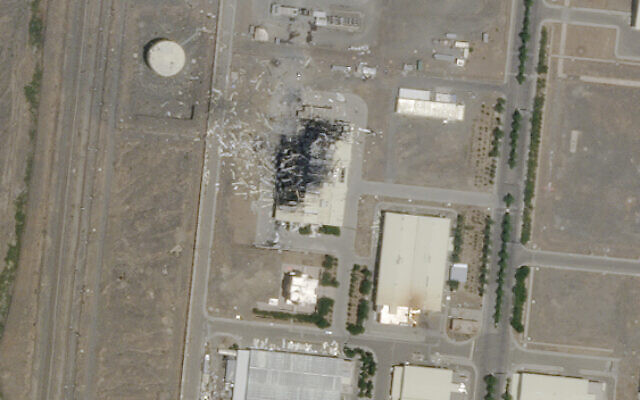
The aftermath of an explosion and a fire at an advanced centrifuge assembly plant at Iran’s Natanz nuclear site, July 5, 2020. (Planet Labs Inc. via AP)

The major concern now was how close Iran has come to being able to build a nuclear weapon since then-US president Donald Trump withdrew the US from the deal in 2018.

This week, with Iran set for talks with world powers in Vienna on November 29, the International Atomic Energy Agency said Tehran had again increased its stockpile of highly enriched uranium.

Iran’s stockpile, as of November 6, was many times in excess of the limit laid down in the agreement with world powers, said the IAEA report. Such highly enriched uranium can be easily refined to make atomic weapons, which is why world powers have sought to contain Tehran’s nuclear program.

The Vienna-based agency told members that it is still not able to verify Iran’s exact stockpile of enriched uranium due to the limitations Tehran imposed on UN inspectors earlier this year.

The IAEA has been unable to access surveillance footage of Iranian nuclear sites or of online enrichment monitors and electronic seals since February. The agency’s chief, Rafael Mariano Grossi, told The Associated Press this month that the situation was like “flying in a heavily clouded sky.”

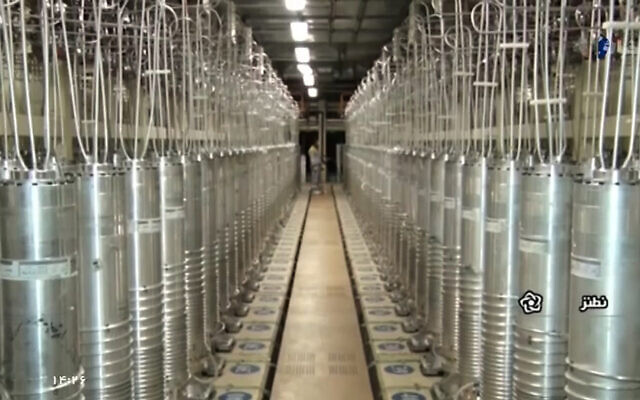
In this image, made from an April 17, 2021 video released by the state-run TV station Islamic Republic Iran Broadcasting, various centrifuge machines line a hall at the Natanz Uranium Enrichment Facility. (IRIB via AP)

Sunday’s NYT report said that since abandoning the agreement, Iran had managed to reduce its breakout time to a bomb from about a year to just several weeks.

“Before Mr. Trump decided to scrap the deal, Iran had adhered to the limits of the 2015 agreement — which by most estimates kept it about a year from ‘breakout,’ the point where it has enough material for a bomb. While estimates vary, that buffer is now down to somewhere between three weeks and a few months, which would change the geopolitical calculation throughout the Middle East,” the report said.

US officials have publicly warned Iran’s violations are making it increasingly unlikely that there can be a return to the 2015 deal as it was.

The US envoy for Iran Robert Malley warned Friday that Tehran was approaching the point of no return for reviving a nuclear deal after it boosted its stocks of enriched uranium before talks resume this month.

“The time will come if Iran continues at this pace with the advancements they’ve made, [it] will make it impossible even if we were going to go back to the JCPOA to recapture the benefits,” Malley told the Manama Dialogue conference in Bahrain, referring to the deal by its official name, the Joint Comprehensive Plan of Action.

“Iran’s advances are spreading alarm across the region… that’s what’s making the clock tick faster and making all of us say that the time is short for a return to the JCPOA,” Malley said.

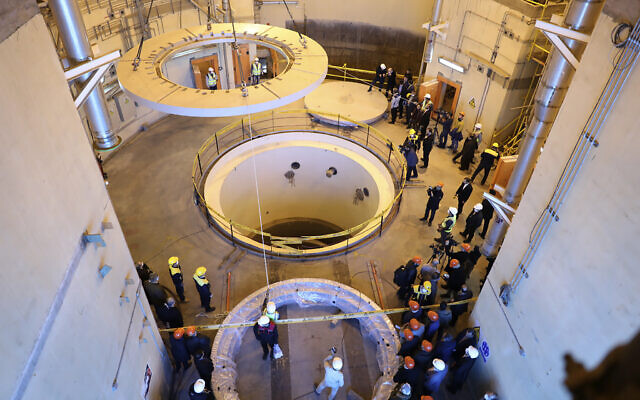
Technicians work at the Arak heavy water reactor’s secondary circuit, as officials and media visit the site, near Arak, 150 miles (250 kilometers) southwest of the capital Tehran, Iran, Monday, Dec. 23, 2019. (Atomic Energy Organization of Iran via AP)

“And I want to be clear, because there’s no ambiguity about what they seem to be doing now, which is to drag their feet on the nuclear talks and accelerate the progress in their nuclear program,” he added.

The US envoy said he was not encouraged by the statements from the new Iranian government of President Ebrahim Raisi, which earlier on Friday accused Washington of conducting a “propaganda campaign” against the country.

With the possibility of a return to the 2015 deal fading, the US was examining the possibility of hammering out an interim deal with Iran, the New York Times report said, confirming a separate report last week.

US National Security Adviser Jake Sullivan raised the prospect of an interim agreement with Iran to allow more time for nuclear negotiations, in talks with his Israeli counterpart, Eyal Hulata, the Axios news site reported.

A pair of American sources said Sullivan and Hulata were just “brainstorming,” and that the proposal was suggested by an unspecified European ally of the US.

The US sources said the proposal was for Iran to suspend a disallowed nuclear activity such as enriching uranium to 60 percent, in exchange for the US and allied countries releasing some frozen Iranian money, or issuing sanctions waivers on humanitarian goods.

An unnamed Israeli official cited in the report said Hulata told Sullivan he was against the idea and Israel’s concern was that any interim agreement could become permanent, allowing Iran to maintain its nuclear infrastructure and supply of uranium it has built up.

The mounting doubts has seen the US trying to reassure its allies in recent days that if diplomacy fails, other options were available.

“The United States remains committed to preventing Iran from gaining a nuclear weapon. And we remain committed to a diplomatic outcome of the nuclear issue,” US Defense Secretary Lloyd Austin told an event put on by the International Institute for Strategic Studies.

“But if Iran isn’t willing to engage seriously, then we will look at all of the options necessary to keep the United States secure,” he said.

Israel has been more direct, repeatedly warning it will attack Iran’s nuclear program and allocating billions of dollars to the military to prepare and train for a potential strike.