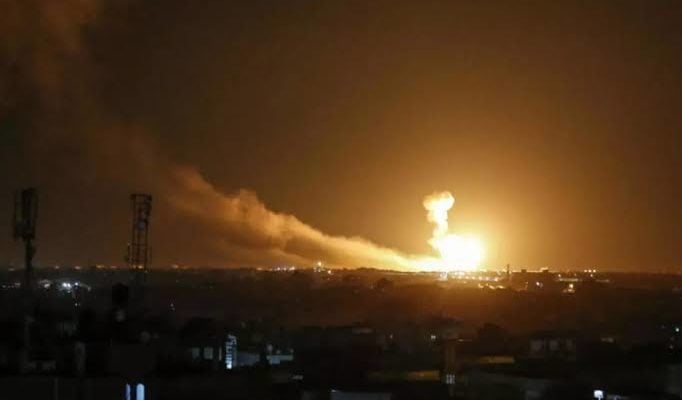
Iran has not acknowledged the attack, but U.S. and Israeli officials said it was retaliation for Israeli airstrikes, drawing the U.S. into Iran’s shadow war with Israel.

Five armed drones were launched at the American military base at Al Tanf, Syria, on Oct. 20. 
Credit…Lolita Baldor/Associated Press

An armed drone strike last month on an American military base in southern Syria was Iranian retaliation for Israeli airstrikes in Syria, according to eight American and Israeli officials who spoke on the condition of anonymity to discuss intelligence matters.

The drone attack, which caused no casualties, would be the first time Iran has directed a military strike against the United States in response to an attack by Israel, an escalation of Iran’s shadow war with Israel that poses new dangers to U.S. forces in the Middle East.

Five so-called suicide drones were launched at the American base at Al Tanf on Oct. 20 in what the U.S. Central Command called a “deliberate and coordinated” attack. Only two detonated on impact, but they were loaded with ball bearings and shrapnel with a “clear intent to kill,” a senior U.S. military official said.

Most of the 200 American troops stationed at the base, whose main role is training Syrian militias to fight the Islamic State, had been evacuated hours earlier after being tipped off by Israeli intelligence, the officials said.

U.S. officials said they believed that Iran directed and supplied the proxy forces that carried out the attack.

They were reluctant to disclose further details of the attack, and a Pentagon spokesman declined to publicly accuse Iran, partly to avoid upending talks to restart the nuclear deal with Tehran, which are set to resume at the end of the month.

However, both Israeli and U.S. intelligence officials said they had intelligence indicating that Iran was behind the operation. Because three of the drones did not explode, American officials were able to study them and determine that they employed the same technology as drones used by Iran-backed militias in Iraq.

Iran has not claimed responsibility for the attack, though Iranian news media applauded it.

“There have been a number of these incidents where they accused Iran without any proof or documents,” Saeed Khatibzadeh, Iran’s Foreign Ministry spokesman, said at a news conference last week. “Countries that have established military bases in Syria without the invitation of Syria’s central government, continue policies of terrorism and support terrorist countries are the real root of instability in the region and in Syria.”

A Telegram channel run by affiliates of Iran’s Islamic Revolutionary Guards Corps said the strike was a response to the U.S. allowing Israeli attacks on “resistance” forces in eastern Syria. Militia commanders, it said, concluded that they “must pull the teeth of the snake,” meaning the United States.

Image

The funeral of Midhat Saleh in a village in the Golan Heights last month. Mr. Saleh was a high-ranking Syrian official who was assassinated by an Israeli sniper.
Credit…Jalaa Marey/Agence France-Presse — Getty Images

The American base lies on a road serving as a vital link for Iranian-backed forces along a strategic corridor from Tehran through Iraq and Syria to southern Lebanon and the Israeli border.

Senior U.S. and Israeli officials said they had intelligence indicating that the drone attack was retaliation for several recent Israeli strikes on Iranian forces in Syria.

On Oct. 8, Israel fired missiles on an air base in central Syria that, according to the Britain-based Syrian Observatory for Human Rights, serves as an Iranian military headquarters.

On Oct. 13, Israeli airstrikes hit Iranian military targets near the cities of Palmyra and Homs, in central Syria, killing three pro-Iranian militiamen and one Syrian soldier. Iranian officials promised to retaliate.

On Oct. 16, an Israeli sniper assassinated Midhat Saleh, a high-ranking Syrian official who Israeli intelligence said was working with Iran to establish military infrastructure along the border for an attack against Israel.

Iranian forces first moved into Syria to defend President Bashar al-Assad against a rebellion that began in 2011, and have used the ensuing civil war as an opportunity to build militias and military infrastructure directed at Israel. Israel has carried out hundreds of attacks against Iranian targets in Syria since 2013.

The U.S. official said the Iranians were reluctant to attack Israel for fear of retaliation, so they did the next best thing — strike the Americans. The official said that Iran wanted to avoid a direct confrontation with the Americans but took a big risk attacking Al Tanf, which could have killed American soldiers, forcing an American military response.

Two senior U.S. officials said that Iran may have believed that the drone strike would be seen as the initiative of militias rather than Iran.

American officials said the head of Iran’s Revolutionary Guards in Syria, Javad Ghaffari, is an aggressive supporter of using military force to oust American troops from Iraq and Syria. But the officials said it was unclear how much the group’s leaders in Iran agreed with this approach.

The American response was to announce new sanctions against two senior members of the Revolutionary Guards, two other Iranians, and two companies that the United States says are affiliated with the Guards’ drone program.

American officials said they were dubious that new sanctions would have enough teeth to do much good.

Image

The Mercer Street oil tanker was attacked off the coast of Oman in July. The strike was thought to be the first Iranian attack in Iran’s maritime conflict with Israel known to have killed civilians. 
Credit…Rula Rouhana/Reuters

Iran appears to have attacked third parties before in response to Israeli attacks.

In 2019, about two weeks after Israel attacked a missile production facility in Beirut belonging to Hezbollah, the powerful Iranian-backed militia in Lebanon, Saudi Arabian oil facilities were attacked with suicide drones and cruise missiles. American officials said Iran had carried out the attack. Iran denied it.

The United States, Israel and Saudi Arabia have all been part of an anti-Iran coalition to varying degrees and Iranian officials see all three as a single threat. In this case, American and Emirati intelligence officials said, Iran attacked Saudi Arabia because it feared a direct confrontation with Israel.

The attack on Al Tanf is the latest in an increasingly tense series of military exchanges and confrontations between Iran, Israel and the United States.

Iran seized an oil tanker in the Sea of Oman last month after an encounter with the U.S. Navy, but the two sides gave widely differing accounts of whose tanker it was and what, exactly, had happened.

Separately, U.S. officials complained this month that multiple drones, believed to be Iranian, had an “unsafe and unprofessional interaction” with the U.S.S. Essex amphibious assault ship as the vessel left the Strait of Hormuz.

In July, an oil tanker managed by an Israeli-owned shipping firm was attacked off the coast of Oman, killing two crew members from Britain and Romania. Israeli and U.S. officials said the attack appeared to have been carried out by several Iranian drones that crashed into living quarters underneath the ship’s command center.

The strike was the first Iranian attack in the maritime conflict known to have killed civilians.

Farnaz Fassihi contributed reporting.


by Reuters and Algemeiner Staff

European External Action Service (EEAS) Deputy Secretary General Enrique Mora, Iranian Deputy at Ministry of Foreign Affairs Abbas Araghchi and Iran’s ambassador to the U.N. nuclear watchdog Kazem Gharibabadi wait for the start of a meeting of the JCPOA Joint Commission in Vienna, Austria May 1, 2021. Photo: EU Delegation in Vienna/Handout via REUTERS

The stated US aim when indirect US-Iranian talks resume this month is to see if the two can revive a 2015 nuclear deal, but Washington’s unspoken goal may be to win support from China and Russia to pressure Iran if the talks fail, diplomats said.

Western diplomats have said time is running low to resurrect the pact, which then-US President Donald Trump abandoned in 2018, earning Iran’s fury and the dismay of the remaining major powers in the pact — Britain, China, France, Germany and Russia.

Under the agreement, Iran limited its nuclear program in exchange for relief from US, EU and UN economic sanctions. Trump’s 2018 decision to reimpose harsh US sanctions prompted Tehran to begin breaching the deal’s nuclear restrictions.

The three European nations have worked hand in glove with the United States to try to restore the deal and Russia has been supportive, notably at the Vienna-based UN nuclear watchdog that monitors Iran’s eroding compliance.

NOVEMBER 18, 2021 3:57 PM

Al Jazeera Report Promotes Hamas Weapons Expo in Gaza Where Students Can Practice Attacking Israelis

The widely-watched Al Jazeera news channel in Qatar promoted an exhibition held in Gaza by Hamas that shows young people…

China, however, has undercut US leverage by buying Iranian oil, throwing Tehran an economic lifeline in violation of US sanctions.

One way to pressure Iran to rejoin the original pact or, if that is not possible, to accept another arrangement would be to persuade Beijing and Moscow that Tehran, not Washington, is the obstacle, diplomats said.

“They need China and Russia,” said a Western diplomat on condition of anonymity.

SHIFTING THE ONUS

While Washington initially got blamed for Trump’s withdrawal and reimposition of sanctions on Iran, the onus may gradually be shifting to Tehran as US President Joe Biden seeks to restore the pact.

US and Iranian officials held six rounds of indirect talks in Vienna between April and June. A new round begins on Nov. 29 after a five-month hiatus triggered by the election of a new Iranian president, Ebrahim Raisi, a hardline cleric who said this month that Iran would not back down in nuclear talks.

US and European diplomats are frustrated by what they view as Iran’s unrealistic demands, including what one described as a recent insistence that all US and EU sanctions imposed since 2017 be dropped, and their expectations for the talks are low.

This month’s talks will be a chance to gauge whether Iran wants to revive the 2015 Joint Comprehensive Plan of Action (JCPOA) and, if not, for Washington to try to garner greater support from China and, to a lesser degree, Russia to put pressure on Tehran.

“(The) Russians are a more helpful partner than China,” said a second Western diplomat on condition of anonymity. The best way to get China’s support was via diplomacy rather sanctioning Chinese companies that buy Iran’s oil, the envoy added.

“We have to talk to China and get them on side,” this diplomat said.

Biden and Chinese President Xi Jinping discussed how to “align” their positions before the Vienna talks during their virtual summit this week.

‘GOOD OLD COLLEGE TRY’

The major powers believe the greater their cohesion, the better the chances of bringing Iran back into the deal, said a third Western diplomat.

“It becomes more important when we come to a crucial point in the discussions,” the diplomat added, referring to the next round and Western hopes that China might eventually trim its oil purchases.

Brookings Institution analyst Robert Einhorn suggested Washington may wish to show it had gone the extra mile to revive the agreement.

“(The idea is to) make a good old college try … but if that doesn’t work, make sure that the world sees Iran as the reason for failure,” Einhorn said.

Shifting the onus to Tehran could prove helpful even if Washington concludes the original deal is dead but tries to fashion another agreement.

The State Department has said it will pursue diplomacy even if the JCPOA cannot be saved.

“We want to present Iran with a clear choice about the path forward. That’s our focus, not thinking of who to blame,” said a US official on condition of anonymity.

“We are not naive about what Iran is trying to do by building its nuclear program while talks proceed at snail’s pace. We are adapting our posture to Iran’s actions even as we seek – in good faith – to try to revive the JCPOA,” he said.

“At some point we may conclude with our partners that it no longer is worth saving the JCPOA. We are not there yet. But … it would be wrong to assume our policy is static.”


Israeli missile strike hits site near Damascus, says Syria

Increasing use of surface-to-surface missiles raises questions about the Israeli Air Force’s freedom of movement in Syrian skies.

By David Hellerman, World Israel News

Israeli missiles struck a target near Damascus on Wednesday morning, Syrian media reports said.

Syria’s state-controlled SANA News Agency claimed Israel fired a pair of surface-to-surface missiles at what it described as an “empty warehouse” and causing no casualties. SANA also claimed that one of the missiles was intercepted by Syrian air defense systems. Syria frequently boasts of intercepting Israeli missiles, though analysts dismiss those claims.

SANA did not indicate the nature of the building or why it might have been targeted. Israeli officials did not comment on the strike, in line with Jerusalem’s policy of never commenting on specific air strikes.

The use of surface-to-surface missiles may reflect shifts in the Israeli Air Force’s freedom of movement in Syria. In October, Prime Minister Naftali Bennett met with Russian President Vladimir Putin. Israeli strikes have continued, but several of attacks were reportedly by surface-to-surface missiles, rather than by air craft.

For years, Putin has largely turned a blind eye to Israeli strikes on Iranian targets in Syria. However, the strikes have caused some embarrassment for Moscow as Syrian air defenses prominently include Russian-made systems.

Over the past several years, Israel has launched hundreds of air strikes throughout Syria on weapons warehouses, communications facilities, drone facilities and more belonging to Iran and its proxies. Jerusalem insists it will not allow Iran to entrench itself along the Israeli-Syrian border.