
Israel conquered the Golan Heights in the Six-Day War, annexing the area by law in 1981. UN Security Council resolution 497, passed only days later, rejected the annexation as “null and void.”
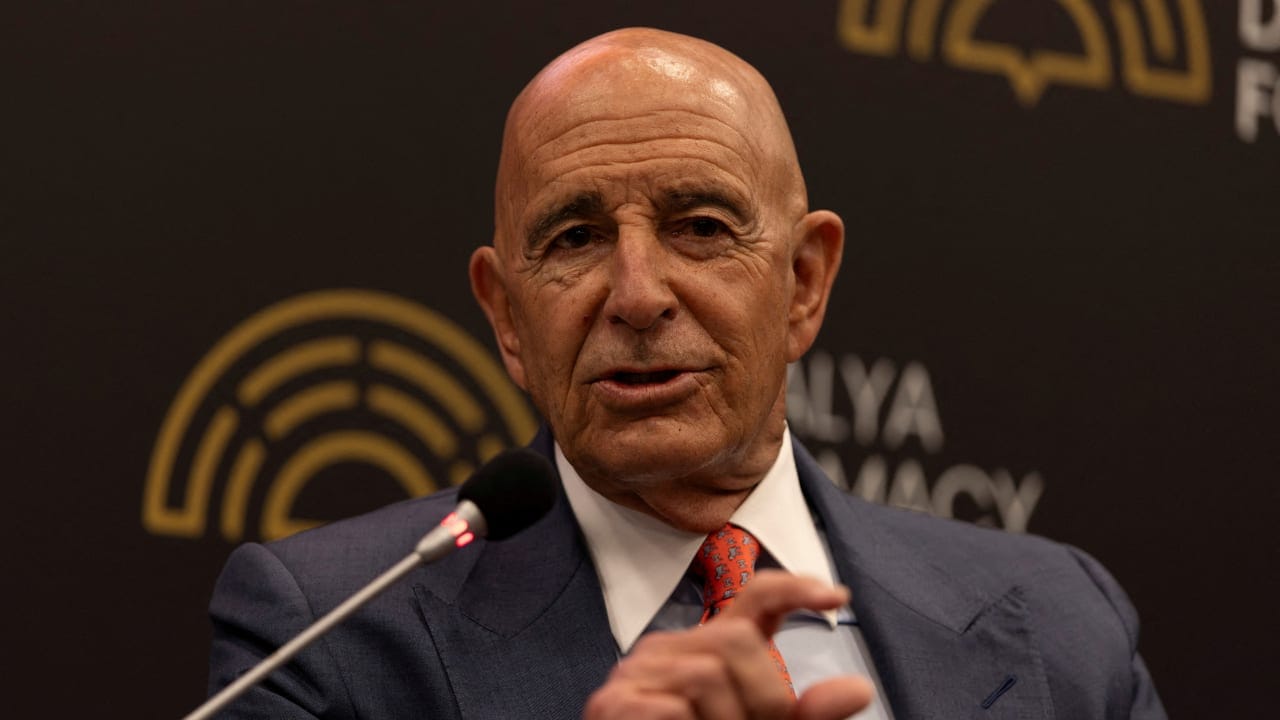
US Special Envoy for Syria and Ambassador to Turkey Tom Barrack speaks during a session at Antalya Diplomacy Forum in Antalya, Turkey, April 17, 2026.
(photo credit: REUTERS/UMIT BEKTAS/FILE PHOTO)
The US ambassador to Turkey and special envoy to Syria and Iraq, Tom Barrack appeared to reverse his previous comments on the status of the Golan Heights in recent days, backing the US recognition of the area as Israeli territory in a statement to the Associated Press on Sunday.

“United States policy on the Golan was set by President Trump in 2019 and is unchanged,” he said, contradicting his claim in an interview with Mario Nawfal on Friday where he stated that Israel occupies the Golan Heights.

“They still occupy the Golan against the UN resolutions, against all of the international order, which has said the Golan is Syria’s,” Barrack said then, despite the US having recognized the area as Israeli for almost a decade.

The interview took place against the backdrop of Israel’s strike on the Abu al-Duhur military airfield in Idlib last week. Israel claimed that Turkish troops were ready to deploy at the base, a claim that Turkey denied.

yrian negotiations primarily on Israeli withdrawal from areas besides Golan

Israel conquered the Golan Heights in the Six-Day War, annexing the area by law in 1981. UN Security Council resolution 497, passed only days later, rejected the annexation as “null and void.”

VIEW OF snow on Mount Hermon in Syria, as seen from the northern Golan Heights, in Jan.
VIEW OF snow on Mount Hermon in Syria, as seen from the northern Golan Heights, in Jan. (credit: FLASH90)

In 2019, Trump recognized the Golan Heights as Israeli, as a part of pro-Israel moves including the recognition of Jerusalem as Israel’s capital and moving the US embassy there.

Syria never rescinded its claim to the Golan Heights, and after Ahmed al-Sharaa took power in December of 2024, the question the area’s status entered the spotlight once again.

During negotiations between Israel and Syrian officials in Jordan on Sunday, the Syrian delegation asked to separate negotiations over the Golan Heights, appearing to prioritize the matter of Israel’s withdrawal from areas captured after December 2024.

Barrack said strike on Syria may have been political

Barrack condemned Israel’s strikes on the Idlib airbase, calling them “serious and worrisome.”

In Friday’s interview, Barrack suggested that Israel may have intended to provoke a faceoff with Turkey through its strike. Barrack also said the strike could have had political motives, with Israeli elections scheduled for October.

Following the attack, Barrack said the US would work to establish a deconfliction mechanism between Israel, Turkey, and Syria, insisting that increased communication would be necessary to prevent violence.

“Syria has demonstrated itself to be a responsible and stable sovereign neighbor, and a carefully structured de-escalation arrangement would contribute significantly to greater calm and predictability across the region,” Barrack told The Jerusalem Post.

Amichai Stein and Reuters contributed to this report.


The Midnight Dispatch


The invitation has not yet been officially confirmed by Iran’s Foreign Ministry or by any of the three countries that are parties to the agreement.

Turkish President Tayyip Erdogan, Saudi Crown Prince Mohammed bin Salman, and Pakistan's Prime Minister Shehbaz Sharif pose after signing a joint defence agreement in Mecca, Saudi Arabia, August 7, 2026.
Turkish President Tayyip Erdogan, Saudi Crown Prince Mohammed bin Salman, and Pakistan’s Prime Minister Shehbaz Sharif pose after signing a joint defence agreement in Mecca, Saudi Arabia, August 7, 2026.
(photo credit: Saudi Press Agency/Handout via REUTERS)
Iran has been invited to join the Mecca Agreement for Mutual Defense, the new security alliance established by Saudi Arabia, Turkey and Pakistan earlier this month, Al Mayadeen reported on Saturday, citing a senior Iranian official.

The invitation has not yet been officially confirmed by Iran’s Foreign Ministry or by any of the three countries that are parties to the agreement.

Mehdi Rahimi, head of the Iranian parliament’s Khaneh Mellat news agency, told the channel that “Iran has received an invitation to join the Mecca Agreement, and the matter is under review.”

Rahimi added that countries in the region “are moving toward seeking a regional security umbrella,” and claimed that this represented “a victory for Iran, because it has been calling for this for a long time.”

The Mecca Agreement was signed on August 7 by Saudi Crown Prince Mohammed bin Salman, Turkish President Recep Tayyip Erdogan and Pakistani Prime Minister Shehbaz Sharif.
Turkish President Tayyip Erdogan meets Saudi Crown Prince Mohammed bin Salman, ahead of the expected signing of a defence deal between Saudi Arabia, Pakistan and Turkey, in Mecca, Saudi Arabia, August 7, 2026.
Turkish President Tayyip Erdogan meets Saudi Crown Prince Mohammed bin Salman, ahead of the expected signing of a defence deal between Saudi Arabia, Pakistan and Turkey, in Mecca, Saudi Arabia, August 7, 2026. (credit: Murat Cetinmuhurdar/Turkish Presidential Press Office/Handout via REUTERS)

The agreement establishes a principle of mutual defense under which an attack on any one of the three countries would be considered an attack on all of them. Turkish Foreign Minister Hakan Fidan compared the mechanism to Article 5 of the NATO treaty, but stressed that the agreement was not directed against Iran or any specific country.

The member states have already begun developing mechanisms for diplomatic and military coordination, including meetings among foreign and defense ministers and military commanders, joint exercises, and cooperation between their defense industries.

Alliance could expand to include more countries

Turkey has said the alliance could expand to include additional countries. Egypt has been publicly mentioned as a possible candidate for membership.
Iran has so far responded to the agreement with cautious approval. Iranian Foreign Ministry spokesman Esmaeil Baghaei said on August 10 that Tehran had “no reason for concern” over the establishment of the alliance.

According to Baghaei, the move reflects growing recognition among countries in the region of the need to build regional security mechanisms.

If the claim that Iran was invited is officially confirmed, Iranian membership would significantly alter the character of the alliance, which was established by three countries with close security ties to the West, and would turn it into a substantially broader regional framework.


Meeting comes after Shaibani told Reuters Israel has ‘historic opportunity’ for diplomacy • IDF struck Syrian airbase last week intended to prevent Turkish military presence, sources told the Post

(L-R): Syrian Foreign Minister Asaad al-Shaibani; Mossad Director Roman Gofman

(L-R): Syrian Foreign Minister Asaad al-Shaibani; Mossad Director Roman Gofman(photo credit: CHAIM GOLDBERG/FLASH90, REUTERS/YVES HERMAN)ByAMICHAI STEIN, IDAN KWELLER, JERUSALEM POST STAFFAUGUST 23, 2026 18:43Updated: AUGUST 24, 2026 00:04

A meeting held on Sunday between Israeli and Syrian officials “went well” amid ongoing efforts to lower tensions between the two countries, a source familiar with the meeting told The Jerusalem Post.

Those in attendance included Mossad chief Roman Gofman and Syrian Foreign Minister Asaad al-Shaibani, as well as the heads of the country’s General and Military intelligence services, according to N12 News.

Shaibani said the meeting dealt with halting Israeli attacks and renewing negotiations for a security agreement between the countries, N12 also reported.

He added that the Syrian side emphasized the need to reduce tensions between Israel and Turkey, N12 reported, saying that Syria fears tensions between the two countries will continue to spill over into Syrian territory.

The Syrian delegation stressed its opposition to an agreement which would prohibit it from building up its military and forging alliances, the report said, adding that the Syrians wanted discussions regarding the Golan Heights to be conducted separately and that the focus of the current talks should remain on the subject of Israel’s withdrawal to pre-2024 lines.

The meeting came after comments from Shaibani to Reuters on Saturday, in which he urged Israel to seize a “historic opportunity” for diplomacy.

View of the Israeli border with Syria, in the Golan Heights, on August 20, 2026.
View of the Israeli border with Syria, in the Golan Heights, on August 20, 2026. (credit: AYAL MARGOLIN/FLASH90)

“We believe there should be contact, especially with a party that constantly threatens the security of Syria. But if this contact doesn’t bring results, then we don’t need it,” he said. “We do not trust Israel currently.”

Shaibani’s comments follow Israel’s strike against Syria’s Abu al-Duhur military airfield on Tuesday.

Israel, Syria disagree on threat of Turkish military presence

Two sources told the Post on Saturday that the strike was intended to prevent the placement of a Turkish radar and air defense system.

Shabaini emphasized to Reuters that the Abu al-Duhur was not at risk of becoming a Turkish base and said he believed Israel carried out the strike even after that message was conveyed.

A spokesperson from Prime Minister Benjamin Netanyahu’s office, in a statement released on Friday, said Israeli intelligence had identified that Turkish troops were going to be deployed to the base.

The spokesperson claimed that Syria “chose to ignore” warnings from Israel regarding the base prior to the strike.

Corinne Baum, Jerusalem Post Staff, and Reuters contributed to this re
