
IDF Chief Lt. Gen. Aviv Kochavi sets out for Washington on Saturday night, June 19 with the tall order of overcoming policy differences with the Biden administration on Iran.  His mission was further complicated by Foreign Minister Yair Lapid’s assurance to Secretary of State Antony Blinken on Thursday, June 17, that Israel would not take the Americans by surprise. Defense Minister Benny Gantz went further to promise “quiet dialogue” before any Israeli action.

These assurances were delivered to the Biden administration before they were cleared by the incoming security cabinet, which holds its first meeting on Sunday, after the IDF chief arrives in Washington. But meanwhile, the US landed a surprise in the form of a Wall Street Journal report that the US was downsizing its air defense forces in the Middle East, in view of “progress” made in the Vienna negotiating track for the US return to the 2015 nuclear accord. President Joe Biden has clearly decided that the Iranian nuclear threat has receded enough to withdraw Patriot and other air defense systems, air force squadrons and their crews from the Middle East, especially from Saudi Arabia, and the time had come to pivot towards “great power confrontation” with Russia and China.

This policy shift was accounted for by the New York Times after the Biden-Putin summit in Geneva as a decision by Biden “to put an optimistic face on his policies.”
Most American foreign policy experts find few grounds for any such  “optimistic face,” fearing it derives more from a naïve blindness to reality rather than a coherent policy. Whereas the US as a military and economic giant can afford to gloss over reality, however, the same can’t be said for Israel. And its new leaders had no business promising not to collide with US policy by surprise actions, certainly not in the shadow of the election of an ultra-extremist, anti-West Iranian president on Friday.

Although US sanctions were imposed on Judge Ebrahim Raisi, the new president, for mass executions of political prisoners, the Biden administration has not wavered from the diplomatic course toward a new nuclear deal with Iran. Neither has the administration been deterred by specific warnings from US intelligence and nuclear experts.

The noted nuclear expert David Albright and Sarah Burkhard this week outlined Tehran’s staged advance towards a nuclear weapon since reaching the forbidden 60pc grade of enriched uranium. This grade “can be used directly in a nuclear explosive,” without resorting to the 90pc grade. With IR-6 high-speed centrifuges, Iran is now producing 0.126 kilos of 60pc-enriched uranium a day and will have amassed enough material for building a single nuclear in one year and three months, say these experts.

By adding a second cluster of centrifuges to the enrichment process, Iran can cut this timeline by eight months. With four clusters, Iran will have accumulated enough 60pc uranium to build a nuke in just four months.

Israel’s military and intelligence are painfully familiar with these figures. This awareness may account for the recent emergence along Israel’s Mediterranean coastal tights of unexplained signs with directions for escaping a tsunami. The sea along this coast is normally pretty placid with only the slightest tidal movement. But what if an Iranian commercial plane flew far out to sea opposite the Israeli shore and dropped just one nuclear bomb in the water, an option rumored to have occurred to Iran’s strategists?  Central Israel’s most densely populated heartland radiating from Tel Aviv would be mortally swamped.

Israel’s security authorities have had to take this peril and others into account. Still, Gen. Kochavi will have his work cut out to convince the current US administration to refrain from giving Iran a fresh lease of life for its nuclear weapons program and malign activities in the region by reviving the 2015 nuclear pact and dropping sanctions. At the very least, he must explain why Israel, confronted with a direct, mortal peril, will have to retain its independence of action, even at the risk of landing surprises on American heads.

For this stance, he will have need of full backing from Prime Minister Naftali Bennett – even if this does not square with his centrist ministers’ message to Washington.


WSJ says defense systems to be removed from Iraq, Kuwait, Jordan and Saudi Arabia; Pentagon says will maintain ability to quickly return forces if necessary


A member of the US Air Force stands near a Patriot missile battery at the Prince Sultan air base in al-Kharj, central Saudi Arabia, February 20, 2020 (Andrew Caballero-Reynolds/Pool via AP)

A member of the US Air Force stands near a Patriot missile battery at the Prince Sultan air base in al-Kharj, central Saudi Arabia, February 20, 2020 (Andrew Caballero-Reynolds/Pool via AP)

WASHINGTON — The Pentagon said Friday it was cutting the number of troops and air defense units deployed to the Middle East, confirming a Wall Street Journal report that eight Patriot batteries were being moved out from the region.

The move comes as US President Joe Biden’s administration seeks to ease tensions with Iran after they heated up in 2019 and saw a strong escalation in the US military presence across the region.

The Wall Street Journal said the Patriot anti-missile batteries were being removed from Iraq, Kuwait, Jordan and Saudi Arabia, and that a separate anti-missile system, called THAAD, was being transferred from Saudi Arabia as well.

Each battery requires hundreds of troops and civilians to operate and support them.

Pentagon spokesperson Commander Jessica McNulty said that some of the units were being redeployed to other countries and some were returning to the United States for maintenance.

She would not say where the redeployed units were being moved to.

“This decision was made in close coordination with host nations and with a clear eye on preserving our ability to meet our security commitments,” she said in an email.

“We maintain a robust force posture in the region appropriate to the threat and are comfortable that these changes do not negatively impact our national security interests,” McNulty said.

“We also retain the flexibility to rapidly flow forces back into the Middle East as conditions warrant.”

Illustrative — In this April 6, 2017 photo released by the US Defense Department, Gulf Arab soldiers take part in the Eagle Resolve exercise in Kuwait City, Kuwait (Staff Sgt. Frank O’Brien/U.S. Army Central via AP)

The US military is rapidly adjusting its global footprint as it pulls out of Afghanistan entirely and sees a greater threat from China in the Asia-Pacific region.

The Pentagon also slashed its troop presence in Iraq last year to 2,500, supporting Iraqi forces in their fight against the Islamic State group.

Iran is still viewed as a major threat across the Middle East, but the Biden administration is in negotiations to restore the agreement on Tehran halting its nuclear development program, which would also see some sanctions on the country lifted.

“The Defense Department maintains tens of thousands of forces in the Middle East, representing some of our most advanced air power and maritime capabilities, in support of US national interests and our regional partnerships,” McNulty said.


According to the WSJ report “the Biden administration is sharply reducing the number of US antimissile systems in the Middle East in a major realignment of its military footprint there.

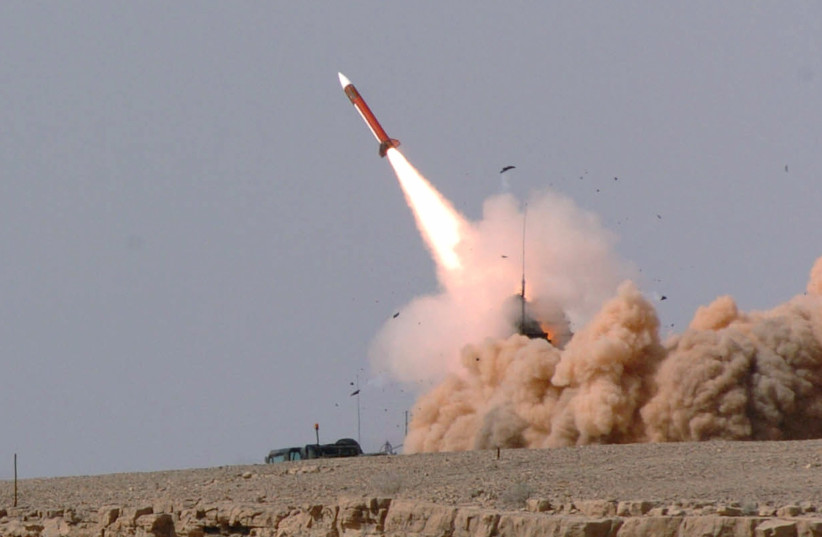
A picture released by Israeli Defence Forces press office shows a launch of a Patriot missile in southern Israel (photo credit: REUTERS)
A picture released by Israeli Defence Forces press office shows a launch of a Patriot missile in southern Israel
(photo credit: REUTERS)
The US is moving up to eight Patriot air defense batteries from key countries in the Middle East, according to a Wall Street Journal Report Friday. The report calls it a “major realignment” of the US military footprint, potentially affecting Iraq, Kuwait, Saudi Arabia and Jordan, key US partners in the region. This means it also could affect Israel. Air defense batteries are key to protecting countries against Iranian missiles and other threats. Removing them, and their radar, has far-reaching ramifications if the reports are accurate.
According to the WSJ report “the Biden administration is sharply reducing the number of US antimissile systems in the Middle East in a major realignment of its military footprint there as it focuses the armed services on challenges from China and Russia, administration officials said.”
This will include around 8 Patriot antimissile batteries. “Another antimissile system known as a Terminal High Altitude Area Defense, or Thaad system, is being withdrawn from Saudi Arabia, and jet fighter squadrons assigned to the region are being reduced,” those officials said. This comes at a time of increasing attacks by Iranian proxies in Iraq against US forces. The US had deployed Patriots to Iraq alongside C-RAM and other systems to protect US forces in 2020. Now new drone threats are emerging in Iraq. Iranian-backed Houthis also used drones and missiles to attack Saudi Arabia, and Iran attacked Saudi Arabia in September 2019 with drones and cruise missiles.
This report follows an Arms Control Association report in April that noted “two out of three flight tests, which aimed to integrate the Patriot and Terminal High Altitude Area Defense (THAAD) missile systems, failed because of software problems, according to a US Government Accountability Office (GAO) report published in April.” The US recently took delivery of two Iron Dome batteries, made in Israel by Rafael Advanced Defense Systems.
According to April reports, the drawdown was already happening as several Patriot batteries had already been moved. THAAD is a key system for countries like South Korea to protect themselves. The US had upped troop levels in Saudi Arabia in October 2019, so some of the drawdown is simply removing forces that had been sent. Over the years, the US had done several displays of force in the region, with Carrier Strike Groups, B-52s and other systems. However, the general trend is that the US is removing forces. Major US forces have been in the region for decades, peaking after the Gulf War in 1991. The US constructed new bases and moved forces from Saudi Arabia to bases in Qatar, the UAE, Bahrain and Kuwait in the wake of tensions in the 1990s and September 11. After the Iraq invasion in 2003 the US sent troops to fight insurgents, known as the “surge” and then left Iraq in 2011, only to return in 2014 to fight ISIS. Former US President Donald Trump vowed to leave Syria and other “endless wars.” The US under Biden is leaving Afghanistan, a promise Trump made as well.
“The redeployment includes hundreds of troops who are members of units that operate or support those systems. The move comes as the military plans a complete withdrawal from Afghanistan by this summer and after the US last fall cut its force posture in Iraq by half—or 2,500 troops—because it said Iraqi forces could secure the country,” the WSJ reports.
According to the report, Defense Secretary Lloyd Austin informed Saudi Crown Prince Mohammed bin Salman on June 2 of the movements. The report comes amid new focus on Iran drone threats and warnings by CENTCOM of the drone threats that are emerging. It comes as the US and Iran are also discussing a deal and after Biden met with NATO members and the Russian President in Europe last week. It also comes amid US-Turkey tensions of Ankara’s acquisition of the Russian S-400 and Ankara being removed from the F-35 program.
For Israel, the implications could loom large. If enemies of the US take the drawdown to mean the US is not committed to the region they may test the US and partner countries. Israel recently did a joint F-35 training with Italy, the UK and US in Italy, the first deployment of the Israeli F-35s abroad. Israel did three joint drills with US F-35s from Al-Dhafra base last year, called Enduring Lightning.
Air defenses like Patriots are key to defending the region. Saudi Arabia has used its Patriots to stop Iranian-backed Houthi threats. The system can be used with other air defense systems. For instance, Israel has had Patriot batteries for years. Israel also uses Iron Dome, David’s Sling and Arrow. The US and Israel worked closely to develop Arrow and David’s Sling, with the US having also supported the Iron Dome after Israel developed the system more than 10 years ago. In the recent war with Hamas, the system countered thousands of rocket threats.
Reports of troop movements and withdrawals have implications, but also need to be contextualized. Reports can sometimes be used to test reactions and see what comes next. It is important to see if the changes actually happen, especially since the number of Patriot batteries in the region should be kept to some extent secret so enemies do not know where they are or what may be vulnerable.
