Fires were reported in the Sha’ar HaNegev area and throughout the Eshkol Regional Council area.

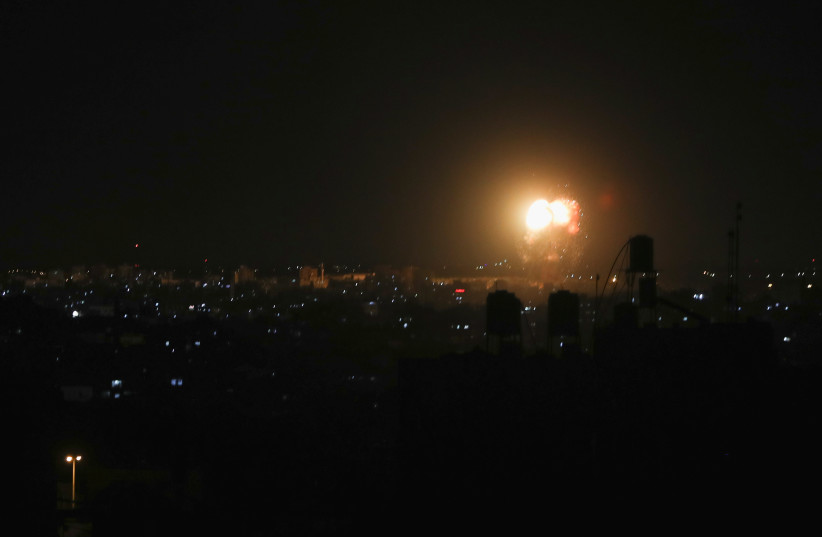
Smoke and flames are seen after an Israeli air strike in the northern Gaza Strip (photo credit: REUTERS/MOHAMMED SALEM)
Smoke and flames are seen after an Israeli air strike in the northern Gaza Strip
(photo credit: REUTERS/MOHAMMED SALEM)
Rocket sirens were heard in Kfar Aza early Friday, amid rising tensions between Israel and the Gaza-based terrorist organizations Hamas and Palestinian Islamic Jihad.

Prior to the rocket fire, the IDF attacked a number of targets in Gaza late Thursday night in response to a number of incendiary balloons that had been launched from Gaza into Israel, Palestinian media reported.

No injuries were reported. The IDF reportedly warned some of the Gaza residents in advance to attacking 10 Hamas targets in the Strip, N12 news reported. The strikes were carried out near Beit Lahiya and Beit Hanoun, which came in response to multiple incendiary balloons launched, causing some eight fires in Israeli communities near Gaza.

Fires were reported in the Sha’ar HaNegev area and throughout the Eshkol Regional Council area.
Tensions between Israel and terrorist organizations in the Gaza Strip have risen in the last three days, following a threat from Hamas to escalate attacks in response to the Jerusalem Flag March on Tuesday.

IDF Chief of Staff Lt.-Gen. Aviv Kohavi held a security briefing with top commanders and instructed them to prepare for renewed fighting with Hamas. Israel and Hamas fought for 10 days last month in what was called “Operation Guardian of the Walls.” Over 4,500 rockets were fired into Israel during that conflict.
“The IDF will continue to destroy terrorist infrastructure throughout Gaza and it views Hamas as being responsible for the attacks that emanate from there,” the IDF said.

A number of fires also broke out in southern Israel on Tuesday, with at least 20 fires sparked by incendiary balloons launched from Gaza. Earlier on Tuesday, Palestinian media published photos of terrorists preparing such balloons to launch towards Israel.

The attack comes following Operation Guardian of the Walls that was conducted in mid-May.

This is a developing story. 

IDF destroys Syrian outpost used by Hezbollah

The post, 150m from the border, was the first destroyed by the government of Naftali Bennett.

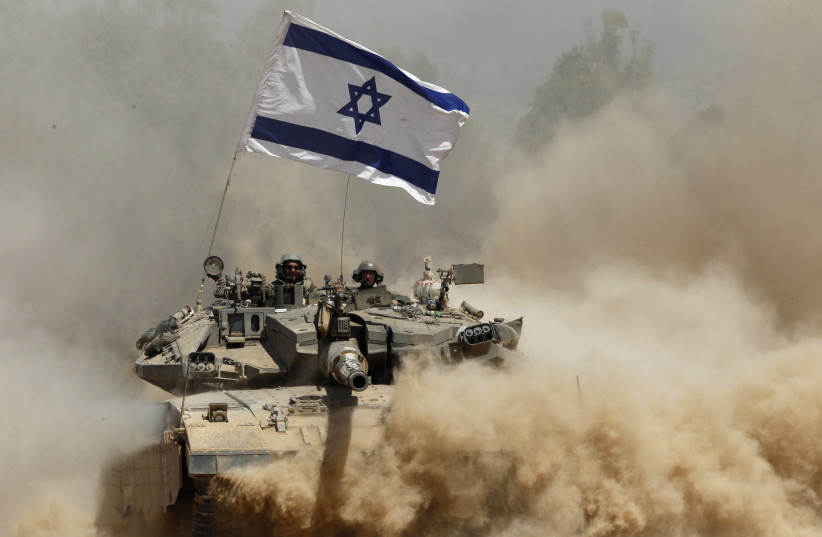
Israeli soldiers ride a tank after returning to Israel from Gaza, 2014 (photo credit: SIEGFRIED MODOLA/REUTERS)
Israeli soldiers ride a tank after returning to Israel from Gaza, 2014
(photo credit: SIEGFRIED MODOLA/REUTERS)
The IDF struck a Syrian outpost near the city of Quientra, marking the first strike on the northern border by the government of Prime Minister Naftali Bennett.
The post, some 150 meters away from the border, was affiliated with the Syrian Army’s 90th Brigade and First Corps had been frequented by Hezbollah officials and used as a reconnaissance post against IDF forces on the Golan Heights. According to Syrian opposition reports it was destroyed by tank fire.
Two weeks ago the IDF destroyed another observation post in the same area built in the demilitarized zone.
Writing on Twitter, Avichay Adraee said that the military “destroyed a forward observation post of the Syrian army that was set up in an Israeli area west of the Alfa line in the Golan Heights.”
Israel, he said, “would not tolerate any attempts to violate our sovereignty.”
There were at least two other strikes blamed on the Jewish State since the beginning of May.
During his tenure as Defense Minister, Bennett worked to escalate Israel’s steps against Iranian forces in Syria with the aim of Tehran to withdraw all of its troops from Israel’s northern borders.
While the IDF does not respond to most foreign reports, it has admitted to carrying out hundreds of airstrikes as part of its “war-between-wars” (known in Hebrew as MABAM) campaign to prevent the transfer of advanced weapons to Hezbollah in Lebanon and the entrenchment of Iranian forces in Syria, where they could easily act against Israel.
Although Israel usually refrains from targeting terror operatives to try to avoid subsequent retaliation, some strikes ascribed to the Jewish state have killed several Hezbollah operatives in southern Syria on the Golan Heights, where the group has been trying to establish a permanent military presence.
The Golan Project has its headquarters in Damascus and the Lebanese capital of Beirut. The operatives began operating in the Syrian towns of Hadar, Quinetra and Erneh to collect intelligence on Israel and military movement on the Israeli Golan Heights.
But according to a December report by the ALMA Research and Education Center, Hezbollah’s presence in southern Syria is much larger than previously revealed, with some 58 sites in the southern Syrian provinces of Quneitra and Daraa, where the terror group’s Southern Command and Golan Project have been deployed.


An Iraqi official confirmed that the Russian state corporation Rosatom would implement the project to build the nuclear reactors.

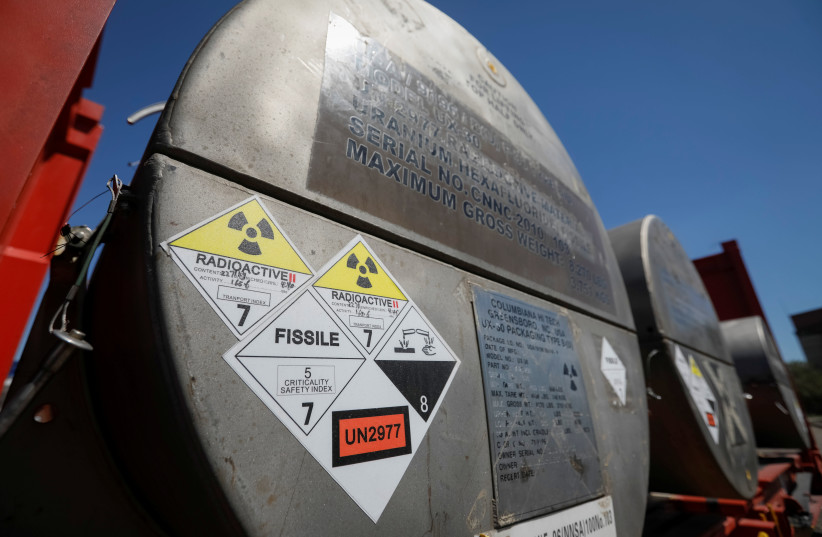
A view shows railway packages for containers with uranium hexafluoride salt, raw material for nuclear reactors, similar to the one be used for the IAEA Low Enriched Uranium (LEU) Bank (photo credit: SHAMIL ZHUMATOV / REUTERS)
A view shows railway packages for containers with uranium hexafluoride salt, raw material for nuclear reactors, similar to the one be used for the IAEA Low Enriched Uranium (LEU) Bank
(photo credit: SHAMIL ZHUMATOV / REUTERS)

Some 40 years after the Israeli airstrike on Saddam Hussein’s nuclear reactor, Iraq is expressing interest in building eight nuclear reactors in order to keep up with rising energy demands in the country.

Kamal Hussain Latif, chairman of the Iraqi Radioactive Sources Regulatory Authority, told Russian state-owned news agency Sputnik on Tuesday that Iraq planned to build eight nuclear reactors to provide 25% of the electricity in the country in 2030. Latif acknowledged that it may take longer to finish all eight reactors and that the number could change.
Latif confirmed that the Russian state corporation Rosatom would implement the project to build the nuclear reactors. Iraq plans to seek $40 billion in loans in order to carry out the project.
South Korea has also offered to help build the plants and even offered Iraqis a tour of reactors in the United Arab Emirates run by the Korea Electric Power Corp., according to Bloomberg magazine.
Iraqi officials announced in May that they were considering 20 possible locations for the planned nuclear reactors.
In April, the Iraqi Radioactive Sources Regulatory Authority announced that it had reached understandings with three countries in order to accelerate the construction of nuclear reactors in Iraq.
Latif told the Iraqi News Agency in April that Iraqi officials had met with Russian and French officials in order to discuss the “peaceful use of nuclear energy” and for medical and industrial purposes. Last year, five countries were confirmed as candidates to build new reactors, including the US, Russia, Argentina, South Korea and France.
The plans to build nuclear reactors come as Iraq suffers from frequent blackouts and faces concerns that it will be unable to keep up with demand in coming years, which is expected to reach 42 gigawatts by 2030.
The plans also come amid rising concerns surrounding Iran’s nuclear ambitions, as it announced on Tuesday that it had made 6.5 kg of uranium enriched to up to 60%, taking yet another step closer to nuclear weapons-grade material. A number of large Iranian-backed militias operate in Iraq.
In an operation on June 7, 1981, the Israel Air Force destroyed Iraq’s Osirak nuclear reactor, which was being built by Hussein’s regime, in an operation involving F-15 and F-16 fighter jets.