In further breach of nuclear deal and amid talks

In further breach of nuclear deal and amid talks on striking new agreement, Tehran spokesperson says country has also stockpiled 108 kilograms of uranium enriched to 20% purity


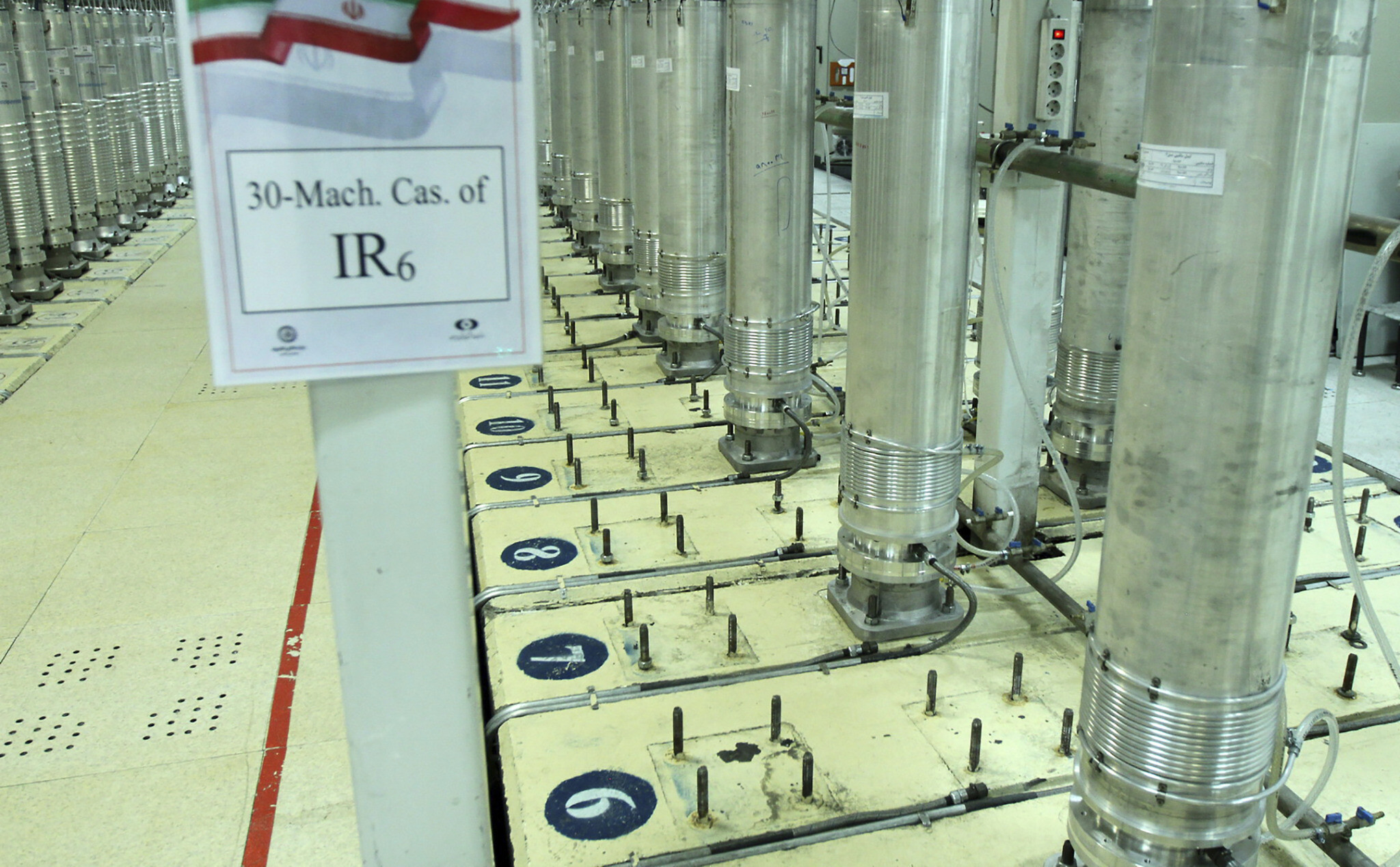
Centrifuge machines in the Natanz uranium enrichment facility in central Iran, in an image released on November 5, 2019. (Atomic Energy Organization of Iran via AP, File)

Centrifuge machines in the Natanz uranium enrichment facility in central Iran, in an image released on November 5, 2019. (Atomic Energy Organization of Iran via AP, File)

Iran said Tuesday that it has produced 6.5 kilograms (14.3 pounds) of uranium enriched to 60 percent purity and 108 kilograms of uranium enriched to 20% purity in five months, far ahead of the schedule set by a law passed earlier this year by Tehran.

The move takes the Islamic Republic even closer to the nuclear weapons-grade level of 90% purity.

The development came amid talks between Iran and world powers in Vienna aimed at rebuilding the 2015 nuclear deal that put curbs on Tehran’s nuclear program in exchange for sanctions relief. Iran has been increasingly violating the terms of the deal since the Trump administration withdrew the United States from it in 2018.

“Under parliament’s law… the Atomic Energy Organization was supposed to produce 120 kg of 20 percent enriched uranium in a year. According to the latest report, we now have produced 108 kg of 20% uranium in the past five months,” government spokesman Ali Rabiei was quoted as saying by state media, according to the Reuters news agency.

“In the area of 60% uranium production, in the short time that has elapsed… about 6.5 kg has been produced,” he added.

Iran’s government spokesman Ali Rabiei speaks at a regular news briefing, on July 22, 2019. (AP Photo/Vahid Salemi)

The United Nations’ atomic watchdog said last month that it had not been able to access data important to monitoring Iran’s nuclear program since late February, when the Islamic Republic started restricting international inspections of its facilities.

The International Atomic Energy Agency made the comment in a report that estimated that as of May 22, Iran’s stockpile included 62.8 kilograms (138.5 pounds) of uranium enriched to 20% purity, and 2.4 kilograms enriched to 60% purity — well above the 3.67% purity allowed under the deal.

Iran’s Governor to the International Atomic Energy Agency (IAEA), Kazem Gharib Abadi, Political deputy at the Ministry of Foreign Affairs of Iran, Abbas Araghchi, and Deputy Secretary General and Political Director of the European External Action Service (EEAS), Enrique Mora stand in front of the ‚Grand Hotel Vienna’ where where closed-door nuclear talks take place in Vienna, Austria, June 2, 2021. (AP Photo/Lisa Leutner)

In the same IAEA report, the agency for the first time released estimates of Iran’s stockpile rather than precise figures, saying that the total stockpile was 3,241 kilograms (7,145 pounds), up about 273 kilograms (600 pounds) from the last quarterly report.

That was down from an increase of nearly 525 kilograms (1,157 pounds) reported in the previous quarterly report.

Though it was not immediately clear what led to the decrease, it came as an explosion in April at Iran’s underground Natanz nuclear facility affected centrifuges there. Iran has yet to offer a full accounting of what happened in an attack it described as “nuclear terrorism.” Israel, which is widely suspected of carrying out the assault, has not commented publicly on it.

The nuclear deal signed in 2015 with the United States, Germany, France, Britain, China and Russia only permits Iran only to keep a total stockpile of 202.8 kilograms (447 pounds) of enriched uranium.

Leaders of the Group of Seven wealthy nations and members of NATO on Monday reaffirmed a commitment to stop Iran from making nuclear weapons, as diplomats from outside the European Union cautioned that negotiations with the Islamic Republic to salvage the 2015 nuclear deal still need more time.

AP contributed to this report.

ntributed to this report.


But foreign ministry spokesperson doubts new leadership will bring about a change of policies


Demonstrators burn representations of the Israeli flag during pro-Palestinians demonstrations in Tehran, Iran, May 19, 2021. (Vahid Salemi/AP)

Demonstrators burn representations of the Israeli flag during pro-Palestinians demonstrations in Tehran, Iran, May 19, 2021. (Vahid Salemi/AP)

The day after the installation of a new government in Israel, Iran’s foreign ministry on Monday expressed skepticism that there would be any change in its policies under fresh leadership.

“Iran’s enemies are gone and powerful Iran is still here,” a ministry spokesman said, according to a report by the Reuters news agency. “I don’t think Israel’s policies will change with the new government.”

In a speech to the Knesset shortly before he was confirmed as premier, Prime Minister Naftali Bennett of the nationalist, right-wing Yamina party said his attitude toward Iran matches that of outgoing leader Benjamin Netanyahu.

Bennett expressed staunch opposition to an American return to the 2015 nuclear deal limiting Iran’s nuclear program, maintaining Netanyahu’s hawkish stance toward Tehran. However, the new government is expected to keep disagreements with the US behind closed doors.

Bennett said the Iranian nuclear program “is approaching a critical point.”

“Israel will not allow Iran to obtain nuclear weapons. Israel is not a party to the [international nuclear] deal and will maintain full freedom to act,” he said.

In a message to Washington, he added: “Renewing the nuclear deal is a mistake.”

Israel’s new Prime Minister Naftali Bennett (C) after the swearing in of the new government, in the Knesset on June 13, 2021. (Olivier Fitoussi/FLASH90)

Former Mossad spy agency chief Yossi Cohen, who retired earlier this month, last week gave a candid interview that included information about Iran and incidents that have hampered its nuclear program over the years.

Cohen intimated that his agency blew up Iran’s underground centrifuge facility at Natanz, gave a detailed description of the 2018 operation in which the Mossad stole Iran’s nuclear archive from safes in a Tehran warehouse, confirmed that Iran’s assassinated top nuclear scientist Mohsen Fakhrizadeh had been in Mossad’s sights for years, and said the regime needs to understand that Israel means what it says when it vows to prevent Iran attaining nuclear weapons.

Aside from Israel’s efforts to prevent Iran from obtaining nuclear weapons, which are alleged to have included sabotage bomb attacks and assassinations, it has also in recent years been fighting a shadow war against Iran in Syria. The Jewish state under Netanyahu repeatedly said it would not allow Iran to obtain a military foothold in the territory or to supply advanced weapons to its proxy, the Hezbollah terror group in Lebanon. Israel has carried out hundreds of airstrikes in Syria in an effort to achieve those goals


Gantz: No political move justifies taking fight public; Bennett thanks Biden for supporting Israel in last Gaza war

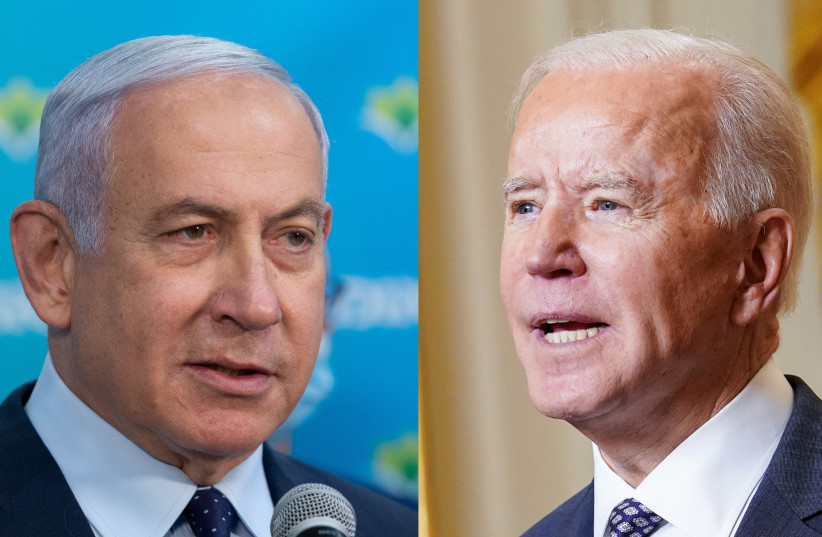
Prime Minister Benjamin Netanyahu and US President Joe Biden (photo credit: REUTERS/KEVIN LAMARQUE AND ALEX KOLOMOISKY/POOL)
Prime Minister Benjamin Netanyahu and US President Joe Biden
(photo credit: REUTERS/KEVIN LAMARQUE AND ALEX KOLOMOISKY/POOL)
Benjamin Netanyahu compared Biden administration’s planned return to the Iran deal to US neglect of European Jews during the Holocaust, in his final speech as prime minister on Sunday.

“The administration in Washington asked me not to discuss our disagreement on Iran publicly, but with all due respect, I can’t do that,” Netanyahu said.

He compared the US returning to the Iran deal to former US president Franklin Delano Roosevelt declining to bomb the train tracks to Auschwitz when he had the chance.

At the time, Netanyahu said, the Jewish people “didn’t have a voice, a country, an army,” but now they do.

Prime Minister Naftali Bennett indicated that he plans to continue former prime minister Benjamin Netanyahu’s policies vis-à-vis Iran, in his address to the Knesset immediately before Netanyahu’s, ahead of the vote to approve a new government under his leadership.

But Netanyahu said Bennett does the opposite of what he says, and therefore, he won’t protect Israel from Iran.

Bennett does not have “the international stature, the knowledge, the government or the public’s trust to be taken seriously when fighting the Iranian threat. An Israeli prime minister has to be able to say no to the president of the US on matters that endanger our existence. I’ll be happy if this doesn’t come true, but from the moment the US returns to the Iran Deal, this government will not approve operations against Iran to stop their armament.”

Iran is “celebrating” Israel’s weak new government, Netanyahu warned, adding in English: “We’ll be back soon.”

Defense Minister Benny Gantz slammed Netanyahu for his remarks, saying “no political move justifies breaking ranks and creating a public dispute…with the US, our greatest friend.”

Gantz vowed to strengthen relations with the US and work with the Biden administration to ensure Iran doesn’t get a nuclear weapon.

“We will make sure Israel has the military option to protect itself,” he added. “The policies that I led will continue and grow stronger in the current government.”

The US and Iran are currently engaged in indirect negotiations in Vienna to return to the JCPOA, which sought to limit Iran’s ability to develop a nuclear weapon. The US under former president Donald Trump left the deal in 2018 and put massive sanctions on Iran, which Teheran demands Washington lift in exchange for their return to compliance, including lowering their uranium enrichment and stopping uranium metal development.

Israel’s main criticisms of the deal are that the restrictions on the Islamic Republic’s nuclear program expire in 2030, and that it does not limit its regional aggression, including proxy warfare.

Bennett said that “returning to the Iran Deal is a mistake that will once again give legitimacy to one of the most violent, darkest regimes in the world,” Bennett said. “Israel will not allow Iran to get nuclear weapons. Israel is not a party to the deal, and will maintain total freedom of action.”

The 2015 Joint Comprehensive Plan of Action gave Iran international legitimacy and billions of dollars, which it spent on building “terrorist outposts in Syria, Gaza, Lebanon and Yemen,” Bennett said.

A senior diplomatic official in the departing government said last week that the Biden administration believes that an agreement with Iran is better than his predecessor’s maximum pressure campaign, which they said did not successfully bring Iran to the table under better conditions for the US.

Israel doubts the US will end up negotiating a “JCPOA-plus,” the official said, despite US Secretary of State Antony Blinken repeatedly saying Washington would seek a “longer and stronger” deal.

The US has been transparent with Israel, and as such, Israel has said it disagrees, publicly and privately, but has not started a defiant public campaign, the official explained. Before Sunday, Netanyahu made public statements against a return to the Iran Deal, but he was more focused on discussions with administration officials, and there was been a strategic dialogue between the National Security Councils in Washington and Jerusalem.

Israel is continuing to discuss the Iran deal with the Biden administration, in hopes of mitigating the damage, the official added.

Bennett left Netanyahu’s military secretary Avi Blatt and National Security Adviser Meir Ben-Shabbat in office, and met with them on Sunday night for a briefing on the security situation.

In his address, Bennett thanked US President Joe Biden for supporting Israel during Operation Guardian of the Walls between Israel and Gaza last month, and his “commitment of many years to Israel’s security.”

The Biden administration blocked three UN Security Council statements against Israel, and Biden and Blinken made repeated statements supporting Israel’s right to defend itself and condemning Hamas. Biden has also said the US will replenish Israel’s stock of Iron Dome missile defense batteries.

Bennett referred to Biden’s remark last month that “until the region says, unequivocally, they acknowledge the right of Israel to exist as an independent Jewish state, there will be no peace.” The incoming prime minister said this is “an important message that will be heard throughout the Middle East.”

“Our government will make an effort to deepen and cultivate relations with our friends in both parties – bipartisan,” Bennett said, saying the last word in English. “If there are disagreements, we will manage them through mutual respect.”

As for last month’s war in Gaza, Bennett said it was “a reminder that the Palestinians are still there,” and that Israel has to “remind the world that our enemies oppose our existence here as a Jewish state. No political constellation will tie our hands and stop us from doing what is needed. Violence and terror aren’t natural phenomena that we just have to accept. The Palestinians have to take responsibility for their actions.”

If there is quiet, then Israel will engage in greater economic cooperation with the Palestinians to “reduce the conflict,” Bennett added.

The incoming prime minister said the new government “will act to strengthen and expand peace agreements with the Arab world,” and “deepen the connections between citizens of Israel and our neighbors.”

Bennett’s speech also included a commitment to bring home the Israeli civilians held hostage, Avera Mengistu and Hisham al-Sayed, and Israeli soldiers whose bodies are being held by Hamas in Gaza, Hadar Goldin and Oron Shaul.

The incoming prime minister plans to direct his remarks to their parents, saying: “I raised my hand in the Security Cabinet in the vote in which we sent Hadar and Oron, of blessed memory, to fight for us in Operation Protective Edge [in 2014]. I see their return as a holy responsibility that must be fulfilled responsibly.”

Tzur Goldin, Hadar Goldin’s brother, wrote on Twitter: “Words about ‘commitments’ have consistently been an excuse and a trick to do nothing for seven years. We will not rush to pat him on the back. Words of actual action to bring back the boys will get our support and encouragement. The new government has a lot of work to do…to change and rehabilitate the approach to Israeli captives and the systems and battle to bring them back.”