
US condemns Tehran’s ‘provocative’ announcement it’ll increase uranium purity to 60%; Israeli analyst: With Natanz out of commission, enrichment at those levels will be limited
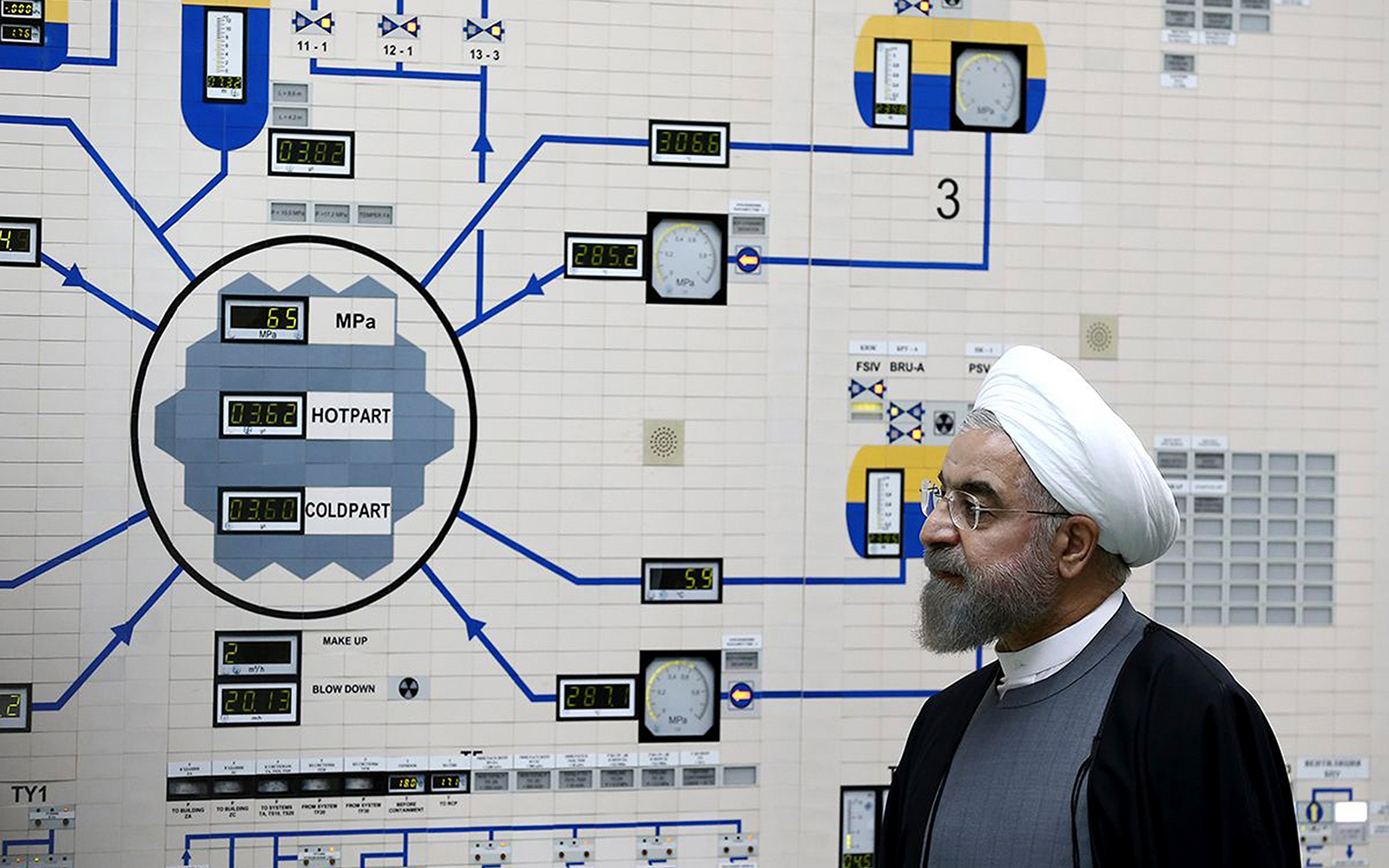
 

Illustrative: Iranian President Hassan Rouhani visits the Bushehr nuclear power plant just outside of Bushehr, Iran, January 13, 2015. (AP Photo/Iranian Presidency Office, Mohammad Berno, File)

Illustrative: Iranian President Hassan Rouhani visits the Bushehr nuclear power plant just outside of Bushehr, Iran, January 13, 2015. (AP Photo/Iranian Presidency Office, Mohammad Berno, File)

The White House said Tuesday it remains committed to nuclear negotiations with Tehran despite the Islamic Republic’s “provocative” statement that it will ramp up uranium enrichment, amid high tensions in the Middle East and alleged tit-for-tat attacks between Israel and Iran.

“We are certainly concerned about these provocative announcements,” US President Joe Biden’s press secretary, Jen Psaki, told reporters.

“We believe that the diplomatic path is the only path forward here and that having a discussion, even indirect, is the best way to come to a resolution,” she said.

The meeting came as a flurry of escalations in Iran and at sea threatened to derail ongoing talks aimed at rescuing Iran’s 2015 nuclear deal. The Biden administration opened indirect talks with Iran over the deal last week.

US President Joe Biden speaks in the South Court Auditorium on the White House campus, in Washington, April 7, 2021. (Evan Vucci/AP)

The nuclear talks in Vienna were set to resume Wednesday, but Russia’s ambassador to the UN said they had been postponed by a day. Russia is a signatory of the deal.

On Tuesday, Iran said it was stepping up uranium enrichment to an unprecedented 60 percent and installing new centrifuges in response to a Sunday attack on its Natanz nuclear facility, which it has blamed on Israel. Washington has denied any involvement.

Iran has threatened Israel over the strike, and an Israeli-owned ship was attacked in the Gulf of Oman Tuesday, the latest incident in the shadow maritime war between Tehran and Jerusalem.

The details of the Natanz incident and extent of the damage are still murky. The event was initially described only as a blackout in the electrical grid feeding above-ground workshops and underground enrichment halls — but later Iranian officials began referring to it as an attack, and an Iranian official on Monday specified that it was a blast that knocked out the plant’s primary and backup power.

Iran’s Foreign Ministry said it damaged some of Iran’s first-generation IR-1 centrifuges, the workhorse of its nuclear program. Unsourced Israeli media reports have claimed that the entire plant remains out of action.

Enrichment to 60% marks a significant escalation and is a short technical step away from weapons-grade uranium. Iran had been enriching up to 20%, and even that was a short step from weapons-grade levels of 90%.

Iran’s Natanz nuclear facility on April 7, 2021 (Planet Labs Inc. via AP)

An Israeli TV report on Tuesday said that Iran will only be able to enrich very small quantities of uranium to 60% since Natanz is still out of commission following the Sunday attack.

Channel 13 analyst Alon Ben David said that despite Iranian officials’ vow to begin the higher enrichment process on Wednesday, they cannot do it at Natanz, since the 6,000 centrifuges there remain inoperable.

There are 1,000 centrifuges at Iran’s Fordo nuclear facility that can enrich to 60% in very small quantities, which did not appear to constitute a significant threat, the Israeli analyst said.

Iran’s semi-official Fars news agency said its atomic energy agency will initiate preparatory steps to ramp up enrichment on Tuesday night. The report said the damaged IR-1 centrifuges will be replaced with new machines that have a higher capacity.

The International Atomic Energy Agency confirmed in a statement that Iran warned it will start enriching uranium up to 60% purity.

In a report to member states, the IAEA’s director-general, Rafael Mariano Grossi, “said Iran had informed the Agency that the country intends to start producing UF6 enriched up to 60 percent,” the statement said.

Earlier Tuesday, Iranian Foreign Minister Mohammad Javad Zarif said the attack at Natanz could hurt the negotiations in Vienna.

“Americans should know that neither sanctions nor sabotage actions would provide them with an instrument for talks,” Zarif said in Tehran alongside visiting Russian Foreign Minister Sergey Lavrov. “They should know that these actions would only make the situation difficult for them.”

Zarif separately renewed his earlier warning to Israel over the sabotage, saying that if Iran determines its archenemy was behind it, “then Israel will get its response and will see what a stupid thing it has done.”

Iran’s Foreign Minister Mohammad Javad Zarif addresses a conference in Tehran, Iran, February 23, 2021. (Vahid Salemi/AP)

Nuclear negotiator Abbas Araghchi, in Vienna to begin informal talks Tuesday night, made a point to make his announcement in English.

“We believe this round of negotiations is the time for the US to present a list and I hope that I can go back to Tehran with the list of sanctions which should be lifted,” Araghchi told Iranian state television’s English-language arm Press TV. “Otherwise, I don’t believe we can continue like this. Otherwise, it would be a waste of time.”

He said authorities would install another 1,000 centrifuges at Natanz.

“The damaged centrifuges in Natanz… would be replaced with more-advanced centrifuges and more-capable centrifuges,” he said. “We insist on what we have asked. All sanctions should be lifted, we verify and then we go back to full compliance if we are satisfied with the verification process.”

Mikhail Ulyanov, Russia’s ambassador to the IAEA, said that “those who undertook an act of sabotage against the nuclear facility in Natanz probably wanted to undermine the process of” reviving the nuclear accord.

“They underestimated the possibility of significant ‘side effects,’” he tweeted. Russia is a member of the nuclear deal.

The move to 60% had been hinted at in the past. Iran’s supreme leader Ayatollah Ali Khamenei had threatened to go to that level in February.

In this picture released by an official website of the office of the Iranian supreme leader, Ayatollah Ali Khamenei addresses the nation in a televised speech in Tehran, Iran, January 8, 2021. (Office of the Iranian Supreme Leader via AP)

Iran previously had said it could use uranium enriched up to 60% for nuclear-powered ships. However, the Islamic Republic currently has no such ships in its navy.

Kayhan, a hard-line Tehran newspaper, urged Iran to “walk out of the Vienna talks, suspend all nuclear commitments, retaliate against Israel and identify and dismantle the domestic infiltration network behind the sabotage.”

Iran’s withdrawal from the talks remains unlikely as the administration of President Hassan Rouhani, whose main diplomatic achievement was the 2015 accord, hopes to get the US to rejoin it and provide desperately needed sanctions relief. But the announcement that it would enrich uranium further shows how pressure has been growing within Iran’s theocracy over how to respond to the attack.

Also Tuesday, an Israeli-owned ship, the Hyperion Ray, sustained minor damage in an attack near the United Arab Emirates, in the third incident of its kind in recent months. There was no immediate claim of responsibility for the strike, but officials in Jerusalem believe Iran is responsible, according to Hebrew media reports.

Tehran and Jerusalem are engaged in a maritime shadow war, with both sides blaming the other for explosions on vessels, marking a new front in the conflict that was previously carried out on land, by air, and with alleged espionage and cyberattacks.

The MV Saviz, an Iranian cargo ship said to serve as a floating base for Iran’s paramilitary Revolutionary Guard forces off the coast of Yemen, was struck by an explosion last Tuesday, likely from a limpet mine.

FILE: A suspicious boat off the stern of the Iranian ship ‘Saviz’ in the Red Sea in 2018. (Al Arabiya video screenshot/File)

The Biden administration has repeatedly said it will return to the 2015 nuclear deal if Iran first returns to compliance. Iran has taken a hardline approach, demanding the US lift all sanctions against it first, putting the two sides at a stalemate.

Officials from the US, Iran, and European intermediaries said talks in Vienna last week were “constructive,” but yielded little progress. US officials later voiced doubts about Iran’s seriousness in the talks.

Israeli officials, including Prime Minister Benjamin Netanyahu, have adamantly opposed the US returning to the nuclear deal, putting Jerusalem at odds with the new White House administration.

US and Israeli security officials held a bilateral strategic group meeting aimed at collaborating in the effort to prevent Iran from obtaining a nuclear weapon on Tuesday. The US stressed its commitment to preventing a nuclear-armed Iran during the virtual discussion and invited Israeli National Security Adviser Meir Ben-Shabbat to visit Washington in the coming weeks.

Natanz explosion destroyed facility 50 meters underground

The attack was reportedly carried out through a remotely detonated device smuggled into the facility.

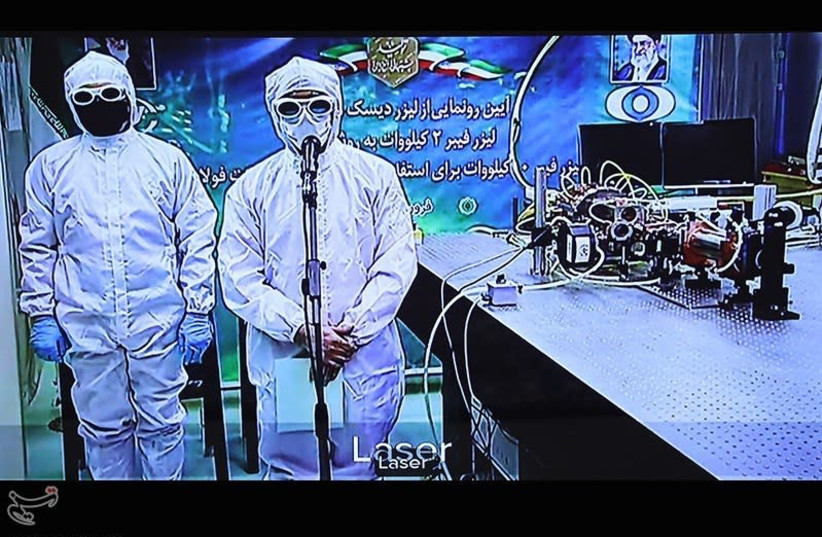
Exhibition of nuclear achievements of Iran's Atomic Energy Organization, April 10, 2021 (photo credit: PRESIDENT.IR VIA TASNIM NEWS AGENCY)
Exhibition of nuclear achievements of Iran’s Atomic Energy Organization, April 10, 2021
(photo credit: PRESIDENT.IR VIA TASNIM NEWS AGENCY)
The alleged Israeli attack on Iran’s Natanz nuclear facility destroyed an electrical substation located 40 to 50 meters underground, Fereydoon Abbasi-Davani, former head of Iran’s Atomic Energy Organization, told Iranian media on Monday.

Davani added that the substation was built underground in order to protect it from air and missile strikes, and that the attack was carried out either via cyber, sabotaged equipment or sabotage committed by agents.
The Iranian official stressed that such an operation takes years, saying “the design of the enemy was very beautiful.” The explosion managed to damage both the power distribution system and the cable leading to the centrifuges in order to cut power to them.
An intelligence official told The New York Times on Tuesday that the attack was carried out through an explosive device that had been smuggled into the facility and detonated remotely, taking out both the primary and backup electrical systems.
Davani confirmed on Monday that this was how the attack last July was carried out as well, telling Iranian media that it was done with explosives that were embedded in a heavy table that was brought into the facility.
The former AEO head explained that in a similar attack at the Fordow nuclear facility in 2012, power lines from the city of Qom were cut by an explosion, so they had anticipated such an attack and had stored fuel for producing electricity for three months in case such an incident occurred.
Davani, who now serves on the Iranian Parliament’s energy commission, survived an assassination attempt in 2010 in which bombs were attached to the side of his car by men on motorcycles. Another nuclear scientist, Majid Shahriari, was killed in a similar attack the same day. Davani reportedly worked closely with Mohsen Fakhrizadeh, Iran’s top nuclear scientist, who was killed in an assassination blamed on Israel last year.
Additionally on Monday, Behrouz Kamalvandi, a spokesman for the AEO, told Iranian media that he had injured his ankle and head while visiting the Natanz facility after the attack when he fell into a seven-meter-deep hole that had been covered with metal. It is unclear whether the hole was related to the explosion.

EXPLOSIVES WERE used to completely destroy the internal power system at Iran’s Natanz uranium enrichment facility in an alleged Israel operation, two intelligence officials told The New York Times on Sunday night.

The explosion caused severe damage to the site and it could take at least nine months to restore production at the facility, according to the officials.

According to The Wall Street Journal, the Biden Administration was given no advance notice about the attack. The White House said on Monday that it was not involved in the attack.
The WSJ report added that destruction of the power supply in the attack could have damaged or destroyed centrifuges by causing them to slow down too rapidly.
A number of former Israeli security officials expressed concerns at the leaks being shared about the attack, with former Mossad chief Danny Yatom warning that it could impact Israel’s operational capability, in an interview with Army Radio on Monday.
“If indeed this thing is the result of an operation involving Israel, this leak is very serious,” said Yatom. “It is detrimental to the Israeli interest and the fight against Iranian attempts to acquire nuclear weapons. There are actions that must remain in the dark.”
“Once Israeli officials are quoted, it forces the Iranians to take revenge,” warned Yatom. “If the Iranians start investigating with the publication hovering over their heads that the people behind the attack are the Israelis or the Americans, they will leave no stone unturned. This has an impact on our operational capability.”
IRANIAN OFFICIALS have downplayed the significance of the attack, with several officials stressing that the impacted centrifuges were first-generation machines that would be replaced with more advanced ones.
Iran’s permanent representative to the International Atomic Energy Agency, Kazem Gharibabadi, claimed on Monday that enrichment had not stopped at Natanz, despite foreign media reports to the contrary.
Iranian Foreign Minister Mohammed Javad Zarif complained to UN Secretary-General Antonio Guterres about the attack, calling it “nuclear terrorism and a war crime.”
“Israel’s efforts aimed at preventing the revival of the international nuclear deal JCPOA, after the US presidential elections, was initially reflected in threats, which have now materialized,” said Zarif, according to Iranian media. The foreign minister added that Iran had accelerated its retaliatory measures against US sanctions in response to the attack.
Saeed Khatibzadeh, a spokesman for the Iranian Foreign Ministry, stated on Monday that Iran would respond to the attack “in its own time.”
“The regime has been carrying out some actions and some news leaks in the last few months. Its goals are clear and not hidden from the elites and intellectuals of Iran,” added Khatibzadeh. “The foreign minister and our delegation are following up on this issue and actions will be announced today or tomorrow. Some actions will be taken in their undisclosed way [and] may never be said.”
An informed official in the Iranian Intelligence Ministry told the IRGC-affiliated Tasnim News Agency on Monday that the identity of the disruption’s cause had been found and that “necessary measures are being taken to arrest the main cause of the disruption in the electricity system of Natanz complex.”
THIS IS the second attack on Natanz that foreign reports have blamed on Israel within the past year, with an explosion and fire at a facility at the site in July reportedly impacting Iran’s nuclear program significantly. The facility hit this week was a new one built at the site to replace the one hit last year.
Iran is still nowhere near having recovered to the point where it had been before that July 2020 explosion in terms of its capacity for assembling new advanced centrifuges, The Jerusalem Post recently reported.
The most recent attack against Natanz took place a day after Iran began injecting uranium hexafluoride gas into advanced IR-6 and IR-5 centrifuges at Natanz and was revealed as US Secretary of Defense Lloyd Austin was visiting Israel.
Tensions are rising between Israel and Iran amid a number of attacks on Iranian and Israeli maritime vessels, with recent reports claiming that Israel has hit dozens of Iranian ships in recent years. Tensions were already high between the two nations after the Fakhrizadeh assassination and reported attempts by Iran to carry out revenge attacks on Israeli embassies around the world.
The report also comes as Iran meets with European and American officials to discuss a possible return to the Joint Comprehensive Plan of Action, the formal name for the nuclear agreement signed in 2015 between the Islamic Republic and world powers.
Prime Minister Benjamin Netanyahu has warned multiple times in the past week that Israel would defend itself against Iranian threats, stressing that Jerusalem would work to combat Tehran’s nuclear ambitions.
The prime minister called the security cabinet’s first meeting in two months next Sunday to discuss Iran amid increased tensions with Tehran.
Yonah Jeremy Bob and Lahav Harkov contributed to this report.


Reuters|
Published: 04.13.21 , 09:56

Iran’s top diplomat said on Tuesday that the attack on the Natanz nuclear facility by Israel was a “very bad gamble” which will strengthen Tehran’s hand in talks with major powers to revive the 2015 nuclear deal that Washington abandoned three years ago.
“I assure you that in near future more advanced uranium enrichment centrifuges will be placed in the Natanz facility,” Iranian Foreign Minister Mohammad Javad Zarif said in a joint news conference with his Russian counterpart in Tehran.