Reports that US and Iran are at a stalemate – with each demanding that the other be the first to comply with the JCPOA before any genuine negotiations can proceed – are laughable

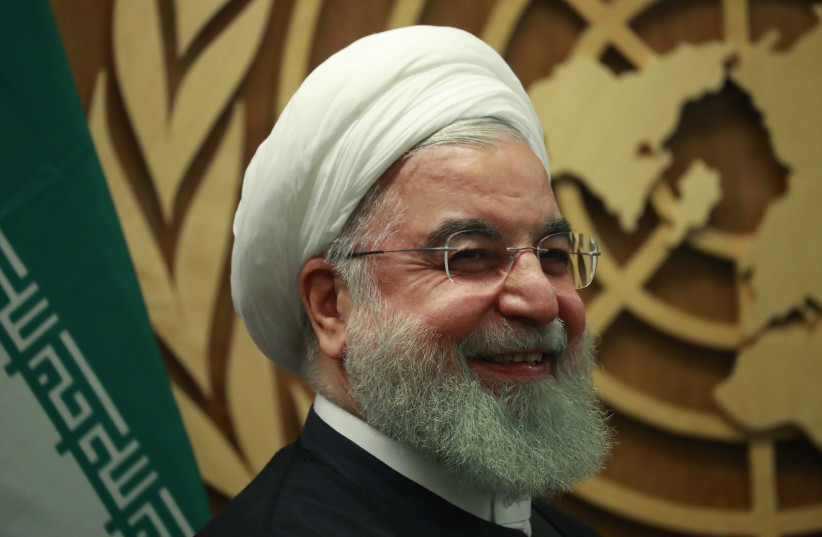
Iran's President Hassan Rouhani attends a meeting with United Nations Secretary General Antonio Guterres on the sidelines of the 74th session of the United Nations General Assembly at UN headquarters in New York City, New York, US, September 25, 2019.  (photo credit: REUTERS/YANA PASKOVA)
Iran’s President Hassan Rouhani attends a meeting with United Nations Secretary General Antonio Guterres on the sidelines of the 74th session of the United Nations General Assembly at UN headquarters in New York City, New York, US, September 25, 2019.
(photo credit: REUTERS/YANA PASKOVA)
 Addressing a session of the Iranian cabinet on Wednesday, President Hassan Rouhani lauded the return of the United States to the nuclear negotiating table. Referring to Tuesday’s summit in Vienna, coordinated by the European Union and attended by representatives from the US, Iran, Russia, China, France and Britain, Rouhani said, “Today, a united voice is being heard, as all parties to the nuclear deal have come to the conclusion that there is no solution better than the Joint Comprehensive Plan of Action, and there is no path other than its full implementation.”

The point of his speech was not to express “unity” with Washington, however. After all, the American and Iranian delegates didn’t even sit in the same room during the first day of the talks, which are taking place in the very city where the JCPOA was signed in 2015.
No, the purpose of his pontification was to praise his mullah puppet-masters for once again bringing the “Great Satan” to its knees. No wonder Atomic Energy Organization of Iran (AEOI) spokesman Behrouz Kamalvandi announced the same day that “in less than four months, we have produced 55 kg. [121 lbs.] of 20% enriched uranium… in around eight months, we can reach 120 kg. [264.5 lbs.]”
It’s typical of Iranian officials to boast about the might of the regime, particularly with a presidential election fast approaching amid severe domestic woes. The country’s internecine problems have been increasing steadily since 2018, when former US President Donald Trump withdrew from the JCPOA and instated a “maximum pressure” sanctions campaign against Tehran.
The outbreak of the coronavirus pandemic, which hit the Islamic Republic especially hard, only served to exacerbate an already untenable situation, with more than 70% of workers unemployed and 80% of the population falling below the poverty line. Nor are those Iranians who can’t afford basic food staples buying the regime’s repeated excuse for their plight: that the US is to blame for “violating” the JCPOA and refusing to lift all sanctions.
They’re also fed up with the leadership’s simultaneous bragging about its massively expensive military build-up. On March 15, for example, the government released footage of an underground Islamic Revolutionary Guard Corps base, which it called a “missile city,” equipped with advanced weaponry and electronic-warfare technology.
According to Middle East Eye, the nuclear-warhead-capable cruise and ballistic missiles at the complex have a range of up to 2,000 km. (approximately 1,243 miles). And last year, the regime announced that it had constructed several such compounds along the coast of the Persian Gulf.



Iran

Officials in Iran once again debunked claims by the U.S. State Department and friendly media that the Biden Administration is in “indirect” talks with Tehran on Wednesday, stating the Islamic regime has nothing to discuss without an end to every American sanction on the rogue state.

State Department spokesman Ned Price confirmed Monday that President Joe Biden approved travel for his top Iran envoy, Robert Malley, to Vienna, Austria, where the remaining signatories to the 2015 Iran nuclear deal would be meeting this week. While Price claimed Malley would be in town for “indirect” talks with the partners in the Joint Comprehensive Plan of Action (JCPOA), Iranian officials quickly dismissed this claim, asserting that “no representative from the United States will attend the Joint Commission meeting or related expert meetings and no direct and indirect negotiations with the United States are on the agenda of Iran’s delegation.”

Iranian officials Wednesday again repeated their clarification that they are not in discussions with any representatives of the Biden administration and that they will only address the Americans if the United States repeals all existing sanctions on Iran. Iran is currently classified as a State Sponsor of Terrorism, which imposes one of the most stringent lists of sanctions available to American diplomats. The classification is not connected to any sanctions imposed under President Donald Trump for violations of the nuclear deal or other sanctions related to human rights abuses against the Iranian people, but Tehran insists they all be repealed together.

“From Iran’s viewpoint, all American sanctions — including the Obama-era sanctions, the sanctions restored by Trump and the additional sanctions in the Trump-era labeled as non-nuclear — must be terminated,” an unnamed “senior” Iranian official told PressTV, an Iranian state media outlet. “Iran’s condition for returning to its JCPOA commitments is the lasting removal of all the entire sanctions.”

Malley, the Biden envoy, is staying in a separate hotel from where the JCPOA meeting is occurring and reportedly has no contact with Iranian diplomats, yet pro-Biden American news outlets have claimed a diplomatic breakthrough is underway in Vienna. The countries actually invited to the meeting — Russia, China, Germany, France, the UK, and Iran — concluded their talks on Tuesday and will not meet again until Friday. They reportedly agreed “to establish two expert-level working groups, one to work on the lifting of sanctions and the other to work on nuclear issues,” according to Iran’s PressTV.

“Iran and U.S. Agree on Path Back to Nuclear Deal,” the New York Times claimed in a headline Wednesday. A CNN analysis applauded that Biden would “spiritually” be involved in the meeting.

“The talks are an important goal for Biden, who was vice president when President Barack Obama struck the original deal and who has surrounded himself with advisers who took part in the lengthy negotiations,” the Washington Post observed, after having admitted that no “talks” between Tehran and Washington are actually occurring.

An opinion piece at NBC News by an expert who admits in the piece to sharing dinner with Iranian President Hassan Rouhani celebrated that the talks, involving no American representatives and resulting in no concrete results, allowed “Biden to fix Trump’s mess.” Trump withdrew from the JCPOA in 2018 due to Iran’s consistent violations of the provisions of the agreement.

“The Vienna talks may be our last chance to restore the deal. The clock is ticking,” the column breathlessly predicts, without clarifying that the United States was not invited and is not participating in the talks.

PressTV and other Iranian outlets such as Mehr, Fars, and Tasnim have, in contrast, portrayed the Vienna talks as a matter between Iran and JCPOA signatories like China and Russia, not America. PressTV highlighted the Chinese envoy’s aggressive demands that Washington lift all sanctions at the meeting.

“The justified request of the injured party, rather than the offending party, should be confirmed and satisfied first. This is a basic right-or-wrong question. The US should lift all sanctions against Tehran and on this basis, Iran can resume full compliance to the nuclear deal,” Wang Qun, China’s envoy in Vienna, told reporters Tuesday, according to PressTV.

Russia, one of Iran’s closest international allies, expressed reservations on calling the Vienna talks a success, rather than focusing on pressuring Washington.

“It is too early to talk about a major breakthrough,” Russian representative at the meeting Mikhail Ulyanov said Tuesday, according to the Russian news agency Tass, noting that there are about 1,500 individual sanctions currently on the Iranian regime, all of which Tehran wants removed.

Price, the State Department spokesman, described Tuesday’s talks as “constructive” and “welcome,” with little emphasis on America’s absence there.

“It is a potentially useful step as we seek to determine what it is that the Iranians are prepared to do to return to compliance with the stringent limitations under the 2015 deal and, as a result, what we might need to do to return to compliance ourselves,” Price suggested.

Talks are scheduled to resume Friday, also without the Biden administration present.


Iran may attack Israel – from its own territory

Tehran may seek revenge for naval attacks – and they may use drones to do it.

Arutz Sheva Staff , Apr 08 , 2021 9:10 AM

War ship (illustrative)

War ship (illustrative)

Following recent clashes between Israel and Iran, including a recent attack on an Iranian vessel in the Red Sea, Israel fears that Iran will try to attack Israel – from its own territory, Israel Hayom reported.

Though Israel did not take official responsibility for the attack, foreign news outlets claimed that Israel’s elite Shayetet 13 naval unit carried out the attack, as part of a series of operations against Iranian targets over the past two years.

Unlike in previous instances, in which Israel foiled weapons and crude oil smuggling, in this instance Israel seemingly told Iran that its recent attack on an Israeli ship in the Arabian Sea was unacceptable.

The Iranian ship which was attacked was one which is normally anchored near Eritrea and gathered intelligence on vessels in the Red Sea, and it is expected that Iran will not overlook the attack.

According to Israel Hayom, one of the options for attacking Israel is sending weapons from Iranian territory to Israeli territory. The Iranians can attack Israel with missiles, and more likely is that Iran will use armed drones capable of flying over 2,000 kilometers. These drones, which fly slowly and near the ground, are especially difficult to shoot down.

Shayetet 13 has carried out dozens of operations against vessels illegally carrying crude oil from Iran to Syria, the site added. Part of the money paid for this oil goes towards funding the Hezbollah terror group and other terror groups, and it is estimated that the Iranians lost two billion dollars in oil sales.