
Reversing Trump policies, US president tells Jordanian king that ‘United States supports a two-state solution to the Israeli-Palestinian conflict’
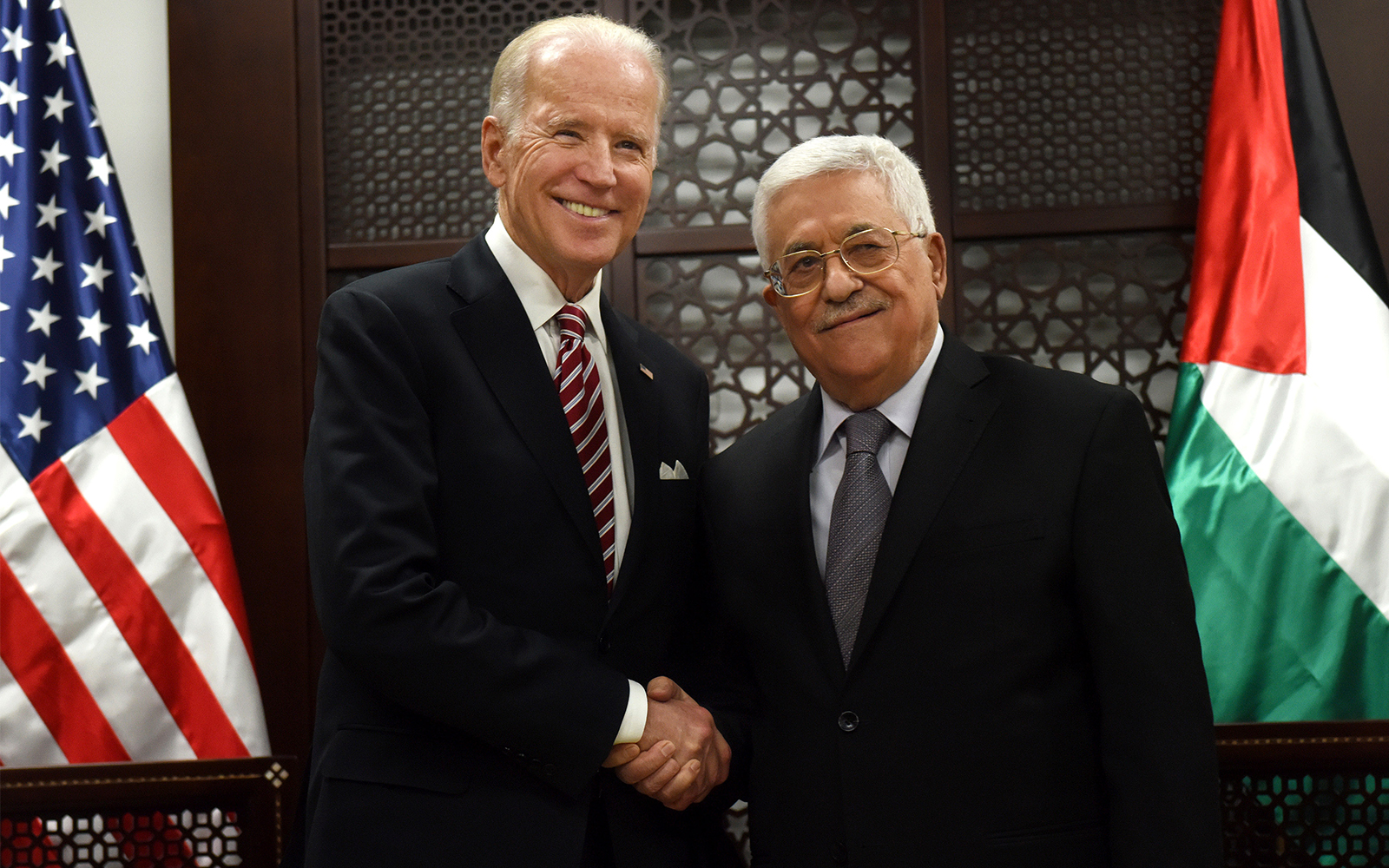
 

Then-US vice president Joe Biden, left, and Palestinian President Mahmoud Abbas, right, at the presidential compound in Ramallah, West Bank, March 9, 2016. (Debbie Hill, Pool via AP)

Then-US vice president Joe Biden, left, and Palestinian President Mahmoud Abbas, right, at the presidential compound in Ramallah, West Bank, March 9, 2016. (Debbie Hill, Pool via AP)

US President Joe Biden on Wednesday promised to press for a two-state solution to the Israeli-Palestinian conflict, as he restored aid to the Palestinians.

In a call with Jordan’s King Abdullah II, a longstanding US ally who recently faced down dissent within the royal family, Biden “affirmed that the United States supports a two-state solution to the Israeli-Palestinian conflict,” a White House statement said.

Biden has long vowed to return the two-state idea to the center of US policy following the dramatic shifts under former president Donald Trump.

His talk with the king came after his clearest break yet with Trump’s Mideast agenda, restoring US funding for the UN agency for Palestinian refugees that his predecessor had severed.

King Abdullah II of Jordan, right, meets with US Vice President Joe Biden, at the Husseiniya Palace in Amman, Jordan, March 10, 2016. (AP Photo/Raad Adayleh)

The State Department said the United States would contribute $150 million to the UN agency and offer $75 million in economic and development assistance for the West Bank and Gaza as well as $10 million for peacebuilding efforts.

Secretary of State Antony Blinken said that the US assistance to the Palestinians “serves important US interests and values” as “a means to advance towards a negotiated two-state solution.”

US Secretary of State Antony Blinken speaks about the release of the ‘2020 Country Reports on Human Rights Practices,’ at the State Department in Washington, March 30, 2021. (Mandel Ngan/Pool via AP)

“It provides critical relief to those in great need, fosters economic development and supports Israeli-Palestinian understanding, security coordination and stability,” Blinken said in a statement.

Israel, which had held off on criticism of Biden in his first months, denounced the assistance to the UN Relief and Works Agency for Palestine Refugees in the Near East, or UNRWA, which provides housing, schools and other care to more than six million Palestinians and their descendants.

“We believe that this UN agency for so-called ‘refugees’ should not exist in its current format,” said Gilad Erdan, the Israeli ambassador to the United States.

Israel argues that the education provided by the UN-backed schools includes incitement against the Jewish state.

“I have expressed my disappointment and objection to the decision to renew UNRWA’s funding without first ensuring that certain reforms, including stopping the incitement and removing anti-Semitic content from its educational curriculum, are carried out,” Erdan said.

Asked about the Israeli criticism, State Department spokesman Ned Price said that the United States took oversight of UNRWA “extraordinarily seriously” and that it would now have “a seat at the table.”

The Biden administration has made no secret of its belief that Trump’s approach to the Israeli-Palestinian conflict, which alienated the Palestinians, was flawed and made prospects for peace less likely. The new administration has argued that when the US leaves such international forums, it loses its ability to influence them.

Palestinian students affiliated with the UNRWA wear face masks amid the coronavirus pandemic, in Rafah, south of the Gaza Strip, on November 25, 2020. (Abed Rahim Khatib/Flash90)

Israel, however, has long pushed for UNRWA’s closure, arguing that it helps perpetuate the conflict with the Palestinians since it confers refugee status upon descendants of those originally displaced around the time of Israel’s War of Independence in 1948.

Pro-Israel advocates have also long criticized UNRWA for its textbooks, which they say promote incitement. Israeli monitoring groups have charged that UNRWA curricula promote violence and deny Israel’s right to exist.

In a statement, Palestinian Authority President Mahmoud Abbas welcomed the resumption of aid, as well as Biden’s “commitment to the two-state solution as a basis for resolving the Palestinian-Israeli conflict.”

The Palestinian leadership hoped that the aid would mark the start of a concerted effort by Biden to pressure Israel, including on stopping settlements in the  West Bank.

“We are eagerly awaiting the resumption not only of financial assistance but of political relations with the United States to allow the Palestinian people to achieve their legitimate rights for an independent state with Jerusalem as its capital,” said Mohammed Shtayyeh, the Palestinian prime minister.

Shortly after Biden’s inauguration in January, the United States said it would restore the Palestine Liberation Organization’s liaison office that was shut down by Trump.

But Biden has held off on any major peace initiative, with even supporters of a two-state solution expecting near-term chances for a breakthrough to be slim, especially amid turbulence in Israel following its latest election.

Blinken has indicated no change to one of Trump’s signature decisions — recognizing Jerusalem as Israel’s capital and moving the US embassy to the city.

Trump had ended UNRWA assistance by arguing that the refugees, some of whom have lived in camps for generations, needed to be permanently resettled.
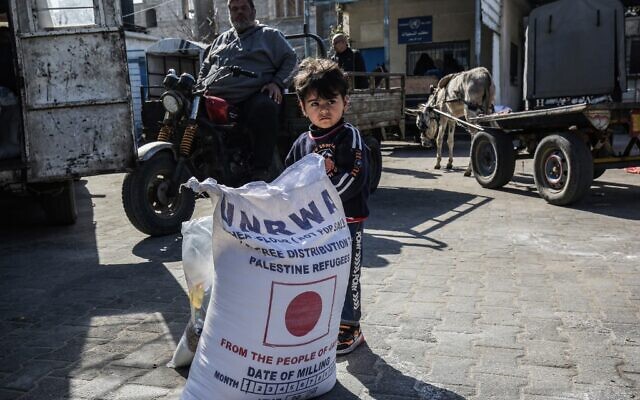
In this file photo taken on February 2, 2020, a child stands next to a sack of flour as people come to receive food aid from a United Nations Relief and Works Agency (UNRWA) distribution center in Khan Younis in the Gaza Strip (SAID KHATIB / AFP)

The latest announcement is still well below the $355 million contributed to UNRWA in 2016 by the United States, then its largest contributor.

Price, the State Department spokesman, did not rule out further US contributions but said the United States was encouraging other donors to do more.

UN spokesman Stephane Dujarric welcomed the restored US assistance, which German Foreign Minister Heiko Maas said “sends the right signal” amid growing needs due to the COVID-19 pandemic.

UNRWA said its needs have been rising due to COVID and the hardships faced by Palestinians living in war-battered Syria, troubled Lebanon and Jordan.

The new funding is in addition to $15 million earlier announced by the United States in COVID assistance to the Palestinians amid criticism that Israel, a leader in vaccinating its own people, has not taken similar initiatives in the West Bank and Gaza.

Israel argues that vaccination is the responsibility of the Palestinian Authority.
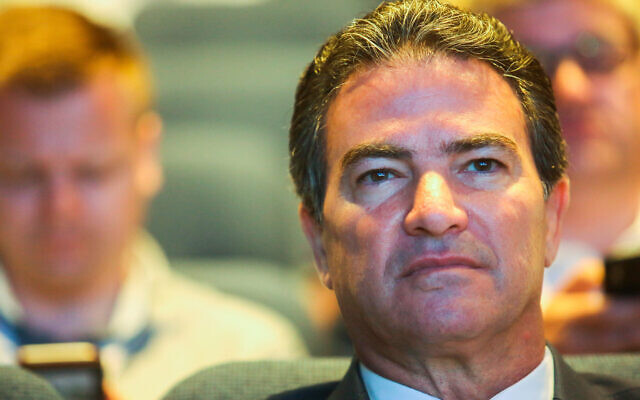


Mossad chief Yossi Cohen will travel to Washington in the next few days for meetings with top officials in the White House and the American intelligence community, Channel 13 news reports.

It will be the first high-level visit by an Israeli official since President Joe Biden took office in January.

The report says Israel is trying to arrange a meeting between Cohen and Biden.

Cohen will present evidence that Iran is lying and hiding details about its nuclear program from the world, the report says, in a bid to prevent the US from reentering the 2015 nuclear deal in its original form.

Mossad chief Yossi Cohen speaks at a Tel Aviv University cyber conference on June 24, 2019. (Flash90)


Iran has steadily overstepped the accord’s limits on its nuclear program in response to Washington’s withdrawal from the accord in 2018.

Israeli Prime Minister Benjamin Netanyahu meets with Brian Hook, US Special Representative for Iran and Senior Adviser to the US Secretary of State, Prime Minister's Office, Jerusalem, June 30, 2020 (photo credit: OLIVIER FITOUSSI/FLASH90)
Israeli Prime Minister Benjamin Netanyahu meets with Brian Hook, US Special Representative for Iran and Senior Adviser to the US Secretary of State, Prime Minister’s Office, Jerusalem, June 30, 2020
(photo credit: OLIVIER FITOUSSI/FLASH90)
Prime Minister Benjamin Netanyahu spoke out against a return to the 2015 nuclear deal with Iran, shortly after the Islamic Republic and world powers began talks in Vienna on Tuesday to do just that.
“The danger that Iran will return – and this time with an international imprimatur – to a path that will allow it to develop a nuclear arsenal is on our doorstep on this very day,” Netanyahu said in a meeting of the Likud faction in the Knesset.
Referring to the Joint Comprehensive Plan of Action (JCPOA), the Iran deal’s official name, Netanyahu said: “We cannot go back to the dangerous nuclear plan, because a nuclear Iran is an existential threat and a very big threat to the security of the whole world.”
Netanyahu noted it is the day before the start of Holocaust Remembrance Day, saying: “We must act against the fanatical regime in Iran that is simply threatening to erase us from the earth… We will always know to defend ourselves by ourselves from those who seek to kill us.”
At about the same time, the indirect negotiations between Iran and the US ended for the day.
Iran’s chief nuclear negotiator, Abbas Araqchi, told state television that Iran and major powers will continue to discuss ways to revive the 2015 nuclear deal that former US president Donald Trump abandoned in 2018.
“The talks in Vienna were constructive… our next meeting will be on Friday,” Araqchi said, adding that Tehran would not suspend its enrichment of uranium to 20% fissile purity in return for the release of $1 billion of its funds blocked in other countries, due to US sanctions reimposed on Iran since 2018.
European intermediaries began shuttling between Iranian and US officials in Vienna as they sought to bring both countries back into full compliance with the 2015 nuclear deal.
Diplomats said the talks could continue for several days to resolve some of the less contentious issues before resuming in several rounds over the coming weeks.
The objective is some form of an accord ahead of June’s Iranian presidential election, an EU official said, although Iranian and US officials have said there is no rush.
Iran has steadily overstepped the accord’s limits on its nuclear program.
While Tehran has repeatedly rebuffed “direct and indirect negotiations” with its old foe, Washington said on Monday it expected the discussions to be difficult. Neither side expected any early breakthrough.
Even without face-to-face talks, however, the presence of both Iran and the United States in the same location marks a step forward.
“We are confident that we are on the right track, and if America’s will, seriousness and honesty is proven, it could be a good sign for a better future for this agreement,” Iranian government spokesman Ali Rabiei told reporters.
The remaining parties to the deal – Russia, China, the UK, France and Germany – briefly met at a Viennese hotel for preparatory talks in the Austrian capital, where the pact was originally reached in 2015.
Russia’s envoy to the International Atomic Energy Agency, Mikhail Ulyanov, said after the meeting that the parties had tasked two expert-level groups on sanctions-lifting and nuclear issues to identify concrete measures to move forward.
The experts were set to begin technical work later on Tuesday with the aim of marrying lists of sanctions that the United States could lift with nuclear obligations Iran should meet.
Iran’s Supreme Leader Ayatollah Ali Khamenei, who has the final say on all state matters, has opposed any gradual easing of sanctions.
The US delegation, headed by special envoy Rob Malley and sanctions expert Richard Nephew, were based in a nearby hotel.
“This is going to involve discussions about identifying the steps that the US has to take and identifying the steps that Iran is going to have to take,” Malley told NPR radio on Tuesday morning.
US President Joe Biden’s administration wants to revive the accord but says this requires negotiations. Tehran has dismissed any direct engagement for now in talks with Washington.
Under the 2015 accord, US and other economic sanctions on Tehran were removed in return for curbs on Iran’s nuclear program, making it harder to develop a nuclear weapon, which would expire in 2030.
Tehran has long denied it is enriching uranium for any other purpose than civilian nuclear energy, but Israel and the European parties to the JCPOA have pointed out that its level of enrichment, as well as the development of uranium metals, do not have civilian uses.
Earlier this week, a senior Israeli official said he found the US position in the talks to be “very troubling.”
The official made the remark in response to an interview with US Special Envoy for Iran Rob Malley on PBS last week, in which he spoke about a return to the JCPOA without mentioning negotiating additional elements that would strengthen the deal, as US President Joe Biden had previously said he would seek.
“If this is American policy, we are concerned,” the official said. “In the past, the Biden administration talked about a ‘longer and stronger deal’… and that’s not [in the Malley interview]. It’s all about going to the 2015 deal.”
Furthermore, the official said, “nowhere in the entire interview does Malley say the goal is to prevent Iran from getting nuclear weapons.”
Former ambassador to the US Michael Oren, who was in Washington at the start of Iran deal negotiations, said the Biden administration is “going against all rationale and all logic in returning to the JCPOA.
“None of us here can figure out why. Why is this so important to them?” he said. “It’s a danger to us in a profound and strategic way.”
Oren described the situation as such that “the only thing standing between the Americans and the JCPOA are the Iranians themselves… That is distressing for us.”
The former ambassador posited that, to the Biden administration, “the details are not important. It’s no longer about the JCPOA, it’s about [former US president Donald] Trump and the Democrats… [Israel] supported Trump on it, so there’s not a lot of sympathy.”
Oren also pointed to remarks by Iranian Foreign Minister Javad Zarif in which he said that if the US returns to compliance with the JCPOA, they will be willing to discuss further arrangements, such as limiting American arm sales in the region.
“That is what the talks will be about,” Oren warned.
Oren expressed concern that a worry Israelis had during the Obama administration could arise again, that the US will “exchange an Iranian nuclear program for ours and create a nuclear-free zone in the Middle East. The Israeli position was it could only happen if all weapons of mass destruction are removed from the Middle East.”
