The US proposal would ask Iran to stop some of its nuclear activities in exchange for some relief from US economic sanctions, Politico reported.

Iran holds military drills as tensions rise with US (photo credit: REUTERS)
Iran holds military drills as tensions rise with US
(photo credit: REUTERS)
The United States is trying to break the nuclear deadlock with Iran and is planning a new proposal that would include some sanctions relief for the Islamic Republic, according to a report in Politico.
Biden administration officials plan to put forth a new proposal to restart nuclear talks between Washington and Tehran as soon as this week, two people familiar with the situation told Politico.
According to the report, the American proposal would ask Iran to stop some of its nuclear activities, such as work on advanced centrifuges and the enrichment of uranium to 20 percent purity, in exchange for some relief from US economic sanctions, said one of Politico’s two sources.
However, the details of this potential deal are still being worked out by the US and it’s not at all certain that Iran will accept the terms. Indeed, Tehran rejected a US proposal earlier this year, saying it was “unacceptable”, countering with their own idea, which the Biden team declared a non-starter.
The Biden administration has been seeking to engage in talks with Iran about having both sides returning to compliance with the deal, under which American-imposed and other economic sanctions will be removed in return for curbs on Iran’s nuclear program to make it harder to develop a nuclear weapon – an ambition Tehran denies.
“Iran is poised to blow through additional nuclear deal restrictions in the next few weeks. This is the crucial time to avoid an escalation of the situation,” Daryl Kimball, executive director of the Arms Control Association, an organization that has closely tracked nuclear negotiations involving Iran, told the news website.
Moreover, as Iran will hold presidential elections in June and given the sensitive politics in Iran surrounding the 2015 nuclear agreement, the theocratic regime is unlikely to allow any major changes to it amid a campaign.
The American proposal slated to be set forth this week is “about trying to get the conversation started” between the United States and Iran, one of the sources familiar with the situation told Politico.

The identity of the country which makes the first step to resume compliance with the 2015 Iran nuclear deal is not an issue for the United States, a US official said earlier this year, suggesting greater flexibility on the part of Washington. “That’s not the issue, who goes first,” the official told Reuters on condition of anonymity.

“Like, we are going to go at 8, they are going to go at 10? Or they go at 8, we go at 10? That’s not the issue,” the official said. “The issue is do we agree on what steps are going to be taken mutually.”
Asked for official comment at the time, a senior Biden administration official declined to discuss details of diplomatic conversations, Politico reported. “We have been clear that we are ready to pursue a mutual return to the [Iran deal],” the official added. “We have also been open that we are talking with our [international] partners … about the best way to achieve this, including through a series of initial, mutual steps. We have been looking at options for doing so, including with indirect conversations through our European partners.”

Reuters contributed to this report.


Turkey tells Israel it is ready to exchange ambassadors again

The Turkish government is ready to dispatch an ambassador to Tel Aviv once the Israeli government commits to simultaneously reciprocating the measure, a senior Turkish official tells Israel Hayom.

EXCLUSIVE: Turkey on Monday informed Israel that it is ready to dispatch an ambassador to Tel Aviv once the Israeli government commits to simultaneously reciprocating the measure, a senior Turkish official told Israel Hayom. The main point of contention between the two former allies remains the presence of senior Hamas officials on Turkish soil.

Following years of contentious relations, Turkey recently altered its foreign policy toward the region in general and Israel in particular. In December, Turkish President Recep Tayyip Erdogan declared that “Turkey wants to improve its relations with Israel. Our intelligence cooperation with Israel is ongoing.” This occurred some three weeks after his close confidant, former Admiral Cihat Yayci, proposed a shared maritime border deal with Israel, which was first reported by Israel Hayom.

The trend continued earlier this month, when Dr. Hakan Yurdakul, a board member of the Turkish Presidency’s Committee for Economic Policies, attended a European Jewish Parliament conference focusing on a renewed agenda between the former allies.

Israel is not the only country in the Middle East with which Ankara wants to rehabilitate and normalize relations. In Ankara’s efforts to normalize ties with Cairo, Turkish authorities on March 20 ordered Istanbul-based TV channels affiliated with the Muslim Brotherhood to immediately stop airing criticism of Egypt. This could indicate that if Israel agrees to restore relations with Turkey, Erdogan’s government could work, to some extent or another, to remove or stifle the senior Hamas leaders residing in Istanbul. Hamas is an offshoot of the Muslim Brotherhood.

Contrary to Cairo’s official denial of rapprochement with Turkey, meanwhile, Prime Minister Benjamin Netanyahu, while speaking at a Likud campaign event in Bat Yam on March 10, confirmed Israel was “engaged in talks with Turkey” about natural gas in the eastern Mediterranean Sea. At the event, the prime minister also noted Israel was holding fruitful talks with Egypt, Greece and Cyprus on the issue of exporting gas to Europe.

“Turkey and Israel never severed their diplomatic ties, despite all the negative events over the years,” Karel Valansi, a political analyst for the T24 Turkish online newspaper, told Israel Hayom. “Both countries have managed to separate economics and politics, and have helped one another on humanitarian issues. The channels of dialogue are always open, such that it’s not easy for either country to give up on their relationship. With that, the relationship has suffered considerably, meaning political will and trust-building measures are needed” for it to be rehabilitated,” she said.

“Bilateral relations between the countries have always been sensitive in regards to the Palestinians,” Valansi added. “At the same time, the personal hostility between the two leaders is another limitation.”

As for Turkey’s foreign policy, Valansi said, “Turkey’s growing isolation in the region and its strained relations with the United States are the catalysts for Ankara’s proposals to normalize relations with other countries in the region, including Israel.”

According to Valansi, “Israel won’t ignore an opportunity to rehabilitate relations with Turkey, but it wants certainty as it pertains to Turkey’s intentions. Turkey used to be a vital economic, diplomatic and defense partner for Israel. With that, the situation today is different. While Turkish-Israeli relations have declined, Israel has strengthened its relations with many other countries in the Middle East and the Persian Gulf. Ankara’s support for Hamas, its growing interest in Jerusalem and its foreign policy shifts all mean Israel must act with caution.”

Dr. Hay Eytan Cohen Yanarocak, an expert on contemporary Turkish politics and foreign policy, told Israel Hayom: “The question isn’t whether Turkey wants to normalize relations with Israel or not, it’s whether it needs to – and it does. Turkey’s immediate interests require immediate alterations to its foreign policy regarding the eastern Mediterranean and Syria. Iran’s influence in the region is growing and Turkey wants to curb this influence in Syria, just as Israel does. Meanwhile, Turkish-US relations are deteriorating by the day. Therefore, Ankara needs Jerusalem as a ‘bridge’ to Washington in order to alleviate the pressure from the Biden administration.”

As for the obstacles in the way of normalization, Yanarocak said Turkey’s support for Hamas remains the most serious. “But it’s not an impossible task – Turkey can take the necessary steps to meet Israel’s demands on this matter. I think what happened with the Muslim Brotherhood could also happen with Hamas. However, the steps against the Muslim Brotherhood were only preliminary. Turkey can take significant steps to convince Israel its intentions are honest.”

The Israeli Foreign Ministry declined to comment.


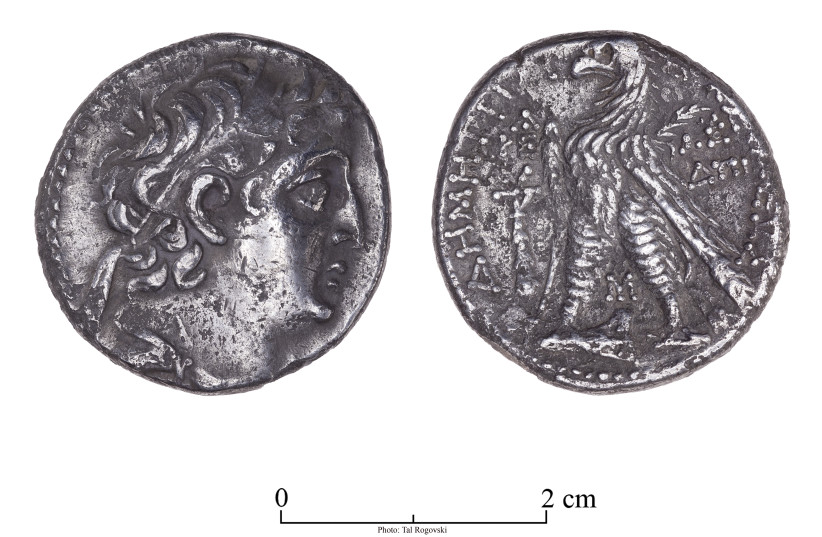
Tyrian shekels are often mentioned in historical accounts from the Second Temple Period, but a very few have actually been found.

The Tyre coin recently discovered at the Tower of David Museum. (photo credit: TAL ROGOVSKY)
The Tyre coin recently discovered at the Tower of David Museum.
(photo credit: TAL ROGOVSKY)
In the midst of one of the most comprehensive conservation projects currently taking place in Israel, archeologists in Jerusalem’s Old City discovered a Tyre coin, believed to have been used to pay the Temple tax by pilgrims making their way to the Temple for Passover, Shavuot or Sukkot.

The ancient coin was found inside a box of artifacts originally excavated in the 1980s, when the last conservation project took place at the site. The box was somehow lost and only discovered recently as part of a well-needed conservation project currently taking place at the Tower of David Museum.

The box included the rare silver coin, called a “Tyre shekel,” which was used during the Second Temple Period and produced in the ancient city of Tyre, where Tyrian shekels were minted from 125 BCE until the outbreak of the Great Revolt in 66 CE.

Tyrian shekels are often mentioned in historical accounts from the Second Temple Period, but very few have actually been found.

The Tower of David complex, where the exciting finding was made, includes the ancient palace of Herod, where many theologians and historians believe that the trial of Jesus took place. The tallest tower in the complex is called the Phasael Tower, which was the first to be identified as the “Tower of David” in the 5th century CE.

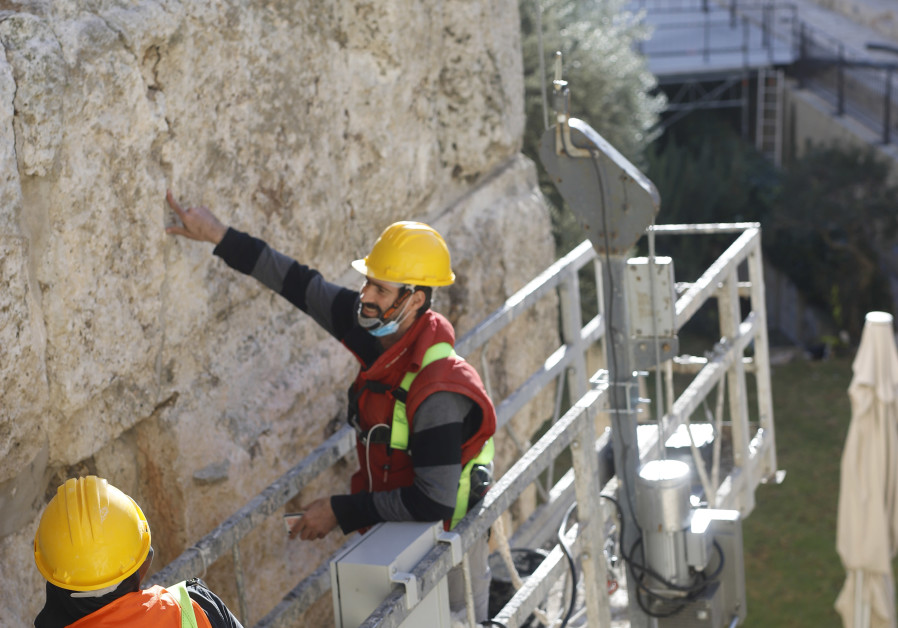
 conservation work taking place at the Phasael tower. A wide crack running from top to bottom is threatning the tower's entire structural integrity. (Credit: Tower of David Museum) conservation work taking place at the Phasael tower. A wide crack running from top to bottom is threatning the tower’s entire structural integrity. (Credit: Tower of David Museum)

It is that tower that is currently undergoing major conservation. A large crack running from top to bottom is threatening the tower’s entire structural integrity, which has led the conservation team leading the project to expedite its efforts to restore the 2,000-year-old damaged stones.

“The Tower of David is one of the most important structures in Israel, both in terms of its history and location,” said Yotam Carmel, conservation manager at Ken HaTor, the company put in charge of the project. “The last conservation project at the Tower of David was carried out in the 1980s. Since then the citadel has been in desperate need of conservation.”

Eilat Lieber, director and chief curator of the Tower of David Museum, noted the importance of the conservation project for future generations.

“At this holiday time, we are grateful for this unique opportunity to physically preserve the walls and towers of this ancient site that stood during the time of the Second Temple thousands of years ago, helping to preserve and conserve the site so that it continues to be a beacon in Jerusalem for future generations to come,” Lieber said.

The Tower of David Museum, located in the ancient citadel at the Jaffa Gate entrance to the Old City, will remain open for the general public throughout the year, in accordance with Health Ministry guidelines.

The coin that was recently discovered will be displayed next year in a new and permanent exhibit at the museum.

For more information: www.tod.org.il