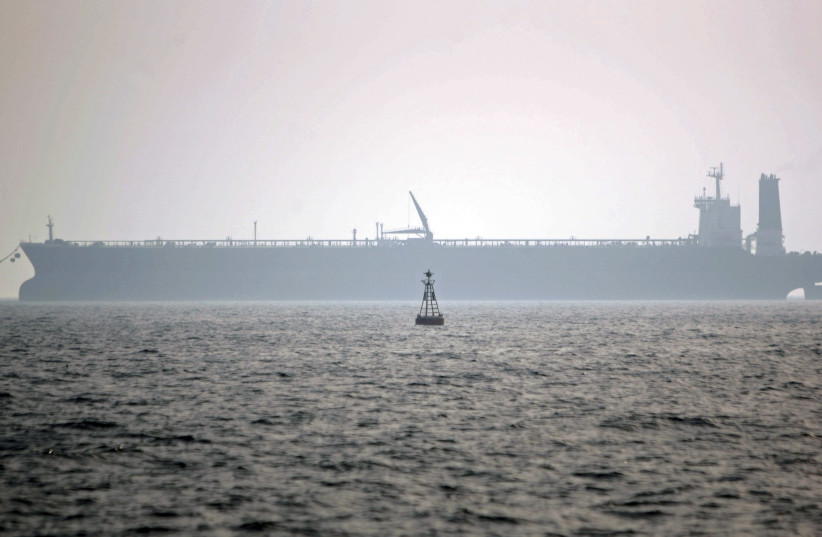
If Iran is “absolutely determined” to develop a nuclear weapon, the only way to stop the rogue regime may be militarily, according to Elliott Abrams.
If that assumption is correct, then “ultimately Israel and the United States will have to face that.”
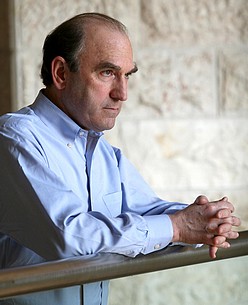 Elliott Abrams (Credit: Ariel Jerozolimski)
Abrams, a senior fellow for Middle Eastern Studies at the Council for Foreign Relations, served as US President Donald Trump’s special representative for Iran and Venezuela. He told The Jerusalem Post that if military action against Iran became necessary, the US and Israel would be left to manage it alone – China, Russia nor the Europeans were likely to seek a military alternative to stopping Iranian nuclear proliferation.
When asked how soon the countries would know if such action were needed, he said, “it is up to the Iranians. Thus far, Iran has been incredibly careful, and since 2003 they have moved slowly. They threatened to enrich uranium up to 60% purity, which would be a very big step. But for now, that is just a threat. They have not done it.”
Abrams said that every country’s intelligence studies the question of “when” and each one has come up with a different answer – and in some cases, these numbers are classified. In his estimation, Iran could have a deliverable nuclear weapon in one-and-a-half years.
“But you never know when they will try to really move that down to being just a few months and that presents this grave, grave decision to the US and Israel,” Abrams said.
“Iran obviously claims it is not seeking a nuclear weapon, but we know how countries behave when they actually don’t seek a nuclear weapon,” he continued. “We know how countries behave when they want nuclear energy only. It’s not how Iran behaves.”
Elliot Abrams and Arkansas Senator Tom Cotton will discuss America’s strategy against the Iranian threat on March 14 at Tikvah Fund’s Jewish Leadership Conference. Register here. $50 discount with code JPOST.
In the meantime, the new US administration under President Joe Biden has expressed interest in rejoining the Joint Comprehensive Plan of Action (JCPOA) deal signed in July 2015 by China, France, Germany, Russia, the United Kingdom and the United States.
Trump abandoned the Iranian nuclear deal in 2018. Abrams said going back to the JCPOA in 2021 is not a simple prospect.
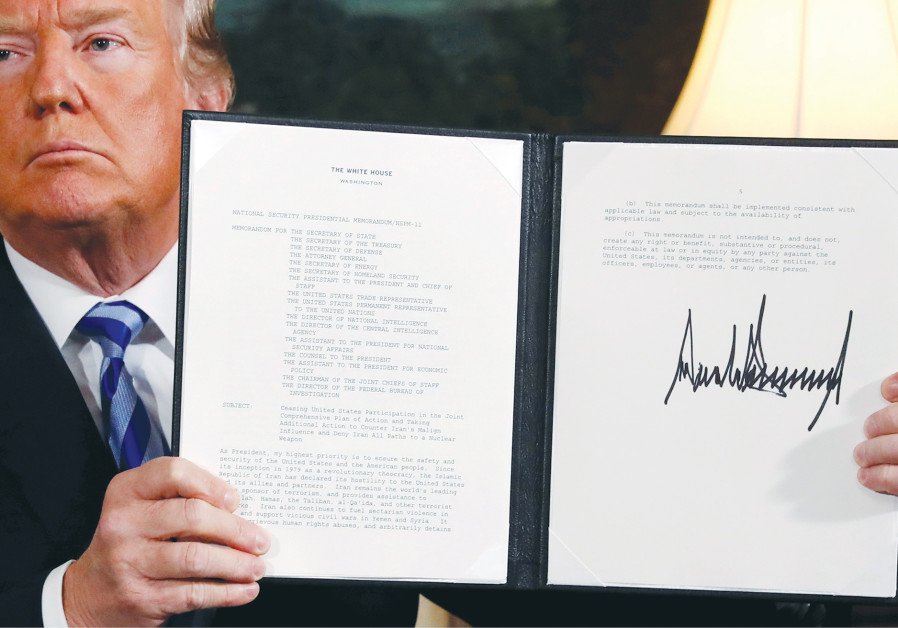 US president Donald Trump holds up a proclamation declaring his intention to withdraw the US from the JCPOA (Credit: JONATHAN ERNST / REUTERS)
“I think they are stuck,” he said. “They clearly want to join the deal, and if you asked them in November, they would have said that by February or March they would have rejoined after a few weeks of negotiations. But it has not happened.
Do you want to hear Abrams speak? Click here to register for the Jewish Leadership Conference. $50 discount with code JPOST.
“The US has not lifted any sanctions and Iran has been doing more and more terrible things,” he continued. “I wonder today if they really believe it is possible to rejoin the JCPOA. I don’t know what conclusions they have reached, but I think they are probably much less optimistic now.”
Neither the US nor Iran has shown a willingness to compromise, leaving the situation at a stalemate.
Abrams said many people have assumed that both sides want to get back to the JCPOA, so it is just a question of working out the arrangement. But he is not so sure that Iran’s supreme leader, Ali Khamenei, wants to get back to the JCPOA, much less negotiate further agreements.
“I don’t think the supreme leader cares about getting a good consumer economy in Iran, I don’t think that his goal is to make sure the Iranian economy is more prosperous, and that Iran looks more like the West,” Abrams said. “He prefers a resistive economy to a Western-style consumer economy… He will have to be persuaded.”
Moreover, while the Biden administration might have set its aspirations on a lengthened and strengthened Iranian deal, Abrams said that this goal might be unachievable without having to give up the leverage that the new administration was given by the Trump administration and would be needed to achieve other needed shifts in Iranian policy.
“There is a huge problem with the administration’s position,” Abrams said, explaining that to get back to the JCPOA, the administration would have to lift oil and financial sanctions on the rogue regime. If the US does so in order to get back to JCPOA, it will have effectively given up all its leverage to go beyond the current agreement, leaving little room for negotiations around the Iranian missile program or the country’s support for terrorism.
Abrams will be among a group of top-tier speakers addressing the questions most relevant to Israel and the Jewish people. It is not too late to register for the Jewish Leadership Conference. Click here to get your ticket – $50 discount with code JPOST.
He said a successful agreement would extend the JCPOA sunset clauses and make them stronger, curtail Iran’s missile program and halt the country’s financial support for Hamas, Hezbollah, the Houthis and Shiite militias – collectively known as the Popular Mobilization Forces – in Iraq.
Currently, Iran is considered the largest state sponsor of terrorism in the world.
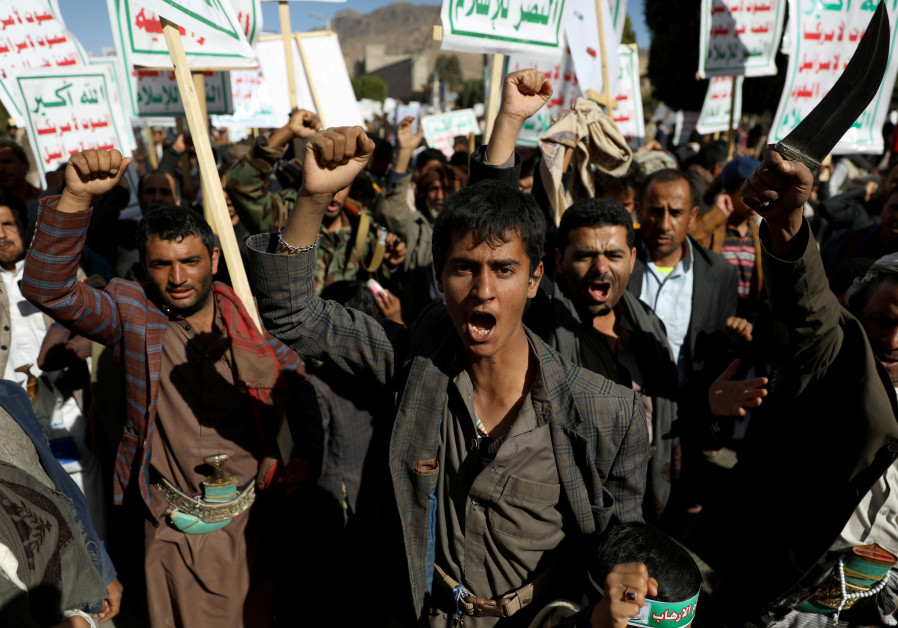 Houthi supporters shout slogans during a rally against the United States’ designation of Houthis as a foreign terrorist organization, in Sanaa, Yemen January 25, 2021 (Credit: REUTERS/KHALED ABDULLAH)
Abrams said that in the five years since the signing of the JCPOA Iran has failed to comply. In the last two years of the Trump administration, the US has implemented a significant sanctions program that includes not only nuclear sanctions but human rights and counterterrorism sanctions. The administration called it the “maximum pressure campaign,” and it was meant to pressure the country to desist from the above activities.
On the one hand, Abrams admitted, Iran moved closer toward developing a nuclear bomb. On the other hand, he said, “If you look at the finances of Hamas and Hezbollah, you see them getting quite a reduced amount from Iran.”
He said that now was the time for negotiations with Iran regardless of who became president, and that was always Trump’s aim. But Abrams said he believes that the Iranians were holding off to see who the president would be, because the Iranian regime “was hoping it would not have to negotiate with President Trump.”
He said that he believes Iran has reached the point where it knows it has to seek relief from sanctions soon. The questions really are how soon is soon, and what price they will have to pay.
This article was written in cooperation with the Tikvah Fund. Learn more about the organization’s upcoming conference.