
Amman’s FM Safadi lashes Israel over cancelled visit to Jerusalem holy site by crown prince: ‘We’re extremely unhappy’


Prime Minister Benjamin Netanyahu meets with Jordanian King Abdullah II in Jordan in January 2014 (Kobi Gideon/GPO/Flash90/ File)

Illustrative: Prime Minister Benjamin Netanyahu meets with Jordanian King Abdullah II in Jordan in January 2014 (Kobi Gideon/GPO/Flash90/ File)

Jordanian Foreign Minister Ayman al-Safadi on Friday lashed out at Prime Minister Benjamin Netanyahu over a canceled visit to Jerusalem’s Temple Mount by Jordan’s Crown Prince Hussein.

Safadi confirmed that Jordan held up granting Netanyahu overflight permission in retaliation, causing him to postpone a planned visit to the United Arab Emirates.

The diplomatic spat underscored Jordanian frustrations with Netanyahu and tensions between the two neighbors that have simmered for years.

Speaking CNN on Friday, Safadi was asked if Netanyahu was correct in blaming “difficulties” with Jordan on coordinating the overflight for the postponement of his Thursday UAE visit.

“You renege on an agreement with Jordan, you disrupt a religious visit, you create conditions that made this religious visit on a holy occasion impossible and then you expect to come to Jordan and fly out of Jordan? Let’s be serious here,” Safadi said.

Hussein had been set to visit the Temple Mount on Wednesday for Lailat al-Miʿraj, a holiday marking a journey undertaken by the Prophet Muhammad. Safadi accused Israel of violating an agreement on the arrangements for the visit, while Israel has said Hussein arrived with heavier security than promised.

“A religious visit for worship at an extremely holy occasion was disrupted by Israeli measures that we don’t understand and don’t accept,” Safadi said in the interview.

“Last minute Israel reneged on those agreements, they violated their obligations as an occupying power and they also violated the right of freedom of worship, so that’s something we’re extremely unhappy with and angry about.”

Under their 1994 peace treaty, Israel recognizes Jordan as the custodian of the Temple Mount, which houses the Al-Aqsa Mosque. The Temple Mount is the holiest place in Judaism and the site of the third holiest shrine in Islam.

Israel captured the Temple Mount and Jerusalem’s Old City from Jordan in the 1967 Six Day War. However, it allowed the Jordanian Waqf to continue to maintain religious authority atop the mount, where Jews are allowed to visit, but not to pray.

Safadi’s latest criticism came a day after he said the Israelis had wanted to unilaterally set restrictions on the royal visit and appeared to blame the spat on the upcoming Israeli elections, in remarks apparently aimed at Netanyahu.

Jordan’s Foreign Minister Ayman Safadi at a press conference in Berlin on March 10, 2021. (Kay Nietfeld/Pool/AFP)

Israel has disputed Safadi’s account, with officials quoted by the Kan public broadcaster saying the prince’s security delegation that arrived at the border was both larger and more heavily armed than had been agreed. The report said that when Israeli authorities insisted the Jordanians keep to the terms of the agreement, Hussein canceled the visit.

Netanyahu said Israel straightened out matters with Jordan and that he would visit the UAE soon.

The premier had been scheduled to meet the Emirati crown prince in his first official visit to the UAE since Jerusalem and Abu Dhabi forged diplomatic ties last year.

While no alternative date for the trip has been given, Channel 12 news said in an unsourced report on Friday that Netanyahu will travel to the UAE this week.

The network also reported the US told the UAE to scale back Netanyahu’s trip, before it was canceled, due to concerns over interfering in Israel’s March 23 elections. The planned visit was reduced to a short stay at the airport, the report said.

Abu Dhabi’s Crown Prince, Sheikh Mohamed bin Zayed Al Nahyan, at a meeting at the White House in Washington, May 15, 2017. (Andrew Harnik/AP)

Separately, an unsourced Channel 13 news report said Netanyahu wanted to sign a peace treaty with Sudan while in Abu Dhabi, but the US told the UAE hosting such a ceremony would amount to election interference.

Hebrew media reports on Wednesday suggested Netanyahu may have also been hoping to meet Sudanese Prime Minister Abdalla Hamdok and/or Saudi Arabian Crown Prince Mohammed bin Salman during the trip, which was scheduled to be held 12 days before Israel holds its fourth national election in two years.

Netanyahu has been seen as eager to make the trip before the March 23 elections.

Surveys show the prime minister struggling to muster the 61-seat Knesset majority that would enable him to form a coalition, though his rivals also have no clear route to power, and the timing of the trip could have bolstered Netanyahu’s campaign.

The trip was expected to be a celebration of Israel’s normalization deals as well as a move to boost Netanyahu’s diplomatic credentials ahead of the elections. Netanyahu may also have hoped to use the visit to consolidate a campaign against a US return to the Iran nuclear deal.

The trip to the UAE had been planned for several months but postponed on numerous occasions. Netanyahu had originally been set to make the trip in November, then December, and then in January and February, but the pandemic, scheduling issues, and internal political crises led to repeated delays.

Emirati officials told the Walla news site Wednesday that there had been concerns the visit would be seen as an intervention in the Israeli elections, but in the end Abu Dhabi reluctantly agreed to the trip.

Israel on Friday approved granting entry to 700 Jordanians to work in Eilat’s hotel industry and slight eased restrictions on land border crossings with Jordan and Egypt.
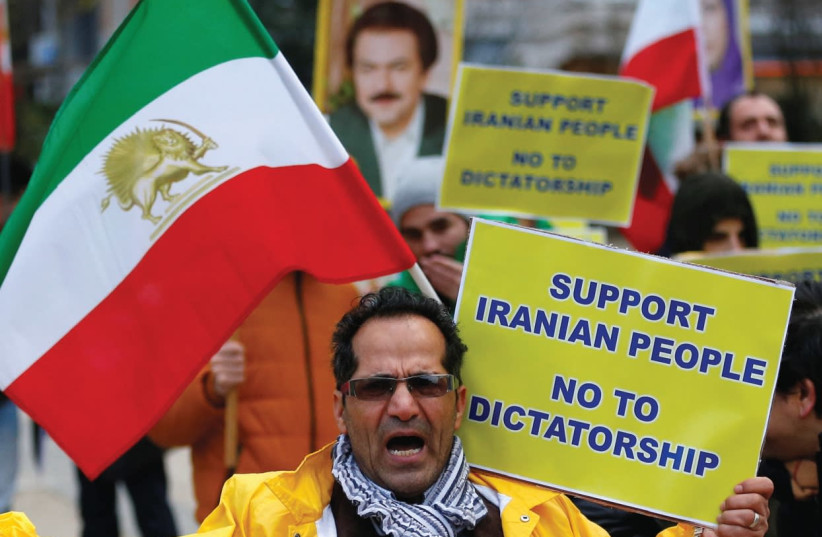


The EU is increasingly frustrated by Washington’s failure to quickly return to the 2015 nuclear accord.

A protester chants slogans against the Iranian regime outside the European Union Council in Brussels on Tuesday (photo credit: REUTERS/FRANCOIS LENOIR)
A protester chants slogans against the Iranian regime outside the European Union Council in Brussels on Tuesday
(photo credit: REUTERS/FRANCOIS LENOIR)
Joe Biden’s presidential campaign promise that the United States would return to the Iran nuclear deal was welcomed by leaders of the European Union. However, the subsequent continuing impasse in relations between Washington and Tehran may cause difficulties between the trans-Atlantic partners, a European expert says.
For more stories from The Media Line go to themedialine.org
The US, under former President Donald Trump, withdrew from the nuclear accord, called the Joint Comprehensive Plan of Action (JCPOA), in May 2018. The EU persisted in its adherence to the agreement and its belief in the agreement’s merits.
Now, almost two months after Biden’s inauguration, an American return to the deal is nowhere in sight. The White House is demanding that Iran first resume compliance with its obligations, while the Iranians insist that the US make the first move and lift the economic sanctions placed on the country.
In the meantime, tensions between the countries are on the rise as Iranian-backed militias attack American troops on Middle East bases, and the US retaliates. This week, the US sanctioned two Iranian Revolutionary Guard members “for gross human rights violations.”
“The situation is stalled now because both Washington and Tehran are convinced they are coming into the negotiations with increased leverage,” Dr. Christopher Bolan, a senior fellow at the Philadelphia-based Foreign Policy Research Institute’s Middle East Program, and a professor of Middle East security studies at the Strategic Studies Institute of the US Army War College in Carlisle, Pennsylvania, told The Media Line.
“From a US vantage point, US unilateral sanctions, especially secondary sanctions, have proved more powerful and durable than expected,” Bolan said. The Iranians, in turn, “have reversed much of their compliance with the JCPOA,” and “have made some progress in creating a ‘resistance economy’ that will allow them to ride out sanctions,” he added.
In the present situation, “both sides feel vindicated in demanding the other side move first,” Bolan said.
The US is adamant that Iran first respect its obligations as stipulated in the 2015 nuclear agreement. The Iranians have violated their commitments by wide margins, enriching uranium beyond the limit set in the agreement and producing uranium metal, a material banned by the accord, which can be used in the construction of nuclear weapons.
This week, US Secretary of State Antony Blinken reaffirmed the American position again when he said that Iranian funds held by South Korea in accordance with US sanctions will not be released until Iran returns to compliance, despite Iranian claims to the contrary. However, the Biden administration has offered to negotiate with Tehran, an offer the Islamic Republic refused.
Mohammad Javad Zarif, the Iranian foreign minister, has repeatedly pointed a blaming finger at the US for failing to abide by the agreement. In a February 21 tweet, he said that: “As the offending side, US must take corrective measures: commit to JCPOA, effectively fulfill obligations. Iran would reciprocate immediately by reversing its remedial measures.”
In response to Blinken’s statement that funds will not be released until Tehran returns to compliance, the Iranian foreign minister tweeted that the “US claims it favors diplomacy; not Trump’s failed policy of ‘maximum pressure.’”
The JCPOA was reached in 2015 under pressure from President Barack Obama by the US, United Kingdom, France, Germany, the EU, Russia, China and Iran. It was intended to significantly limit Iran’s ability to produce nuclear weaponry, and to place Iran’s nuclear facilities under international supervision. US allies such as Saudi Arabia and Israel were staunchly opposed to the deal.
In 2018, Trump withdrew the US from the accord and imposed strict sanctions on Iran in a policy he termed “maximum pressure.” Trump’s actions were in keeping with his campaign rhetoric, in which he called the agreement “the worst deal ever negotiated.”
The withdrawal was received with displeasure by the US’s European allies and the EU.
Since then, the EU has stuck to the deal, refusing to align with Washington and reimpose sanctions on Iran that were lifted as part of the nuclear deal, and insisting it is a diplomatic success that will prevent Iran from producing nuclear armaments.
Josep Borrell, the EU’s foreign policy chief, recently said during a virtual address to the Atlantic Council: “For us, the Europeans, the Iran nuclear deal, it’s a triumph of diplomacy, and we are very proud of it.” He also said that returning the US to the agreement is currently “the most urgent and important” subject in US-EU relations.
Biden’s promise that the US would return to the deal was a cause for hope in the EU, and Borrell said on January 11: “We welcome President-elect Biden’s positive statements on the JCPOA, and look forward to working with the incoming US-administration.”
However, as the weeks go by, European confidence in the promise is shaking.
“The EU is currently gauging the position of the new US administration. It has fought hard to preserve the 2015 deal during the previous years, but is now unsure which way Washington will go,” Dr. Cornelius Adebahr, a nonresident fellow at Carnegie Europe and author of “Europe and Iran: The Nuclear Deal and Beyond,” told The Media Line.
A report this week from the think tank the European Council on Foreign Relations (ECFR), penned by Julien Barnes-Dacey and Ellie Geranmayeh, also pointed out the contrast between Biden’s promise and the current American policy.
“Despite his pledges to readjust US policy on Iran, Biden is still essentially pursuing the Trump-era maximum pressure campaign, designed to force Tehran to make concessions first,” the document said.
The ECFR report cautioned that if Washington does not “urgently” take diplomatic steps, with the aid of European brokerage, tensions between Iran and the US may escalate out of control.
Adebahr pointed to another issue that may arise if the US does not return to the agreement.
“The Biden administration and the EU as well as the 27 member-states are aiming to devise common policies in a number of areas where the two sides previously diverged.

This is easier said than done on issues from China to world trade to climate change,” Adebahr said.
Notably, the Iranian issue is one in which there is a “considerable overlap of interests,” he added, “and neither side wishes to add another thorny issue to the trans-Atlantic in-tray.”
However, if the current situation perseveres, “this may actually cement the – untenable – status quo, if and when Washington does not undertake the course correction that candidate Biden had promised,” Adebahr said.
Bolan, meanwhile, agrees with the European belief that movement forward should be made without delay, and cautioned that “slow progress makes a return to the JCPOA less likely and more problematic.”
While he believes a US return will take some time, “windows of opportunity never last forever,” he said.
In his eyes, the way forward is evident: “Both sides engaging with each other to develop a step-by-step plan to simultaneously move back toward compliance in graduated steps.”
However, Bolan believes that the chances of deterioration in US-EU relations because of the Iran issues are slim.
“While there are differences in the US and European position, too much commentary dismisses the vast areas of overlapping interests,” he said. “The differences are comparatively slight, with EU tactical preference for a quick return to the JCPOA to form the basis for a larger deal, and the US Biden administration unwilling to lift sanctions as a precondition in the absence of Iranian compliance,” the American expert explained.
“Moreover, the longer Iran remains out of compliance with the terms of the JCPOA, mounting EU security concerns will increasingly leave Iran − not the US − isolated in terms of EU policy,” Bolan said.


Report: Iranian ship attacked near Syria

“It’s an act of terrorism”, Iran’s Shipping Lines spokesman says. Source in Iran claims: “Israel attacked the ship”.

Arutz Sheva , Mar 12 , 2021 4:54 PM


Ship on fire

Iran’s Shipping Lines spokesman says that a Shahre Kord cargo ship was attacked by an explosive object on Wednesday in intl waters of the Mediterranean sea. According to the report, the ship was en route to Europe.

“It’s an act of terrorism”, the spokesman says, “Iran will legally pursue it to find culprits”.

According to Pouria Zeraati, of Manoto TV, an Iranian sources said that Israel is behind the attack. “Israel attacked an Iranian-owned cargo ship near Latakia port in Syria”, the source told Zeraati.