
Deal inked during Steve Mnuchin’s trip to Khartoum, the 1st by a top US official since the Trump administration removed Sudan from terror list as part of normalization deal


US Treasury Secretary Steven Mnuchin (L) and Sudanese Justice Minister Nasredeen Abdulbari sign the Abraham Accords in Sudan's capital Khartoum, January 6, 2021. (Screen capture: Facebook)

US Treasury Secretary Steven Mnuchin (L) and Sudanese Justice Minister Nasredeen Abdulbari sign the Abraham Accords in Sudan’s capital Khartoum, January 6, 2021. (Screen capture: Facebook)

Sudan on Wednesday signed the “Abraham Accords” with the United States, paving the way for the African country to normalize ties with Israel.

A statement from the office of Sudan’s prime minister said Justice Minister Nasredeen Abdulbari signed the accord Wednesday with visiting US Treasury Secretary Steven Mnuchin.

The agreement signed Wednesday was a largely symbolic document, indicating Sudan’s intentions to move forward with normalization. The memorandum did not officially establish diplomatic ties between Khartoum and Jerusalem, a move that is expected to happen in the near future, at an as yet undetermined date.

Recent US-negotiated deals between Arab and Muslim countries and Israel have been a major foreign policy achievement by US President Donald Trump’s administration.

The deals were named the “Abraham Accords” after the biblical patriarch revered by Muslims and Jews.

The signing came just over two months after Trump announced that Sudan would start to normalize ties with Israel.

Before Sudan, the Trump administration engineered diplomatic pacts late last year between Israel and the United Arab Emirates and Bahrain. Morocco also reestablished diplomatic relations with Israel, after cutting ties in 2000 in solidarity with Palestinians during the Second Intifada.

The accords have also contributed to the severe isolation and weakening of the Palestinians by eroding a longstanding Arab consensus that recognition of Israel should only be given in return for concessions in the peace process.

Mnuchin arrived in Sudan on Wednesday, the first visit by a senior American official since Trump’s administration removed the African country from the US list of state sponsors of terrorism in a deal that saw Sudan normalize its ties with Israel.

In this September 15, 2020, photo, Prime Minister Benjamin Netanyahu, left, US President Donald Trump, Bahrain Foreign Minister Abdullatif al-Zayani and United Arab Emirates Foreign Minister Abdullah bin Zayed al-Nahyan on the Blue Room Balcony after signing the Abraham Accords during a ceremony on the South Lawn of the White House in Washington. (AP Photo/Alex Brandon)

Mnuchin landed in Khartoum’s international airport, where he was received by acting Finance Minister Heba Mohammed Ali and US Charge d’Affaires in Sudan Brian Shukan, the prime minister’s office said in a statement.

It is the first visit by a sitting US treasury chief to Sudan, the statement said. US Secretary of State Mike Pompeo in August became the first top American diplomat to visit Sudan since 2005, when Condoleezza Rice visited. Pompeo was also the most senior US official to visit the African country since last year’s ouster of al-Bashir.

Mnuchin’s visit came after a one-day visit to Cairo, where he met with Egypt’s President Abdel-Fattah el-Sissi, a close US ally. The stops are part of a flurry of activity during the final days of the Trump administration. Democrat Joe Biden becomes US president on January 20.

The US treasury secretary met with Prime Minister Abdalla Hamdok, and is scheduled to meet with other Sudanese leaders including Gen. Abdel-Fattah Burhan, head of the ruling sovereign council.

The visit came “at a time when our bilateral relations are taking historical leaps towards a better future. We’re planning to make tangible strides today as our relations enter a #NewEra,” Hamdok tweeted.

Sudanese Prime Minister Abdullah Hamdok, left, elbow bumps as he welcomes US Treasury Secretary Steven Mnuchin to the Cabinet Building, in Khartoum, Sudan, January 6, 2021. (AP Photo)

Mnuchin’s one-day visit focused on the country’s struggling economy and possible US economic assistance, including debt relief, the statement said. Sudan today has more than $60 billion in foreign debt. Relief from its arrears and access to foreign loans are widely seen as its gateway to economic recovery.

Sudan’s Finance Ministry said it inked a “memorandum of understanding” with the US Treasury Department to facilitate the payment of Sudan’s arrears to the World Bank.

The ministry said the settlement would enable Sudan’s government to have more than $1 billion annually from the World Bank, for the fist time since Sudan was designated as pariah state nearly three decades ago. It did not provide further details.

The Justice Ministry, however, announced last month that the US would play a $1 billion bridge loan to the World Bank to help clear Sudan’s arrears with the institution, in addition to $1.1 billion direct and indirect aid from the US.

Sudan is on a fragile path to democracy after a popular uprising led the military to overthrow al-Bashir in April 2019. The county is now ruled by a joint military and civilian government that seeks better ties with Washington and the West.

The government has been struggling with a huge budget deficit and widespread shortages of essential goods, including fuel, bread and medicine.

Annual inflation soared past 200% in the past months as prices of bread and other staples surged, according to official figures.
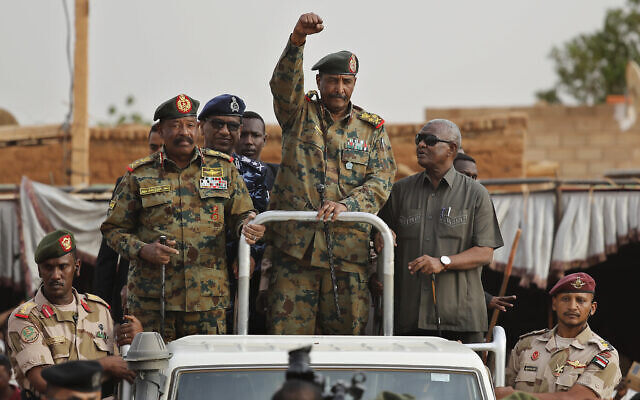
Sudanese Gen. Abdel-Fattah al-Burhan, head of the military council, waves to his supporters at a military-backed rally, in Omdurman district, west of Khartoum, Sudan, June 29, 2019. (AP Photo/Hussein Malla)

Last month, Trump’s administration finalized the removal of Sudan from the US list of state sponsors of terrorism. The move was a key incentive for the government in Khartoum to normalize relations with Israel.

Sudan’s economy has suffered from decades of US sanctions and mismanagement under al-Bashir, who had ruled the country since a 1989 Islamist-backed military coup.

The designation dates back to the 1990s, when Sudan briefly hosted al-Qaeda leader Osama bin Laden and other wanted terrorists. Sudan was also believed to have served as a pipeline for Iran to supply weapons to Palestinian terrorists in the Gaza Strip.

Mnuchin’s visit came amid rising tensions between military and civilian members of Sudan’s transitional government. That tensions, which resurfaced in recent weeks, have largely centered on the Sudanese military’s economic assets, over which the civilian-run finance ministry does not have control.

John Prendergast, co-founder of The Sentry watchdog group, urged The US treasury secretary to pressure the military and security apparatus to allow “independent oversight” to businesses they control.

“As Secretary Mnuchin engages with the leadership in Khartoum, it is critical that he weighs in with strong support for international anti-money laundering standards and fiscal transparency, which are essential for Sudan to counter the looting of its national economy,” he said.

https://www.timesofisrael.com/sudan-signs-abraham-accords-with-us-paving-way-for-israel-normalization/


Earth is spinning faster: Time flies in 50-year record

The planet is speeding up and a negative leap second may soon be needed so atomic clocks can align correctly with the turning world.

EARTH, from Beresheet’s vantage point (photo credit: SPACEIL)
EARTH, from Beresheet’s vantage point
(photo credit: SPACEIL)
What if the feeling that time flies were actually true?

Indeed, the Earth has been spinning abnormally quick lately, reported The Telegraph. The planet is now completing its rotation in 1.4602 milliseconds less than the usual 86,400 seconds.

The speed of the Earth‘s rotation varies constantly because of the complex motion of its molten core, oceans and atmosphere, as well as the effect of celestial bodies such as the Moon.

The friction of the tides and the change in distance between the Earth and the Moon all make for daily variations in the speed the planet rotates on its axis, the Telegraph reported, adding that even the snow building up on mountains and melting in the summer can shift the rotation.

July 19, 2020 was recorded as the shortest day since records began in the 1960s after highly accurate atomic clocks were developed and compared the length of a standard day to fixed stars in the sky.

According to The Telegraph, the previous shortest day in 2005 was beaten 28 times in 2020, and 2021 is expected to be the fastest year ever, with the average day passing 0.5 milliseconds faster than usual.

The planet is speeding up and a negative leap second may soon be needed so atomic clocks can align correctly with the turning world, and it would be the first time ever that a second has been removed from global clocks.

“It is certainly correct that the Earth is spinning faster now than at any time in the last 50 years,” Peter Whibberley, senior research scientist with National Physical Laboratory’s time and frequency group, told The Telegraph, adding that “it’s quite possible that a negative leap second will be needed if the Earth’s rotation rate increases further, but it’s too early to say if this is likely to happen.”

“There are also international discussions taking place about the future of leap seconds, and it’s also possible that the need for a negative leap second might push the decision towards ending leap seconds for good.”

On Sunday, the solar day lasted just 23 hours, 59 minutes and 59.9998927 seconds, then slowed down on Monday to a little more than 24 hours.

However, in the course of 2021, atomic clocks are expected to accumulate a lag of about 19 milliseconds.

While it would take hundreds of years for the difference to become obvious to most people, modern satellite communication and navigation systems rely on time being consistent with the conventional positions of the Sun, Moon and stars.

It is the task of scientists and officials at the International Earth Rotation Service, based in Paris, to monitor the planet’s rotation and inform countries when leap seconds must be added or taken away six months in advance.


Syria says Israeli airstrikes hit sites around Damascus

State media reports attack struck targets south and west of capital, which have been reportedly bombed by Israel in the past


A Syrian anti-aircraft missile is fired into sky near Damascus during an alleged Israeli airstrike on January 6, 2021. (Screen capture: SANA)

A Syrian anti-aircraft missile is fired into sky near Damascus during an alleged Israeli airstrike on January 6, 2021. (Screen capture: SANA)

Israeli airstrikes targeted a number of sites around Damascus, Syrian media reported late Wednesday night.

According to Syrian outlets, the attacks struck the area of el-Kisweh, south of the capital, and around the town of al-Dimas, west of Damascus.

Both areas have been used as bases of operation for Iranian forces in Syria, as well as Iranian-backed militias. Both have also reportedly been targeted by Israel in the past.

There were no immediate reports of injuries.

Volume 90%

Syria’s state media outlet SANA reported that the attacks began shortly after 11 p.m. Wednesday.

“The Israeli enemy carried out an air attack by means of a barrage of missiles from the direction of the occupied Syrian Golan on some targets in the southern region,” SANA reported, citing a military source.

Residents of the Israeli Golan Heights reported hearing the sounds of explosions.

In response to the attack, the Syrian military fired a large number of surface-to-air missiles and other anti-aircraft weapons into the sky. The military source told SANA that most of the incoming Israeli missiles were intercepted. Such claims by the Syrian military are generally disregarded by Syrian war analysts, who consider them false, empty boasts.

The attack on Thursday night came eight days after a round of airstrikes on an Iranian target in western Syria and a Syrian military air defense battery, which killed one Syrian soldier and injured several others.

The IDF has launched hundreds of strikes in Syria since the start of the civil war in 2011 against moves by Iran to establish a permanent military presence in the country and efforts to transport advanced, game-changing weapons to terrorist groups in the region, principally Hezbollah.

The last reported strikes in Syria attributed to Israel took place earlier last month near the town of Masyaf in the central Hama province. The airstrikes destroyed four weapons manufacturing facilities, according to satellite images released by a private Israeli intelligence firm.

Masyaf is a significant military area for Syrian President Bashar Assad’s regime that includes a military academy and a scientific research center. The general area around Masyaf, which is also believed to have a major Iranian presence, has reportedly been targeted by Israel many times in the past.
