
Iran, Biden official duke it out over ballistic missiles
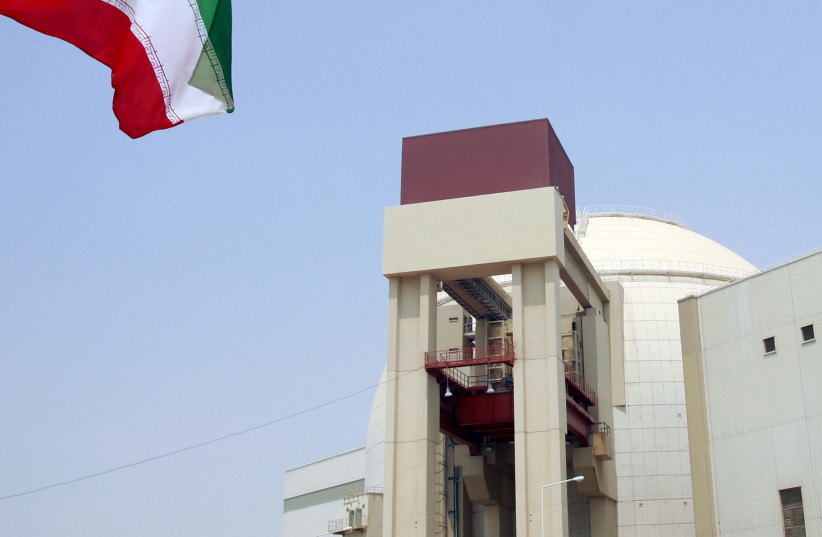
A general view of the Bushehr main nuclear reactor, Iran (photo credit: REUTERS/RAHEB HOMAVANDI)
A general view of the Bushehr main nuclear reactor, Iran
(photo credit: REUTERS/RAHEB HOMAVANDI)
A lot is not known about Iran’s newly announced move on Monday to enrich uranium up to the 20% level, but at maximum speed, a top nuclear expert has told The Jerusalem Post that its nuclear breakout time to a bomb could be cut to only six weeks.

Institute for Science and International Security president David Albright said that there were many variables, such as how many IR-1, IR-2ms or even IR-4 or IR-6 centrifuges were being used.

Albright also said that as long as the Islamic Republic was stopping at the 20% level, ironically, it could take six months or more to significantly cut down the breakout time to a nuclear weapon.

Currently, experts have said that even as Tehran has enough low-level enriched uranium for several nuclear bombs, that because it has not gone above the 5% enrichment level, it remains around three months away.

Basically, the idea is that the ayatollahs continue to enrich uranium at the same level so that their potential for more nuclear bombs increases, while they do not actually come any closer to their first actual nuclear weapon.

In contrast, after about a half year of sustained uranium enrichment to the 20% level, Albright is saying the time to get to an actual nuclear weapon, if Iran chose to rush toward one, would be cut in half to only six weeks.

The six weeks would be needed to enrich up from 20% to the weaponized level of uranium at 90%.

Meanwhile, also on Monday, Iranian Foreign Ministry spokesman Saeed Khatibzadeh pushed back hard on comments about Iran’s ballistic missile program made by incoming President-elect Joe Biden administration’s National Security Advisor Jake Sullivan on Sunday in an interview with CNN.

As reported by the Iranian media Mehr website, Khatibzadeh said: “Iran’s defense capability has never been and will not be negotiated.”

“Iran’s defense capability is pursued independently based on the country’s needs. Once in the JCPOA and Resolution 2231, the issue of missiles has been mentioned and resolved,” he added.

Stating that the United States knows that Iran’s nuclear program is peaceful, Khatibzadeh said: “As a result, the missile issue is a secondary issue, and arms embargoes have been lifted.”

“We will not renegotiate any parts of the JCPOA, and these are internal comments and have no value for Iran. Our response is the full and unconditional implementation of the JCPOA and compensation for the events of the past,” the Foreign Ministry spokesman added.

Sullivan had said in his CNN interview that the US would agree to rejoin the 2015 nuclear deal in rolling back sanctions if Iran returned to the deal’s nuclear limits and agreed to follow-on negotiations regarding its ballistic missile program.

One of a few major holes in the 2015 deal that many Israeli critics have highlighted was that it lacked any teeth to limit the Islamic Republic’s ballistic missile testing.

Though Tehran claims its ballistic missiles are defensive, the same missiles can be fitted with nuclear warheads and any testing can help Iran advance toward that goal.

Sullivan did not say how they would convince Iran to agree to new limits on its ballistic missiles once the US had already rejoined the nuclear deal, but Biden himself has also mentioned the issue previously in an interview with The New York Times’ Thomas Friedman.

Responding to Iran’s announcement, the IAEA told the Post on Monday that, “director-general Rafael Mariano Grossi has informed IAEA Member States that Iran today began feeding uranium already enriched up to 4.1% U-235 into six centrifuge cascades at the Fordow Fuel Enrichment Plant for further enrichment up to 20%.”
“IAEA inspectors were present at the site to detach the Agency’s seal from a cylinder with the feed material. The cylinder was then connected to the feeding line to start the production of uranium enriched up to 20%,” said the spokesman’s statement.
Further, the IAEA added, “The six cascades had been reconfigured as three sets of two interconnected cascades, comprising a total of 1044 IR-1 centrifuges.  Iran had previously informed the Agency of its intention to start producing uranium enriched up to 20%.”

Former IDF intelligence chief Amos Yadlin tweeted in response that Iran’s jumping enrichment to 20% was “its most significant and blatant violation to date” of the nuclear deal.

Yadlin said that the Islamic Republic is trying to box in the incoming Biden administration by setting new facts on the ground leading into nuclear negotiations.

He added that Tehran had calculated that “the Trump administration will not have sufficient time to respond,” with only two weeks left in office.

The former intelligence chief said that Israel must press Biden to use the sanctions leverage he will inherit from Trump to get Iran to agree to enough add-ons to the 2015 nuclear deal that its holes will be filled.


SAUDI ARABIA, QATAR TO SIGN U.S.-BROKERED DEAL TO EASE GULF CRISIS

Saudi crown prince and Qatari emir

Saudi Crown Prince Mohammed bin Salman (L) and Qatar Emir Sheikh Tamim Bin Hamad Al-Thani. Photo: Fayez Nureldine/AFP via Getty Images

Saudi Arabia, Qatar and other Gulf countries are expected to sign an agreement on Tuesday toward ending a diplomatic crisis in the Gulf after 3½ years.

The big picture: A Saudi-led coalition severed ties with Qatar in 2017 and closed their airspace and sea routes to Qatari planes and vessels, citing Qatar’s alleged support for terror groups and relations with Iran. In recent weeks, Saudi Arabia and Qatar have been under pressure from the Trump administration to end the dispute.

  • The U.S. maintains close ties with both Qatar and its rivals, but the Trump administration’s past several attempts to reconcile the parties have been unsuccessful.
  • Both Gulf countries see the signing of the agreement as a gesture to the Trump administration and part of their effort to “clean the table” to prepare for the incoming Biden administration.
  • Jared Kushner mediated between the parties and traveled to Saudi Arabia to participate in the signing during this week’s Gulf Cooperation Council (GCC) summit.

The latest: Ahead of the signing of the agreement, the Kuwaiti foreign minister announced that Saudi Arabia and Qatar would open their land, air and sea borders starting on Monday night.

Driving the news: Kushner traveled to the GCC summit in Al Ula, Saudi Arabia, with White House envoy Avi Berkowitz and adviser Brian Hook, who helped negotiate the agreement.

  • The summit will be the first time the Emir of Qatar Tamim Bin Hamad al-Thani will visit Saudi Arabia since the crisis erupted in 2017. The leaders of Saudi Arabia, Bahrain, the United Arab Emirates, Oman and Kuwait will also attend.
  • The leaders are going to sign an agreement that includes three confidence-building measures: Saudi Arabia, UAE and Bahrain will lift the air and sea blockade of Qatar; Qatar will withdraw all lawsuits against its three Gulf neighbors; and all parties will stop their media campaigns against each other.

Behind the scenes: The deal was reached in principle during Kushner’s last visit to Saudi Arabia and Qatar several weeks ago, where he met Saudi Crown Prince Mohammed bin Salman and Sheikh Tamim. Kushner has close relationships with both leaders.

  • U.S. officials say that after meeting the Saudi crown prince, Kushner traveled to Qatar’s capital Doha with Hook while leaving close aides Berkowitz and Adam Boehler behind in Saudi Arabia. The two mediated talks between the Saudis and the Qataris over the phone in real time until a draft deal was reached.
  • In the last few weeks, final discussions were held with the Saudis and the Qataris to ensure both sides were committed to the understandings that were reached, the officials told me.
  • The White House also lobbied the UAE, Bahrain and Egypt — all three of which have reservations about the agreement, as they view Qatar in a negative light and do not believe the Qataris are sincere.
  • The deal almost fell apart on Sunday when a last-minute miscommunication created new tensions between the Saudis and the Qataris, sources briefed on the matter told me.
  • Kushner and his team were supposed to leave on Sunday afternoon but postponed their trip. A source told me Kushner and his team were forced to negotiate with the Saudis and the Qataris into the night on Sunday until a solution was found. They left Washington en route to Saudi Arabia early Monday morning.

What they’re saying: A senior diplomat from one of the Gulf countries told me the agreement is a step in the right direction and includes some positive developments — but it does not mark the end of the Gulf rift.

  • “Some of the issues were solved, but the root causes for the rift — bad personal relationships between the leaders and big policy differences on Iran, Turkey and the Muslim Brotherhood — are still there,” the diplomat told me.

The bottom line: The agreement, which will be signed on Tuesday, would be a last-minute achievement for Kushner and the Trump administration before President-elect Joe Biden takes office on Jan. 20.


Netanyahu: Increased enrichment shows Iran seeks nuclear weapons

“A few minutes ago, the process of producing 20% enriched uranium has started in Fordow enrichment complex,” Iran said Monday.

Prime Minister Benjamin Netanyahu, during a meeting with Slovenia's Prime Minister Janez Janša in Jerusalem, December 8, 2020 (photo credit: OHAD TZVEIGENBERG‏/POOL)
Prime Minister Benjamin Netanyahu, during a meeting with Slovenia’s Prime Minister Janez Janša in Jerusalem, December 8, 2020
(photo credit: OHAD TZVEIGENBERG‏/POOL)
Iran is continuing to show that it plans to develop nuclear weapons, Prime Minister Benjamin Netanyahu warned after Iran announced it had resumed 20% uranium enrichment at an underground nuclear facility on Monday.
“Iran’s decision to continue violating its commitments, to increase the level of enrichment and advance its abilities to enrich uranium underground cannot be explained in any way other than the continued implementation of its intention to develop a military nuclear program,” Netanyahu warned.
The prime minister added that “Israel will not allow Iran to develop nuclear weapons.”
The move is the latest Iranian contravention of the 2015 nuclear deal with major powers.
“A few minutes ago, the process of producing 20% enriched uranium has started in Fordow enrichment complex,” government spokesman Ali Rabeie told Iranian state media.
The step was one of many mentioned in a law passed by Iran’s parliament last month in response to the killing of the country’s top nuclear scientist, which Tehran has blamed on Israel. Such moves by Iran could hinder attempts by the incoming Biden administration to rejoin the deal.
The head of the International Atomic Energy Agency is set to inform members on Monday about developments in Iran, the IAEA said in response to the announcement.
“Agency inspectors have been monitoring activities at the Fordow Fuel Enrichment Plant in Iran. Based on their information, Director General Rafael Mariano Grossi is expected to submit a report to IAEA Member States later today,” a spokesman for the nuclear watchdog said by email.
In Brussels, an European Union Commission spokesperson said that the “move, if confirmed, would constitute a considerable departure from Iran’s commitments”.
“All participants are interested in keeping deal alive. The deal will be kept alive as long as all participants keep their commitments.“
EU said it would wait for a briefing by the head of the IAEA to EU member states before commenting further.

The Iran nuclear deal’s main aim was to extend the time Iran would need to produce enough fissile material for a nuclear bomb, if it chose to, to at least a year from roughly two to three months. It also lifted international sanctions against Tehran, which US President Donald Trump’s administration reimposed after leaving the Iran deal in 2018.
On January 1, the International Atomic Energy Agency said Tehran had told the watchdog it planned to resume enrichment up to 20% at Fordow site, which is buried inside a mountain.
“The process of gas injection to centrifuges has started a few hours ago and the first product of uranium hexafluoride (UF6) gas will be available in a few hours,” Rabeie said.”The process has started after taking measures like informing the UN nuclear watchdog.”
Iran had earlier breached the deal’s 3.67% limit on the purity to which it can enrich uranium, but it had only gone up to 4.5% so far, well short of the 20% level and of the 90% that is weapons-grade.
US intelligence agencies and the IAEA believe Iran had a secret, coordinated nuclear weapons program that it halted in 2003. Iran denies ever having had one.
