
While Turkey frequently spreads misinformation via its state media, imprisons journalists and dissidents and bashes the US, it is growing closer to Russia.
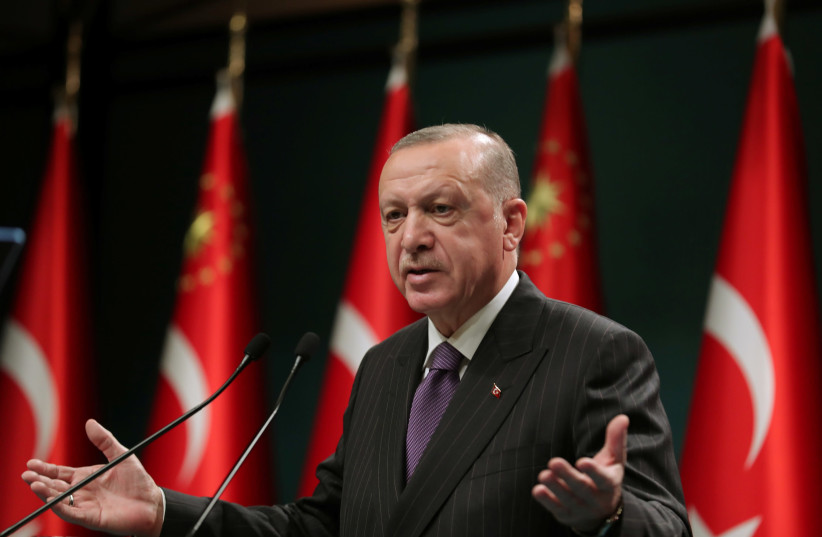
Turkey has encouraged its lobbyists in the US to claim that Ankara is doing “geopolitics” designed to be a “bulwark” against Russia, using Cold War-era terminology to encourage Westerners to believe that Ankara is on the side of Washington against Moscow. The reality, however, is that Turkey’s goal is to work with Russia and Iran to reduce US influence.
This has been the result in every area that Ankara has invaded and involved itself. Turkey worked with Russia to partition parts of northern Syria, removing US forces and spreading extremism. In Libya, a conflict that the US was once involved in has now become a playground for Turkish-backed militias.
The recent war between Azerbaijan and Armenia was likewise designed to bring Turkey and Russia into direct contact in the southern Caucasus, remove US influence and partition the area.
Evidence for this can be found in the agreement to end the war, which saw Russian peacekeepers and soldiers increase their role in Nagorno-Karabakh, an autonomous Armenian region in Azerbaijan. Turkey prodded Baku into war against Armenians there, causing massive damage and forcing 50,000 to flee.
For Turkey, the attacks on Armenian civilians were a success, replicating Turkish-backed ethnic-cleansing in Afrin, where Kurds were expelled in January 2018. The model was the same in Nagorno-Karabakh. Turkey sent extremists, accused of beheading people, to ransack churches and force Armenians out.
A hundred years after the Armenian genocide carried out by the Ottoman regime in 1915, Turkey wanted to continue the process. Much as in 1915, the goal in the end would bring renewed Russian involvement in the Caucasus.
RUSSIAN RESCUE workers have now reconstructed more than 250 buildings in Nagorno-Karabakh, according to Russia’s TASS media. “As many as 251 buildings have been reconstructed so far, including an apartment building, 245 private houses, two government buildings, an infrastructure facility and two social facilities,” it reported.
Some 2,600 more buildings damaged in the war may now receive Russian support. Russia views this as a kind of police action, going in to stop squabbling by former Soviet socialist republics. This is how Ankara views the region as well, but from the Ottoman Empire’s point of view.
That is why Turkey keeps talking about rewriting the Lausanne Treaty and other agreements made after World War I. Ankara’s invasion of Syria and setting up a dozen bases in northern Iraq, as well as involvement in Libya and the Eastern Mediterranean, is part of this.
Turkey sells its involvement with different public-relations campaigns in different places. In Washington, it sells this as “geopolitics,” pretending to be a US ally. In fact, Turkey is rapidly buying Russian arms.
Turkey and Russia met in the Russian resort city of Sochi last week to talk strategy. Turkey’s state media reported: “The top Turkish and Russian diplomats met Tuesday to discuss international issues and help prepare for a meeting of the two countries’ presidents. Turkish Foreign Minister Mevlut Cavusoglu met with his Russian counterpart, Sergey Lavrov, in Sochi ahead of a planned meeting of the high-level Russian-Turkish Cooperation Council, set to be co-chaired by their presidents.”
WHILE TURKEY frequently spreads misinformation via its state media, imprisons journalists and dissidents and bashes the US, it is growing closer to Russia. It is now four years since Russia’s ambassador to Turkey was assassinated. That incident has been quietly pushed aside in favor of the new alliance.
Turkey, Russia and Iran see this as a pragmatic working relationship, growing out of the Astana Process, or Syrian peace process, of 2016 that was supposed to carve up Syria into areas of influence and remove the US from eastern Syria. The end goal is the same: Remove the US and give each member of this new alliance their respective area of control.
Turkey has tried to hint to Israel, as well as the US, that it wants “reconciliation.” However, when Turkish President Recep Tayyip Erdogan speaks, he continues his militarist drive. His sycophants despise the US and Europe. They use the term “reconciliation” only because they think gullible Western media will buy them time and perhaps an in with the new US administration to continue their work with Russia and Iran.
The US once had a wider role in the Caucasus. Georgia expected American support in 2008 when it wandered into a war with Russia over disputed areas. When Georgia was defeated, the US and European role there declined. Later in 2014, Ukraine expected more US support but saw Russia annex Crimea.
The war that Turkey prodded Azerbaijan into last September was the final end of US involvement in the Caucasus. While Turkey sold the war as being needed to confront Iran and Russia, Ankara was, in fact, working with Tehran and Moscow.
The goal was to bring Russia into the southern Caucasus as peacekeepers and to remove any Western influence. This is because Armenia had been seeking to drift away from the Russia orbit. Nikol Pashinyan wanted to seek closer ties to the West. To break this, Moscow allowed Turkish-backed Azerbaijan to launch a war to weaken him in the summer and fall of 2019. Weakened and defeated, he sued for peace, and Russia and Turkey moved into disputed areas with Baku’s acquiescence.
Now, Armenia is totally hostage to Moscow and Ankara. Turkey wants this. Azerbaijan, which sought for decades to grow closer to the US and also to Israel as a strategic partner, has now also seen itself cornered by Ankara. The end result is more Iranian, Russian and Turkish control and a weakening of independent southern Caucasus states.
WESTERN MEDIA is fed stories about how the Turkish-Iranian-Russian triangle is destined to clash because of historic Ottoman, Persian and Russian imperial goals, or because they are Sunni, Shi’ite and Christian countries. This is a misreading of history. They are more likely to work together against their common enemies in the West and to further their joint authoritarian and military agendas.
They share much in common as rising powers in the world, seeking to end the unipolar world of US hegemony that grew out of the Cold War. Those in Washington who see Turkey through a Cold War lens are wrong about Turkey’s overall agenda. The agenda of Ankara is always to weaken and reduce the US role in the Middle East and to increase the Russian and Iranian role.
In every invasion Ankara has performed so far, it has sought to increase Russia’s and Iran’s power – not only weaken America but to also weaken any groups that want democracy or a more free press and to bring in extremists and authoritarians.
John F. Kennedy in 1960 argued that the world was not just divided into a Soviet and American camp, but rather those countries that were “free” as opposed to those that aren’t. He understood that authoritarians prefer to work together; that is what is happening in the Caucasus.


