
American officials fear the Islamic Republic could carry out attacks on date of assassination of its top general
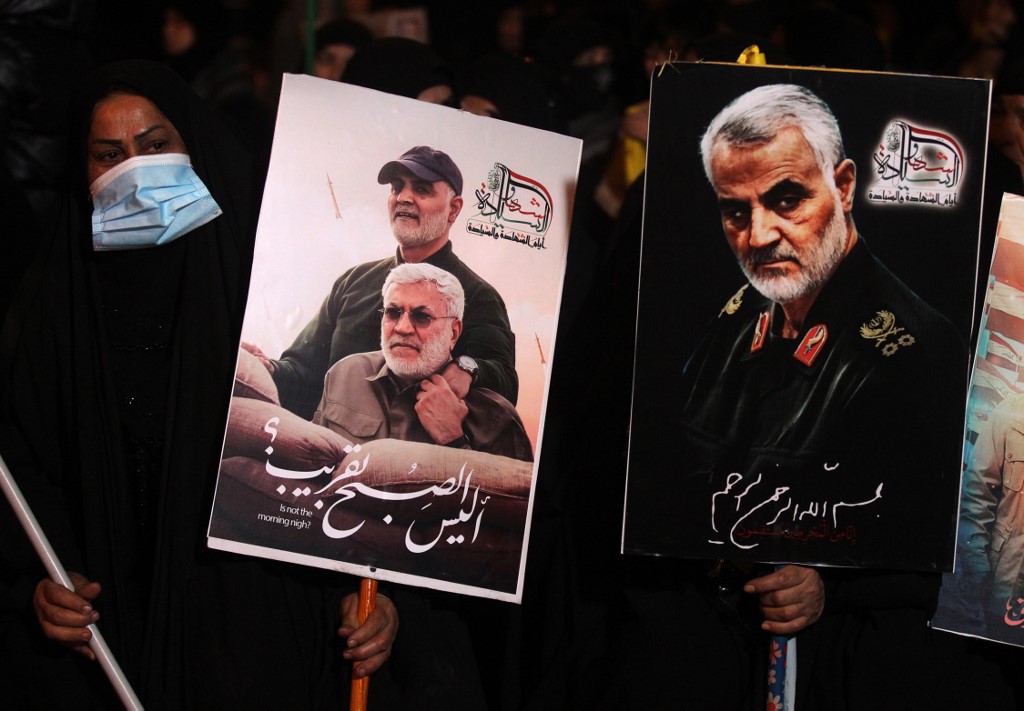
 

People carry portraits of late Iraqi commander Abu Mahdi al-Muhandis and Iranian commander Qasem Soleimani at Baghdad Airport, in Baghdad on January 2, 2021, at the site of their killing (AHMAD AL-RUBAYE / AFP)

People carry portraits of late Iraqi commander Abu Mahdi al-Muhandis and Iranian commander Qasem Soleimani at Baghdad Airport, in Baghdad on January 2, 2021, at the site of their killing (AHMAD AL-RUBAYE / AFP)

Iran on Sunday marked one year since the death of General Qassem Soleimani in an American drone strike in Baghdad, amid fears in Washington that Tehran could retaliate for the killing on the anniversary.

US officials have expressed concern that Iran may be planning attacks against US-allied targets in neighboring Iraq or elsewhere in the region to coincide with the date. In recent weeks the US military has taken a range of steps designed to deter Iran, while publicly emphasizing that it is not planning, and has not been instructed, to take unprovoked action against Iran.

US President Donald Trump has warned Iran against any attack, and the US has flown strategic bombers over the Persian Gulf in a show of force meant to deter Iran from attacking American or allied targets in the Middle East. A US nuclear submarine crossed the Strait of Hormuz on Monday.

Iranian officials have issued a stream of threats against the US as the anniversary of Soleimani’s death approached, while accusing Trump of seeking a “pretext” for war.
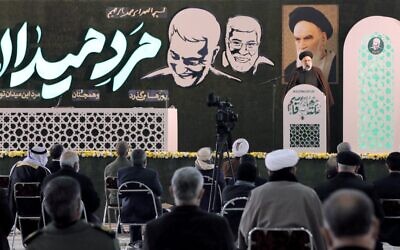
Iranian judiciary chief Ebrahim Raisi speaks during a ceremony on the occasion of the first anniversary of death of former Quds force commander Qasem Soleimani in Tehran, on January 1, 2021. (STR / AFP)

The US killed Soleimani, who oversaw the Revolutionary Guard’s expeditionary Quds Force, and others in the January 3, 2020, strike near Baghdad International Airport. It came after months of incidents raising tensions between the two countries and ultimately saw Iran retaliate with a ballistic missile strike targeting American troops in Iraq.

Iran has also threatened to attack Israel since the assassination of its top nuclear scientist, Mohsen Fakhrizadeh, in late November, in a raid blamed on the Jewish state.

The Israeli military is preparing for the possibility of a strike by Iran-backed militias in Iraq or Yemen, according to a Friday report. The Israel Defense Forces held discussions last week about possible attacks, including missile and drone strikes, from the Iraqi militias and Houthi groups in Yemen, the Kan public broadcaster reported.

Further ratcheting up tensions, the UN nuclear watchdog said Friday that Iran intends to produce uranium enriched up to 20 percent purity, well beyond the threshold set by the 2015 Vienna accord and a short jump from weapons-grade material.

Iranian Foreign Minister Mohammad Javad Zarif speaks outside the Lebanese Foreign Ministry, August 14, 2020. (AP Photo/Hussein Malla)

Iranian Foreign Minister Mohammad Javad Zarif claimed Saturday that Israeli agents were planning to attack American targets in order to instigate an aggressive US reaction against Iran and spark armed conflict, warning Trump to avoid such a “trap.” And he warned that any attack against the Islamic Republic by the US would “backfire badly” on Washington’s “BFFs” (an initialism for “best friends forever”), in an apparent reference to the Jewish state.

“New intelligence from Iraq indicate (sic) that Israeli agent-provocateurs are plotting attacks against Americans — putting an outgoing Trump in a bind with a fake casus belli,” Zarif tweeted.

Top Iranian authorities, including supreme leader Ayatollah Ali Khamenei, had previously said that all those involved in Soleimani’s killing would face retribution.
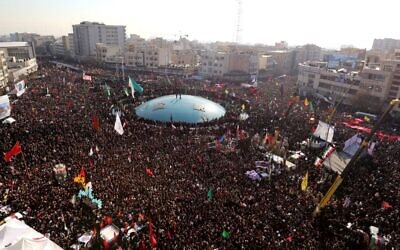
Mourners gather to pay homage to slain Iranian military commander Qassem Soleimani, Iraqi paramilitary chief Abu Mahdi al-Muhandis and other victims of a US attack, in the capital Tehran on January 6, 2020. (Atta Kenare/AFP)

Days after Soleimani’s killing, Iran launched a volley of missiles at Iraqi bases housing US and other coalition troops, with Trump refraining from any further military response.

The Iranian leadership has called the strikes a “slap” and vowed that “severe revenge” awaits.

CNN on Friday reported disagreements within the Pentagon as to the threat level from Iran. Some officials said the threat was the highest it’s been since Soleimani’s killing, with US forces in the region in real danger of attack, while others insisted this was an exaggeration.

“We do see several planning efforts underway and if even some of them are true and they execute they could kill several Americans,” one military official said.

Tensions between Washington and Tehran have soared since 2018, when Trump unilaterally withdrew the US from the Iran nuclear deal and reimposed crippling sanctions.

The two sides have twice come to the brink of war since June 2019, especially following the killing of Soleimani, who headed the foreign operations arm of the Islamic Revolutionary Guard Corps.


Daniel Salami|
Published: 01.02.21 , 23:31
Commander of the Islamic Revolution Guards Corps (IRGC) Aerospace Force Brigadier General Amir Ali Hajizadeh told Lebanese Al-Manar channel that Hezbollah in Lebanon and Hamas in Gaza will serve as the first line of defense if Israel attacks Iran.
He added that Iran will “flatten” Tel Aviv and Haifa if Israel launches an attack against the Islamic Republic.


The State of Israel has always viewed Morocco as a moderate Arab nation that has immense influence within the Arab world.

AN EL AL airliner displays the Israeli, Moroccan and US flags last week as it arrives in Rabat. (photo credit: US EMBASSY IN MOROCCO/REUTERS)
AN EL AL airliner displays the Israeli, Moroccan and US flags last week as it arrives in Rabat.
(photo credit: US EMBASSY IN MOROCCO/REUTERS)
The recent signing of the peace agreement between Israel and Morocco was an historic breakthrough. This step was not, however, the result of recent efforts made by Prime Minister Benjamin Netanyahu, but the product of decades of cooperation carried out behind the scenes and far away from the camera lens.

Israel’s normalizing relations with the royal palace and Morocco’s King Mohammed VI has been a work in progress for many years now. These efforts became public knowledge when the late prime minister and defense minister Yitzhak Rabin openly visited Morocco, which culminated with the opening of liaison offices in Tel Aviv and Rabat. The liaison office in Tel Aviv was later shuttered for political reasons, namely the outbreak of the Second Intifada and the Israeli-Palestinian conflict, but the two countries have continued to maintain unofficial relations during the interim years.

Israel’s security establishment, including the Mossad, has maintained – and continues to maintain – ongoing contact with Morocco with the aim of strengthening moderate forces in North Africa and assisting in the collaborative fight against global terrorism led by Iran.

Morocco is currently waging an uncompromising struggle for international recognition of its sovereignty over the Western Sahara region. It has been facing terrorist attacks from the Western Sahara’s Polisario Front, which receives official support from Algeria and Iran, as well as from Hezbollah forces that recently infiltrated the region and are aiding in the training and arming of Polisario Front fighters.

The State of Israel has always viewed Morocco as a moderate Arab nation that has immense influence within the Arab world, and King Mohammed VI’s esteem among world leaders, as well as his special status within the Arab League, constitute a tremendous political and strategic advantage for Israel.

The king’s order in May 2018 to bring home Morocco’s ambassador to Iran and to expel Iran’s ambassador in Rabat was a clear sign of the king’s seriousness in the fight against global terrorism – which is being led by Iran, together with Hezbollah.

Two and a half years ago, I was asked to intercede on behalf of Morocco in its quest for recognition by the world’s leading power – the US – of its control over the Western Sahara, on the grounds that Morocco has a genuine desire to carry out development and grant rights to local residents (known as the autonomy plan). The Moroccans knew that the key to the White House and the quickest path to Washington were through Jerusalem.

I accepted the plea for help, but only after confirming that American recognition would be contingent upon Morocco agreeing to upgrade diplomatic relations with the State of Israel, reopening its liaison office in Tel Aviv and approving direct flights between Israel and Morocco. In order to verify the proposal, I held meetings with high-level Moroccan officials and heard from them firsthand that the king was indeed interested in putting this plan into action.

I approached a number of senior US government officials, and we immediately set up meetings at the White House with Jason Greenblatt, the Middle East adviser to the US president, as well as with National Security Council and State Department representatives. Everyone involved understood the advantages and approved of the initiative.

There’s no doubt that this breakthrough will have a host of geostrategic implications in the fields of economics, trade, agriculture, water issues and energy, and, of course, in security and political matters.

Having ties to King Mohammed VI, as the leader of the moderate Arab world, will have a direct impact on the national security of the State of Israel and will strengthen the country’s position vis-à-vis other Arab countries. This strategy will continue to have a positive impact, including the way Morocco allows all of its citizens freedom of worship, regardless of their religion. Moreover, the king has an especially warm relationship with the country’s Jewish community, and the more than one million Israelis whose families hail from Morocco have fond memories of and a longing for the homes they left behind.

Unlike its relationships with other Arab countries, Morocco shares a close connection with Israel and the two nations have many common values that have anchored them in their longstanding relationship.

From conversations and meetings I held with Moroccan officials, I’ve come to understand that King Mohammed VI is genuinely interested in establishing a truly peaceful, warm and courageous relationship with Israel. His unique leadership will lead to a steadfast relationship with Israel and the possibility of reinstating diplomatic relations in the near future.

We must not forget, though, that Morocco has made a sincere and genuine commitment to promoting peace in the region and to bringing about an end to the Israeli-Palestinian conflict in the framework of a two-state solution, which in my opinion, there is no excuse for not implementing.

The writer serves as an MK for the Yesh Atid Party. He served as deputy head of the Mossad and director-general of the Ministry of Strategic Affairs and Public Diplomacy.

https://www.jpost.com/opinion/king-mohammed-vi-of-morocco-is-leading-the-way-to-peace-opinion-653915