
Israel and Lebanon to launch direct maritime border talks, report says

After visit from senior US State Department official, negotiations that likely required tacit Hezbollah approval reportedly set to take place in southern Lebanon next month


Illustrative: Israel's offshore Leviathan gas platform. (Albatross)

Illustrative: Israel’s offshore Leviathan gas platform. (Albatross)

After years of on-and-off negotiations, Israel and Lebanon have reportedly agreed to launch high-level, direct talks aimed at demarcating a maritime border.

The talks will take place immediately following the Sukkot holiday, which ends on October 10, and will be held at the headquarters of the United Nations Interim Force in Lebanon (UNIFIL) in the southern Lebanese town of Naqoura, according to a Friday Channel 12 report.

The issue of the shared maritime border is sensitive, mainly because of a dispute over coastal drilling rights.

The breakthrough allowing for next month’s summit was achieved during a recent visit to the region by Assistant US Secretary of State for Near East Affairs David Schenker, the network said.

A senior US official will be brokering the maritime talks, the report said.

Schenker has been shuttling between Jerusalem and Beirut in recent weeks in an effort to succeed in reaching an agreement where previous administrations have failed.

The US State Department declined a request for comment.

The Israeli side of the maritime talks will be led by Energy Minister Yuval Steinitz, Channel 12 said, without specifying whether he will be making the trip to Lebanon himself. The Lebanese negotiating team will be led by Shiite Parliament Speaker Nabih Berri, in coordination with President Michel Aoun’s office.

David Schenker, US assistant secretary of state for near eastern affairs, in Beirut, Lebanon, on September 9, 2019. (Hussein Malla/AP)

No agreement was reached to allow for similar direct talks to demarcate Israel’s land border with Lebanon, but added if an agreement is reached regarding the maritime border, it will allow for the acceleration of natural gas drilling in the economic waters of both countries, the report said.

The network also speculated that such high-level talks “almost certainly” required the tacit approval of the Hezbollah terror group, which is based in southern Lebanon.

Axios previously reported that Washington had renewed efforts to launch direct negotiations between Israel and Lebanon over their disputed maritime border, and hoped to reach a breakthrough before November’s US election.

Israeli officials told the website that the administration decided to make a new push for progress in the wake of the Beirut port explosion and amid Lebanon’s economic and civil crisis.

Lebanon in 2018 signed its first contract to drill for oil and gas off its coast, including a block disputed by Israel, with which it has fought several wars. Lebanon and Israel are still technically at war.

The Israeli officials cited by the report said one of the last issues of disagreement was who would mediate the talks, with Lebanon seeking mediation by both the US and UN, while Israel wants the UN to act as host only, with no active role.

Schenker told Lebanese journalists earlier this month that “incremental progress” was being made, and later told a Brookings Institute video conference that “the sticking point is… absurd.”

It is not known whether he was referring to the issue of mediation, as reported by Axios.

Schenker also said of Lebanon’s incentive: “We’re talking about free money for a state that is in a financial crisis.”
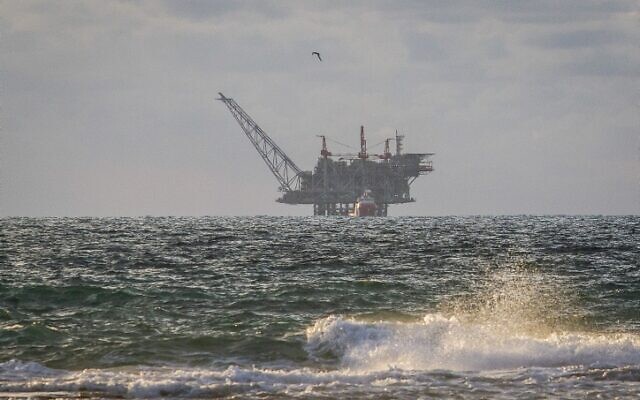
A view of the Leviathan natural gas gas processing rig from Dor Habonim Beach Nature Reserve, January 1, 2020. (Flash90)

But an Israeli official who spoke to the news site said: “There is progress. We see willingness on the Lebanese side to move and settle this dispute. We are ready to start talks immediately and we hope it can happen before the end of the year.”

The Israeli government in May 2019 said it had agreed to enter US-mediated talks with Lebanon to resolve the maritime border dispute. However, pressure from Hezbollah was reported to have caused Beirut to back out.

In February 2018, Lebanon signed its first contract for offshore drilling in two blocks in the Mediterranean for oil and gas with a consortium comprising energy giants Total, ENI and Novatek.

Lebanon in April said initial drilling in Block 4 had shown traces of gas but no commercially viable reserves.

Exploration of Block 9 has not started and is much more controversial as Israel also claims ownership over part of it.

https://www.jpost.com/metro/uae-israel-deal-changes-the-players-in-the-middle-east-energy-game-643625


Sudan, Oman ‘to normalise ties with Israel next week’: reports

Sudan, Oman 'to normalise ties with Israel next week': reports
Oman and Sudan could announce normalisation deals with Israel as soon as next week, according to Friday reports, after the US hinted at more Arab countries joining accords struck between the Jewish state and the United Arab Emirates and Bahrain.
Citing Hebrew-language newspaper Maariv, Israeli broadcaster i24 News stated Sudan and Oman are holding US-brokered talks with Israel so as to announce peace deals next week.

US Ambassador to the United Nations Kelly Craft on Wednesday revealed a third normalisation agreement between Israel and an unnamed Arab country may happen in the next day or two.

i24 News previously reported Israeli Prime Minister Benjamin Netanyahu will likely meet with Abdel Fattah Al-Burhan, the leader of Sudan’s transitional sovereign council, in the coming days in Uganda, the second meeting between both officials.

In return for the normalisation deal, Sudanese officials hope Khartoum will be removed from the United States’ State Sponsors of Terrorism list.

The designation, in place since the 1990s, exposes Sudan to harmful sanctions and limits the amount of international aid available to the country amid a spiralling economic crisis.

On its end, Oman expressed support for last month’s normalisation of ties between the neighbouring UAE and Israel.

Since the UAE and Bahrain signed an agreement to establish full diplomatic ties with Israel earlier this month, speculation has pointed to a handful of other Arab countries on the brink of reaching similar deals, with Oman and Sudan as the most likely candidates.

The Trump administration has made Israeli-Arab normalisation a key focus of its Middle East foreign policy close to the US elections on November 3.

The Palestinians have been vocal in their opposition to the agreements, arguing such decisions remove any incentive for Israel to end its occupation of the Palestinian territories.


Saudi King backs US peace efforts

Speaking to UN General Assembly, Saudi Arabia’s King Salman calls for comprehensive solution on Iran.

Elad Benari , 24/09/20 05:35


Saudi flag

Saudi flag

iStock

Saudi Arabia’s King Salman bin Abdulaziz on Wednesday called for a comprehensive solution on Iran and to disarm its affiliate Hezbollah in Lebanon, and expressed support for US efforts to start talks between Israel and Palestinian Arabs, Reuters reported.

Speaking for the first time before the United Nations General Assembly, he said Iran has exploited the 2015 nuclear deal with world powers “to intensify its expansionist activities, create its terrorist networks, and use terrorism,” adding that this had produced nothing but “chaos, extremism, and sectarianism.”

“A comprehensive solution and a firm international position are required,” he told the 193-member General Assembly in a video statement, prerecorded due to the coronavirus pandemic.

“Our experience with the Iranian regime has taught us that partial solutions and appeasement did not stop its threats to international peace and security,” King Salman added, according to Reuters.

US President Donald Trump quit the Iran nuclear deal in 2018 and has since reimposed sanctions on the Islamic Republic. Trump asserts that all countries also have to reinstate UN sanctions in an attempt to push the Islamic Republic to negotiate a new deal, but the remaining parties to the nuclear deal have rejected the demand.

The King also commented on attempts to mediate peace between Israel and the Palestinian Arabs, saying the 2002 Arab peace initiative is the basis for a “comprehensive and just solution” ensuring the Palestinians obtain an independent state with eastern Jerusalem as its capital.

“We support the efforts of the current US administration to achieve peace in the Middle East by bringing the Palestinians and the Israelis to the negotiation table to reach a fair and comprehensive agreement,” he said.

The king stopped short of endorsing recent US-brokered agreements by the United Arab Emirates and Bahrain to establish ties with Israel.

Last week, US President Donald Trump told reporters that many more countries are on the way to reaching new peace deals in the Middle East.

Asked if he expected Saudi Arabia to follow suit, Trump said “I do. I spoke with the king of Saudi Arabia.” He added the move would come “at the right time.”

The President recently said he expected Saudi Arabia to join the Israel-UAE deal. A senior member of the Saudi royal family later stressed that Saudi Arabia’s price for normalizing relations with Israel is the creation of a sovereign Palestinian state with Jerusalem as its capital.

King Salman reiterated that position during a recent conversation with Trump, saying there would be no normalization with Israel without Palestinian statehood.

https://www.israelnationalnews.com/News/News.aspx/287840