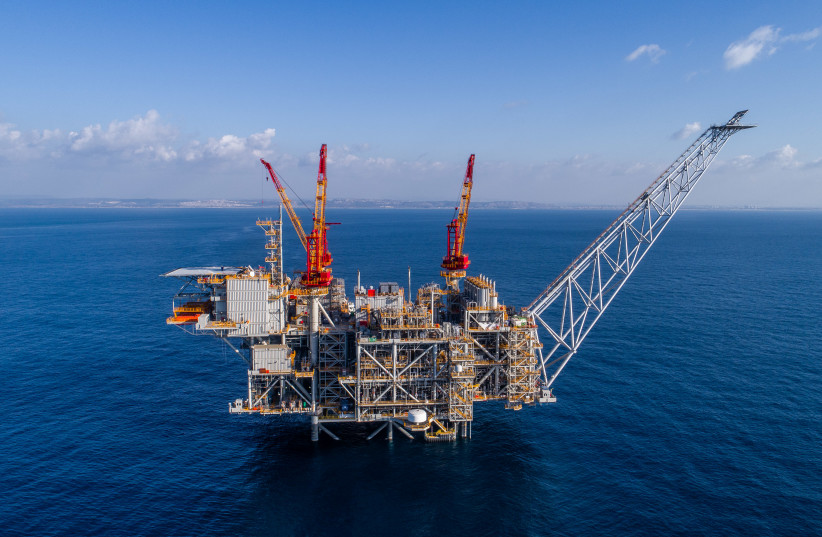
Egypt, Israel, Greece, Cyprus, Italy, Jordan and the Palestinian Authority signed the charter of the East Mediterranean Gas Forum (EMGF) in a virtual ceremony hosted by Cairo on Tuesday.
Natural gas exploration and the massive reserves found in the Eastern Mediterranean over the past several years mean that what began as an informal forum of Egypt, Cyprus, Israel and Greece is now a formal intergovernmental organization based in Cairo. Egypt is positioning itself as an energy and exporter hub in the region.
The bloc seeks to promote gas exports at a time when Israel has established new ties with Arab states.
The group unites Turkey, Greece and Cyprus despite a bitter dispute over offshore drilling rights. France wants to join, and the United States and European Union have requested observer status.
For Israel, the forum “brings regional cooperation with Arab and European countries, the first of its kind in history, with contracts to export [Israeli] gas to Jordan and Egypt worth $30 billion, and that is just the beginning,”
Israeli Energy Minister Yuval Steinitz says.
Tareq Awwad, an international energy expert based in Israel, told The Media Line that “the future is with gas” as oil reserves dwindle.
“Egypt is positioning itself as a source of gas and electricity. It has made agreements with neighboring countries such as Jordan to meet Amman’s electricity needs, and those of other countries,” he said.
Dolphinus Holdings, an Egyptian company, signed a deal in 2018 to buy $15 billion worth of Israeli natural gas in two 10-year installments.
Egypt has two liquefied natural gas (LNG) plants that are idle or running at less than capacity and available for exports.
The newly formed gas bloc comes after the United Arab Emirates and Bahrain signed normalization deals with Israel last month, sending shockwaves through Middle Eastern political corridors. The deals are sure to have great consequences for the region’s economies and financial sectors.
The moment the UAE-Israel agreement was announced, business leaders from those countries rushed to meet and ink mega deals.
Dr. Alex Coman, a value-creation expert at the Interdisciplinary Center Herzliya’s Adelson School of Entrepreneurship, told The Media Line that cooperation in banking, technology and agriculture shows great promise.
“There is a lot of potential for cooperation between them, with money from wealthy Gulf states, and Israeli knowhow,” he said.
The UAE-Israel deal speaks of “enhancing energy cooperation between the two countries.” Coman says such cooperation could include many sectors and bring tremendous business opportunities.
“Hi-tech is becoming very critical in replacing fossil energy and I know that many countries in the Gulf want to take their profits from fossil energy and invest in the future. So they want to be more involved in these sectors, and Israel is very good in this area,” he noted.
Awwad says the region is rapidly changing.
“What is happening now is the drawing of a new map of everything related to energy in the Middle East,” he stated.
Traditional pathways for energy produced in the Gulf may be changing following the establishing of diplomatic ties between the UAE and Israel, he adds.
“Gulf oil passes now through the Strait of Hormuz, Bab el-Mandeb and the Suez Canal. This [UAE-Israel] agreement would change this route and turn it into pipelines crossing the Arabian Peninsula to Israel,” Awwad said.
But the new model is not limited to energy. Goods from the United States and Europe, now reaching the Gulf through the Suez Canal, can instead transit a land bridge through Israel and then Jordan, which will benefit greatly from its new role as a regional hub for commerce.
Both the UAE and Israel have their eyes on the economic and financial benefits of peace.
The energy-rich UAE knows that one day, its main source of revenue will dry up, and it is looking to diversify its economy. It wants to marry its massive wealth with investment in the many sectors in which Israel has experience.
Coman expects more regional players to join in.
“Arab countries, maybe Saudi Arabia and, at some point, Iraq, will be involved in this pipeline that will export Arab oil, Gulf oil, through the Gulf into Jordan, Israel and on to Europe,” he speculated.
Dubai-based DP World, one of the largest maritime logistics companies globally, has signed a memorandum of understanding with the Israeli firm DoverTower to mount a joint bid to operate Haifa Port. If the bid goes through, Awwad says it will change how energy and goods are transported.
“It is no coincidence that Dubai Ports has agreed with the Israeli company to manage Haifa Port,” he said. “This is a gigantic strategic project.”
The bid is still in the discussion stage. It is motivated in part by politics and driven by business leaders who are looking to revive old pipelines and railroads.
These projects could revolutionize the way oil and gas are transported, and connect Israel and the region in a network to move goods, energy and people.
They foresee a market that marginalizes Iran and weakens its control over the vital shipping lanes in the Gulf, bypassing Bab al-Mandab and the Strait of Hormuz, which Tehran has frequently threatened to close. They will also make the Islamic Republic’s oil imports more expensive compared to those of its Gulf neighbors.
Politically, this plan will support the so-called axis of moderate states in the region.
“Gulf oil used to pass through the Suez Canal and the Cape of Good Hope. This agreement would change this route and turn it into the Eilat-Ashdod line,” Awwad emphasized.
This in turn would create new alliances, such as an “Egyptian-Israeli axis, where the Gulf will depend on them to transfer energy to Europe,” he said.
These newly formed energy blocs have European and American support.
Efforts are also underway to revive Ottoman railroads.
Back in 2016, Israel reopened one such historic pathway. The railroad will reach Jordan in the North at the Jordan River Crossing/Sheikh Hussein Bridge, and the Palestinian Authority at the Jalamah checkpoint near Jenin in the northern West Bank.
Jordan will become the new gateway to the Gulf for goods coming from the West, with a free trade zone being built as a hub and a first point for the distribution of goods. It will also be the connecting point for energy to be transported through its territory to Israeli ports and on to the West.
The new railroad will also connect Jordan to Saudi Arabia’s North and South. The plan is to eventually bring in Saudi Arabia and Iraq.
Publicly, Riyadh has no diplomatic relations with Israel, which would make it almost impossible for it to take part in any of these projects. King Salman is on record as saying there will be no normalization with Israel until a final resolution to the Israeli-Palestinian conflict is reached.
But this does not mean that the desert kingdom is not eager to follow in its Gulf neighbors’ footsteps in establishing diplomatic ties with Israel. Crown Prince Mohammed bin Salman (MbS), the day-to-day ruler of the country, has made comments that seem to indicate support for the eventual establishment of full relations.
A source in Riyadh who asked to keep his identity confidential told The Media Line there is a clash between the old guard and the new, and that “it’s only a matter of time before [normalization] happens.”
The source says MbS’s Saudi Vision 2030 plan to reduce the kingdom’s dependence on oil and diversify its economy and develop service sectors has Israel in mind.
“Bin Salman knows that he needs to move forward with his plan as he works to diversify the economy, and he is competing regionally for market share,” the Riyadh-based source said.
The crown prince wants to partner the kingdom’s wealth with Israel’s experience in many fields. According to the new model, this cooperation will also support the Palestinian economy as envisioned in US President Donald Trump’s January 2020 peace plan.
Ayidh Swaidan, a Saudi specialist in economics and energy affairs, told The Media Line that he did not anticipate “any immediate change to oil and gas policies and future plans for GCC [Gulf Cooperation Council] countries” because most Saudi exports go to Asia and, to a lesser degree, Europe.
“The main countries Saudi Arabia exports to are China and India, and less to the US. I don’t see any relationship between the signing of the agreements and new projects,” he said.
Yet Swaidan argues that this could change as Saudi Arabia looks to diversify its financial resources.
“The government is keen about staying competitive and making sure it creates new opportunities for its citizens,” he said. “This goes hand in hand with the political vision of the kingdom.”
Once approved, funding for these mammoth projects will not a problem as top UAE and Israeli investment funds are eager to finance them.
There will be winners and losers in the new endeavors, and Coman argues that it would “change their lives” if the Palestinians agree to join in.
“The Palestinians would benefit greatly from such projects,” he stated. “Economically, things would start again. But we need a lot of optimism for that.”
Lebanon, too, is surely watching amid fears that Gulf imports from Europe will pass through Haifa instead of Beirut, something that could spell doom for a country already reeling economically, financially and politically.
The new framework would also challenge the influence of Russia, a major gas supplier to Europe.
“Europe is very frustrated with its dependence on Russian gas and oil. So there’s great enthusiasm in Europe to get an alternative route,” Coman said.
“I think that if this pipeline becomes a reality and gas flows from Israel through Cyprus and Greece to Europe,” he noted, “it would be very nice both for us and the Gulf countries.”
https://www.jpost.com/metro/uae-israel-deal-changes-the-players-in-the-middle-east-energy-game-643625