Iran on Sunday called on the rest of the world to unite against US “reckless actions,” after Washington unilaterally declared UN sanctions against the Islamic republic were back in force.
“We expect the international community and all the countries in the world to stand against these reckless actions by the regime in the White House and speak in one voice,” foreign ministry spokesman Saeed Khatibzadeh told a news conference in Tehran.
The Russian foreign ministry also condemned the unilateral declaration by the United States as “illegitimate” and “unacceptable.”
Get The Times of Israel’s Daily Edition by email and never miss our top storiesFREE SIGN UP
“The illegitimate initiatives and actions of the United States by definition cannot have international legal consequences for other countries,” the foreign ministry said in a statement.
Russia, a key ally of Iran, accused Washington of putting on a “theatrical performance” and insisted that the US statements “do not correspond to reality.”
It accused the US of “trying to force everyone to wear virtual reality goggles” and accept its version of events, adding: “The world is not an American computer game.”
Washington’s defiance has dealt a “serious blow to the authority of the UN Security Council” and showed “open contempt for its decisions and for international law as a whole,” the ministry said. “This is unacceptable, and not only for us, but for other members of the Security Council too.”
Russia said it “fully supports” the position of the majority of Security Council members that the US moves are “legally and procedurally null and void.”
The United States unilaterally proclaimed on Saturday that UN sanctions against Iran were back in force and promised to punish those who violate them, in a move that risked increasing Washington’s isolation and international tensions.
“Today, the United States welcomes the return of virtually all previously terminated UN sanctions on the Islamic Republic of Iran,” Secretary of State Mike Pompeo said in a statement.
According to him, the measures were “back in effect” from 8:00 p.m. Washington time.
The administration of US President Donald Trump also promised to “impose consequences” on any UN member state which does not comply with the sanctions, even though the United States is one of the only countries in the world which believes they are in force.
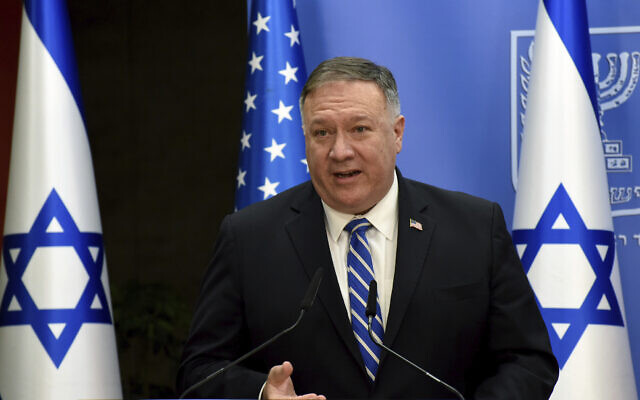
US Secretary of State Mike Pompeo speaks during a joint statement to the press with Prime Minister Benjamin Netanyahu after their meeting, in Jerusalem, August 24, 2020. (Debbie Hill/Pool via AP)
The threat is formidable: those deemed to be in defiance by Washington will be denied access to the US financial system and markets.
“If UN member states fail to fulfill their obligations to implement these sanctions, the United States is prepared to use our domestic authorities to impose consequences for those failures and ensure that Iran does not reap the benefits of UN-prohibited activity,” Pompeo stated.
He promised that measures would be announced in the coming days against “violators.”
With 45 days to go until the November 3 election, Trump could unveil those measures during his speech at the UN General Assembly on Tuesday.
However, the US is almost alone on the issue: all other major powers — China, Russia and also Washington’s own European allies — have challenged the claim.
“Any decision or action taken with a view to re-installing [the sanctions] would be incapable of legal effect,” France, Britain and Germany said in a joint letter sent Friday to the Security Council and of which AFP obtained a copy.

In this photo released by the official website of the office of the Iranian Presidency, President Hassan Rouhani, right, welcomes Director General of International Atomic Energy Agency, IAEA, Rafael Mariano Grossi for their meeting in Tehran, Iran, Wednesday, Aug. 26, 2020 (Iranian Presidency Office via AP)
The Americans themselves realize the statement is a “false claim,” Iranian foreign minister Mohammad Javad Zarif said Saturday.
In mid-August, the US suffered a resounding defeat at the UN Security Council when it tried to extend the embargo on conventional weapons being sent to Tehran, which was due to expire in October.
Pompeo made an unusually vehement attack on France, Britain and Germany, accusing them of “siding with Iran’s ayatollahs,” and on August 20 announced the controversial “snapback,” which aimed to reestablish all sanctions against Tehran a month later.
The sanctions were lifted in 2015 when Iran signed on to an international agreement not to seek to build nuclear weapons.
But Trump said that the landmark accord, negotiated by his predecessor Barack Obama, was insufficient and withdrew the US from the agreement in 2018. He then renewed and even strengthened Washington’s bilateral sanctions.

US President Donald Trump speaks with reporters as he walks to Marine One on the South Lawn of the White House, Tuesday, Sept. 15, 2020, in Washington. Trump is en route to Philadelphia. (AP Photo/Alex Brandon)
At the moment, the US is insisting it is still a participant in the agreement that it stormed out of, but only so that it can activate the snapback option.
Virtually every other member of the Security Council disputes Washington’s ability to execute this legal pirouette, and the council has not taken the measure any further.
The Trump administration, however, is acting as if the international sanctions are in place, while the rest of the international community continues to act as if nothing has changed.
Washington is hammering home that the arms embargo has been extended “indefinitely” and that many activities related to Tehran’s nuclear and ballistic missile programs are now subject to international sanctions.
But “I don’t see anything happening,” said one UN diplomat. “It would be just a statement. It’s like pulling a trigger and no bullet coming out.”
Another diplomat deplored the “unilateral” US act, saying that “Russia and China are sitting, happy, eating popcorn, watching” the “huge destabilizing fallout” between Washington and its European partners.
But if the United States were to carry out the threat of secondary sanctions, tensions could continue to spiral.