
Move forcefully opposed by most countries, except for Israel and Gulf, and expected to be ignored by rest of Security Council, which could undermine credibility of world body


US Secretary of State Mike Pompeo is flanked by US Ambassador to the United Nations Kelly Craft as he speaks to reporters following a meeting with members of the UN Security Council about Iran's alleged non-compliance with a nuclear deal and calling for the restoration of sanctions against Iran at United Nations headquarters in New York, August 20, 2020. (MIKE SEGAR / POOL / AFP)

US Secretary of State Mike Pompeo is flanked by US Ambassador to the United Nations Kelly Craft as he speaks to reporters following a meeting with members of the UN Security Council about Iran’s alleged non-compliance with a nuclear deal and calling for the restoration of sanctions against Iran at United Nations headquarters in New York, August 20, 2020. (MIKE SEGAR / POOL / AFP)

WASHINGTON — In defiance of overwhelming opposition, the United States is preparing to declare that all international sanctions against Iran have been restored. Few countries believe the move is legal, and such action could provoke a credibility crisis at the United Nations.

Virtually alone in the world on the matter save for Israel, the Trump administration will announce on Saturday that UN sanctions on Iran eased under the 2015 nuclear deal are back in force, after invoking a “snapback” clause despite having pulled out of the landmark pact.

The other members of the UN Security Council, including US allies, say the US lost the right to trigger a return to sanctions and have vowed to ignore the step. That sets the stage for ugly confrontations as the world body prepares to celebrate its 75th anniversary at a coronavirus-restricted General Assembly session next week.

The question is how the Trump administration will respond to being ignored. It already has slapped extensive sanctions on Iran, but could impose penalties on countries that don’t enforce the UN sanctions it claims to have reimposed. A wholesale rejection of the US position could push the administration, which has already withdrawn from multiple UN agencies, organizations and treaties, further away from the international community.

In the midst of a heated campaign for reelection, US President Donald Trump plans to address Iran in a speech to the General Assembly on Tuesday. Officials say he will also touch on his brokering of agreements for Israel and the United Arab Emirates and Bahrain to normalize relations in part to solidify a regional bulwark against Iran.
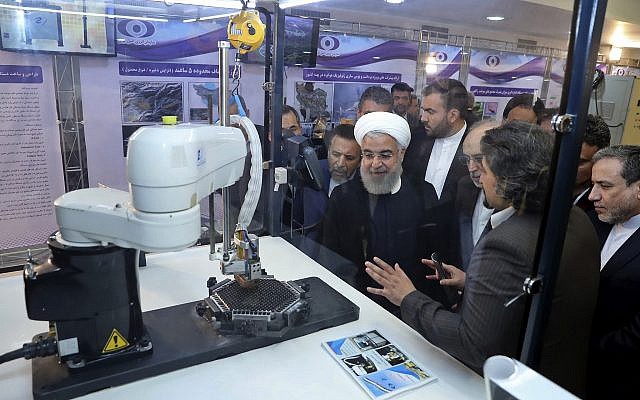
In this April 9, 2018 file photo, released by an official website of the office of the Iranian Presidency, President Hassan Rouhani listens to explanations on new nuclear achievements at a ceremony to mark ‘National Nuclear Day,’ in Tehran, Iran. (Iranian Presidency Office via AP, File)

And, as he seeks to demonstrate statesmanlike credentials ahead of the election, Trump has injected another element of uncertainty into the mix by threatening to retaliate “1,000 times” harder against Iran if it attacks US personnel overseas.

His tweeted warning came earlier this week in response to a report that Iran is plotting to assassinate the US ambassador to South Africa in retaliation for the US killing of a top Iranian general at the beginning of the year. Neither Trump nor any other senior US official has confirmed such a plot exists, although they have said Iran has a long history of political assassinations.

Amid uncertainty over that, the other 14 members of the Security Council and all but about five of the UN’s 195 member states say the US lost its legal standing to act on sanctions when Trump withdrew from the nuclear accord more than two years ago. The US argues it retains the right to enact the snapback of sanctions because the council resolution that endorsed the deal refers to it as a participant.
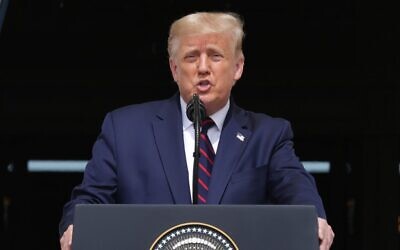
US President Donald Trump speaks at the signing ceremony of the Abraham Accords on the South Lawn of the White House September 15, 2020 in Washington, DC. (Alex Wong/Getty Images/AFP)

“These will be valid UN Security Council (actions) and the United States will do what it always does, it will do its share as part of its responsibilities to enable peace,” Secretary of State Mike Pompeo said on Wednesday. “We’ll do all the things we need to do to ensure that those sanctions are enforced.”

Pompeo traveled to the United Nations on August 20 to formally notify the Security Council that the US was triggering snapback because Iran is not complying with the nuclear deal. He dismissed suggestions that the administration was engaged in anything legally questionable or even controversial.

He said the snapback mechanism was the “one thing that the previous administration got right” in the nuclear deal that Trump has denounced as the worst deal ever negotiated. The agreement was a signature foreign policy achievement of President Barack Obama and gave Iran billions of dollars in sanctions relief in exchange for curbs on it nuclear program.

Yet, aside from Israel and the Gulf Arab states, almost no country in the world agrees with the US. Russia and China, along with American allies Britain, France and Germany, who often disagree but remain parties to the 2015 agreement, are united in declaring the US action “illegal.”
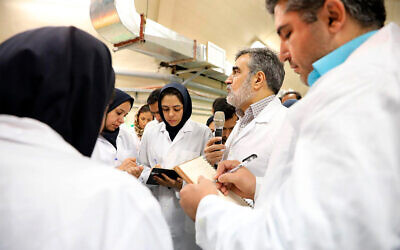
In this photo released by the Atomic Energy Organization of Iran, spokesman of the organization Behrouz Kamalvandi, center, briefs the media while visiting Fordo nuclear site near Qom, south of Tehran, Iran, Nov. 9, 2019. (Atomic Energy Organization of Iran via AP)

Nonetheless, the US special envoy for Iran, Elliott Abrams, told reporters Wednesday that all UN sanctions would “snap back” at 8 p.m. EDT on Saturday.

”We expect all UN member states to implement their member state responsibilities and respect their obligations to uphold these sanctions,” Abrams told reporters.

“If other nations do not follow it,” he said, “I think they should be asked … whether they do not think they are weakening the structure of UN sanctions.”

Iran has responded angrily to the US bid.

“The reality is simple. The US is not a member of the nuclear deal to use the so-called snapback mechanism against Iran; even if the US were a member of the nuclear deal, it could not do the snapback without implementing its nuclear deal undertakings with a good will,” Iran’s Deputy Foreign Minister Mohsen Baharvand said on Wednesday, according to the semi-official Fars News Agency.

Iranian lawmakers have openly said the Islamic Republic will resume its nuclear activities if the sanctions are imposed.

“If the US succeeds in automatically returning the sanctions, then there will be left nothing called the nuclear deal and certainly, the Islamic Republic of Iran will discard the undertakings it was implementing under the nuclear deal,” said MP Zohreh Elahian, a member of Iranian parliament’s National Security and Foreign Policy Commission, according to Fars.

“The parliament is determined to give up the Islamic Republic of Iran’s undertakings under the nuclear deal in case the sanctions are reinstated on Saturday and our country’s peaceful nuclear industry will again continue its activities without limitations of the nuclear deal.”
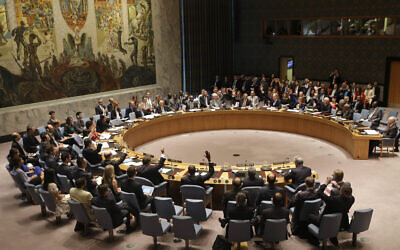
In this July 20, 2015, file photo, members of the Security Council vote at United Nations headquarters on the landmark nuclear deal between Iran and six world powers. (AP/Seth Wenig, File)

UN diplomats said the three European countries remaining in the Joint Comprehensive Plan of Action, or JCPOA, who are all currently Security Council members, will likely respond by issuing a statement reiterating their position that the United States cannot trigger snapback.

Trump administration officials been attacking the 2015 nuclear deal for years. They say it is fatally flawed because certain restrictions on Iran’s nuclear activity gradually expire and will allow the country to eventually develop atomic weapons.

The UN sanctions the US is seeking to reimpose include a ban on uranium enrichment, all missile activity, and the indefinite extension of an arms embargo that would otherwise expire on Oct. 18. The Security Council rejected a US effort to extend the embargo in a lopsided vote that got support from only one country, the Dominican Republic.

Pompeo reiterated Wednesday that Iran “remains the world’s largest state sponsor of terrorism and we don’t believe that them being able to trade in weapons of war with impunity is remotely acceptable.” He called the US decision to reimpose sanctions “good for the peoples of all nations.”

But opposition to the US move is widespread and strong, including from 13 of the other 14 Security Council members.

“Under intl law you can’t withdraw from an agreement and then claim you can still benefit from its provisions. Under ‘rules-based intl order where the rules are defined by the US this seems to be OK provided it serves US interests,” Russia’s deputy UN ambassador Dmitry Polyansky tweeted.

European Union High Representative Josep Borrell, in softer terms, delivered the same message in August saying the United States “cannot be considered to be a JCPOA participant state for the purposes of possible sanctions snapback foreseen by the resolution.”

Times of Israel staff contributed to this report.


Ankara’s aggression has spurred a most unlikely pact

” alt=”Ankara’s aggression has spurred a most unlikely pact” />
(Photo by ADEM ALTAN/AFP via Getty Images)

The monumental accords being signed in Washington between Israel, the UAE and Bahrain represent a new era in Israeli peacemaking. These agreements are being signed with Gulf states and they are a result of shared interests. At the top of the list of Israeli concerns is the Iranian threat. But Turkey’s increasingly aggressive stance in the Mediterranean and across the Middle East is easily overlooked as a catalyst for closer Israeli-UAE relations.

In the last year, Turkey has invaded parts of northern Syria, sent mercenaries to fight in Libya, launched a military operation in northern Iraq, and threatened Greece, Cyprus, Egypt and France. Ankara’s decision to deploy a naval flotilla in the Mediterranean has led to Greek and Egyptian military exercises with the UAE participating in the Greek drill and supporting Egypt in Libya. Increasingly Israel, Greece, Cyprus, Egypt, France and the UAE share concerns about Ankara’s antics.

To understand how Turkey’s role helped bring Israel and the UAE closer together we need to understand how Abu Dhabi and Ankara are on different sides in the Middle East. The UAE is a central ally of Saudi Arabia and together they work closely with Bahrain and Egypt. For instance, when in 2015 Saudi intervened in Yemen’s civil war to fight Iranian-backed Houthi rebels, the UAE played a key supporting role. The UAE also helped the Egyptian-backed general Khalifa Haftar in Libya’s civil war. Turkey backs the opponents of Haftar.

Saudi Arabia, Egypt and the UAE are also the foremost opponents of the Muslim Brotherhood in the Middle East. Erdogan and his AK Party have roots in the Brotherhood. His support for the former Egyptian leader Mohammed Morsi, and its support for Hamas, is linked to a shared Brotherhood background. Ankara hosted Hamas leaders twice this year. Ankara’s increasing religious zeal, demonstrated in the conversion of the Hagia Sophia back into a mosque, is laced with statements about ‘liberating Al-Aqsa mosque’ – the Dome of the Rock – in Jerusalem. This illustrates how Turkey’s regional alliance system is rooted in opposition to Israel while backing groups that are hostile to the UAE as well. Israel’s Mossad has assessed that Turkey’s current regime could be a greater long-term threat than Iran.

Closer to home for the Emirates and Bahrain is the Gulf crisis with Qatar. In 2017, Riyadh led the UAE, Bahrain and Egypt in breaking relations with Qatar. Turkey immediately sent troops to Doha to deter a Saudi invasion. The Qatari crisis has its own complex history but what is important for us to understand two things. The first is that it accelerated existing processes in the Gulf, leading to break in the Gulf Cooperation Council and secondly it causing the UAE and Saudi Arabia to feel threatened by a break in ranks so close to home. With the war in Yemen dragging on and Iranian drones and cruise missiles targeting Saudi Arabia, the UAE became more open to an Israel deal.

Israel is starting to be seen as a potential ally by many Gulf states. Historically the country had trade offices and links in the Gulf dating back to the 1990s. Meanwhile, Saudi promised peace in exchange for Israel’s withdrawal from the occupied Palestinian territories in 2002. What changed Gulf calculations was a sense of Iran’s growing threat during the Obama years and now the emergence of Turkey’s wider role in Libya and Qatar and the support for Hamas in Gaza.

Turkey’s attempt to ride the Palestinian issue, positioning itself as a champion of the cause, could potentially displace Saudi Arabia and Jordan as the leading Islamic countries with a role in Jerusalem. What does that have to do with the UAE? The UAE is Saudi’s main ally and, by quietly approving its outreach to Israel, the Saudis can enable peace without necessarily signing an accord with Israel itself. There is now growing speculation that Saudi will follow Bahrain and the UAE eventually.

This normalisation process has given the UAE and others, backed by the Saudis, a way to regain control of regional policy and to call Iran and Ankara’s bluff. For these Gulf states, it accomplishes several things at the same time: the move improves relations with the United States, leading to weapons deals and other economic goodies. But it can also bring Israel into the Greco-Egyptian alliance over territorial disputes with Turkey. This was reflected in US Secretary of State Mike Pompeo’s trip to Cyprus and the region recently.

Saudi Arabia and the Gulf states could have faced a rising Iranian threat without gambling on peace deals with Israel this quickly. What encouraged them to move more quickly was the increasing role of Turkey and its aggressive moves in Libya, the Mediterranean, Syria, Iraq, Gaza, Jerusalem and now even northern Lebanon.

In an ironic twist of history, it was the Obama administration’s empowering of Iran through the Iran deal and the Trump administration giving Turkey a free hand in northern Syria that helped encourage this Israeli-Gulf alliance. Turkey’s aggressive moves forced its adversaries to come together.

https://www.spectator.co.uk/article/ankara-s-aggression-has-spurred-a-most-unlikely-pact


Iran’s axis worried about Israel-Saudi ties

Five years of Iranian aggression in Syria and Yemen have backfired for Tehran as Israel and Gulf became closer.

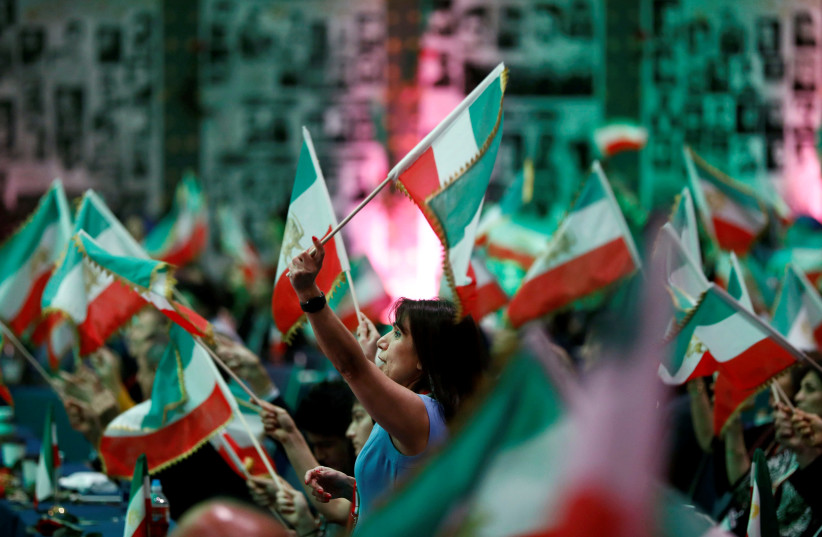
Attendees wave flags as Iranian Americans from across California converge in Los Angeles to participate in the California Convention for a Free Iran and to express support for nationwide protests in Iran from Los Angeles, California, U.S., January 11, 2020. (photo credit: REUTERS/ PATRICK T. FALLON)
Attendees wave flags as Iranian Americans from across California converge in Los Angeles to participate in the California Convention for a Free Iran and to express support for nationwide protests in Iran from Los Angeles, California, U.S., January 11, 2020.
(photo credit: REUTERS/ PATRICK T. FALLON)
Iran is concerned about the next steps Israel and its new Gulf partners will take in the wake of the Abraham Accords signed in Washington on Tuesday.

Tehran’s displeasure is difficult to measure but the overall context and hints in pro-Iranian media give away the sense that the regime in Tehran and its allies and proxies in the Middle East view the potential Saudi-Israel relationship with concern.

Iran has been zig-zagging between hyperbolic condemnation of the UAE and Bahrain for working with Israel, to trying to ignore the setback that its threats have resulted in. Iran’s threats and its attempt to leverage the Iran Deal of 2015 to act with impunity throughout the region fueled the Israel-Gulf relationship.

Iran believed incorrectly that it had a blank check after the JCPOA signing to basically take over the Middle East. It sent drones and missiles in increasing numbers to Yemen in 2015, forcing Riyadh’s hand and brining Saudi Arabia and the UAE into Yemen’s civil war. Saudi Arabia didn’t want an Iranian-backed proxy on its doorstep.

Once Saudi Arabia was in Yemen the Iranians rapidly increased production of technical assistance for the Houthis. Soon ballistic missiles and drones were raining down on southern Saudi Arabia and even targeting Riyadh.

But Iran wasn’t satisfied even with this apparent accomplishment. It targeted the oil pump station at Al-Duadmi in Saudi Arabia in mid-May 2019 using drones allegedly sent to Kataib Hezbollah in Iraq.

Then Iran ordered the Houthis to strike at Shaybah oil field near the UAE border. The attack was a message and it was sent in August 2019.

In September 2019, Iran went one step further using 25 drones and cruise missiles to attack Saudi Arabia’s Abqaiq facility. Iran, for some reason, has believed that the more it attacks Saudi Arabia the more it will pressure Riyadh, but then is surprised that Saudi Arabia and its Gulf allies would become more willing to look to potential talks with Israel.

Similarly Iran began to increase its role in Syria after the Iran deal. This included construction of facilities and support for missile factories in Syria. By the fall of 2017 Iran had agents at Masyaf and other sites, such as Kiswa south of Damascus.

Those sites were targeted by airstrikes in 2018 and 2019. Iran began to pour resources into T-4 base and also the Albukamal border crossing area in 2018.

Airstrikes hit Kataib Hezbollah, an Iranian proxy, in Syria’s Albukamal in June 2018. By 2019 Iran had built a whole base called Imam Ali near Albukamal. In April 2018 Iran even tried to unload a 3rd Khordad air defense system at T-4, according to a Ynet report.

These Iranian projects, trafficking weapons to Hezbollah and building up a footprint in Syria to threaten Israel, while threatening Saudi Arabia from Yemen have been Tehran’s main strategies. Iran also funds Hamas and Hezbollah and Palestinian Islamic Jihad. Riyadh is concerned about Iran’s role in Lebanon, summoning Lebanon Sunni leader Saad Hariri for consultations in 2017.

Now pro-Iranian media, such as Al-Mayadeen, is reporting about potential Saudi-Israel relations. “In the time of normalization there is no place for neutrality, with or against Palestine,” shouts a headline at Al-Mayadeen on September 16. “The day is recorded for those who would compromise,” say the Houthis, according to Fars News reports.

The headlines are the same basically. The Houthis, Hezbollah, Iran, Kataib Hezbollah and all the proxies and pieces and tentacles of the Tehran octopus across the region are being told to repeat the same mantra.

That is why Kataib Hezbollah is mobilizing a protest in Basra, not far from Kuwait and the Saudi border, to show off its strength, according to reports. Basra was the center off Iraq protests for a year demanding more employment and investment. Now the only investment they get is anti-Israel and anti-Saudi propaganda.

Iran’s Tasnim news also reports that, while Saudi Arabia supports the Palestinians, that it could work with Israel in the future. This leaves little doubt that after five years of Iranian attacks and threats and pressure against Israel and Saudi Arabia, that Iran’s main concern is the next moves in Riyadh.

Iran’s Press TV on September 16 says that Saudi Arabia is part of the “plots against Muslims,” and highlights Saudi air raids on Yemen as well as alleged Saudi nuclear facilities and a Saudi challenge to Qatar.

You don’t put five headlines against Saudi Arabia on your site the day after the UAE-Bahrain deal unless that is your main concern.

While Iran wants to downplay the UAE-Bahrain deal in its media, and highlight Saudi Arabia, it quietly knows that it has suffered a setback. Five years of trying to dominate Syria, Lebanon, Iraq and Yemen have encouraged Israel and the Gulf to work more closely and brought the Trump administration’s transactional deal-making foreign policy a string of successes.

Even though Iran has operationalized its lobby in the West to talk about how Iran is “surrounded,” Tehran knows that its aggression has had blowback and potentially backfired. It must now weigh the next step.

Last year it used drone strikes and pushed rocket attacks on US forces in Iraq as well as mining ships in the Gulf of Oman. It still has an expanding drone and missile arm and clandestine networks to move its weapons all across the region.
