Iran backs Hamas and Palestinian Islamic Jihad in Gaza and coordinates closely with them.

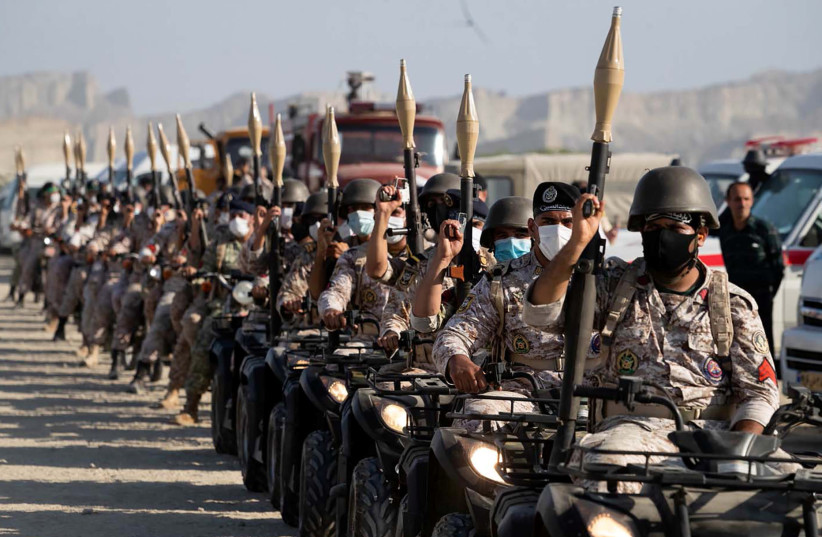
Members of the Iranian Army take part in the annual military drill, dubbed “Zolphaghar 99”, in the Gulf of Oman, Iran on September 7, 2020 (photo credit: WANA NEWS AGENCY/REUTERS)
Members of the Iranian Army take part in the annual military drill, dubbed “Zolphaghar 99”, in the Gulf of Oman, Iran on September 7, 2020
(photo credit: WANA NEWS AGENCY/REUTERS)
Iranian media stressed that rockets were fired at Israel from Gaza during the signing of the peace deals with the UAE and Bahrain. Fars News said that the rocket sirens were heard in Ashkelon and Ashdod “at the same time as Arab, American and Zionists officials gathered at the White House.”

Fars News put the details up quickly on its site online, indicating it was either paying close attention or had advance knowledge of the strikes. Iran’s media sought to highlight the rocket fire immediately to distract from the signing ceremony. Iran backs Hamas and Palestinian Islamic Jihad in Gaza and coordinates closely with them. Fars News said the rockets were fired at the “Zionist settlements of Ashkelon and Ashdod.”
Fars News appeared to claim it had relied on a Reuters and Yediot Ahronot account, but its photos and explanatory text indicated it had done more work on this issue. The Iranian media was interested in the “size of the rocket” used and also Israel’s air defense systems being activated.

Fars News claims that Israel’s assertions that it intercepted the rockets were “not true” and it showed images of a shop allegedly damaged, “two people were injured.” The Iranian media, which is close to the Islamic Revolutionary Guard Corps, stressed that this rocket fire came during the signing of the agreement with the UAE and Bahrain.

This was obvious, and others have drawn the conclusions that the Palestinian armed factions in Gaza did this on purpose directly timed to the speeches of the signing.

However, what is of interest here is that the Iranian media generally tried to ignore the signing. In the past Iran has led the charge in condemnation of the new agreements. It has accused the Gulf states of “betraying” the Palestinians. Iran’s regime has opposed US President Donald Trump’s “Deal of the Century.”

Iran has increased its rhetoric in recent weeks, slamming Bahrain for joining the agreements and hinting that it could try to undermine Bahrain’s leaders or strike at the country. Last September Iran used drones and cruise missiles to attack Saudi Arabia. It has also sent drones and missiles to the Houthi rebels in Yemen.

The Houthis have been increasing attacks on Saudi Arabia. Recent reports in Gulf and Austrian media have accused Qatar of being linked to the Houthis. Qatar also has warm relations with Iran, helps pay salaries in Gaza, has hosted Hamas and is close to Turkey. Turkey, like Iran, has slammed the Israel deals with the Gulf and Turkey’s current leadership has vowed to “liberate Al-Aqsa” in Jerusalem.

In contrast to Fars News, Tasnim news in Iran stressed that Trump might be open to a new Iran Deal, a story based on US media reports. It also stressed pro-Iranian groups support for attacks on US troops in Iraq. It also highlighted Hamas in Gaza condemning the Israeli deal and other issues.

Overall the Iranian coverage indicates that Tehran is paying close attention to the rocket fire on Israel and the deal with the Gulf. It wants to emphasize the role of Hamas. Hamas leaders recently also met Turkey’s President Recep Tayyip Erdogan and Hamas is seeking to increase its clout in Lebanon with a high level delegation staying in Lebanon for weeks. Hamas has also met with Hezbollah. Iran appears to seek to highlight the Hamas role in order to counteract the agreements between Israel and the Gulf.

Al-Mayadeen media, which tends to support Iran and its proxies, also has highlighted the increasing role of Hamas. In general the narrative seems to be that if Israel and the UAE and Bahrain are increasing their connections, then Iran will at least pretend that its friends and allies, such as Hezbollah and Hamas, are increasing their role.

https://www.jpost.com/middle-east/iran-in-the-shadow-of-the-peace-deal-missile-fire-on-israel-from-gaza-642395


Two states, settlements not part of Israel deals with UAE, Bahrain

Israel and UAE commit to tolerance and coexistence for Jews, Christians and Muslims.

L to R: United Arab Emirates (UAE) Foreign Minister Abdullah bin Zayed, Bahrain’s Foreign Minister Abdullatif Al Zayani, Israel's Prime Minister Benjamin Netanyahu and US President Donald Trump stand together after signing of the Abraham Accords. September 15, 2020. (photo credit: REUTERS/TOM BRENNER)
L to R: United Arab Emirates (UAE) Foreign Minister Abdullah bin Zayed, Bahrain’s Foreign Minister Abdullatif Al Zayani, Israel’s Prime Minister Benjamin Netanyahu and US President Donald Trump stand together after signing of the Abraham Accords. September 15, 2020.
(photo credit: REUTERS/TOM BRENNER)
A settlement freeze or two-state solution with the Palestinians are not part of the Abraham Accords Prime Minister Benjamin Netanyahu signed on Tuesday instituting peace and diplomatic relations with the UAE and Bahrain.

The “Treaty of Peace, Diplomatic Relations and Full Normalization Between the United Arab Emirates and The State of Israel” recalls the ceremony in the White House in January, in which US President Donald Trump presented his peace plan and commits the sides to the treaty to “continuing their efforts to achieve a just, comprehensive, realistic and enduring solution to the Israeli-Palestinian conflict.”
It also commits them “to working together to realize a negotiated solution to the Israeli-Palestinian conflict that meets the legitimate needs and aspirations of both peoples, and to advance comprehensive Middle East peace, stability and prosperity.”
The preamble also recalls Israel’s peace treaties with Egypt and Jordan, neither of which calls for a two-state solution.
Earlier Tuesday, UAE Minister of State for Foreign Affairs Anwar Gargash said a Palestinian state was referenced in the Abraham Accords, in that it refers to previous signed agreements. However, the peace treaty with Egypt called for Palestinian autonomy, and the treaty with Jordan tied peace to the continuation of the Oslo process, which did not explicitly include the establishment of a Palestinian state.
The “Declaration of Peace, Cooperation, And Constructive Diplomatic and Friendly Relations” between Israel and Bahrain, which is only one page long, simply states that they will continue “the efforts to achieve a just, comprehensive and enduring resolution of the Israeli-Palestinian conflict.”
Neither agreement mentioned that Israel would be suspending its plans to extend sovereignty to parts of Judea and Samaria, though Netanyahu has publicly admitted that is the case, nor did they call to freeze construction in Israeli communities in those areas, as had previously been rumored.
Also not mentioned in the agreement were any arms sales, including F-35 jets that the UAE seeks to purchase, while the Israeli position is that doing so would threaten its qualitative military edge in the Middle East, an advantage guaranteed under US law.
The declaration signed by Netanyahu and Bahrain Foreign Minister Abdullatif Al Zayani states that they agreed to establish full diplomatic relations and work together on security, while advancing peace and coexistence.
In addition, Bahrain and Israel plan to draw up agreements in the coming weeks on investments, tourism, direct flights, telecommunications, technology, energy, healthcare, culture, the environment and more, in addition to the reciprocal opening of embassies.
The Israel-UAE document is seven pages long and includes a commitment to interfaith tolerance in the Middle East.
“Recognizing that the Arab and Jewish peoples are descendants of a common ancestor, Abraham, and inspired, in that spirit, to foster in the Middle East a reality in which Muslims, Jews, Christians and peoples of all faiths, denominations, beliefs and nationalities live in, and are committed to, a spirit of coexistence, mutual understanding and mutual respect,” the treaty reads.
Another article in the treaty calls for the sides to work “in the spirit of their common ancestor, Abraham” to foster coexistence and respect through programs, such as interfaith dialogue and cultural and academic exchanges.
The treaty also features Tuesday’s date according to the Jewish, Muslim and Christian calendars.
The sides agreed to establishing peace, diplomatic relations and normalization, to exchanging ambassadors and opening embassies, and cooperating in various spheres, including finance and investment, civil aviation, consular services, innovation trade and economic relations, health care, science, technology and “peaceful uses of outer-space,” fester, education and more. The agreement included 13 annexes briefly outlining cooperation on on a broad range of topics.
As for Netanyahu’s commitment to bring the matter to the government and Knesset, the treaty states that it “shall be ratified by both Parties as soon as practicable in conformity with their respective national procedures and will enter into force following the exchange of instruments of ratification.”
All four parties signed “The Abraham Accords Declaration,” an umbrella agreement and more general declaration of intent, which the US hopes more Arab countries will join.
The declaration calls to strengthen “peace in the Middle East based on mutual understanding and coexistence, as well as respect for human dignity and freedom, including religious freedom.”
It also encourages the promotion of interfaith and intercultural dialogue “to advance a culture of peace among the three Abrahamic religions and all humanity.”
The relevant parties signed three copies of each agreement, in English, Hebrew and Arabic. During the ceremony, UAE Foreign Minister Abdullah bin Zayed asked Netanyahu to show him where to sign in the Hebrew document, and Netanyahu asked him for help with the Arabic version in return.


Iran building new centrifuge production site, state TV says

Tehran’s nuclear chief says work has already begun on facility to replace Natanz, damaged in mysterious July 2 explosion

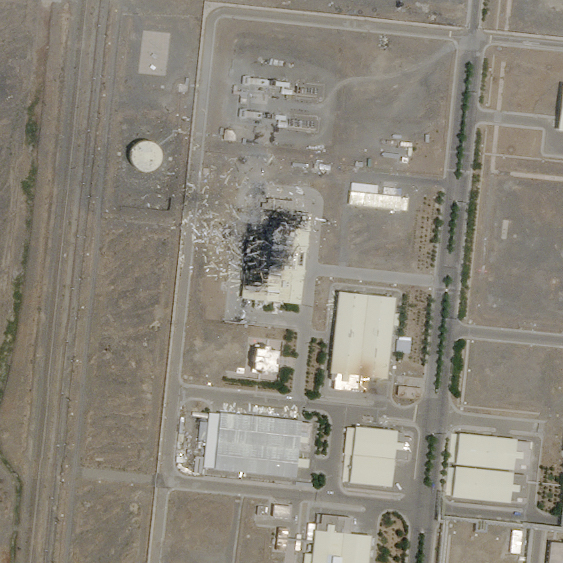
The aftermath of an explosion and a fire at an advanced centrifuge assembly plant at Iran's Natanz nuclear site, July 5, 2020. (Planet Labs Inc. via AP)
The aftermath of an explosion and a fire at an advanced centrifuge assembly plant at Iran’s Natanz nuclear site, July 5, 2020. (Planet Labs Inc. via AP)

Iran said Tuesday it is building a sophisticated new building near its underground Natanz nuclear site, state TV reported.

The report quoted Ali Akbar Salehi, head of the country’s nuclear agency, as saying the new structure is being built in the wake of a July explosion that damaged a building that housed centrifuge machines.

“Regarding the evil action and sabotage that was carried out, it has been decided to establish a more modern, wider and more comprehensive hall to be constructed in the heart of the mountains around Natanz,” Salehi was quoted as saying.

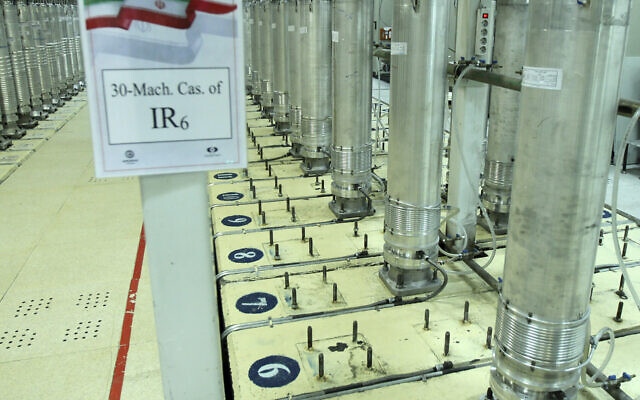
Natanz hosts the country’s main uranium enrichment facility. In its long underground halls, centrifuges rapidly spin uranium hexafluoride gas to enrich uranium.

Iranian Atomic Energy Organization head Ali Akbar Salehi at a news conference at the European Commission headquarters in Brussels, November 26, 2018. (Francisco Seco/AP)

Salehi said construction of the new building “has already begun.”

On Sunday, Iran said it had found those who were involved in the alleged sabotage, but said details will be released later.

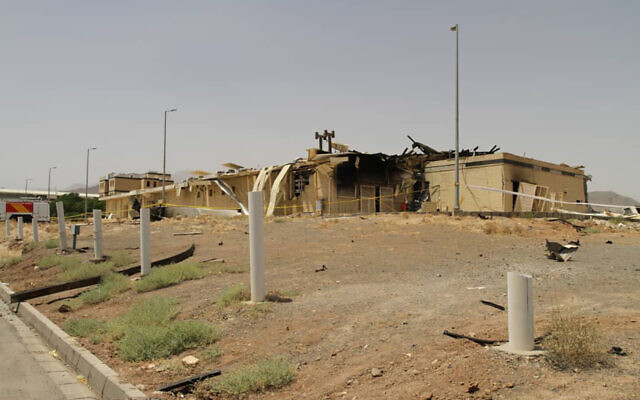
The July 2 explosion, which foreign media reports have attributed to Israel or the US, damaged an advanced centrifuge development and assembly plant. Atomic Energy Organization of Iran spokesman Behrouz Kamalvandi said this week that it did not interrupt operations but has vowed that Iran would respond if international actors were found to be behind the explosion.

In July Iranian news website “Didban Iran” (“Iran Watch”), tied to the country’s intelligence ministry, reported the Islamic Revolutionary Guard Corps had concluded that the instigator of the blast was Ershad Karimi, a contractor at the site who owns a company, MEHR, that supplies precision measuring equipment.

Centrifuge machines in the Natanz uranium enrichment facility in central Iran, November 5, 2019. (Atomic Energy Organization of Iran via AP, File)

According to a New York Times report, the blast was most likely the result of a bomb planted at the facility, potentially at a strategic gas line. The report did not rule out the possibility that a cyberattack was used to cause a malfunction that led to the explosion.

The explosion was one of a series of mysterious blasts at Iranian strategic sites around the same time, which were largely attributed to either Washington, Jerusalem, or both.

Reports last month indicated Iran has been moving to boost uranium enrichment at Natanz. A document from the International Atomic Energy Agency cited by the Bloomberg news agency said new advanced centrifuges were being moved from a pilot facility to a new area of the nuclear facility.

The move appeared to violate the 2015 nuclear agreement Iran signed with world powers, and may show that the alleged sabotage at the plant did not significantly set back Iran’s nuclear program. It also suggested the damage to Natanz was not as severe as first believed.

Under the nuclear accord, officially known as the Joint Comprehensive Plan of Action, Iran committed to limiting its nuclear program in exchange for sanctions relief.

This photo released July 2, 2020, by the Atomic Energy Organization of Iran, shows a building after it was damaged by a fire, at the Natanz uranium enrichment facility some 200 miles (322 kilometers) south of the capital Tehran, Iran. (Atomic Energy Organization of Iran via AP)

But the JCPOA has been on life support since the US withdrew from it and reimposed unilateral sanctions in 2018.

Iran has since taken small but escalatory steps away from compliance with the agreement, as it presses for the sanctions relief it was promised. Some of those steps are believed to have been at the Natanz nuclear site.

The US is currently engaged in a likely-doomed bid to renew international sanctions against Iran at the UN, despite Trump’s withdrawal from the accord.

The IAEA says Iran enriches uranium to about 4.5% purity — above the terms of the nuclear deal but below weapons-grade levels of 90%. Workers there also have conducted tests on advanced centrifuges, according to the IAEA.