Egypt praises, Iran & Palestinians slam Bahrain over Israel ties

Iran said Bahrain was now a partner to the “crimes of the Zionist regime” which threatens the security of the region and the world of Islam.” The Palestinians called Bahrain’s action a “betrayal.” Egyptian President Abdel Fattah el-Sisi said it was an “important step” that would help establish “stability and peace in the Middle East, in a way that achieves a just and permanent settlement of the Palestinian issue.”

Turkey denounced Bahrain for its decision to establish diplomatic relations with Israel as a blow to efforts to defend the Palestinian cause. Jordan’s foreign minister Ayman Safadi said that the necessary steps to achieve a fair and comprehensive peace in the region should come from Israel, which must stop undermining the two-state solution and end illegal occupation of Palestinian lands.

https://www.debka.com/mivzak/egypt-praises-iran-palestinians-slam-bahrain-over-israel-ties/


US president issues warning after reports say Tehran plotting revenge for US killing of top general Qassem Soleimani


US President Donald Trump speaks to reporters as he arrives at Sacramento McClellan Airport, in McClellan Park, California, September 14, 2020. (AP Photo/Andrew Harnik)

US President Donald Trump speaks to reporters as he arrives at Sacramento McClellan Airport, in McClellan Park, California, September 14, 2020. (AP Photo/Andrew Harnik)

US President Donald Trump threatened Iran on Monday over reports it was plotting revenge for the US killing in January of top Iranian general Qassem Soleimani.

“According to press reports, Iran may be planning an assassination, or other attack, against the United States in retaliation for the killing of terrorist leader Soleimani,” Trump wrote on Twitter.

“Any attack by Iran, in any form, against the United States will be met with an attack on Iran that will be 1,000 times greater in magnitude!” he warned.

The Politico news site reported on Sunday that Iran was planning to assassinate the US ambassador to South Africa, Lana Marks.

The article, citing US intelligence reports seen by a US government official and another official familiar with the documents, said that Marks was likely chosen due to her closeness to Trump.

Iran dismissed the allegation.

Iran already retaliated for Soleimani’s killing in January, firing missiles at a US base in Iraq, to which the US did not respond. However, the killing of a US ambassador would likely push an already tense region to war.

US officials have said that Tehran was likely to seek to further avenge Soleimani’s death.

Marks, 66, a Palm Beach, Florida-based luxury fashion and handbag designer, is a long-time friend of the US president and was a member of Trump’s exclusive Mar-a-Lago club in Florida before she was appointed ambassador in 2018.

Marks was born and raised in South Africa and was CEO of the Lana Marks Collections design firm, which caters to celebrities. Born Lana Banks, she grew up in the city of Port Elizabeth, where here family were prominent members of the city’s Jewish community.

In this 2012 file photo, Lana Marks and her husband, Dr. Neville Marks, are shown at the 2012 Mental Health Association of Palm Beach County, Inc. Bell Society Dinner at The Colony Hotel in Palm Beach, Fla. (Meghan McCarthy/Palm Beach Post via AP)

Trump ordered the drone strike in Iraq on January 3 that killed Soleimani, the head of the extraterritorial Quds Force of the Iranian Revolutionary Guard Corps and one of Iran’s most powerful officials. At the time, Trump said Soleimani was planning attacks against US troops in the region but White House officials have since given different justifications for the killing, including deterrence.

In response to the drone strike, Iran fired volleys of ballistic missiles at Iraqi bases housing US troops. There were no reported casualties at the time but it has since been revealed that dozens of soldiers developed brain injuries from the blasts.

However, the Politico report said that Iran still sought further revenge and was considering several targets, including the killing of Marks.

It said Marks had been informed of the threats against her, which reportedly involved the Iranian embassy in South Africa.

The report said that US officials have been aware of a general threat against Marks since the spring, but the threat had become more specific in recent weeks.

The report also noted that Iran runs a clandestine operation in South Africa and Marks may be more vulnerable than envoys in other countries, where the US has better security coordination with local authorities.

The strike on Soleimani exacerbated already high tensions between the US and Iran, which have been steadily escalating since Trump withdrew Washington from the 2015 nuclear accord. The agreement, negotiated under the US administration of Barack Obama, had imposed restrictions on Iran’s nuclear program in exchange for the lifting of international sanctions.

Mourners holding posters of Iranian general Qassem Soleimani attend a funeral ceremony in Tehran, Iran, January 6, 2020. (AP Photo/Ebrahim Noroozi)

The US has since imposed crippling sanctions on Iran, including its vital oil and gas industry, pushing the country into an economic crisis that has ignited several waves of sporadic, leaderless protests.

Open action by Iran against the US would be a significant departure from the usual methods of the Islamic Republic, which in the past has preferred to use regional proxies to see through its plans.

Iran-backed terror groups have often targeted civilians.

One such case was the 2012 Lebanese Hezbollah terror group attack on Israeli tourists in Bulgaria in revenge for the killing by Israel of one of the Iran-backed group’s leaders.

Iran’s Foreign Ministry on Monday denied the Politico report. “Such baseless remarks are part of the Trump administration’s counter-intelligence campaign against Iran. The US regime’s resort to allegations and lies against Iran on the threshold of the US presidential election and concurrent with its pressures to use the UN Security Council mechanisms with the aim of increasing pressure on the Iranian nation was predictable,” Foreign Ministry Spokesman Saeed Khatibzadeh said, according to the semi-state Fars news site.


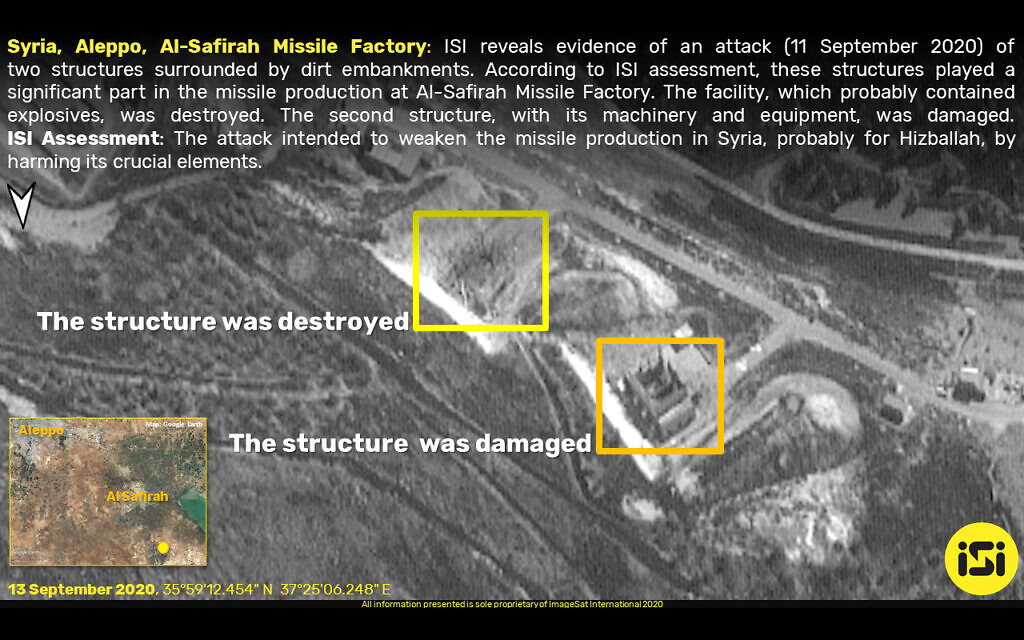
Satellite images show one building completely destroyed, another damaged following last week’s reported bombing near Aleppo


The results of a reported Israeli airstrike on a missile production in the town of al-Safira, outside Aleppo, in northern Syria on September 11, 2020. (ImageSat International)

The results of a reported Israeli airstrike on a missile production in the town of al-Safira, outside Aleppo, in northern Syria on September 11, 2020. (ImageSat International)

A reported Israeli airstrike on Friday targeted a missile production facility outside Aleppo, completely destroying one building and damaging another, according to satellite images released by a private Israeli intelligence firm.

“The attack intended to weaken missile production in Syria, probably for Hezbollah, by harming its crucial elements,” said the company, ImageSat International, which specializes in satellite imagery analysis.

The strike was said to target the Syrian regime’s missile factory in al-Safira, outside Aleppo, in northern Syria.

The Israel Defense Forces did not comment on the reported strikes, in accordance with its longstanding policy to neither confirm nor deny its activities in Syria.

The Aleppo region, near the Syrian border with Turkey, is an uncommon — but not unprecedented — site for reported Israeli airstrikes.

According to ImageSat, the two buildings that were hit in the strike “played a significant part in the missile production at the al-Safirah Missile Factory.”

The results of a reported Israeli airstrike on a missile production in the town of al-Safira, outside Aleppo, in northern Syria on September 11, 2020. (ImageSat International)

Satellite images taken on Sunday showed at least some of the damage caused by the strike. One building, which ImageSat said likely contained explosives, was completely leveled in the attack. The second building sustained significant damage.

Israel rarely publicly confirms details of its operations in the country, but has long maintained that it would take action against Iran’s military presence in Syria and efforts to supply terror groups in the region with advanced munitions.

Israel has launched hundreds of strikes in Syria since the start of the civil war in 2011. It has targeted government troops, allied Iranian forces, and fighters from the Lebanese Shiite terror group Hezbollah.

Earlier this month, the Syrian SANA state news agency said that the Israeli military launched missiles at targets near the central city of Homs.

The results of a reported Israeli airstrike on the Damascus International Airport on August 31, 2020. (ImageSat International)

According to the SANA, Israeli jets fired “a burst of missiles” at the T-4 Syrian military airbase, the largest in the country, at 10:23 p.m., from the area of al-Tanf, a US-controlled region of Syria near the Iraq border.

A Syrian opposition group claimed that the strike killed 16 Iran-backed fighters.

The Israeli military has long maintained that the T-4 base, also known as Tiyas base, is being used by Iran to move weapons throughout the region, including to Hezbollah, and to conduct its own operations.

The reported strikes on September 2 came two days after Israel was said to have launched missiles at targets in Syria’s south, killing at least two Syrian soldiers. A Syrian civilian woman was also reportedly killed when a Syrian military anti-aircraft missile struck her home.

That reported strike appeared to be the first by Israel on targets in Syria since a July 20 attack in which a Hezbollah fighter was killed, prompting the Lebanese terror group to vow revenge for his death and sparking as-yet-unresolved tensions.