
Iran says 1,044 centrifuges now active at underground plant

Tehran announced resumption of enrichment at Fordo site last November in a further step away from 2015 nuclear accord abandoned by Washington in May 2018
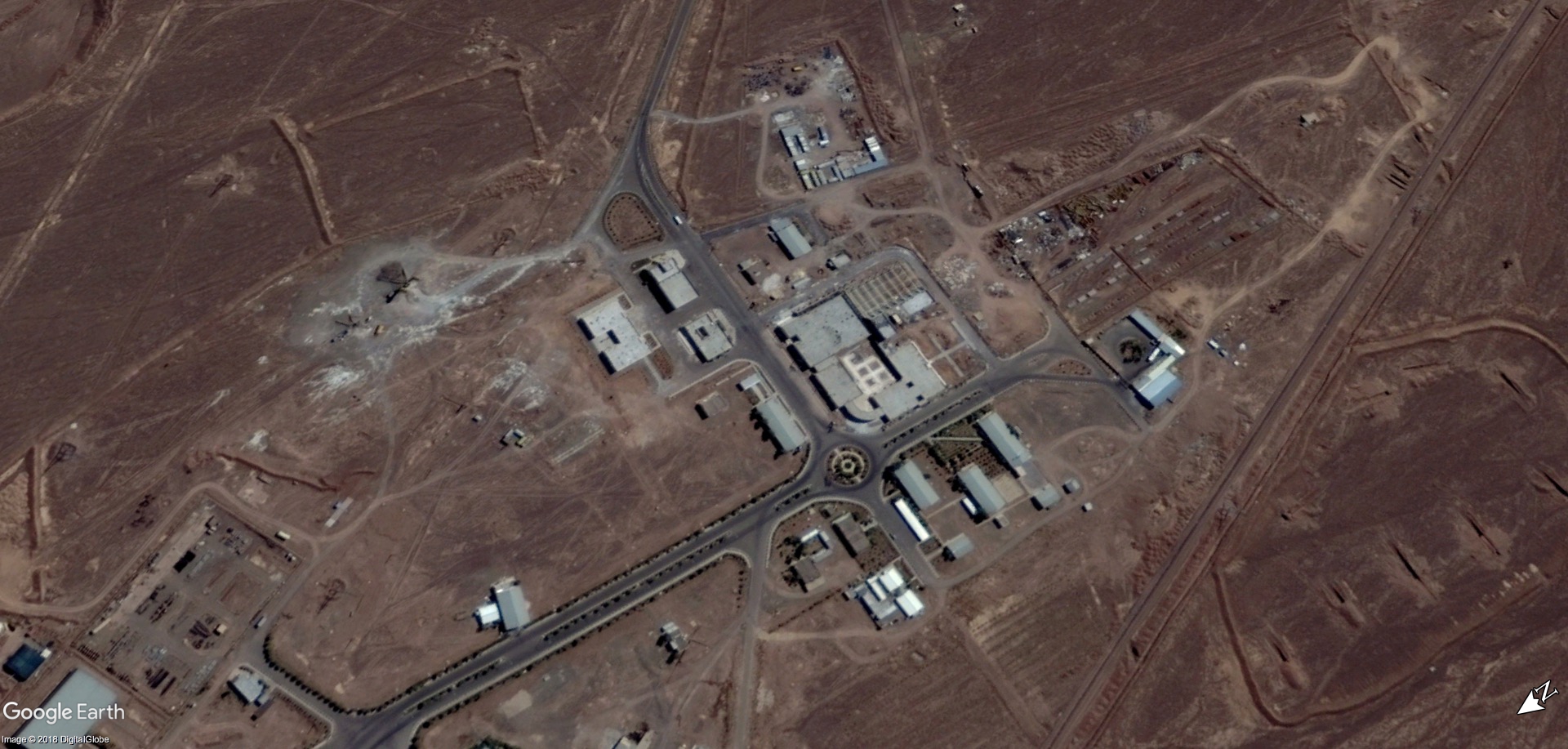
 

A satellite image from September 15, 2017, of the Fordo nuclear facility in Iran. (Google Earth)

A satellite image from September 15, 2017, of the Fordo nuclear facility in Iran. (Google Earth)

TEHRAN, Iran — The head of Iran’s atomic agency said Sunday that 1,044 centrifuges were active at the Fordo uranium enrichment plant, in line with steps to reduce its commitments to the nuclear deal.

The suspension of all enrichment at the underground facility near the Shiite holy city of Qom was one of the restrictions on Iran’s nuclear activities that it accepted in return for the lifting of international sanctions in the 2015 accord.

Tehran first announced the resumption of enrichment at Fordo last November, the fourth phase of its push since May 2019 to progressively suspend commitments to the deal.

It was in retaliation for Washington’s abandonment of the accord in May 2018, followed by its unilateral reimposition of sanctions on Iran.

“Currently 1,044 centrifuges are enriching at Fordo,” Ali Akbar Salehi, the head of Iran’s atomic agency, told the Iranian parliament’s news agency ICANA.

In this photo released Novenber 4, 2019 by the Atomic Energy Organization of Iran, its head Ali Akbar Salehi speaks with the media while visiting the Natanz enrichment facility in central Iran. (Atomic Energy Organization of Iran via AP)

“We were committed in the JCPOA that these 1,044 machines do not carry out enrichment, but it is being done per dropped commitments as much as needed and we will stockpile the enriched material, too,” he added, referring to the accord’s official name, the Joint Comprehensive Plan of Action.

Iran’s other walk-back steps included exceeding the accord’s restrictions on enriched uranium reserves and enrichment level, development of advanced centrifuges, and foregoing a limit on its number of centrifuges.

In a joint statement in November, Britain, France, Germany and the European Union said Iran’s decision to restart activities at Fordo was “inconsistent” with the 2015 deal.

The parties to the accord have called on Iran to return to its commitments, but Tehran insists the steps can be reversed once its economic benefits from the deal are realized.

The United Nations’ nuclear watchdog said on September 4 that Iran’s stockpile of enriched uranium now stands at more than 10 times the limit set down in the deal.

Tensions between Tehran and Washington have escalated since the US pulled out of the deal.


US, Iran to battle over sanctions at International Court of Justice

Opening week arguments to focus on whether UN’s top justice forum has jurisdiction to rule on Tehran’s claim against Washington; final judgement will take years


Judges take their seats prior to reading the court's verdict as delegations of Iran and the US listen at the International Court of Justice, or World Court, in The Hague, Netherlands, February 13, 2019.

Illustrative: Judges take their seats prior to reading the court’s verdict as delegations of Iran and the US listen at the International Court of Justice, or World Court, in The Hague, Netherlands, February 13, 2019.

The HAGUE, Netherlands (AFP) — The United States and Iran will face off at the UN’s top court on Monday in the latest round of a battle over sanctions on Tehran reimposed by US President Donald Trump.

Tehran dragged Washington to the International Court of Justice (ICJ) in The Hague in 2018 after Trump pulled the US out of a landmark international nuclear deal with Iran.

They will argue over the coming week about whether the court, set up after World War II to deal with disputes between UN member states, actually has jurisdiction in the case.

Iran says the sanctions brought back by the Trump administration breach the 1955 “Treaty of Amity” between the two countries, signed long before the 1979 Iranian revolution severed ties.

In this photo released by the official website of the office of the Iranian Presidency, President Hassan Rouhani, left, talks with his Minister of Health and Medical Education Saeed Namaki during a meeting in Tehran, Iran, Saturday, July 4, 2020. (Iranian Presidency Office via AP)

Tehran won an early victory in October 2018 when the ICJ ordered sanctions on humanitarian goods to be eased as an emergency measure while the overall lawsuit is dealt with.

The US responded by formally ending the treaty, agreed when Iran was ruled by the Western-oriented shah, and accusing Iran of using the ICJ for “propaganda” purposes.

The United States will first address the court on Monday at 1300 GMT about whether judges have jurisdiction in the case, while Iran will speak on Wednesday.

A decision on that issue could take several months, while a final judgment will take years.

‘Unclean hands’

Relations between Washington and Tehran have been tense since the Iranian revolution, and have spiraled since Trump unilaterally pulled out of the nuclear deal in May 2018.

The deal, involving the five permanent members of the UN Security Council — Britain, China, France, Russia and the United States, plus Germany — had limited Iran’s nuclear program to prevent it from producing a weapon.

Trump in pulling out of the deal, signed by his predecessor Barak Obama, said it did not go far enough in limiting Iran’s potential for nuclear weapons development.

Washington then reimposed sanctions on Iran and companies with ties to it, notably hitting Iran’s vital oil sector and central bank, while major global firms halted their activities in Iran.

US President Donald Trump speaks during a news conference at the White House in Washington, September 10, 2020. (AP Photo/Susan Walsh)

Tehran took the case to the ICJ and, in response to Iran’s request for so-called “provisional measures” while the case is resolved, the judges two years ago found that some of the sanctions breached the 1955 treaty.

The court ordered Washington to lift measures on medicines, medical equipment, food, agricultural goods, and airplane parts and services.

The ICJ is also dealing with a separate case over Tehran’s bid to unfreeze $2 billion in assets frozen in the United States.

In February 2019 the court said the case could go ahead, rejecting US arguments that Iran’s “unclean hands” — Tehran’s alleged backing for terror groups — should disqualify its lawsuit.


MNA – Referring to an upcoming Iran, China, China, and Russia joint exercise, Iran’s Navy Commander said that this 3 world powers’ joint effort conveys the message that they are capable to influence the equations of the World.

While speaking in an IRIB TV program, Iran’s Navy Commander Rear Admiral Hossein Khanzadi made some remarks over Iran’s current naval status.

He referred to the reflection of the recent Zolfaghar 99 war game in foreign media, in which one US plane and two drones, that had violated the law and entered the Iranian Air Defense Identification Zone (ADIZ) illegally, were intercepted by homemade Karrar drone, stressing that the important point about this inspiring military exercise is that despite all pressures and sanctions, the Islamic Republic of Iran has accomplished high-tech equipment in defense fields.

This exercise conveys the message that any threats and mischievous acts to Iran will be responded firmly, he added.

He went on to say, “Being the world’s center of energy (Fossil Fuel), the eastern waters of the Strait of Hormuz, Makran coast, Oman Sea and North part of India Ocean in which three-day exercise was carried out enjoys some global and geopolitical features in terms of the size and strategic waterways.”

As all vessels that import oil and goods to Iran must pass through the maritime passages in the region, therefore Iran attaches great importance on providing its sea borders with security, he said and added, “In Zolfaghar 99 war game we practiced how to establish security, peace, and authority in the area.”

Iran’s Navy Commander also seized the chance to announce the Iranian nation that in the upcoming future, Iran’s Armed Force will be equipped with some new, high-tech drones and defense equipment.

Elsewhere in his remarks, he referred to a joint exercise by Iran, China, and Russia which will be carried out in the near future, stressing that this joint effort among these 3 world powers conveys a message that Iran, China, and Russia are capable to influence all equations of the world.

Addressing the countries who have the illusion of unipolarity and self-managing in the world, Khazandi asserted that the joint effort by Iran, China, and Russia will show that the world is moving towards multipolarization.

https://theiranproject.com/blog/2020/09/13/iran-china-russia-joint-exercise-to-influence-world-equation-navy-commander/
