
Iran and Turkey ostensibly back different sides in Syria, but in recent years they have grown closer due to joint opposition to the US and also Israel. Iran and Turkey both back Hamas, for instance.

President Vladimir Putin of Russia, Hassan Rouhani of Iran and Tayyip Erdogan of Turkey meet in Tehran, Iran September 7, 2018. (photo credit: REUTERS)
President Vladimir Putin of Russia, Hassan Rouhani of Iran and Tayyip Erdogan of Turkey meet in Tehran, Iran September 7, 2018.
(photo credit: REUTERS)
Pro-government media in Turkey widely embraced the recent talks between Ankara and Tehran. They are at least the sixth round of such talks that have generally been held in the framework of discussing Syria.

Iran and Turkey ostensibly back different sides in Syria, but in recent years they have grown closer due to joint opposition to the US and also Israel. Iran and Turkey both back Hamas, for instance.

They share a regional worldview on many issues. They are increasingly cooperation now against Kurdish dissident groups.

The Iran-Turkey emerging warm relationship runs counter to the ideas that have been put forward by commentators, think tanks, experts and strategists that have divided the Middle East into sectarian camps of “Sunni” and “Shi’ite.”

This paradigm arose only in the last decades, whereas before the region was portrayed as divided into other camps, such as nationalist regimes or pro-Soviet regimes and those closer to the US.

The sectarian divide was fanned due to conflicts in places like Iraq and Lebanon. Groups like ISIS did target Shi’ites for extermination. In Pakistan and Afghanistan it is common for Sunni extremist groups to target Shi’ites as well.

Iran’s alliance system is largely based not only in Shi’ite communities in Lebanon and Iraq, but also other non-Sunni groups, such as the Syrian regime leadership. The mass sectarian violence in Iraq after the US invasion in 2003 appeared to show that the region would split along religious lines. A decade and a half later things are not so simple.

One of the issues with the “Sunni vs Shia” analysis was that it created a concept whereby western countries were supposed to ally with “Sunnis” against Iran, or in the opposite when embracing the Iran deal, they were supposed to go soft on Hezbollah and the Assad regime to please Iran and “confront” the former “Sunni Arab leaders” in places like the Gulf.

This simplistic binary was posited as a way for policymakers to approach the region. These ideas that Middle East conflicts were rooted in religious issues going back to the 8th century led to comments by leaders such as US President Barack Obama about conflicts going back “millennia” in the Middle East, a comment he was critiqued for in 2016.

US President Donald Trump appeared to channel the same view in a speech to West Point graduates in June when he said it was not the duty of the US to solve “ancient conflicts in faraway lands.”

When it comes to Turkey and Iran this lens of “ancient conflict” is often at play. We are told that Turkey and Iran cannot get along because one is the descendant of the Ottoman Empire and the other the Persian Empire. One is Sunni and led by a pro-Muslim Brotherhood party and the other is a Shi’ite revolutionary Islamic “republic.”

The rhetoric coming out of Tehran and Ankara doesn’t sound like Persia vs. Ottomans and Shia vs. Sunni. In the opposite, Turkey today embraces Iran and pushes for “dialogue with Iran to find possible solutions to problems in their shared region,” Turkey’s President indicated, according to Anadolu in Turkey. “Dialogue between Turkey and Iran has played a determinant role in resolving many regional problems,” Turkey regime leader Recep Tayyip Erdogan, said at the sixth meeting of the Turkey-Iran High-Level Cooperation Council.

Iran’s Hassan Rouhani agreed: “I believe our cooperation will return to its previous levels as the epidemic subsides.”

Let’s compare this to the daily dose of Iranian regime views of other states, like the US, Israel or Saudi Arabia, or Turkish media daily attacks on France, the US, Israel and other countries. Iran’s supreme leader said this week that “Zionists and arrogant powers anti-Islamic policies are behind such hostile moves…to divert West Asian nations and states attention away from evil plots US and Zionist regime are hatching for the region.”

Turkey’s foreign minister has said Europe is “racist spoiled children” who should “know their place.” Ankara has compared several European countries to Nazi regimes and daily threatens Greece, comparing a future battle with Greece to the defeat of Greeks in wars 100 years ago. One would have to go back many years to find similar insults by Turkey directed at Iranian regime leaders.

For some policymakers in the West there is a theory that Turkey is a natural ally against Iran and that this Sunni-Shia divide can be somehow exploited and that these countries are destined to clash.

However, both Turkey an Iran today have media that is basically state controlled. In Turkey people are imprisoned for critiquing the president, critiquing Ankara’s recent wars or even making fun of TV shows.

This means almost all Turkish media in Turkey today reflects the views of the AK Party that is in power. That media is warm towards Iran. The same is true of Iranian media.

Gone are the days when Turkey’s media would critique Iranian-backed groups in Iraq or when Iran would call Turkish-backed groups “takfiri militants.”

That doesn’t mean Iran and Turkey see eye-to-eye on Syria. It means that they have agreed to partition part of Syria and Iraq into spheres of influence. Iran sees Iraq as its “near abroad” and Turkey sees northern Syria and northern Iraq as its “near abroad.” Both regimes are intensely hostile to Israel and Saudi Arabia and Ankara has grown hostile to the US, embracing Russia. Iran and Turkey are both growing closer to China.

Together Turkey, Iran, Qatar and Malaysia have also worked on discussions about a new “Islamic currency” and other solutions to global “Islamic” issues. Turkey speaks frequently about the Islamic “ummah” or community, as does Iran, and both countries seek to “liberate Al-Aqsa,” a reference to Jerusalem’s Islamic holy sites.

The Hamas connection, whereby both are supported of Hamas, represents the way that Turkey, Iran, and to an extent Qatar as well, are now a regional alliance that is emerging. In some places these allies come up against each other potentially, such as in Iraq or Syria, or Lebanon.

But they generally share more than divides them now. For instance Turkey wants a foothold in Lebanon. It will work within the Sunni community. Iran has a foothold.

Both want to weaken the pro-Saudi Sunni elements of Lebanon. That is how they work together. They don’t agree on all things, but they both work with Russia and Hamas, and they both dislike Israel and the US, and they both prefer to carve up the region into spheres of influence to weaken Saudi Arabia and the UAE.

Whether the current Turkey-Iran honeymoon will last, or whether it is a temporary alliance of convenience that will inevitably fall apart as they grow stronger, remains to be seen. However, the old paradigm of seeing the Middle East solely through the sectarian lens has been upended by the realities on the ground.

The sectarian killings have been reduced and just as the Cold War regimes morphed into something else, so these conflicts are morphing as well. The key question now is whether Ankara might even go one step further and begin to put out feelers to groups such as Hezbollah or the Houthis to discuss how they might work together against Israel or Saudi Arabia.


Israel, UAE to sign deal at White House ceremony next Tuesday

Israeli delegation to be led by Netanyahu, who says he is ‘proud’ to attend event; Emirati FM bin Zayad, brother of crown prince, said to represent UAE


National Security Adviser Meir Ben-Shabbat elbow bumps with an Emirati official ahead of boarding the plane before leaving Abu Dhabi, United Arab Emirates, September 1, 2020. (Nir Elias/Pool/AFP)

National Security Adviser Meir Ben-Shabbat elbow bumps with an Emirati official ahead of boarding the plane before leaving Abu Dhabi, United Arab Emirates, September 1, 2020. (Nir Elias/Pool/AFP)

Israel and the United Arab Emirates will sign their historic deal normalizing relations at a White House ceremony on September 15, a senior White House official confirmed to The Times of Israel on Tuesday.

US officials said senior delegations from both countries would likely be led by Prime Minister Benjamin Netanyahu and Emirati Foreign Minister Abdullah bin Zayad, the brother of the Abu Dhabi crown prince.

The officials, who were not authorized to discuss the matter publicly and spoke on condition of anonymity, said the ceremony would either be held on the South Lawn, the Rose Garden or inside, depending on weather.

Netanyahu’s office issued a statement in the premier’s name on Tuesday evening confirming his attendance. “I am proud to travel to Washington next week, at the invitation of President Trump, and to attend the historic White House ceremony establishing the peace agreement between Israel and the United Arab Emirates,” the prime minister said.

US President Donald Trump, seated, holds up a signed proclamation recognizing Israeli sovereignty on the Golan Heights, alongside Israeli Prime Minister Benjamin Netanyahu, standing center, in the Diplomatic Reception Room at the White House in Washington, DC, March 25, 2019. (Saul Loeb/AFP)

Senior UAE official Hend al-Otaiba also issued a statement confirming Bin Zayed’s attendance, adding that the ceremony “will be a momentous occasion in the histories of our two countries and the region.”

Numerous Arab diplomats, including from countries that don’t have formal ties with Israel, are expected to attend the ceremony, in a bid to show that the agreement enjoys widespread support, the Walla news site reported.

The ceremony will come just a month after the agreement to establish full diplomatic relations was announced on August 13. The deal delivered a key foreign policy victory to US President Donald Trump as he seeks reelection, and reflected a changing Middle East in which shared concerns about archenemy Iran have largely overtaken traditional Arab support for the Palestinians.

According to Walla, Israel and the US are still working toward a diplomatic breakthrough with another Arab state before the signing ceremony, though it is unclear if this will be possible.

While officials in Israel and the US claimed in the wake of the UAE announcement that another country or more would follow within days or weeks, those expectations have dampened. Other Arab states reportedly in talks with Israel have shown reluctance for anything stronger than a goodwill gesture, instead insisting that a peace deal with the Palestinians preclude any normalization.

The initial Israel-UAE normalization deal announcement was followed by the first direct commercial flight between the countries, the establishment of telephone links and commitments to cooperate in numerous areas.

The United Arab Emirates is reportedly planning on sending an official delegation to Israel on September 22 to further advance the normalization efforts. The delegation will be “in reciprocation” for a trip to Abu Dhabi last week by senior Israeli and US officials, a source told the Reuters news agency.

Jared Kushner, US President Donald Trump’s son-in-law and adviser, led the delegation that visited Abu Dhabi last week on the first-ever direct Israeli flight from Ben Gurion Airport outside Tel Aviv. Also on the trip were US National Security Adviser Robert O’Brien and his Israeli counterpart, Meir Ben-Shabbat.


Palestinians said to scale down criticism of Israel-UAE deal

Resolution drafted ahead of Wednesday Arab League meeting reportedly leaves out call to condemn normalization agreement

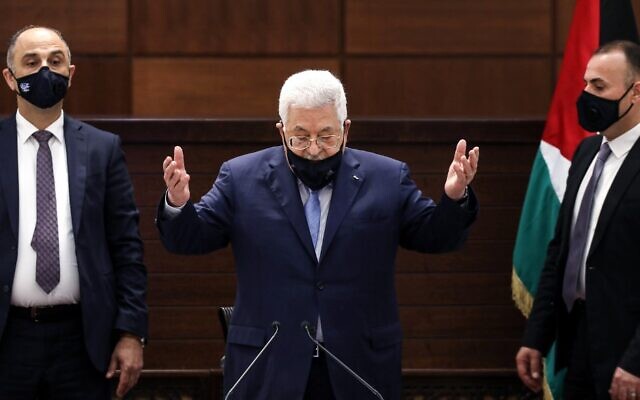
Palestinian Authority President Mahmoud Abbas (C) recites a prayer as he arrives for a meeting in the West Bank's Ramallah on September 3, 2020, (Alaa BADARNEH / POOL / AFP)
Palestinian Authority President Mahmoud Abbas (C) recites a prayer as he arrives for a meeting in the West Bank’s Ramallah on September 3, 2020, (Alaa BADARNEH / POOL / AFP)

The Palestinian Authority has reportedly scaled down its criticism of the Israel-United Arab Emirates normalization deal ahead of an Arab League meeting on the matter in Cairo.

The Reuters news agency reported Tuesday that a draft resolution presented by the PA ambassador ahead of Wednesday’s meeting “does not include a call to condemn, or act against, the Emirates over the US-brokered deal.”

PA President Mahmoud Abbas also sent out an order barring statements or actions against other Arab leaders, including the heads of the UAE, the report said.

The draft resolution, which will be debated at Wednesday’s meeting, reportedly says the Israel-UAE agreement “doesn’t diminish Arab consensus over the Palestinian cause, the Palestinian cause is the cause of the entire Arab nation.”

“The trilateral announcement doesn’t change the principal Arab vision based on the fact that the two-state solution [based] on the 1967 borders is the only way to achieve peace in the Middle East,” the draft says.

It is a stark departure from recent rhetoric by Palestinian leaders, including Abbas, who have called the pact a “betrayal” and a “stab in the back.”

Abbas hosted a meeting in Ramallah on Thursday night on the normalization agreement that included the leaders of terror groups Hamas and Islamic Jihad.

Israel and the UAE announced on August 13 that they were establishing full diplomatic relations. The UAE is just the third Arab country to agree to official relations with Israel, after Egypt and Jordan. Israeli and American officials have expressed hope that other Gulf Arab countries will soon follow suit, with relations based on mutual commercial and security interests, and shared enmity toward Iran.

UAE delegates wave to a departing El Al plane, in Abu Dhabi, September 1, 2020 (El Al spokesperson’s office)

Some Arab states, including Egypt, Oman and Bahrain, have issued praise for the normalization agreement.

Oman, Bahrain, Morocco, and Saudi Arabia are among the countries that Israel and the US hope could follow the UAE in forging diplomatic ties with the Jewish state. But Saudi Arabia has said it will not normalize relations until Israel agrees to the establishment of an independent Palestinian state, in keeping with the decades-old stance of most Arab nations.

As part of the deal with the UAE, Israel agreed to suspend indefinitely plans to annex parts of the West Bank, an achievement Abu Dhabi has highlighted in explaining why it sought the accord.

The deal was followed by the first commercial flight between Israel and the UAE, with neighboring Saudi Arabia and Bahrain deciding to allow such flights to pass through their airspace.

Jared Kushner, US President Donald Trump’s son-in-law and adviser, led a delegation that visited Abu Dhabi last week on that flight. Also on the trip were US National Security Adviser Robert O’Brien and his Israeli counterpart, Meir Ben-Shabbat.

On Friday, in another diplomatic step forward for Israel, Serbia announced it would move its embassy in Israel to Jerusalem, and Muslim-majority Kosovo said it will recognize Israel and open an embassy in Jerusalem. The moves came as part of US-brokered discussions to normalize economic ties between Belgrade and Pristina.
