
“The relocation by any country of its embassy in Israel to Jerusalem would constitute a clear violation of international law,” Ankara said.

Serbia’s President Aleksandar Vucic speaks during a joint news conference with Turkish President Tayyip Erdogan after their meeting in Belgrade, Serbia, October 7, 2019
(photo credit: REUTERS/DJORDJE KOJADINOVIC)
Turkey has expressed disappointment and “concern” at Friday’s announcement that Kosovo intends to establish diplomatic ties with Israel and that Kosovo and Serbia plan to open embassies in Jerusalem.

The announcement was made by US President Donald Trump on Friday, during a meeting to establish normalized economic ties between Serbia and Kosovo. In 2018, America was the first country to move its embassy from Tel Aviv to Jerusalem.

The Turkish Ministry of Foreign Affairs released a statement on Kosovo’s planned embassy in Jerusalem saying, “It is disappointing that such a step, which would constitute a clear violation of international law, is even considered by the Kosovo authorities.”

The statement also elaborated on Turkey’s support for its fellow Muslim nation, saying that, “Turkey, one of the first countries to recognize Kosovo, has also provided great support for the efforts toward the international recognition of this country from the very outset. However, we do not find it right to build this process against international law and especially upon the suffering of the Palestinian people whose territories are under occupation.

“We call upon the leadership of Kosovo to comply with these resolutions and refrain from acts that would harm the historical and legal status of Jerusalem, and that would prevent Kosovo from being recognized by other states in the future,” the statement said.

Israel has not recognized Kosovo since the tiny Balkan nation declared independence from neighbor Serbia in 2008.

“Kosovo will be the first Muslim-majority country to open an embassy in Jerusalem,” Prime Minister Benjamin Netanyahu said on Friday. “As I said during recent days, the circle of peace and recognition of Israel is expanding, with more countries expected to join.”

“My government is dedicated to open the embassy in Jerusalem, establish diplomatic relations and deepen bilateral relations,” Kosovan Prime Minister Avdullah Hoti wrote on Twitter in response to Netanyahu.

Ankara also condemned the move by Serbia to relocate its embassy, with the Ministry of Foreign Affairs saying in a separate statement, “We are deeply concerned by the decision of the Republic of Serbia to relocate its embassy in Israel to Jerusalem.”

“The relocation by any country of its embassy in Israel to Jerusalem would constitute a clear violation of international law.”

“We call upon all countries to comply with the UN resolutions on this matter, to respect the historical and legal status of Jerusalem and to refrain from acts that would further hamper the resolution of the Israeli-Palestinian conflict,” the ministry said.

Turkey and Serbia have had mixed relations over the years, punctuated in 2013 by a speech by then Turkish Prime Minister Recep Tayyip Erdoğan in which he claimed: “Do not forget that Kosovo is Turkey and Turkey is Kosovo.” However, Serbia has stated that it sees a stable Turkey as vital for the Balkan region. The two currently enjoy full diplomatic relations.

In phone call, US president talks up peaceful overtures between Israel, Gulf; Salman says Riyadh appreciates US efforts but signals that Palestinians remain main focus for kingdom


In this file photo taken on May 20, 2017, US President Donald Trump (L) and Saudi Arabia's King Salman bin Abdulaziz al-Saud take part in a signing ceremony at the Saudi Royal Court in Riyadh. (Mandel Ngan/AFP)

In this file photo taken on May 20, 2017, US President Donald Trump (L) and Saudi Arabia’s King Salman bin Abdulaziz al-Saud take part in a signing ceremony at the Saudi Royal Court in Riyadh. (Mandel Ngan/AFP)

Saudi Arabia’s King Salman praised US President Donald Trump for Washington’s diplomatic efforts in the region in a phone call Sunday, days after a top White House official visited to press the kingdom on normalization with Israel.

Salman “expressed the Kingdom’s appreciation for the efforts made by the United States of America to establish peace.” He also stressed “the Kingdom’s keenness to reach a lasting and just solution to the Palestinian cause to bring peace,” which he stressed was “the main starting point for the Kingdom’s efforts and the Arab Peace Initiative,” a statement carried by Saudi Arabia’s official news agency read.

Introduced in 2002, the Arab Peace Initiative is a Saudi proposal for recognition and normalization with Israel conditioned on the establishment of a Palestinian state.

Trump talked up the significance of the United Arab Emirates’ recent decision to forge an open relationship with Israel, in a possible push to encourage Riyadh to follow suit.

“President Trump highlighted the significance of the Abraham Accords and discussed ways to enhance regional security and prosperity,” a White House statement read.

He told the Saudi king that he welcomed Riyadh’s decision to allow Israeli planes to overfly its airspace on the way to and from the UAE, according to a statement from the White House.

Trump also urged the Saudis to negotiate with other Gulf states to resolve an unspecified rift, according to the statement, presumably referring to the dispute with Qatar over its alleged support for terrorism.

Salman, who placed the call to Trump, also discussed efforts to battle the coronavirus pandemic and Saudi Arabia’s position as head of the G20 this year, the Saudi press Agency said.

The call came amid a blitz by the White House to find other Arab countries beyond the UAE willing to openly normalize ties with Israel, though Saudi Arabia is widely seen as unlikely to do so any time soon.

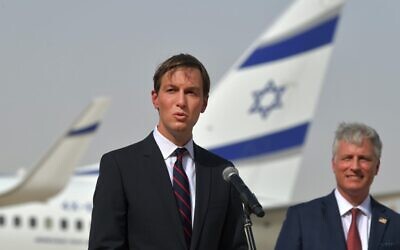
US Presidential Adviser Jared Kushner next to US National Security Adviser Robert O’Brien (R) in front of an El Al plane at the Abu Dhabi airport, following the arrival of the the first-ever Israeli flight to the UAE, on August 31, 2020. (KARIM SAHIB / AFP)

Last Tuesday, senior White House adviser Jared Kushner visited Saudi Arabia and Bahrain, reportedly to discuss normalization with Israel, after flying from Tel Aviv to the UAE on the first ever Israeli commercial flight between the destinations.

There was no comment from the White House on the call.

Saudi Arabia, which dominates the Western-allied Gulf Cooperation Council and is an important US ally, has consistently insisted that it will not normalize ties until after a peace deal is reached between Israel and the Palestinians based on the two-state solution. That stance is in line with the Arab Peace Initiative, a 2002 Saudi-led offer by the Arab League to immediately establish ties with Israel once the Israeli-Palestinian conflict is put to bed, and if Jerusalem returns the Golan Heights to Syria.

However, Riyadh has notably not criticized the UAE for abandoning the accord and has expressed a willingness for goodwill gestures toward Israel, which shares a common enemy in Iran.

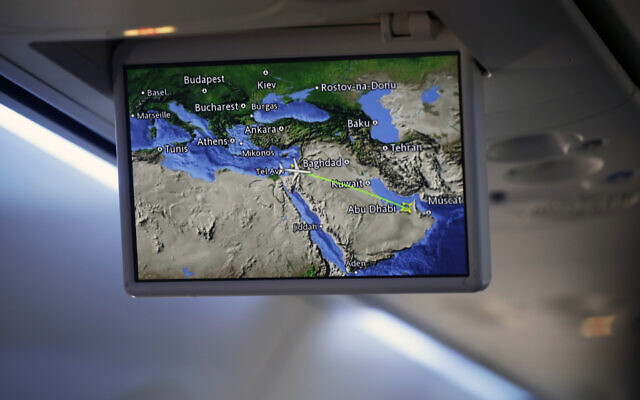
An overhead screen displays a map showing the flight route of an El Al plane from Israel en route to Abu Dhabi, United Arab Emirates, Monday, Aug. 31, 2020. (Nir Elias/Pool Photo via AP)

US and Israeli officials have expressed high expectations that one or more Arab states will establish ties with Israel in the coming months on the heels of the UAE announcements.

Among the countries considered to be possible candidates are Oman, Bahrain and Sudan, with some also lumping in Saudi Arabia. Bahrain has indicated it will not make a move before Saudi Arabia does, and Sudan’s leaders told US Secretary of State Mike Pompeo that Khartoum’s transition government lacks the authority to forge a peace treaty with a former enemy country.

The Trump administration has been heavily involved in pushing to improve Israel’s international standing, in what some see as a pre-election maneuver to shore up support among evangelicals.

On Friday, Trump announced that former wartime foes Serbia and Kosovo had agreed to normalize economic ties as part of US-brokered talks that include Belgrade moving its Israeli embassy to Jerusalem, and mutual recognition between Israel and Kosovo.

Agencies contributed to this report.


President of Malawi says his country will open embassy in Jerusalem

Presiden

(JTA) — The president of Malawi said that his country would open an embassy in Jerusalem

Lazarus Chakwera made the announcement Saturday in parliament as part of a larger announcement about new diplomatic missions Malawi will be opening. Malawi currently does not have a diplomatic mission in Israel.

The announcement came a day after Serbia and Kosovo announced that they too would open Jerusalem embassies.

Most countries with diplomatic missions in Israel locate them in Tel Aviv. The Trump administration moved the American embassy to Jerusalem in 2018, more than two decades after Congress first mandated such a move.

On Sunday, chief Palestinian peace negotiator Saeb Erekat announced that the Palestinian Authority would sever relations with any country that opens an embassy in Jerusalem.

t of Malawi says his country will open embassy in Jerusalem
